



Community hub
Recent from talks
Knowledge base stats:
Talk channels stats:
Members stats:
Chryselephantine sculpture
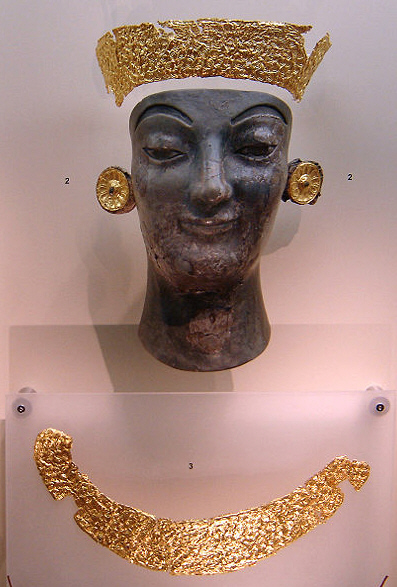
Chryselephantine sculptures (from Ancient Greek χρυσός (khrusós) 'gold' and ἐλεφάντινος (elephántinos) 'ivory') are sculptures made with gold and ivory. Chryselephantine cult statues enjoyed high status in Ancient Greece.
Chryselephantine statues were built around a wooden frame with thin carved slabs of ivory attached, representing the flesh, and sheets of gold leaf representing the garments, armour, hair, and other details. In some cases, glass paste, glass, and precious and semi-precious stones were used for detail such as eyes, jewellery, and weaponry.
The origins of the technique are obscure. There are known examples, from the 2nd millennium BC, of composite sculptures made of ivory and gold from areas that became part of the Greek world, most famously the so-called "Palaikastro Kouros" (not to be confused with the Archaic Kouros statues), from Minoan Palaikastro, c. 1450 BC. It is likely the only enshrined Minoan cult image that has survived. It is, however, not clear whether the Greek chryselephantine tradition is connected with these.
Chryselephantine sculpture became widespread during the Archaic period. Later, acrolithitic statues, with marble heads and extremities and a wooden trunk either gilded or covered in drapery, were a comparable technique used for cult images.
The technique was normally used for cult statues within temples; typically, they were greater than life-sized. Construction was modular, so that some of the gold could be removed and melted for coin or bullion in times of severe financial hardship, to be replaced later when finances had recovered. For example, the figure of Nike held in the right hand of Phidias's Athena Parthenos was made from solid gold with this very purpose in mind. Indeed, in times of prosperity, up to six solid gold Nikae were cast,[citation needed] serving as a "sacred treasury" whose safety was ensured by the sanctity accorded to a cult object, as well as the presence of priestesses, priests, and maintenance staff at the temple.
The two best-known examples, both from the Classical period, are those sculpted by Phidias: the 13-metre tall (43 ft) standing statue of Athena Parthenos in the Parthenon at Athens, and the 12-metre (39 ft) seated statue of Zeus in the temple at Olympia, considered one of the Seven Wonders of the Ancient World.
Chryselephantine statues were not only intended to be visually striking; they also displayed the wealth and cultural achievements of those who constructed them or financed their construction. The creation of such a statue involved skills in sculpture, carpentry, jewellery, and ivory-carving. Once completed, the statues required constant maintenance. It is known that at Olympia, skilled personnel were employed to ensure the upkeep of the Zeus statue. In the second century BC, the prominent sculptor Damophon of Messene was commissioned to repair it.
Due to the high value of some of the materials used and the perishable nature of others, most chryselephantine statues were destroyed during antiquity and the Middle Ages. For example, of the statue of Athena Parthenos, only the hole that held its central wooden support survives today in the floor of her temple. The appearance of the statue is nevertheless known from a number of miniature marble copies discovered in Athens, as well as from a detailed description by Pausanias. Pausanias also described Phidias's statue of Zeus at Olympia. Here, some of the clay moulds for parts of Zeus's garments made of glass or glass-paste have been discovered in the building known as the "Workshop of Phidias". They are the only finds directly associated with the great sculptor's most famous works and thus provide useful information on their creation.
Hub AI
Chryselephantine sculpture AI simulator
(@Chryselephantine sculpture_simulator)
Chryselephantine sculpture
Chryselephantine sculptures (from Ancient Greek χρυσός (khrusós) 'gold' and ἐλεφάντινος (elephántinos) 'ivory') are sculptures made with gold and ivory. Chryselephantine cult statues enjoyed high status in Ancient Greece.
Chryselephantine statues were built around a wooden frame with thin carved slabs of ivory attached, representing the flesh, and sheets of gold leaf representing the garments, armour, hair, and other details. In some cases, glass paste, glass, and precious and semi-precious stones were used for detail such as eyes, jewellery, and weaponry.
The origins of the technique are obscure. There are known examples, from the 2nd millennium BC, of composite sculptures made of ivory and gold from areas that became part of the Greek world, most famously the so-called "Palaikastro Kouros" (not to be confused with the Archaic Kouros statues), from Minoan Palaikastro, c. 1450 BC. It is likely the only enshrined Minoan cult image that has survived. It is, however, not clear whether the Greek chryselephantine tradition is connected with these.
Chryselephantine sculpture became widespread during the Archaic period. Later, acrolithitic statues, with marble heads and extremities and a wooden trunk either gilded or covered in drapery, were a comparable technique used for cult images.
The technique was normally used for cult statues within temples; typically, they were greater than life-sized. Construction was modular, so that some of the gold could be removed and melted for coin or bullion in times of severe financial hardship, to be replaced later when finances had recovered. For example, the figure of Nike held in the right hand of Phidias's Athena Parthenos was made from solid gold with this very purpose in mind. Indeed, in times of prosperity, up to six solid gold Nikae were cast,[citation needed] serving as a "sacred treasury" whose safety was ensured by the sanctity accorded to a cult object, as well as the presence of priestesses, priests, and maintenance staff at the temple.
The two best-known examples, both from the Classical period, are those sculpted by Phidias: the 13-metre tall (43 ft) standing statue of Athena Parthenos in the Parthenon at Athens, and the 12-metre (39 ft) seated statue of Zeus in the temple at Olympia, considered one of the Seven Wonders of the Ancient World.
Chryselephantine statues were not only intended to be visually striking; they also displayed the wealth and cultural achievements of those who constructed them or financed their construction. The creation of such a statue involved skills in sculpture, carpentry, jewellery, and ivory-carving. Once completed, the statues required constant maintenance. It is known that at Olympia, skilled personnel were employed to ensure the upkeep of the Zeus statue. In the second century BC, the prominent sculptor Damophon of Messene was commissioned to repair it.
Due to the high value of some of the materials used and the perishable nature of others, most chryselephantine statues were destroyed during antiquity and the Middle Ages. For example, of the statue of Athena Parthenos, only the hole that held its central wooden support survives today in the floor of her temple. The appearance of the statue is nevertheless known from a number of miniature marble copies discovered in Athens, as well as from a detailed description by Pausanias. Pausanias also described Phidias's statue of Zeus at Olympia. Here, some of the clay moulds for parts of Zeus's garments made of glass or glass-paste have been discovered in the building known as the "Workshop of Phidias". They are the only finds directly associated with the great sculptor's most famous works and thus provide useful information on their creation.