Hubbry Logo
Athena ParthenosAthena ParthenosMain
Open search
Athena Parthenos
Community hub
Athena Parthenos
logo
8 pages, 0 posts
0 subscribers
Be the first to start a discussion here.
Athena Parthenos
Athena Parthenos
from Wikipedia

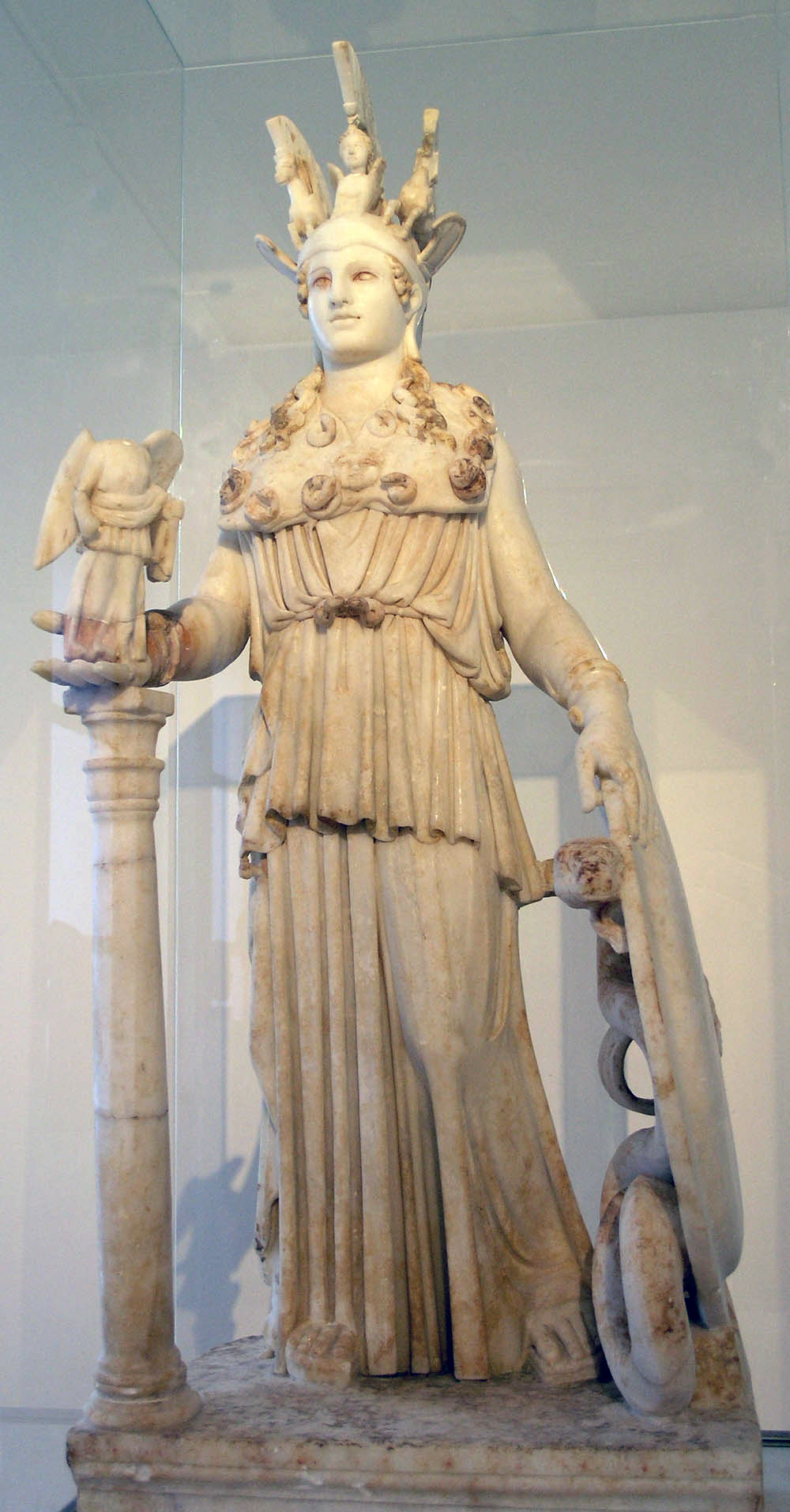
The Varvakeion Athena reflects the type of the restored Athena Parthenos: Roman period, 2nd century CE (National Archaeological Museum of Athens).

The statue of Athena Parthenos[N 1] (Ancient Greek: Παρθένος Ἀθηνᾶ, lit.'Athena the Virgin') was a monumental chryselephantine sculpture of the goddess Athena. Attributed to Phidias and dated to the mid-fifth century BCE, it was an offering from the city of Athens to Athena, its tutelary deity. The naos of the Parthenon on the acropolis of Athens was designed exclusively to accommodate it.

Many artists and craftsmen worked on the realization of the sculpture, which was probably built around a core of cypress wood, and then paneled with gold and ivory plates. At about 13 meters high, the statue reflected the established aesthetic canon of the severe style (clothing) while adopting the innovations of the high classical (leg position). She was helmeted and held a large round shield and spear, placed on the ground to her left, next to her sacred snake. Clothes, jewellery, accessories, and even the statue base were decorated, mainly with the snake and gorgon motif.

The statue was lost at an unknown date sometime in the first millennium. Several replicas and works were inspired by the original.

Parthenon and statue of Athena

[edit]
Plan numéroté du Parthénon
Plan of the Parthenon:
1) Pronaos (east side)
2) Naos hecatompedos neos (east side)
3) Chryselephantine statue of Athena Parthenos
4) Parthenon (virgin room, treasure) (west side)
5) Opisthodomos (west side)

In 480 BCE, the Persians ransacked the Acropolis of Athens, including the pre-Parthenon, which was under construction at the time.[1] After their victories in Salamis and Plataea, the Athenians had sworn not to complete the destroyed temples but to leave them as they were, in memory of the Persian "barbarism".[2] In the succeeding years, however, Athens grew to control much of the region through its domination of the Delian League, a confederation of Greek states originally designed to protect themselves against the Persians. Within 30 years, the league had evolved into an Athenian powerhouse. By 454 BCE, the Delian treasury had been relocated to Athens, where the money was funnelled into an ambitious plan to rebuild the city and its destroyed temples, including the Parthenon.[3][4]

The new Parthenon was erected between 447 and 438 BCE.[1] Pericles chose the sculptor Phidias to supervise the building program with the architects Ictinos and Kallikrates.[5] The sekos (closed part surrounded by the peristyle) was divided into two rooms. The small one to the west, the "Parthenon" itself (the "virgin room"), housed the treasure of the League of Delos and other offerings.[1][6][7] To the east, the "hecatompedos neos"[N 2] housed the statue of Athena Parthenos. The room was 29.90 m long, or around one hundred Athenian feet, by 19 m wide, with a ceiling height of 12.50 m.[8]

The new building was not intended to become a temple, but a treasury meant to house the colossal chryselephantine statue of Athena Parthenos.[1] It is even likely that the statue project preceded the building project.[9] This was an offering from the city to the goddess, but not a statue of worship: there was no priestess of Athena Parthenos.[7]

Primary ancient sources about the statue are writings by Pausanias[N 3] and Pliny the Elder.[N 4][10] Pausanias is also the originator of the surname "Parthenos." Early writings mentioned "the statue", "the statue of Athena", "the golden statue of Athena", "the ivory statue of Athena", or simply "the Athena." Since at least the end of the fifth century BCE, however, the patron goddess of the Parthenon has been known as "Athena Parthenos."[11]

Construction

[edit]
Inscription grecque sur bloc de marbre blanc
Fragment of the accounts relating to the realization of the statue of Athena Parthenos, IG I3 458, Museum of the Acropolis of Athens.

According to Pausanias and Plutarch,[N 5] the statue is not by Phidias alone but of a team of craftsmen representing several trades, Phidias supervising all the decoration work of the Parthenon.[12][13][14] The location of the workshop where the statue was made is unknown. It could have been on the acropolis, at the eastern end, under what was later to become the old Acropolis museum. However, given the cost of precious materials (gold and ivory), it could also have been installed elsewhere, at the foot of the sacred rock, far from the comings and goings of the main site and its dust.[13]

The statue was likely made of "spare parts", perhaps first mounted in the workshop, then dismantled, moved to the Parthenon, after its completion, and installed in its final place.[13] The remaining accounts make it possible to estimate the cost of the work at 704 talents, or the equivalent of 200 Triremes (the city's naval power base). However, the statue was considered an ultimate financial reserve, the gold decorating it could be melted down if necessary.[15] According to the various ancient authors,[N 6] the weight of gold used was between 40 and 50 talents, or between 1 and 1.3 tons of gold. By way of comparison, the annual toll of the "allies" of the League of Delos at the time amounted to 28 talents. On another note, this gold would have represented for the city of Athens more than a year's salary for 10,000 skilled workers, more than a year's pay for 10,000 hoplites or 10,000 rowers in the war fleet.[16] The quantity and cost of ivory are more difficult to determine. It was needed for the face, arms, and feet of the statue, as well as for the gorgon's head depicted on the goddess's chest. It is less certain that ivory could have been used for the rendering of snake scales. On an inscription of 440-439 BCE there is recorded the purchase of an unknown amount of elephant ivory for the sum of 24 talents and 743 silver drachmas. However, it is difficult to know if this constituted all the necessary material.[17]

The statue was mounted on a rot-proof wooden frame, probably cypress. A decree of the Athenians thanks the people of the Eteocarpathians for providing them with a large quantity of cypress wood. This wood came from a forest dedicated to Apollo and therefore could only be exploited for religious purposes. In the Parthenon's soil is still visible the hole (75.5 cm by 54 cm and 37 cm deep) where the central beam was planted. Around this "mast", a whole frame in the same cypress wood gave shape to the statue. The city had the technique and craftsmen capable of this work with its many marine carpenters.[18][19] To this reinforcement were fixed, probably nailed, gold plates. It is not possible to know if they had been melted (and the moulds preserved, perhaps in case of repair) or hammered (Sphyrelaton technique).[18][20] Ivory work was much more difficult, even if the statue of Athena Parthenos was not the first Greek statue to use this imported material. Oppian gives valuable indications of the techniques used. The necessary surfaces (face, arms, and feet) far exceeded the size of elephant tusks. However, these are made up of thin layers of superimposed ivory that can be "unrolled like a roll of papyrus". The next problem was to give shape to these long blades. It was the work of specialists able to soften the material and then mould it.[N 7] The ivory plates thus created had the flexibility of the wax plates used for moulding bronze statues, a technique that Phidias mastered perfectly.[21] If the gold plates were probably directly nailed to the frame, the more fragile ivory was certainly fixed more delicately with dowels or glued with fish glue.[N 8] The joints between ivory plates would most certainly have been masked in the drop shadows and by jewellery (bracelets and necklace). The ivory then had to be polished, most often with squatine skins (type of shark). Finally, the ivory was painted: the goddess was "made-up", using red pigment on her cheeks and lips as well as on her nails. It is also very unlikely that the gold was left as is; it would likely have been inlaid with precious and semi-precious stones that reflected the light.[22]

The statue must have been completed in 438 BCE when it was consecrated and installed in the Parthenon. Gold and ivory that had not been used were then offered for sale.[23]

Description

[edit]
The image above contains clickable links
Rendition of the chryselephantine statue of Athena Parthenos by Alan LeQuire (1990), located in the Parthenon's replica, Centennial Park (Nashville) 

The statue was installed in the main room of the Parthenon to the east. Behind her and on her sides, Doric columns supported the roof and offered her the setting of a canopy. In front of her, a large basin filled with water played several roles: it was used to maintain a sufficient degree of humidity in the room (to conserve ivory) and it also had to reflect the external light and illuminate the work. It was suggested that there could have been windows (probably 3 m high and 2.5 m wide) on each side of the door (9.75 m high and 4.19 m wide) that would have allowed daylight in.[23][24][25]

According to Pliny the Elder, the statue measured 26 cubits (about 11.50 m) in height, probably including the base. Thus it would have risen within one and a half meters from the ceiling,[26][27][10] filling the room with the divine presence. Phidias' idea was apparently to represent the goddess under her "true" aspect, in all her majesty, beauty, magnificence, and size, since the gods were considered to be much taller than humans.[28]

Only the pedestal of the statue has been preserved. It is a parallelepiped in poros measuring 8.065 by 4.10 m (26 ft 5.5 in by 13 ft 5.4 in) and 1.30 to 1.50 m (4 ft 3 in to 4 ft 11 in) high.[18] On the front of this base, a carved plaque evoked the birth of Pandora in the presence of twenty gods.[29][23][10] It is the only decorative element that was not subsequently copied and reproduced, so its details are unknown. It is not even possible to know if the plaque was made of marble or gilded bronze. The presence of this theme (birth of the first woman and the first femme fatale) is quite difficult to reconcile with the representation of the virgin goddess of wisdom.[29] It was perhaps a symbol of both aspects of femininity,[29] or even the growing role of women in Athens in the fifth century BCE.[28] Other interpretations have been proposed. Because Helios and Selene framed the scene, it is possible to interpret it as a kind of calendar. But Pandora can also be understood as a warning that, with the gods, nothing is ever taken for granted.[N 9] On this reading, the triumphant Athens of Pericles has mastered modern techniques, just as the first men mastered fire. But those men had thereby unbalanced the old order and had been punished with the gift of a dangerous woman made by Hephaestus, god of fire and technology. Athens, therefore, had to avoid a similar form of hubris. More optimistically, Pandora's myth could be a reminder that even in dire straits, hope can always be reborn.[30] Finally, far from Pandora described by Hesiod and quoted by Pausanias to evoke the decoration of the base, there is an Athenian Pandora. She is one of the daughters of Erechtheus, one of the Hyacinthides who sacrificed herself to save the city. She would have had a miraculous birth, of the autochthonic type, and was linked to the goddess Athena, mainly by weaving. Pandora was presented in this Athenian myth as a kourotrophic (child carrier therefore a nurse) and a bearer of benefits. From then on, Joan Connelly[N 10] proposes to read the scene as the apotheosis of Athenian Pandora, and not as the birth of the "Hesiodic" Pandora.[31]

Athena wore a peplos half-open on the right side, as was the rule for female representations in the first half of the fifth century BCE. However, her posture was new (in the canon that Polykleitos would then develop for his athlete statues): the left leg was a little bent, the knee forward, the heel not posing on the ground. This posture seems to have been chosen more for technical reasons of balance and volume of the lower manikin than for aesthetic reasons. The bust, on the other hand, does not seem to have been affected by the imbalance of the lower body, it would have been very straight and frontal.[26][27][10]

Over her peplos, she bore at the breast the aegis lined with snakes and within its centre, at the level of the solar plexus, an ivory gorgoneion. The goddess' face was also ivory, probably with a neutral expression, as was then the aesthetic rule. However, she may have had her lips ajar, symbolizing the breath of life. Gemstones allowed her eyes to have the Persian colour corresponding to one of Athena's epithets.[N 11] Long strands of hair escaped from her helmet and descended to the aegis. It was a reinterpretation of the korai hairstyle, the archaic statues of young women abundantly dedicated to the goddess on the acropolis of Athens. The helmet was of the Attic type, with paragnathides (pieces protecting the cheeks) raised and decorated with gryphons. The top of the helmet had three crests: a sphinx in the centre, surrounded on each side by a winged horse. The visor was decorated with protomes. The edge of her sandals ("Etruscan" type), about 20 cm high, was decorated with a painted or carved centauromachy, the sources do not allow a conclusive answer. Her belt was two snakes tied. Athena also wore jewellery: a pendant on each ear, snake-shaped bracelets on each wrist and biceps, and a necklace.[26][27][32]

The left hand held her shield and spear. At her feet on the left side, her sacred snake nestled. In her right hand, perhaps leaning on a column for support, she held a statue of Nike, 2 m high. This symbol of victory held a crown of gold laurels, which she was to be about to place on the goddess's head. The column appears in copies made of terracotta or marble, which lack the tensile strength of bronze, but its presence in the original statue is debated.[26][23][32] If it was included, the column could explain the fact that Athena's sacred snake was placed on her left side (where it partially hid the decoration of her shield), rather than on her right side, its usual position.[33] Such a column might have been the first example of a Corinthian capital, which is said to have been developed by Iktinos for the temple of Apollo in Bassae.[26]

The shield had a diameter of 4.8 to 5 m (15 ft 9 in to 16 ft 5 in) and was decorated on the outside with an amazonomachy. This was the most visible and therefore the most described and copied decorative element. In the centre was again a gorgoneion that must have looked like the Rondanini Medusa since it is strongly inspired by it. He was surrounded by about thirty fighters. Theseus commanded the Greek troops, so the Athenians. In front of them, Amazons were attacking the Acropolis as indicated by the steep scenery. According to Plutarch,[N 12] Phidias represented himself among the Athenians, in the centre at the top, as a bald old man preparing to throw the stone held with two hands above his head. He would also have included Pericles, right next to him, on the right, armed with a spear. This gesture, which was criticized for him, is however proof that this relief-carved decoration was indeed by the hand of Phidias himself.[34][35][36] The inside of the shield, less visible, was painted with a gigantomachy.[9][37] The three fights represented on the statue (centauromachy, gigantomachy, and amazonomachy) were also found on the carved decoration of the Parthenon. The southern metopes are decorated with a centauromachy, those in the east with a gigantomachy, and those in the west with an amazonomachy.[38][39]

The snake (δράκων), perhaps represented the Chthonian powers that would have been present on the acropolis from the beginning, or even Erichthonios himself whom the goddess had raised on her sacred rock.[40][41] In fact, the monsters (sphinx, gryphons, winged horses, snakes, and gorgonians) that adorn the statue of the deity symbolize these primitive forces she domesticated.[28]

The themes chosen to decorate this statue, as well as those that adorned the entire building, were part of an iconographic and political program of the celebration of the city through its guardian goddess. Athens, at the height of its power in the time of Pericles, evoked here the victory of (its) civilization over chaos, disorder, hybris, and barbarism in general, even beyond the commemoration of its victory in the Median wars. The virtues and piety of the city were read in its offering to its goddess. Its commercial and naval power materialized in the materials used: gold and ivory, very expensive, from far away.[42]

History

[edit]

Ivory, a fragile material and subject to desiccation, was maintained with oiled water that was left available in a basin at the foot of the statue. The oil layer left a protective film preventing evaporation and giving shine to the ivory.[43]

The luxury of the statue contrasted with its interior filled, like all chryselephantine statues, with "levers, corners, nails that cross the machine from side to side, ankles, pitch, clay and other things as shocking to the eye, not to mention an infinity of flies or shrews", as Lucian describes in Dream or the Rooster, XXIV.18.[44]

According to sources in 438 BCE (from the consecration of the statue) or in 432 BCE (just before the outbreak of the Peloponnesian War), Phidias was accused of diverting part of the precious metals used to make the statue of Athena Parthenos, which was also sacrilege in itself since gold belonged to the goddess. Arrested, he would have escaped, which was interpreted as an admission of guilt. He reportedly fled to Olympia where he made the Chryselephantine statue of Zeus and where he died. For historians, an accusation against Phidias would then have been a way for Pericles' political opponents to attack the archon.[45][44] Later, between 300 and 295 BCE, the tyrant Lachares allegedly had the gold plates removed to pay his troops. However, the veracity of this gesture is difficult to establish. If Lachares had taken gold permanently, he committed sacrilege. If his gesture was a simple "borrowing" from Athena, the rule was to repay with interest, difficult if the only way to obtain funds was to strip the goddess.[18][44]

The Parthenon was ravaged by a fire at an indeterminate date in late antiquity, causing serious damage. The roof collapsed. The Doric columns of the naos were replaced by columns from the Hellenistic stoas of the Roman agora.[46] The statue was damaged but restored. It may have been transported to Constantinople with the Chryselephantine statue of Zeus of Olympia where it could still have been in the 10th century CE.[18][23] Another hypothesis is based on the presence of traces of a second base. The statue of Athena Parthenos could then have been replaced, at an indeterminate point in time.[47] Until the edict of Theodosius in 380, the Parthenon retained its pagan religious role. It then seems to have experienced a more or less long period of abandonment. Somewhere between the fifth and the seventh century, the building was transformed into a church. Sources do not mention the statue at that time; it is therefore not possible to know if it had been destroyed or transported to Constantinople.[48]

Antique copies and replicas

[edit]
Parthenon - Cross section restored. Benoît Édouard Loviot. 1879. Paris Musée des Beaux-Arts. Inv. Env. 71–07.

At least sixty-nine small-scale copies of the statue are known.[49] Very early on, her influence was felt, sometimes very far away. Thus, gold medallions from a tomb in Kul-Oba (Crimea) and preserved in the Hermitage Museum, reproduce the head of the statue. During Roman times, small copies were mass-produced, sometimes simplifying the decor. The Athena of Varvákeion is one of the most famous examples. Sometimes, only the decoration was reproduced, mainly that of the outside of the shield, apparently in the form of decorative plates for export.[50]

Among the most famous ancient copies are the Lenormant Athena and therefore the Athena of Varvakeion preserved in the National Archaeological Museum of Athens, the Minerva with the necklace of the Louvre Museum or a Roman copy signed Antiochos preserved at the Palazzo Altemps (Roman National Museum). A restoration was made by sculptor Pierre-Charles Simart between 1846 and 1855 for the Duke of Luynes. It is exhibited in its castle in Dampierre.[18]

A life-size replica was made in 1990 for the Nashville Parthenon by American sculptor Alan LeQuire. On a steel and aluminium frame, a mixture of plaster and fibreglass was covered with 8 kg of gold leaf.[51]

In 2024, the Parthenon and the statue of Athena were reconstructed by Juan de Lara in 3D and developed into a digital project titled The Parthenon 3D.[52][53] De Lara was able to reconstruct the visual effects of the gold and ivory when light interacted with them in a fully physically-based rendered environment.

Notes

[edit]

References

[edit]

Bibliography

[edit]
Revisions and contributorsEdit on WikipediaRead on Wikipedia
from Grokipedia
Athena Parthenos was a colossal chryselephantine cult statue of the goddess , crafted by the renowned Greek sculptor and dedicated in the temple on the in 438 BCE. Standing approximately 12 meters (40 feet) tall, it was constructed with a wooden core overlaid in for the flesh and gold plates for the drapery and ornaments, making it one of the most opulent artworks of the Classical Greek period. The statue depicted Athena as the virgin protector of the city, fully armed and embodying ideals of wisdom, warfare, and civic virtue central to Athenian identity. Ancient descriptions, particularly by the traveler Pausanias in the 2nd century CE, provide the primary account of its appearance. Athena stood upright in a long tunic reaching her feet, wearing a helmet with a Sphinx on top and griffins in relief on the sides; her bore an ivory head of across her breast. In her right hand, she held a smaller statue of Nike (Victory) about four cubits tall, while her left grasped a , with her resting at her feet depicting the , a battle between Athenians and , in relief; a serpent, interpreted as Erichthonius, coiled beside the shield, and the statue's base illustrated the birth of . The spearhead and were enclosed by a fence for protection, and the overall effect, illuminated within the temple's , was described as dazzling. Created during the leadership of as part of ' grand building program funded by the treasury, the symbolized the city's imperial power and cultural zenith following victories in the Persian Wars. It served as the focal point of the Panathenaic festival, where Athenians honored their patron deity, reinforcing themes of divine protection, democratic prosperity, and military triumph. ' design integrated intricate iconography, such as the shield's , to evoke ' historical and mythological narratives of defense against barbarism. The original Athena Parthenos was lost sometime in , possibly during the 5th or CE amid Christian conversions of pagan sites, though ancient accounts mention repairs and in the Roman era. No full-scale ancient replicas survive intact, but smaller Roman copies, like the , and modern reconstructions, such as Alan LeQuire's 1990 version in Nashville's , preserve its legacy based on literary and archaeological evidence.

Historical Context

The Parthenon as Athena's Temple

The Parthenon was constructed between 447 and 432 BCE as a central element of the rebuilding program initiated by following the destruction wrought by the Persian invasion in 480 BCE. This ambitious project aimed to restore and elevate ' cultural and religious prominence in the aftermath of the . The temple's design is attributed to the architects Ictinus and , with the sculptor serving as artistic overseer, ensuring integration of sculptural elements with the architecture. Measuring approximately 69.5 meters in length and 30.9 meters in width, the structure exemplifies classical Greek architecture through its peripteral form, featuring eight Doric columns on the short sides and seventeen on the long sides, while incorporating Ionic elements such as the continuous inner . These stylistic choices blended the austerity of the with the refinement of Ionic details, creating a harmonious and innovative aesthetic. Dedicated to Athena Parthenos, the functioned both as a sacred temple and as the Athenian state treasury, storing vast reserves of gold and silver. Its construction was financed through tributes from the , the alliance's treasury having been relocated to in 454 BCE, underscoring the building's role in symbolizing Athenian imperial power. The total cost amounted to roughly 469 talents of silver, a sum derived from surviving ancient inscriptions detailing expenditures on materials, labor, and decoration. Within the temple's naos, or , the colossal statue of Athena Parthenos was installed, with overseeing its creation to align seamlessly with the architectural space.

Role of Athena Parthenos in Athenian Religion

Athena Parthenos, often translated as "Virgin Athena," represented the goddess in her aspect as an eternal maiden, embodying wisdom, strategic warfare, and the protection of the Athenian . The term "Parthenos" derives from the word parthénos (παρθένος), meaning "maiden," "girl," or "virgin," underscoring her un wedded and independent status among the Olympian deities. As ' patron deity, she symbolized the intellectual and defensive strengths that defined the city's identity, guiding heroes like in the Odyssey and serving as a divine protector against external threats. The statue of Athena Parthenos was commissioned in the mid-5th century BCE, shortly after the Persian Wars of 480 BCE, as a monumental to commemorate ' victory over the invaders and to invoke the goddess's ongoing favor. This dedication transformed the into a sacred center, with the statue housed in the as a focal point for divine gratitude and renewal. The project, initiated under during ' , integrated the cult into the state's religious framework, where priestesses of oversaw rituals, including preliminary sacrifices at associated altars. Central to her worship were the Panathenaic festivals, held annually but culminating in the Greater every four years, which featured a grand delivering a newly woven —a sacred robe—to adorn the . This , involving citizens from all social strata, reinforced communal bonds and Athena's role as civic guardian, with the peplos symbolizing collective devotion and renewal. Votive offerings, such as shields, jewelry, and other dedications, were routinely presented at her sanctuary, while sacrifices of animals like cows and sheep accompanied prayers for protection and prosperity. Oracles, including consultations at , occasionally guided aspects of her cult, such as the procurement of materials for sacred items. Politically, Athena Parthenos epitomized and imperial ambition, standing as an icon of the city's cultural and military supremacy in the 5th century BCE. The statue and its associated rituals projected Athens' power to allies and rivals alike, linking divine patronage to the of citizen participation and collective defense. Through these elements, her cult not only sustained religious piety but also bolstered the ideological foundations of the Athenian empire.

Creation and Design

Commission and Phidias' Workshop

The commissioning of the Athena Parthenos statue occurred in 447 BCE, when the Athenian assembly authorized its creation as a central element of ' ambitious building program on the , aimed at glorifying during its imperial height. This initiative, funded primarily through tributes from the , reflected the democratic oversight of public expenditures, with the boule (council of 500) responsible for legal and financial supervision of major projects. , already renowned for his earlier commission of the colossal bronze statue on the around 456 BCE, was selected as chief sculptor due to his demonstrated mastery in large-scale works and close ties to . Phidias' appointment was not without contention; political rivals accused him of embezzlement and impiety during the project's execution, charges that Plutarch attributes to efforts by Pericles' opponents to undermine the statesman. To counter potential financial scrutiny, Pericles advised incorporating removable gold elements into the design, allowing for periodic weighing to verify the use of public funds. These controversies culminated in Phidias' trial and exile from around 432 BCE, shortly after the statue's completion, though the project proceeded under his leadership until then. The workshop, established adjacent to the , functioned as a bustling hub employing hundreds of skilled artisans, including sculptors, goldsmiths, and painters, coordinated by to execute the complex chryselephantine technique. Preparatory work involved detailed sketches and full-scale models known as arma, which allowed for precise planning of the statue's proportions and assembly before final fabrication. This organizational approach mirrored Phidias' methods in prior projects and ensured efficiency in a collaborative environment. Construction of the statue ran parallel to the Parthenon temple's erection, which began in the same year, and concluded around 438 BCE, with the total budget drawn from Athenian public treasuries to symbolize civic piety and power. The boule maintained rigorous accounts, including allocations for materials and labor, underscoring the project's integration into broader fiscal strategies of the era.

Materials and Construction Techniques

The Athena Parthenos was crafted using the chryselephantine technique, a prestigious method combining gold (chrysos) and ivory (elephas) over a wooden core to create a monumental cult statue symbolizing divine opulence. The core consisted of a sturdy wooden frame, likely constructed from cypress wood for its durability and resistance to decay, which supported the overall structure and allowed for the attachment of outer layers. Ivory sheets, carved to represent the goddess's exposed flesh—including her face, neck, arms, and feet—were meticulously shaped and affixed to the frame using adhesives like fish glue, with additional security provided by metal pins and carefully scored joints to ensure stability in the statue's colossal scale. Gold plates, hammered thin and often about 0.75 mm in thickness, were overlaid on the wooden core for the drapery, helmet, shield, and other accessories, hammered into place and secured similarly to the ivory components. This construction enabled the to reach a of approximately 11 to 12 meters (about 40 feet), including its base, making it one of the largest chryselephantine works of antiquity. The materials were sourced through extensive trade networks: derived from elephant tusks imported from , valued for its fine grain and workability in rendering lifelike skin textures, while the gold was sourced through extensive trade networks, including tributes from the . An estimated 40 talents (roughly 1,000 kg or 2,200 lbs) of pure gold were employed, reflecting the immense resources dedicated to the project under Phidias's supervision. A key innovation in the design was the removability of the gold plates, fastened in a manner that allowed them to be detached, weighed, and reinstalled without damaging the underlying structure—this feature ensured accountability for the during audits and permitted its temporary reuse amid ' financial strains, for example, around 296 BCE, when the plates were removed by the tyrant Lachares to pay mercenaries. The assembly incorporated flexible joints and internal supports, contributing to the statue's resilience against environmental stresses, while the temple's controlled interior likely aided in maintaining stable humidity to prevent from drying and cracking over time. These techniques highlighted the advanced , , and ivory-carving expertise of fifth-century BCE Athenian artisans, setting a benchmark for large-scale .

Physical Description

Appearance and Iconography

Athena Parthenos was depicted as a standing colossal figure, upright with her helmeted head slightly turned to the right, embodying a poised and majestic presence. In her extended right hand, she held a small of Nike, the goddess of Victory, approximately four cubits tall, symbolizing Athenian military triumphs and divine favor in warfare. Her left hand grasped a , while at her side rested a large propped against the ground, accompanied by a serpent at her feet representing Erichthonius, the mythical autochthonous hero of and a foster child of . She wore a long tunic reaching to her feet over a , draped in the —a protective goatskin mantle—adorned with the carved ivory head of at its center, evoking her role as protector against chaos. The goddess's helmet was crested with a central sphinx flanked by griffins in relief, motifs that highlighted Athenian cultural interests, such as the myth associated with the sphinx, and protective mythical creatures symbolizing vigilance and strength. The base of the statue featured relief scenes depicting the birth of , surrounded by Olympian gods, underscoring themes of creation, human origins, and Athena's involvement in divine craftsmanship. On the shield's exterior, reliefs illustrated the , the mythological battle between Greeks and , while the interior portrayed the Gigantomachy, the gods' victory over giants; the sandals included scenes from the Centauromachy, the mythological battle between the and centaurs. These elements collectively emphasized Athena's dual attributes of strategic warfare and intellectual , with the Nike figure reinforcing her patronage of victorious endeavors and the shield's narratives celebrating Athenian resilience and divine support. The statue adhered to the classical Greek canon of proportions, estimated at a 1:8 head-to-body , which contributed to its harmonious and idealized form, reflecting Phidias's mastery in conveying divine perfection through human-like symmetry. This iconographic program not only glorified as the virgin protector of but also integrated mythological and historical references to affirm the city's exceptionalism and cultural supremacy.

Scale and Artistic Details

The colossal scale of the Athena Parthenos underscored its role as a monumental , towering at approximately 12 meters (39 feet) in total height from the base to the crest of the helmet, dominating the interior of the Parthenon's . The statue's rectangular base measured roughly 4 by 8 meters, elevating the figure to fill much of the chamber's vertical space while allowing worshippers to circumambulate it. Its immense weight, estimated at several tons, stemmed primarily from the wooden core, overlaid with hammered plates totaling 44 talents (about 1,100 kilograms or 2,400 pounds) for the and accessories, and panels for the exposed flesh, drawn from the tusks of numerous . Artistic innovations in the statue emphasized naturalism and viewer engagement through subtle optical refinements, including a gentle contrapposto pose that shifted weight to one leg for dynamic balance, countering the rigidity of earlier archaic figures when viewed from below. The eyes featured intricately carved with glass inlays and painted details to achieve a gaze, enhancing the illusion of vitality in the goddess's stern expression. On the interior of the shield, held at waist level, sculpted a detailed Gigantomachy scene in low relief, positioned at an angle accessible for close inspection by visitors approaching the statue. The design incorporated lighting effects tailored to the cella's east-facing orientation, where sunlight filtered through the doorway to strike the golden surfaces, creating a radiant glow that evoked a divine aura as the reflected light danced across the ivory and metal elements. Subtle asymmetries, such as slight tilts in the and , compensated for foreshortening from ground level, ensuring proportional harmony in perception. Specific details amplified this craftsmanship: the sphinx crowning the was carved in to serve as a dramatic focal point, while the skin was formed from hundreds of thin sheets, meticulously joined and polished to a translucent sheen that mimicked living flesh under the ambient light.

Historical Trajectory

Installation and Ancient Use

The colossal chryselephantine statue of Athena Parthenos was dedicated in 438 BCE within the during the Great festival, marking the culmination of a grand procession that originated at the Dipylon Gate in the district and wound its way up to the . This ceremony, attended by citizens, dignitaries, and athletes, emphasized the goddess's role as Athens' protector, with the newly unveiled statue serving as the procession's focal point amid sacrifices, music, and athletic contests. In daily worship, priestesses offered at the statue's base to honor , while the quadrennial Greater involved the presentation of a specially woven to , dedicated in the nearby to the goddess's ancient wooden image. City officials managed the care of the Athena Parthenos, including periodic removal and polishing of its removable gold plates to maintain their shine and allow for inspections. The Athena Parthenos integrated deeply into Athenian civic culture, acting as a sacred focal point for oaths sworn in and public deliberations, where leaders invoked the goddess's wisdom and justice. Its image permeated , inspiring standardized depictions of Athena's helmeted head on Athenian coinage from the mid-fifth century BCE onward and frequent portrayals in vase paintings that highlighted her armed, victorious form amid mythological scenes. Positioned in the Parthenon's eastern on a raised pedestal, the faced the entrance doors, allowing controlled viewing primarily from the threshold to limit access and enhance its awe-inspiring presence through dramatic lighting contrasts. Inner barriers of wood or metal enclosed the , preventing unauthorized proximity while permitting interactions. During the (431–404 BCE), the embodied Athenian imperial strength and divine favor, bolstering morale and serving as propaganda to assert cultural superiority over rivals like .

Loss and Destruction

The original colossal statue of Athena Parthenos was likely destroyed in a fire that damaged the around 165 BCE during the . A , also chryselephantine, was subsequently created and installed, despite earlier depredations on its elements, such as when the Lachares ordered the removable gold plates stripped and melted down around 295 BCE to finance his troops during the siege by Demetrius Poliorcetes. Although Roman emperors looted artworks from Greek sanctuaries, no direct evidence indicates they targeted the Athena Parthenos specifically, and it appears to have remained intact until . The replica likely survived the Herulian sack of in 267 CE, a devastating barbarian raid that severely damaged the structures, including the , through fire and looting, though archaeological evidence points to earlier destruction of the original. By the early 5th century CE, as spread under the , the statue was removed from the , possibly relocated to around 485 CE. The 's conversion into a , dedicated to the Virgin Mary (Parthenos ), occurred around the late 5th or early 6th century CE, by which time the had been cleared of the , including the addition of an in the east wall. Archaeological evidence from the Parthenon cella, including traces of burning in the east naos, dates primarily to the fire of c. 165 BCE rather than later periods. During the Byzantine and subsequent Ottoman eras, further fires and structural collapses exacerbated the damage to the , though the statue was already gone; surviving elements of the may have been melted down for coinage or destroyed in . The was likely destroyed during the by the in 1204 CE, where its gold was melted down and other materials burned. The last indirect ancient reference to the Parthenon's interior appears in the writings of Byzantine historian Nicetas Choniates around 1204 CE, who describes the structure as a church without mentioning the once-central idol, consistent with its absence.

Legacy and Influence

Ancient Copies and Roman Replicas

Numerous ancient copies of the Athena Parthenos statue were produced during the Hellenistic and Roman periods, primarily in reduced scales using materials like and , reflecting the original's enduring prestige as a symbol of Athenian power. These imitations varied in fidelity, with some simplifying the elaborate drapery or adjusting attributes like the Nike figure in the goddess's hand, while others closely mirrored the chryselephantine original's pose and . Over 100 small-scale versions survive, often discovered in domestic or contexts across the Mediterranean, attesting to their widespread use in and decoration. Among the most notable marble variants is the Varvakeion Athena, a Roman-era statuette dated to the 2nd or 3rd century CE, standing approximately 0.94 meters tall and discovered in 1880 near the Varvakeion school in Athens. Now housed in the National Archaeological Museum in Athens, it is regarded as the best-preserved and most accurate copy of Phidias's original, capturing the goddess's serene expression, crested helmet with sphinx and griffins, and flowing peplos with aegis details. Another key example is the Lenormant Athena, a smaller unfinished marble statuette from the 1st century CE, unearthed in Athens in 1859 and measuring about 0.42 meters in height. Preserved in the National Archaeological Museum, it deviates slightly with a more rigid posture and abbreviated drapery but retains core elements like the spear and shield, providing valuable insights into replication techniques. Larger-scale attempts include the Hellenistic Athena from Pergamon, a Pentelic marble statue dating to around 170 BCE, originally about 3.1 meters tall and found in the city's Library precinct within the Sanctuary of Athena Polias Nikephoros. Currently in the Pergamon Museum in Berlin, this colossal figure adapts the Parthenos type for local cultic purposes, emphasizing Pergamon's cultural ties to Athens through simplified yet monumental proportions and added civic symbolism. Roman replicas often served imperial , with emperors commissioning versions to evoke classical Greek heritage; these adaptations, typically in and smaller scales, appeared in elite villas, temples, and public spaces, as noted by , who highlighted Phidias's unparalleled influence on Roman sculptural traditions. Miniature bronzes and marbles, such as those in the and , further illustrate this dissemination, blending devotion with artistic homage.

Modern Reconstructions and Cultural Significance

In the 19th century, French architect and art theorist Antoine-Chrysostôme Quatremère de Quincy produced influential drawings and a detailed written reconstruction of the Athena Parthenos statue in his 1820 publication Restitution de la Minerve en or et ivoire de Phidias au Parthenon, envisioning its chryselephantine form based on ancient descriptions and surviving Roman copies to revive classical ideals during the neoclassical revival. A prominent 20th-century effort culminated in the full-scale of the Athena Parthenos installed in Nashville's , a reproduction of the Athenian temple built for the 1897 Tennessee Centennial Exposition. Sculpted by local Alan LeQuire and unveiled in 1990 after eight years of research and construction, the 42-foot (13-meter) tall statue is crafted from plaster coated in , with ivory-toned details, at a cost of $250,000, serving as the world's only exact-size indoor recreation of the lost original. Advancing into the 21st century, digital technologies have enabled precise reconstructions, including 3D models derived from scans of ancient fragments and Roman replicas. The in features a holographic projection of the statue and offers downloadable 3D models via platforms like , created around 2022 using scanning to visualize its original scale and iconography. Recent projects, such as Juan de Lara's 2025 immersive of the interior, incorporate AI-assisted simulations of ancient lighting to depict the statue emerging dramatically from shadows. Post-2020 efforts, including a 2023 app by the 's project, allow users to experience the statue in its temple context via mobile devices, overlaying digital reconstructions on the physical site. Archaeological advancements in the and have refined understandings of the statue's appearance through pigment analysis on fragments and related sculptures, revealing traces of vibrant colors like , , red ochre, and rare , indicating the original was far brighter and more polychromatic than previously assumed based on white marble replicas. These findings, using non-invasive techniques like UV-Vis and , challenge 19th-century monochromatic ideals and inform modern reconstructions. The Athena Parthenos holds profound cultural significance as a symbol of Western civilization in , embodying ideals of reason, , and artistic excellence that inspired 18th- and 19th-century architects and thinkers, such as those who designed the U.S. Capitol and neoclassical monuments across and America. In literature, it influenced Romantic poets like , whose odes to Greek urns and classical beauty evoked the statue's aura of timeless wisdom and divine patronage. Modern feminist interpretations recast Athena as an empowered female figure—virgin, warrior, and strategist—challenging patriarchal myths and serving as a model for intellectual independence, evident in and scholarship that reexamine her role beyond ancient gender norms. Ongoing controversies, particularly the dispute, underscore the statue's legacy; about half of the sculptures, including metopes and friezes depicting Athena's myths, reside in the , prompting Greek calls for to reunite the ensemble at the . , recognizing the (including the ) as a since 1987, has emphasized heritage preservation through reports praising conservation efforts and urging dialogue on the marbles' return, as reiterated in 2021 and 2025 statements tying the site's integrity to global cultural equity.

References

Add your contribution
Related Hubs
User Avatar
No comments yet.