


Community hub
Recent from talks
Contribute something
Nothing was collected or created yet.
| Zeus | |
|---|---|
 | |
| Abode | Mount Olympus |
| Symbol | Thunderbolt, eagle |
| Genealogy | |
| Parents | Cronus and Rhea |
| Siblings | Hestia, Hades, Hera, Poseidon and Demeter |
| Spouse | |
| Children | see list |
| Equivalents | |
| Roman | Jupiter |
| Part of a series on |
| Ancient Greek religion |
|---|
 |


Zeus (/zjuːs/, Ancient Greek: Ζεύς)[a] is the chief deity of the Greek pantheon. He is a sky and thunder god in ancient Greek religion and mythology, who rules as king of the gods on Mount Olympus.
Zeus is the child of Cronus and Rhea, the youngest of his siblings to be born, though sometimes reckoned the eldest as the others required disgorging from Cronus's stomach. In most traditions, he is married to Hera, by whom he is usually said to have fathered Ares, Eileithyia, Hebe, and Hephaestus.[2][3] At the oracle of Dodona, his consort was said to be Dione,[4] by whom the Iliad states that he fathered Aphrodite.[7] According to the Theogony, Zeus's first wife was Metis, by whom he had Athena.[8] Zeus was also infamous for his erotic escapades. These resulted in many divine and heroic offspring, including Apollo, Artemis, Hermes, Persephone, Dionysus, Perseus, Heracles, Helen of Troy, Minos, and the Muses.[2]
He was respected as a sky father who was chief of the gods[9] and assigned roles to the others:[10] "Even the gods who are not his natural children address him as Father, and all the gods rise in his presence."[11][12] He was equated with many foreign weather gods, permitting Pausanias to observe "That Zeus is king in heaven is a saying common to all men".[13] Among his symbols are the thunderbolt and the eagle.[14] In addition to his Indo-European inheritance, the classical "cloud-gatherer" (Greek: Νεφεληγερέτα, Nephelēgereta)[15] also derives certain iconographic traits from the cultures of the ancient Near East, such as the scepter.
Name
[edit]The god's name in the nominative is Ζεύς (Zeús). It is inflected as follows: vocative: Ζεῦ (Zeû); accusative: Δία (Día); genitive: Διός (Diós); dative: Διί (Dií). Diogenes Laërtius quotes Pherecydes of Syros as spelling the name Ζάς.[16] The earliest attested forms of the name are the Mycenaean Greek 𐀇𐀸, di-we (dative) and 𐀇𐀺, di-wo (genitive), written in the Linear B syllabic script.[17]
Zeus is the Greek continuation of *Dyēus the name of the Proto-Indo-European god of the daytime sky, also called *Dyeus ph2tēr ("Sky Father").[18][19] The god is known under this name in the Rigveda (Vedic Sanskrit Dyaus/Dyaus Pita), Latin (compare Jupiter, from Iuppiter, deriving from the Proto-Indo-European vocative *dyeu-ph2tēr),[20] deriving from the root *dyeu- ("to shine", and in its many derivatives, "sky, heaven, god").[18] Albanian Zoj-z and Messapic Zis are clear equivalents and cognates of Zeus. In the Greek, Albanian, and Messapic forms the original cluster *di̯ underwent affrication to *dz.[21][22] Zeus is the only deity in the Olympic pantheon whose name has such a transparent Indo-European etymology.[23]
Plato, in his Cratylus, gives a folk etymology of Zeus meaning "cause of life always to all things", because of puns between alternate titles of Zeus (Zen and Dia) with the Greek words for life and "because of".[24] This etymology, along with Plato's entire method of deriving etymologies, is not supported by modern scholarship.[25][26]
Diodorus Siculus wrote that Zeus was also called Zen, because the humans believed that he was the cause of life (zen).[27] While Lactantius wrote that he was called Zeus and Zen, not because he is the giver of life, but because he was the first who lived of the children of Cronus.[28]
Zeus was called by numerous alternative names or surnames, known as epithets. Some epithets are the surviving names of local gods who were consolidated into the myth of Zeus.[29]
Mythology
[edit]Birth
[edit]In Hesiod's Theogony (c. 730 – 700 BC), Cronus, after castrating his father Uranus,[30] becomes the supreme ruler of the cosmos, and weds his sister Rhea, by whom he begets three daughters and three sons: Hestia, Demeter, Hera, Hades, Poseidon, and lastly, "wise" Zeus, the youngest of the six.[31] He swallows each child as soon as they are born, having received a prophecy from his parents, Gaia and Uranus, that one of his own children is destined to one day overthrow him as he overthrew his father.[32] This causes Rhea "unceasing grief",[33] and upon becoming pregnant with her sixth child, Zeus, she approaches her parents, Gaia and Uranus, seeking a plan to save her child and bring retribution to Cronus.[34] Following her parents' instructions, she travels to Lyctus in Crete, where she gives birth to Zeus,[35] handing the newborn child over to Gaia for her to raise, and Gaia takes him to a cave on Mount Aegaeon (Aegeum).[36] Rhea then gives to Cronus, in the place of a child, a stone wrapped in swaddling clothes, which he promptly swallows, unaware that it is not his son.[37]
While Hesiod gives Lyctus as Zeus's birthplace, he is the only source to do so,[38] and other authors give different locations. The poet Eumelos of Corinth (8th century BC), according to John the Lydian, considered Zeus to have been born in Lydia,[39] while the Alexandrian poet Callimachus (c. 310 – c. 240 BC), in his Hymn to Zeus, says that he was born in Arcadia.[40] Diodorus Siculus (fl. 1st century BC) seems at one point to give Mount Ida as his birthplace, but later states he is born in Dicte,[41] and the mythographer Apollodorus (first or second century AD) similarly says he was born in a cave in Dicte.[42] In the second century AD, Pausanias wrote that it would be impossible to count all the people claiming that Zeus was born or brought up among them.[43]
| Children of Cronus and Rhea[44] | ||||||||||||||||||||||||||||||||||||||||||||||||||||||||||||||||||||||||||||||||||||||||||||||||||||||||||||||||||||||||||||||||||||||||||||||||||||||||||||||||||||||||||||||||||||||||||||||||||||||||||||||||||||||||||||||||||||||||||||||||||||||||
|---|---|---|---|---|---|---|---|---|---|---|---|---|---|---|---|---|---|---|---|---|---|---|---|---|---|---|---|---|---|---|---|---|---|---|---|---|---|---|---|---|---|---|---|---|---|---|---|---|---|---|---|---|---|---|---|---|---|---|---|---|---|---|---|---|---|---|---|---|---|---|---|---|---|---|---|---|---|---|---|---|---|---|---|---|---|---|---|---|---|---|---|---|---|---|---|---|---|---|---|---|---|---|---|---|---|---|---|---|---|---|---|---|---|---|---|---|---|---|---|---|---|---|---|---|---|---|---|---|---|---|---|---|---|---|---|---|---|---|---|---|---|---|---|---|---|---|---|---|---|---|---|---|---|---|---|---|---|---|---|---|---|---|---|---|---|---|---|---|---|---|---|---|---|---|---|---|---|---|---|---|---|---|---|---|---|---|---|---|---|---|---|---|---|---|---|---|---|---|---|---|---|---|---|---|---|---|---|---|---|---|---|---|---|---|---|---|---|---|---|---|---|---|---|---|---|---|---|---|---|---|---|---|---|---|---|---|---|---|---|---|---|---|---|---|---|---|---|---|
| ||||||||||||||||||||||||||||||||||||||||||||||||||||||||||||||||||||||||||||||||||||||||||||||||||||||||||||||||||||||||||||||||||||||||||||||||||||||||||||||||||||||||||||||||||||||||||||||||||||||||||||||||||||||||||||||||||||||||||||||||||||||||
Infancy
[edit]
While the Theogony says nothing of Zeus's upbringing other than that he grew up swiftly,[45] other sources provide more detailed accounts. According to Apollodorus, Rhea, after giving birth to Zeus in a cave in Dicte, gives him to the nymphs Adrasteia and Ida, daughters of Melisseus, to nurse.[46] They feed him on the milk of the she-goat Amalthea,[47] while the Kouretes guard the cave and beat their spears on their shields so that Cronus cannot hear the infant's crying.[48] Diodorus Siculus provides a similar account, saying that, after giving birth, Rhea travels to Mount Ida and gives the newborn Zeus to the Kouretes,[49] who then takes him to some nymphs (not named), who raised him on a mixture of honey and milk from the goat Amalthea.[50] He also refers to the Kouretes "rais[ing] a great alarum", and in doing so deceiving Cronus,[51] and relates that when the Kouretes were carrying the newborn Zeus that the umbilical cord fell away at the river Triton.[52]
Hyginus, the author of the Fabulae, relates a version in which Cronus casts Poseidon into the sea and Hades to the Underworld instead of swallowing them. When Zeus is born, Hera (also not swallowed), asks Rhea to give her the young Zeus, and Rhea gives Cronus a stone to swallow.[53] Hera gives him to Amalthea, who hangs his cradle from a tree, where he is not in heaven, on earth or in the sea, meaning that when Cronus later goes looking for Zeus, he is unable to find him.[54] Hyginus also says that Ida, Althaea, and Adrasteia, usually considered the children of Oceanus, are sometimes called the daughters of Melisseus and the nurses of Zeus.[55]
According to a fragment of Epimenides, the nymphs Helice and Cynosura are the young Zeus's nurses. Cronus travels to Crete to look for Zeus, who, to conceal his presence, transforms himself into a snake and his two nurses into bears.[56] According to Musaeus, after Zeus is born, Rhea gives him to Themis. Themis in turn gives him to Amalthea, who owns a she-goat, which nurses the young Zeus.[57]
Antoninus Liberalis, in his Metamorphoses, says that Rhea gives birth to Zeus in a sacred cave in Crete, full of sacred bees, which become the nurses of the infant. While the cave is considered forbidden ground for both mortals and gods, a group of thieves seek to steal honey from it. Upon laying eyes on the swaddling clothes of Zeus, their bronze armour "split[s] away from their bodies", and Zeus would have killed them had it not been for the intervention of the Moirai and Themis; he instead transforms them into various species of birds.[58]
Ascension to power
[edit]
According to the Theogony, after Zeus reaches manhood, Cronus is made to disgorge the five children and the stone "by the stratagems of Gaia, but also by the skills and strength of Zeus", presumably in reverse order, vomiting out the stone first, then each of the five children in the opposite order to swallowing.[59] Zeus then sets up the stone at Delphi, so that it may act as "a sign thenceforth and a marvel to mortal men".[60] Zeus next frees the Cyclopes, who, in return, and out of gratitude, give him his thunderbolt, which had previously been hidden by Gaia.[61] Then begins the Titanomachy, the war between the Olympians, led by Zeus, and the Titans, led by Cronus, for control of the universe, with Zeus and the Olympians fighting from Mount Olympus, and the Titans fighting from Mount Othrys.[62] The battle lasts for ten years with no clear victor emerging, until, upon Gaia's advice, Zeus releases the Hundred-Handers, who (similarly to the Cyclopes) were imprisoned beneath the Earth's surface.[63] He gives them nectar and ambrosia and revives their spirits,[64] and they agree to aid him in the war.[65] Zeus then launches his final attack on the Titans, hurling bolts of lightning upon them while the Hundred-Handers attack with barrages of rocks, and the Titans are finally defeated, with Zeus banishing them to Tartarus and assigning the Hundred-Handers the task of acting as their warders.[66]
Apollodorus provides a similar account, saying that, when Zeus reaches adulthood, he enlists the help of the Oceanid Metis, who gives Cronus an emetic, forcing to him to disgorge the stone and Zeus's five siblings.[67] Zeus then fights a similar ten-year war against the Titans, until, upon the prophesying of Gaia, he releases the Cyclopes and Hundred-Handers from Tartarus, first slaying their warder, Campe.[68] The Cyclopes give him his thunderbolt, Poseidon his trident and Hades his helmet of invisibility, and the Titans are defeated and the Hundred-Handers made their guards.[68]
According to the Iliad, after the battle with the Titans, Zeus shares the world with his brothers, Poseidon and Hades, by drawing lots: Zeus receives the sky, Poseidon the sea, and Hades the underworld, with the earth and Olympus remaining common ground.[69]
Challenges to power
[edit]
Upon assuming his place as king of the cosmos, Zeus's rule is quickly challenged. The first of these challenges to his power comes from the Giants, who fight the Olympian gods in a battle known as the Gigantomachy. According to Hesiod, the Giants are the offspring of Gaia, born from the drops of blood that fell on the ground when Cronus castrated his father Uranus;[70] there is, however, no mention of a battle between the gods and the Giants in the Theogony.[71] It is Apollodorus who provides the most complete account of the Gigantomachy. He says that Gaia, out of anger at how Zeus had imprisoned her children, the Titans, bore the Giants to Uranus.[72] There comes to the gods a prophecy that the Giants cannot be defeated by the gods on their own, but can be defeated only with the help of a mortal; Gaia, upon hearing of this, seeks a special pharmakon (herb) that will prevent the Giants from being killed. Zeus, however, orders Eos (Dawn), Selene (Moon) and Helios (Sun) to stop shining, and harvests all of the herb himself, before having Athena summon Heracles.[73] In the conflict, Porphyrion, one of the most powerful of the Giants, launches an attack upon Heracles and Hera; Zeus, however, causes Porphyrion to become lustful for Hera, and when he is just about to violate her, Zeus strikes him with his thunderbolt, before Heracles deals the fatal blow with an arrow.[74]
In the Theogony, after Zeus defeats the Titans and banishes them to Tartarus, his rule is challenged by the monster Typhon, a giant serpentine creature who battles Zeus for control of the cosmos. According to Hesiod, Typhon is the offspring of Gaia and Tartarus,[75] described as having a hundred snaky fire-breathing heads.[76] Hesiod says he "would have come to reign over mortals and immortals" had it not been for Zeus noticing the monster and dispatching with him quickly:[77] the two of them meet in a cataclysmic battle, before Zeus defeats him easily with his thunderbolt, and the creature is hurled down to Tartarus.[78] Epimenides presents a different version, in which Typhon makes his way into Zeus's palace while he is sleeping, only for Zeus to wake and kill the monster with a thunderbolt.[79] Aeschylus and Pindar give somewhat similar accounts to Hesiod, in that Zeus overcomes Typhon with relative ease, defeating him with his thunderbolt.[80] Apollodorus, in contrast, provides a more complex narrative.[81] Typhon is, similarly to in Hesiod, the child of Gaia and Tartarus, produced out of anger at Zeus's defeat of the Giants.[82] The monster attacks heaven, and all of the gods, out of fear, transform into animals and flee to Egypt, except for Zeus, who attacks the monster with his thunderbolt and sickle.[83] Typhon is wounded and retreats to Mount Kasios in Syria, where Zeus grapples with him, giving the monster a chance to wrap him in his coils, and rip out the sinews from his hands and feet.[84] Disabled, Zeus is taken by Typhon to the Corycian Cave in Cilicia, where he is guarded by the "she-dragon" Delphyne.[85] Hermes and Aegipan, however, steal back Zeus's sinews, and refit them, reviving him and allowing him to return to the battle, pursuing Typhon, who flees to Mount Nysa; there, Typhon is given "ephemeral fruits" by the Moirai, which reduce his strength.[86] The monster then flees to Thrace, where he hurls mountains at Zeus, which are sent back at him by the god's thunderbolts, before, while fleeing to Sicily, Zeus launches Mount Etna upon him, finally ending him.[87] Nonnus, who gives the longest and most detailed account, presents a narrative similar to Apollodorus, with differences such as that it is instead Cadmus and Pan who recovers Zeus's sinews, by luring Typhon with music and then tricking him.[88]
In the Iliad, Homer tells of another attempted overthrow, in which Hera, Poseidon, and Athena conspire to overpower Zeus and tie him in bonds. It is only because of the Nereid Thetis, who summons Briareus, one of the Hecatoncheires, to Olympus, that the other Olympians abandon their plans (out of fear for Briareus).[89]
Partners before Hera
[edit]
According to Hesiod, Zeus takes Metis, one of the Oceanid daughters of Oceanus and Tethys, as his first wife. However, when she is about to give birth to a daughter, Athena, he swallows her whole upon the advice of Gaia and Uranus, as it had been foretold that after bearing a daughter, she would give birth to a son, who would overthrow him as king of gods and mortals; it is from this position that Metis gives counsel to Zeus. In time, Athena is born, emerging from Zeus's head, but the foretold son never comes forth.[90] Apollodorus presents a similar version, stating that Metis took many forms in attempting to avoid Zeus's embraces, and that it was Gaia alone who warned Zeus of the son who would overthrow him.[91] According to a fragment likely from the Hesiodic corpus,[92] quoted by Chrysippus, it is out of anger at Hera for producing Hephaestus on her own that Zeus has intercourse with Metis, and then swallows her, thereby giving rise to Athena from himself.[93] A scholiast on the Iliad, in contrast, states that when Zeus swallows her, Metis is pregnant with Athena not by Zeus himself, but by the Cyclops Brontes.[94] The motif of Zeus swallowing Metis can be seen as a continuation of the succession myth: it is prophesied that a son of Zeus will overthrow him, just as he overthrew his father, but whereas Cronos met his end because he did not swallow the real Zeus, Zeus holds onto his power because he successfully swallows the threat, in the form of the potential mother, and so the "cycle of displacement" is brought to an end.[95] In addition, the myth can be seen as an allegory for Zeus gaining the wisdom of Metis for himself by swallowing her.[96]
In Hesiod's account, Zeus's second wife is Themis, one of the Titan daughters of Uranus and Gaia, with whom he has the Horae, listed as Eunomia, Dike and Eirene, and the three Moirai: Clotho, Lachesis and Atropos.[97] A fragment from Pindar calls Themis Zeus's first wife, and states that she is brought by the Moirai (in this version not her daughters) up to Olympus, where she becomes the bride of Zeus and bears him the Horae.[98] According to Hesiod, Zeus lies next with the Oceanid Eurynome, by whom he becomes the father of the three Charites: Aglaea, Euphrosyne and Thalia.[99] Zeus then partners with his sister Demeter, producing Persephone.[100] Zeus's next union is with the Titan Mnemosyne; as described at the beginning of the Theogony, Zeus lies with Mnemosyne in Piera each night for nine nights, producing the nine Muses.[101] His next partner is the Titan Leto, by whom he fathers the twins Apollo and Artemis, who, according to the Homeric Hymn to Apollo, are born on the island of Delos.[102] In Hesiod's account, only then does Zeus take his sister Hera as his wife.[103]
| Children of Zeus and his partners before Hera[104] |
|---|
Marriage to Hera
[edit]_-_Napoli_MAN_9559_-_01.jpg)
While Hera is Zeus's last wife in Hesiod's version, in other accounts she is his first and only wife.[108] In the Theogony, the couple has three children, Ares, Hebe, and Eileithyia.[109] While Hesiod states that Hera produces Hephaestus on her own after Athena is born from Zeus's head,[110] other versions, including Homer, have Hephaestus as a child of Zeus and Hera as well.[111]
Various authors give descriptions of a youthful affair between Zeus and Hera. In the Iliad, the pair are described as having first lay with each other before Cronus is sent to Tartarus, without the knowledge of their parents.[112] A scholiast on the Iliad states that, after Cronus is banished to Tartarus, Oceanus and Tethys give Hera to Zeus in marriage, and only shortly after the two are wed, Hera gives birth to Hephaestus, having lay secretly with Zeus on the island of Samos beforehand; to conceal this act, she claimed that she had produced Hephaestus on her own.[113] According to another scholiast on the Iliad, Callimachus, in his Aetia, says that Zeus lay with Hera for three hundred years on the island of Samos.[114]
According to a scholion on Theocritus's Idylls, Zeus, one day seeing Hera walking apart from the other gods, becomes intent on having intercourse with her, and transforms himself into a cuckoo bird, landing on Mount Thornax. He creates a terrible storm, and when Hera arrives at the mountain and sees the bird, which sits on her lap, she takes pity on it, laying her cloak over it. Zeus then transforms back and takes hold of her; when she refuses to have intercourse with him because of their mother, he promises that she will become his wife.[115] Pausanias similarly refers to Zeus transforming himself into a cuckoo to woo Hera, and identifies the location as Mount Thornax.[116]
According to a version from Plutarch, as recorded by Eusebius in his Praeparatio evangelica, Hera is raised by a nymph named Macris[117] on the island of Euboea when Zeus kidnaps her, taking her to Mount Cithaeron, where they find a shady hollow, which serves as a "natural bridal chamber". When Macris comes to look for Hera, Cithaeron, the tutelary deity of the mountain, stops her, saying that Zeus is sleeping there with Leto.[118] Photius, in his Bibliotheca, tells us that in Ptolemy Hephaestion's New History, Hera refuses to lay with Zeus, and hides in a cave to avoid him, before an earthborn man named Achilles convinces her to marry Zeus, leading to the pair first sleeping with each other.[119] According to Stephanus of Byzantium, Zeus and Hera first lay together at the city of Hermione, having come there from Crete.[120] Callimachus, in a fragment from his Aetia, also apparently makes reference to the couple's union occurring at Naxos.[121]
Though no complete account of Zeus and Hera's wedding exists, various authors make reference to it. According to a scholiast on Apollonius of Rhodes's Argonautica, Pherecydes states that when Zeus and Hera are being married, Gaia brings a tree which produces golden apples as a wedding gift.[122] Eratosthenes and Hyginus attribute a similar story to Pherecydes, in which Hera is amazed by the gift, and asks for the apples to be planted in the "garden of the gods", nearby to Mount Atlas.[123] Apollodorus specifies them as the golden apples of the Hesperides, and says that Gaia gives them to Zeus after the marriage.[124] According to Diodorus Siculus, the location of the marriage is in the land of the Knossians, nearby to the river Theren,[125] while Lactantius attributes to Varro the statement that the couple are married on the island of Samos.[126]
There exist several stories in which Zeus, receiving advice, is able to reconcile with an angered Hera. According to Pausanias, Hera, angry with her husband, retreats to the island of Euboea, where she was raised, and Zeus, unable to resolve the situation, seeks the advice of Cithaeron, ruler of Plataea, supposedly the most intelligent man on earth. Cithaeron instructs him to fashion a wooden statue and dress it as a bride, and then pretend that he is marrying one "Plataea", a daughter of Asopus. When Hera hears of this, she immediately rushes there, only to discover the ruse upon ripping away the bridal clothing; she is so relieved that the couple are reconciled.[127] According to a version from Plutarch, as recorded by Eusebius in his Praeparatio evangelica, when Hera is angry with her husband, she retreats instead to Cithaeron, and Zeus goes to the earth-born man Alalcomeneus, who suggests he pretend to marry someone else. With the help of Alalcomeneus, Zeus creates a wooden statue from an oak tree, dresses it as a bride, and names it Daidale. When preparations are being made for the wedding, Hera rushes down from Cithaeron, followed by the women of Plataia, and upon discovering the trick, the couple are reconciled, with the matter ending in joy and laughter among all involved.[128]
| Children of Zeus and Hera[129] | ||||||||||||||||||||||||||||||||||||||||||||||||||||||||||||||||||||||||||||||||||||||||||||||||||||||||||||||||||||||||||||||||||||||||||||||||||||||||||||
|---|---|---|---|---|---|---|---|---|---|---|---|---|---|---|---|---|---|---|---|---|---|---|---|---|---|---|---|---|---|---|---|---|---|---|---|---|---|---|---|---|---|---|---|---|---|---|---|---|---|---|---|---|---|---|---|---|---|---|---|---|---|---|---|---|---|---|---|---|---|---|---|---|---|---|---|---|---|---|---|---|---|---|---|---|---|---|---|---|---|---|---|---|---|---|---|---|---|---|---|---|---|---|---|---|---|---|---|---|---|---|---|---|---|---|---|---|---|---|---|---|---|---|---|---|---|---|---|---|---|---|---|---|---|---|---|---|---|---|---|---|---|---|---|---|---|---|---|---|---|---|---|---|---|---|---|---|
| ||||||||||||||||||||||||||||||||||||||||||||||||||||||||||||||||||||||||||||||||||||||||||||||||||||||||||||||||||||||||||||||||||||||||||||||||||||||||||||
Affairs
[edit]
After his marriage to Hera, different authors describe Zeus's numerous affairs with various mortal women.[131] In many of these affairs, Zeus transforms himself into an animal, someone else, or some other form. According to a scholion on the Iliad (citing Hesiod and Bacchylides), when Europa is picking flowers with her female companions in a meadow in Phoenicia, Zeus transforms himself into a bull, lures her from the others, and then carries her across the sea to the island of Crete, where he resumes his usual form to sleep with her.[132] In Euripides's Helen, Zeus takes the form of a swan, and after being chased by an eagle, finds shelter in the lap of Leda, subsequently seducing her,[133] while in Euripides's lost play Antiope, Zeus apparently took the form of a satyr to sleep with Antiope.[134] Various authors speak of Zeus raping Callisto, one of the companions of Artemis, doing so in the form of Artemis herself according to Ovid (or, as mentioned by Apollodorus, in the form of Apollo),[135] and Pherecydes relates that Zeus sleeps with Alcmene, the wife of Amphitryon, in the form of her own husband.[136] Several accounts state that Zeus approached the Argive princess Danae in the form of a shower of gold,[137] and according to Ovid he abducts Aegina in the form of a flame.[138]
In accounts of Zeus's affairs, Hera is often depicted as a jealous wife, with there being various stories of her persecuting either the women with whom Zeus sleeps, or their children by him.[139] Several authors relate that Zeus sleeps with Io, a priestess of Hera, who is subsequently turned into a cow, and suffers at Hera's hands: according to Apollodorus, Hera sends a gadfly to sting the cow, driving her all the way to Egypt, where she is finally transformed back into human form.[140] In later accounts of Zeus's affair with Semele, a daughter of Cadmus and Harmonia, Hera tricks her into persuading Zeus to grant her any promise. Semele asks him to come to her as he comes to his own wife Hera, and when Zeus upholds this promise, she dies out of fright and is reduced to ashes.[141] According to Callimachus, after Zeus sleeps with Callisto, Hera turns her into a bear, and instructs Artemis to shoot her.[142] In addition, Zeus's son by Alcmene, the hero Heracles, is persecuted continuously throughout his mortal life by Hera, up until his apotheosis.[143]
According to Diodorus Siculus, Alcmene, the mother of Heracles, was the very last mortal woman Zeus ever slept with; following the birth of Heracles, he ceased to beget humans altogether, and fathered no more children.[144]
List of disguises used by Zeus
[edit]| Disguise | When desiring | |
|---|---|---|
| Eagle or flame of fire | Aegina | [145] |
| Amphitryon | Alcmene | [146] |
| Satyr | Antiope | [147] |
| Artemis or Apollo | Callisto | [148] |
| Shower of gold | Danaë | [149] |
| Bull | Europa | [150] |
| Eagle | Ganymede | [151] |
| Cuckoo | Hera | [152] |
| Swan | Leda | [153] |
| Goose | Nemesis | [154] |
Offspring
[edit]The following is a list of Zeus's offspring, by various mothers. Beside each offspring, the earliest source to record the parentage is given, along with the century to which the source dates.
Prometheus and conflicts with humans
[edit]
When the gods met at Mecone to discuss which portions they will receive after a sacrifice, the titan Prometheus decided to trick Zeus so that humans receive the better portions. He sacrificed a large ox, and divided it into two piles. In one pile he put all the meat and most of the fat, covering it with the ox's grotesque stomach, while in the other pile, he dressed up the bones with fat. Prometheus then invited Zeus to choose; Zeus chose the pile of bones. This set a precedent for sacrifices, where humans will keep the fat for themselves and burn the bones for the gods.
Zeus, enraged at Prometheus's deception, prohibited the use of fire by humans. Prometheus, however, stole fire from Olympus in a fennel stalk and gave it to humans. This further enraged Zeus, who punished Prometheus by binding him to a cliff, where an eagle constantly ate Prometheus's liver, which regenerated every night. Prometheus was eventually freed from his misery by Heracles.[253]
Now Zeus, angry at humans, decides to give humanity a punishing gift to compensate for the boon they had been given. He commands Hephaestus to mold from earth the first woman, a "beautiful evil" whose descendants would torment the human race. After Hephaestus does so, several other gods contribute to her creation. Hermes names the woman 'Pandora'.
Pandora was given in marriage to Prometheus's brother Epimetheus. Zeus gave her a jar which contained many evils. Pandora opened the jar and released all the evils, which made mankind miserable. Only hope remained inside the jar.[254]
When Zeus was atop Mount Olympus he was appalled by human sacrifice and other signs of human decadence. He decided to wipe out mankind and flooded the world with the help of his brother Poseidon. After the flood, only Deucalion and Pyrrha remained.[255] This flood narrative is a common motif in mythology.[256]

In the Iliad
[edit]
| Trojan War |
|---|
 |
- ^ Attic–Ionic Greek: Ζεύς, romanized: Zeús Attic–Ionic Greek: [zděu̯s] or [dzěu̯s], Koine Greek pronunciation: [zeʍs], Modern Greek pronunciation: [zefs]; genitive: Δῐός, romanized: Diós [di.ós]
Boeotian Aeolic and Laconian Doric Greek: Δεύς, romanized: Deús Doric Greek: [děu̯s]; genitive: Δέος, romanized: Déos [dé.os]
Greek: Δίας, romanized: Días Modern Greek: [ˈði.as̠]
The Iliad is an ancient Greek epic poem attributed to Homer about the Trojan War and the battle over the City of Troy, in which Zeus plays a major part.
Scenes in which Zeus appears include:[257][258]
- Book 2: Zeus sends Agamemnon a dream and is able to partially control his decisions because of the effects of the dream
- Book 4: Zeus promises Hera to ultimately destroy the City of Troy at the end of the war
- Book 7: Zeus and Poseidon ruin the Achaeans fortress
- Book 8: Zeus prohibits the other Gods from fighting each other and has to return to Mount Ida where he can think over his decision that the Greeks will lose the war
- Book 14: Zeus is seduced by Hera and becomes distracted while she helps out the Greeks
- Book 15: Zeus wakes up and realizes that his own brother, Poseidon has been aiding the Greeks, while also sending Hector and Apollo to help fight the Trojans ensuring that the City of Troy will fall
- Book 16: Zeus is upset that he could not help save Sarpedon's life because it would then contradict his previous decisions
- Book 17: Zeus is emotionally hurt by the fate of Hector
- Book 20: Zeus lets the other Gods lend aid to their respective sides in the war
- Book 24: Zeus demands that Achilles release the corpse of Hector to be buried honourably
Other myths
[edit]When Hades requested to marry Zeus's daughter, Persephone, Zeus approved and advised Hades to abduct Persephone, as her mother Demeter would not allow her to marry Hades.[259]
In the Orphic "Rhapsodic Theogony" (first century BC/AD),[260] Zeus wanted to marry his mother Rhea. After Rhea refused to marry him, Zeus turned into a snake and raped her. Rhea became pregnant and gave birth to Persephone. Zeus in the form of a snake would mate with his daughter Persephone, which resulted in the birth of Dionysus.[261]
Zeus granted Callirrhoe's prayer that her sons by Alcmaeon, Acarnan and Amphoterus, grow quickly so that they might be able to avenge the death of their father by the hands of Phegeus and his two sons.[262]
Both Zeus and Poseidon wooed Thetis, daughter of Nereus. But when Themis (or Prometheus) prophesied that the son born of Thetis would be mightier than his father, Thetis was married off to the mortal Peleus.[263][264]
Zeus was afraid that his grandson Asclepius would teach resurrection to humans, so he killed Asclepius with his thunderbolt. This angered Asclepius's father, Apollo, who in turn killed the Cyclopes who had fashioned the thunderbolts of Zeus. Angered at this, Zeus would have imprisoned Apollo in Tartarus. However, at the request of Apollo's mother, Leto, Zeus instead ordered Apollo to serve as a slave to King Admetus of Pherae for a year.[265] According to Diodorus Siculus, Zeus killed Asclepius because of complains from Hades, who was worried that the number of people in the underworld was diminishing because of Asclepius's resurrections.[266]
The winged horse Pegasus carried the thunderbolts of Zeus.[267]
Zeus took pity on Ixion, a man who was guilty of murdering his father-in-law, by purifying him and bringing him to Olympus. However, Ixion started to lust after Hera. Hera complained about this to her husband, and Zeus decided to test Ixion. Zeus fashioned a cloud that resembles Hera (Nephele) and laid the cloud-Hera in Ixion's bed. Ixion coupled with Nephele, resulting in the birth of Centaurus. Zeus punished Ixion for lusting after Hera by tying him to a wheel that spins forever.[268]
Once, Helios the sun god gave his chariot to his inexperienced son Phaethon to drive. Phaethon could not control his father's steeds so he ended up taking the chariot too high, freezing the earth, or too low, burning everything to the ground. The earth itself prayed to Zeus, and in order to prevent further disaster, Zeus hurled a thunderbolt at Phaethon, killing him and saving the world from further harm.[269] In a satirical work, Dialogues of the Gods by Lucian, Zeus berates Helios for allowing such thing to happen; he returns the damaged chariot to him and warns him that if he dares do that again, he will strike him with one of this thunderbolts.[270]
Roles and epithets
[edit]
Zeus played a dominant role, presiding over the Greek Olympian pantheon. He fathered many of the heroes and was featured in many of their local cults. Though the Homeric "cloud collector" was the god of the sky and thunder like his Near-Eastern counterparts, he was also the supreme cultural artifact; in some senses, he was the embodiment of Greek religious beliefs and the archetypal Greek deity.
Popular conceptions of Zeus differed widely from place to place. Local varieties of Zeus often have little in common with each other except the name. They exercised different areas of authority and were worshiped in different ways; for example, some local cults conceived of Zeus as a chthonic earth-god rather than a god of the sky. These local divinities were gradually consolidated, via conquest and religious syncretism, with the Homeric conception of Zeus. Local or idiosyncratic versions of Zeus were given epithets — surnames or titles which distinguish different conceptions of the god.[29]
These epithets or titles applied to Zeus emphasized different aspects of his wide-ranging authority:
- Zeus Aegiduchos or Aegiochos: Usually taken as Zeus as the bearer of the Aegis, the divine shield with the head of Medusa across it,[272] although others derive it from "goat" (αἴξ) and okhē (οχή) in reference to Zeus's nurse, the divine goat Amalthea.[273][274]
- Zeus Agoraeus (Ἀγοραῖος): Zeus as patron of the marketplace (agora) and punisher of dishonest traders.
- Zeus Areius (Αρειος): either "warlike" or "the atoning one".
- Zeus Eleutherios (Ἐλευθέριος): "Zeus the freedom giver" a cult worshiped in Athens[275]
- Zeus Horkios: Zeus as keeper of oaths. Exposed liars were made to dedicate a votive statue to Zeus, often at the sanctuary at Olympia
- Zeus Olympios (Ολύμπιος): Zeus as king of the gods and patron of the Panhellenic Games at Olympia
- Zeus Panhellenios ("Zeus of All the Greeks"): worshipped at Aeacus's temple on Aegina
- Zeus Xenios (Ξένιος), Philoxenon, or Hospites: Zeus as the patron of hospitality (xenia) and guests, avenger of wrongs done to strangers

Cults
[edit].jpg)
Panhellenic cults
[edit]
The major center where all Greeks converged to pay honor to their chief god was Olympia. Their quadrennial festival featured the famous Games. There was also an altar to Zeus made not of stone, but of ash, from the accumulated remains of many centuries' worth of animals sacrificed there.
Outside of the major inter-polis sanctuaries, there were no modes of worshipping Zeus precisely shared across the Greek world. Most of the titles listed below, for instance, could be found at any number of Greek temples from Asia Minor to Sicily. Certain modes of ritual were held in common as well: sacrificing a white animal over a raised altar, for instance.
Zeus Velchanos
[edit]With one exception, Greeks were unanimous in recognizing the birthplace of Zeus as Crete. Minoan culture contributed many essentials of ancient Greek religion: "by a hundred channels the old civilization emptied itself into the new", Will Durant observed,[278] and Cretan Zeus retained his youthful Minoan features. The local child of the Great Mother, "a small and inferior deity who took the roles of son and consort",[279] whose Minoan name the Greeks Hellenized as Velchanos, was in time assumed as an epithet by Zeus, as transpired at many other sites, and he came to be venerated in Crete as Zeus Velchanos ("boy-Zeus"), often simply the Kouros.
In Crete, Zeus was worshipped at a number of caves at Knossos, Ida and Palaikastro. In the Hellenistic period a small sanctuary dedicated to Zeus Velchanos was founded at the Hagia Triada site of an earlier Minoan town. Broadly contemporary coins from Phaistos show the form under which he was worshiped: a youth sits among the branches of a tree, with a cockerel on his knees.[280] On other Cretan coins Velchanos is represented as an eagle and in association with a goddess celebrating a mystic marriage.[281] Inscriptions at Gortyn and Lyttos record a Velchania festival, showing that Velchanios was still widely venerated in Hellenistic Crete.[282]
The stories of Minos and Epimenides suggest that these caves were once used for incubatory divination by kings and priests. The dramatic setting of Plato's Laws is along the pilgrimage-route to one such site, emphasizing archaic Cretan knowledge. On Crete, Zeus was represented in art as a long-haired youth rather than a mature adult and hymned as ho megas kouros, "the great youth". Ivory statuettes of the "Divine Boy" were unearthed near the Labyrinth at Knossos by Sir Arthur Evans.[283] With the Kouretes, a band of ecstatic armed dancers, he presided over the rigorous military-athletic training and secret rites of the Cretan paideia.
The myth of the death of Cretan Zeus, localised in numerous mountain sites though only mentioned in a comparatively late source, Callimachus,[284] together with the assertion of Antoninus Liberalis that a fire shone forth annually from the birth-cave the infant shared with a mythic swarm of bees, suggests that Velchanos had been an annual vegetative spirit.[285] The Hellenistic writer Euhemerus apparently proposed a theory that Zeus had actually been a great king of Crete and that posthumously, his glory had slowly turned him into a deity. The works of Euhemerus himself have not survived, but Christian patristic writers took up the suggestion.
Zeus Lykaios
[edit]
The epithet Zeus Lykaios (Λύκαιος; "wolf-Zeus") is assumed by Zeus only in connection with the archaic festival of the Lykaia on the slopes of Mount Lykaion ("Wolf Mountain"), the tallest peak in rustic Arcadia; Zeus had only a formal connection[286] with the rituals and myths of this primitive rite of passage with an ancient threat of cannibalism and the possibility of a werewolf transformation for the ephebes who were the participants.[287] Near the ancient ash-heap where the sacrifices took place[288] was a forbidden precinct in which, allegedly, no shadows were ever cast.[289]
According to Plato,[290] a particular clan would gather on the mountain to make a sacrifice every nine years to Zeus Lykaios, and a single morsel of human entrails would be intermingled with the animal's. Whoever ate the human flesh was said to turn into a wolf, and could only regain human form if he did not eat again of human flesh until the next nine-year cycle had ended. There were games associated with the Lykaia, removed in the fourth century to the first urbanization of Arcadia, Megalopolis; there the major temple was dedicated to Zeus Lykaios.
There is, however, the crucial detail that Lykaios or Lykeios (epithets of Zeus and Apollo) may derive from Proto-Greek *λύκη, "light", a noun still attested in compounds such as ἀμφιλύκη, "twilight", λυκάβας, "year" (lit. 'light's course") etc. This, Cook argues, brings indeed much new 'light' to the matter as Achaeus, the contemporary tragedian of Sophocles, spoke of Zeus Lykaios as "starry-eyed", and this Zeus Lykaios may just be the Arcadian Zeus, son of Aether, described by Cicero. Again under this new signification may be seen Pausanias's descriptions of Lykosoura being 'the first city that ever the sun beheld', and of the altar of Zeus, at the summit of Mount Lykaion, before which stood two columns bearing gilded eagles and 'facing the sun-rise'. Further Cook sees only the tale of Zeus's sacred precinct at Mount Lykaion allowing no shadows referring to Zeus as 'god of light' (Lykaios).[291]

Additional cults
[edit] | This section needs additional citations for verification. (June 2021) |
Although etymology indicates that Zeus was originally a sky god, many Greek cities honored a local Zeus who lived underground. Athenians and Sicilians honored Zeus Meilichios (Μειλίχιος; "kindly" or "honeyed") while other cities had Zeus Chthonios ("earthy"), Zeus Katachthonios (Καταχθόνιος; "under-the-earth") and Zeus Plousios ("wealth-bringing"). These deities might be represented as snakes or in human form in visual art, or, for emphasis as both together in one image. They also received offerings of black animal victims sacrificed into sunken pits, as did chthonic deities like Persephone and Demeter, and also the heroes at their tombs. Olympian gods, by contrast, usually received white victims sacrificed upon raised altars.
In some cases, cities were not entirely sure whether the daimon to whom they sacrificed was a hero or an underground Zeus. Thus the shrine at Lebadaea in Boeotia might belong to the hero Trophonius or to Zeus Trephonius ("the nurturing"), depending on whether you believe Pausanias, or Strabo. The hero Amphiaraus was honored as Zeus Amphiaraus at Oropus outside of Thebes, and the Spartans even had a shrine to Zeus Agamemnon. Ancient Molossian kings sacrificed to Zeus Areius (Αρειος). Strabo mention that at Tralles there was the Zeus Larisaeus (Λαρισαιος).[292] In Ithome, they honored the Zeus Ithomatas, they had a sanctuary and a statue of Zeus and also held an annual festival in honour of Zeus which was called Ithomaea (ἰθώμαια).[293]
Hecatomphonia
[edit]Hecatomphonia (Ancient Greek: ἑκατομφόνια), meaning killing of a hundred, from ἑκατόν "a hundred" and φονεύω "to kill". It was a custom of Messenians, at which they offered sacrifice to Zeus when any of them had killed a hundred enemies. Aristomenes have offered three times this sacrifice at the Messenian wars against Sparta.[294][295][296][297]
Non-panhellenic cults
[edit]
In addition to the Panhellenic titles and conceptions listed above, local cults maintained their own idiosyncratic ideas about the king of gods and men. With the epithet Zeus Aetnaeus he was worshiped on Mount Aetna, where there was a statue of him, and a local festival called the Aetnaea in his honor.[298] Other examples are listed below. As Zeus Aeneius or Zeus Aenesius (Αινησιος), he was worshiped in the island of Cephalonia, where he had a temple on Mount Aenos.[299]
Oracles
[edit]Although most oracle sites were usually dedicated to Apollo, the heroes, or various goddesses like Themis, a few oracular sites were dedicated to Zeus. In addition, some foreign oracles, such as Baʿal's at Heliopolis, were associated with Zeus in Greek or Jupiter in Latin.
The Oracle at Dodona
[edit]The cult of Zeus at Dodona in Epirus, where there is evidence of religious activity from the second millennium BC onward, centered on a sacred oak. When the Odyssey was composed (circa 750 BC), divination was done there by barefoot priests called Selloi, who lay on the ground and observed the rustling of the leaves and branches.[300] By the time Herodotus wrote about Dodona, female priestesses called peleiades ("doves") had replaced the male priests.
Zeus's consort at Dodona was not Hera, but the goddess Dione — whose name is a feminine form of "Zeus". Her status as a titaness suggests to some that she may have been a more powerful pre-Hellenic deity, and perhaps the original occupant of the oracle.
The Oracle at Siwa
[edit]The oracle of Ammon at the Siwa Oasis in the Western Desert of Egypt did not lie within the bounds of the Greek world before Alexander's day, but it already loomed large in the Greek mind during the archaic era: Herodotus mentions consultations with Zeus Ammon in his account of the Persian War. Zeus Ammon was especially favored at Sparta, where a temple to him existed by the time of the Peloponnesian War.[301]
After Alexander made a trek into the desert to consult the oracle at Siwa, the figure arose in the Hellenistic imagination of a Libyan Sibyl.
Identifications with other gods
[edit]Foreign gods
[edit]

Zeus was identified with the Roman god Jupiter and associated in the syncretic classical imagination (see interpretatio graeca) with various other deities, such as the Egyptian Ammon and the Etruscan Tinia. He, along with Dionysus, absorbed the role of the chief Phrygian god Sabazios in the syncretic deity known in Rome as Sabazius. The Seleucid ruler Antiochus IV Epiphanes erected a statue of Zeus Olympios in the Judean Temple in Jerusalem.[303] Hellenizing Jews referred to this statue as Baal Shamen (in English, Lord of Heaven).[304] Zeus is also identified with the Hindu deity Indra. Not only they are the king of gods, but their weapon - thunder is similar.[305]
Helios
[edit]Zeus is occasionally conflated with the Hellenic sun god, Helios, who is sometimes either directly referred to as Zeus's eye,[306] or clearly implied as such. Hesiod, for instance, describes Zeus's eye as effectively the sun.[307] This perception is possibly derived from earlier Proto-Indo-European religion, in which the sun is occasionally envisioned as the eye of *Dyḗus Pḥatḗr (see Hvare-khshaeta).[308] Euripides in his now lost tragedy Mysians described Zeus as "sun-eyed", and Helios is said elsewhere to be "the brilliant eye of Zeus, giver of life".[309] In another of Euripides's tragedies, Medea, the chorus refers to Helios as "light born from Zeus."[310]
Although the connection of Helios to Zeus does not seem to have basis in early Greek cult and writings, nevertheless there are many examples of direct identification in later times.[311] The Hellenistic period gave birth to Serapis, a Greco-Egyptian deity conceived as a chthonic avatar of Zeus, whose solar nature is indicated by the sun crown and rays the Greeks depicted him with.[312] Frequent joint dedications to "Zeus-Serapis-Helios" have been found all over the Mediterranean,[312] for example, the Anastasy papyrus (now housed in the British Museum equates Helios to not just Zeus and Serapis but also Mithras,[313] and a series of inscriptions from Trachonitis give evidence of the cult of "Zeus the Unconquered Sun".[314] There is evidence of Zeus being worshipped as a solar god in the Aegean island of Amorgos, based on a lacunose inscription Ζεὺς Ἥλ[ιο]ς ("Zeus the Sun"), meaning sun elements of Zeus's worship could be as early as the fifth century BC.[315]
The Cretan Zeus Tallaios had solar elements to his cult. "Talos" was the local equivalent of Helios.[316]
Later representations
[edit]Philosophy
[edit]In Neoplatonism, Zeus's relation to the gods familiar from mythology is taught as the Demiurge or Divine Mind, specifically within Plotinus's work the Enneads[317] and the Platonic Theology of Proclus.
The Bible
[edit]Zeus is mentioned in the New Testament twice, first in Acts 14:8–13: When the people living in Lystra saw the Apostle Paul heal a lame man, they considered Paul and his partner Barnabas to be gods, identifying Paul with Hermes and Barnabas with Zeus, even trying to offer them sacrifices with the crowd. Two ancient inscriptions discovered in 1909 near Lystra testify to the worship of these two gods in that city.[318] One of the inscriptions refers to the "priests of Zeus", and the other mentions "Hermes Most Great" and "Zeus the sun-god".[319]
The second occurrence is in Acts 28:11: the name of the ship in which the prisoner Paul set sail from the island of Malta bore the figurehead "Sons of Zeus" aka Castor and Pollux (Dioscuri).
The deuterocanonical book of 2 Maccabees 6:1, 2 talks of King Antiochus IV (Epiphanes), who in his attempt to stamp out the Jewish religion, directed that the temple at Jerusalem be profaned and rededicated to Zeus (Jupiter Olympius).[320]
Genealogy
[edit]| Zeus's family tree[321] |
|---|
Gallery
[edit]-
 Enthroned Zeus (Greek, c. 100 BC) - modeled after the Olympian Zeus by Pheidas (c. 430 BC)
 -
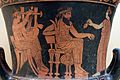 Olympian assembly, from left to right: Apollo, Zeus and Hera
 -
 The abduction of Europa
 -
 The "Golden Man" Zeus statue
 -
 Zeus and Hera
 -
![1st century BC statue of Zeus[327]](//upload.wikimedia.org/wikipedia/commons/thumb/7/7e/Marbury_Hall_Zeus_-_Getty_Museum_%2873.AA.32%29.jpg/120px-Marbury_Hall_Zeus_-_Getty_Museum_%2873.AA.32%29.jpg) 1st century BC statue of Zeus[327]
1st century BC statue of Zeus[327]
.jpg)


![1st century BC statue of Zeus[327]](https://en.wikipedia.org/wiki/File:Marbury_Hall_Zeus_-_Getty_Museum_(73.AA.32).jpg)
See also
[edit]

- Family tree of the Greek gods
- Agetor
- Ambulia – Spartan epithet used for Athena, Zeus, and Castor and Pollux
- Hetairideia – Thessalian Festival to Zeus
- Temple of Zeus, Olympia
- Zanes of Olympia – Statues of Zeus
Footnotes
[edit]Notes
[edit]- ^ The sculpture was presented to Louis XIV as Aesculapius but restored as Zeus, ca. 1686, by Pierre Granier, who added the upraised right arm brandishing the thunderbolt. Marble, middle 2nd century CE. Formerly in the "Allée Royale", (Tapis Vert) in the Gardens of Versailles, now conserved in the Louvre Museum (Official online catalog)
- ^ a b Hamilton, Edith (1942). Mythology (1998 ed.). New York: Back Bay Books. p. 467. ISBN 978-0-316-34114-1.
{{cite book}}: ISBN / Date incompatibility (help) - ^ Hard 2004, p. 79.
- ^ Brill's New Pauly, s.v. Zeus.
- ^ Homer, Il., Book V.
- ^ Plato, Symposium 180e.
- ^ There are two major conflicting stories for Aphrodite's origins: Hesiod's Theogony claims that she was born from the foam of the sea after Cronos castrated Uranus, making her Uranus's daughter, while Homer's Iliad has Aphrodite as the daughter of Zeus and Dione.[5] A speaker in Plato's Symposium offers that they were separate figures: Aphrodite Ourania and Aphrodite Pandemos.[6]
- ^ Hesiod, Theogony 886–900.
- ^ Homeric Hymns.
- ^ Hesiod, Theogony.
- ^ Burkert, Greek Religion.
- ^ See, e.g., Homer, Il., I.503 & 533.
- ^ Pausanias, 2.24.4.
- ^ Brill's New Pauly, s.v. Zeus.
- ^ Νεφεληγερέτα. Liddell, Henry George; Scott, Robert; A Greek–English Lexicon at the Perseus Project.
- ^ Laërtius, Diogenes (1972) [1925]. "1.11". In Hicks, R. D. (ed.). Lives of Eminent Philosophers. "1.11". Diogenes Laertius, Lives of Eminent Philosophers (in Greek).
- ^ "The Linear B word di-we". "The Linear B word di-wo". Palaeolexicon: Word study tool of Ancient languages.
- ^ a b "Zeus". American Heritage Dictionary. Retrieved 3 July 2006.
- ^ Robert S. P. Beekes, Etymological Dictionary of Greek, Brill Publishers, 2009, p. 499.
- ^ Harper, Douglas. "Jupiter". Online Etymology Dictionary.
- ^ Hyllested, Adam; Joseph, Brian D. (2022). "Albanian". In Olander, Thomas (ed.). The Indo-European Language Family: A Phylogenetic Perspective. Cambridge University Press. p. 232. doi:10.1017/9781108758666. ISBN 9781108758666. S2CID 161016819.
- ^ Søborg, Tobias Mosbæk (2020). Sigmatic Verbal Formations in Anatolian and Indo-European: A Cladistic Study (Thesis). University of Copenhagen, Department of Nordic Studies and Linguistics. p. 74..
- ^ Burkert (1985). Greek Religion. Harvard University Press. p. 321. ISBN 0-674-36280-2.
- ^ "Plato's Cratylus" by Plato, ed. by David Sedley, Cambridge University Press, 6 November 2003, p. 91
- ^ Jevons, Frank Byron (1903). The Makers of Hellas. C. Griffin, Limited. pp. 554–555.
- ^ Joseph, John Earl (2000). Limiting the Arbitrary. John Benjamins. ISBN 1556197497.
- ^ "Diodorus Siculus, Bibliotheca Historica, Books I-V, book 5, chapter 72". www.perseus.tufts.edu.
- ^ Lactantius, Divine Institutes 1.11.1.
- ^ a b Hewitt, Joseph William (1908). "The Propitiation of Zeus". Harvard Studies in Classical Philology. 19: 61–120. doi:10.2307/310320. JSTOR 310320.
- ^ See Gantz, pp. 10–11; Hesiod, Theogony 159–83.
- ^ Hard 2004, p. 67; Hansen, p. 67; Tripp, s.v. Zeus, p. 605; Caldwell, p. 9, table 12; Hesiod, Theogony 453–8. So too Apollodorus, 1.1.5; Diodorus Siculus, 68.1.
- ^ Gantz, p. 41; Hard 2004, p. 67–8; Grimal, s.v. Zeus, p. 467; Hesiod, Theogony 459–67. Compare with Apollodorus, 1.1.5, who gives a similar account, and Diodorus Siculus, 70.1–2, who does not mention Cronus's parents, but rather says that it was an oracle who gave the prophecy.
- ^ Cf. Apollodorus, 1.1.6, who says that Rhea was "enraged".
- ^ Hard 2004, p. 68; Gantz, p. 41; Smith, s.v. Zeus; Hesiod, Theogony 468–73.
- ^ Hard 2004, p. 74; Gantz, p. 41; Hesiod, Theogony 474–9.
- ^ Hard 2004, p. 74; Hesiod, Theogony 479–84. According to Hard 2004, the "otherwise unknown" Mount Aegaeon can "presumably ... be identified with one of the various mountains near Lyktos".
- ^ Hansen, p. 67; Hard 2004, p. 68; Smith, s.v. Zeus; Gantz, p. 41; Hesiod, Theogony 485–91. For iconographic representations of this scene, see Louvre G 366; Clark, p. 20, figure 2.1 and Metropolitan Museum of Art 06.1021.144; LIMC 15641; Beazley Archive 214648. According to Pausanias, 9.41.6, this event occurs at Petrachus, a "crag" nearby to Chaeronea (see West 1966, p. 301 on line 485).
- ^ West 1966, p. 291 on lines 453–506; Hard 2004, p. 75.
- ^ Fowler 2013, pp. 35, 50; Eumelus fr. 2 West, pp. 224, 225 [= fr. 10 Fowler, p. 109 = PEG fr. 18 (Bernabé, p. 114) = Lydus, De Mensibus 4.71]. According to West 2003, p. 225 n. 3, in this version he was born "probably on Mt. Sipylos".
- ^ Fowler 2013, p. 391; Grimal, s.v. Zeus, p. 467; Callimachus, Hymn to Zeus (1) 4–11 (pp. 36–9).
- ^ Fowler 2013, p. 391; Diodorus Siculus, 70.2, 70.6.
- ^ Apollodorus, 1.1.6.
- ^ "Pausanias, Description of Greece, Messenia, chapter 33, section 1". www.perseus.tufts.edu. Retrieved 18 March 2025.
- ^ Hesiod, Theogony 133–8, 453–8 (Most, pp. 12, 13, 38, 39); Caldwell, p. 4, table 2, p. 9, table 12.
- ^ Hard 2004, p. 68; Gantz, p. 41; Hesiod, Theogony 492–3: "the strength and glorious limbs of the prince increased quickly".
- ^ West 1983, p. 122; Apollodorus, 1.1.6.
- ^ Hard 2004, p. 612 n. 53 to p. 75; Apollodorus, 1.1.7.
- ^ Hansen, p. 216; Apollodorus, 1.1.7.
- ^ Diodorus Siculus, 7.70.2; see also 7.65.4.
- ^ Diodorus Siculus, 7.70.2–3.
- ^ Diodorus Siculus, 7.65.4.
- ^ Diodorus Siculus, 7.70.4.
- ^ Gantz, p. 42; Hyginus, Fabulae 139.
- ^ Gantz, p. 42; Hard 2004, p. 75; Hyginus, Fabulae 139.
- ^ Smith and Trzaskoma, p. 191 on line 182; West 1983, p. 133 n. 40; Hyginus, Fabulae 182 (Smith and Trzaskoma, p. 158).
- ^ Hard 2004, p. 75–6; Gantz, p. 42; Epimenides fr. 23 Diels, p. 193 [= Scholia on Aratus, 46]. Zeus later marks the event by placing the constellations of the Dragon, the Greater Bear and the Lesser Bear in the sky.
- ^ Gantz, p. 41; Gee, p. 131–2; Frazer, p. 120; Musaeus fr. 8 Diels, pp. 181–2 [= Eratosthenes, Catasterismi 13 (Hard 2015, p. 44; Olivieri, p. 17)]; Musaeus apud Hyginus, De astronomia 2.13.6. According to Eratosthenes, Musaeus considers the she-goat to be a child of Helios, and to be "so terrifying to behold" that the Titans ask for it to be hidden in one of the caves in Crete; hence Earth places it in the care of Amalthea, who nurses Zeus on its milk.
- ^ Hard 2004, p. 75; Antoninus Liberalis, 19.
- ^ Gantz, p. 44; Hard 2004, p. 68; Hesiod, Theogony 492–7.
- ^ Hard 2004, p. 68; Hesiod, Theogony 498–500.
- ^ Hard 2004, p. 68; Gantz, p. 44; Hesiod, Theogony 501–6. The Cyclopes presumably remained trapped below the earth since being put there by Uranus (Hard 2004, p. 68).
- ^ Hard 2004, p. 68; Gantz, p. 45; Hesiod, Theogony 630–4.
- ^ Hard 2004, p. 68; Hesiod, Theogony 624–9, 635–8. As Gantz, p. 45 notes, the Theogony is ambiguous as to whether the Hundred-Handers were freed before the war or only during its tenth year.
- ^ Hesiod, Theogony 639–53.
- ^ Hesiod, Theogony 654–63.
- ^ Hesiod, Theogony 687–735.
- ^ Hard 2004, p. 69; Gantz, p. 44; Apollodorus, 1.2.1.
- ^ a b Hard 2004, p. 69; Apollodorus, 1.2.1.
- ^ Gantz, p. 48; Hard 2004, p. 76; Brill's New Pauly, s.v. Zeus; Homer, Iliad 15.187–193; so too Apollodorus, 1.2.1; cf. Homeric Hymn to Demeter (2), 85–6.
- ^ Hard 2004, p. 86; Hesiod, Theogony 183–7.
- ^ Hard 2004, p. 86; Gantz, p. 446.
- ^ Gantz, p. 449; Hard 2004, p. 90; Apollodorus, 1.6.1.
- ^ Hard 2004, p. 89; Gantz, p. 449; Apollodorus, 1.6.1.
- ^ Hard 2004, p. 89; Gantz, p. 449; Salowey, p. 236; Apollodorus, 1.6.2. Compare with Pindar, Pythian 8.12–8, who instead says that Porphyrion is killed by an arrow from Apollo.
- ^ Ogden, pp. 72–3; Gantz, p. 48; Fontenrose, p. 71; Fowler, p. 27; Hesiod, Theogony 820–2. According to Ogden, Gaia "produced him in revenge against Zeus for his destruction of ... the Titans". Contrastingly, according to the Homeric Hymn to Apollo (3), 305–55, Hera is the mother of Typhon without a father: angry at Zeus for birthing Athena by himself, she strikes the ground with her hand, praying to Gaia, Uranus, and the Titans to give her a child more powerful than Zeus, and receiving her wish, she bears the monster Typhon (Fontenrose, p. 72; Gantz, p. 49; Hard 2004, p. 84); cf. Stesichorus fr. 239 Campbell, pp. 166, 167 [= PMG 239 (Page, p. 125) = Etymologicum Magnum 772.49] (see Gantz, p. 49).
- ^ Gantz, p. 49; Hesiod, Theogony 824–8.
- ^ Fontenrose, p. 71; Hesiod, Theogony 836–8.
- ^ Hesiod, Theogony 839–68. According to Fowler, p. 27, the monster's easy defeat at the hands of Zeus is "in keeping with Hesiod's pervasive glorification of Zeus".
- ^ Ogden, p. 74; Gantz, p. 49; Epimenides fr. 10 Fowler, p. 97 [= fr. 8 Diels, p. 191 = FGrHist 457 F8].
- ^ Fontenrose, p. 73; Aeschylus, Prometheus Bound 356–64; Pindar, Olympian 8.16–7; for a discussion of Aeschylus's and Pindar's accounts, see Gantz, p. 49.
- ^ Apollodorus, 1.6.3.
- ^ Gantz, p. 50; Fontenrose, p. 73.
- ^ Hard 2004, p. 84; Fontenrose, p. 73; Gantz, p. 50.
- ^ Hard 2004, p. 84; Fontenrose, p. 73.
- ^ Fontenrose, p. 73; Ogden, p. 42; Hard 2004, p. 84.
- ^ Hard 2004, p. 84–5; Fontenrose, p. 73–4.
- ^ Hard 2004, p. 85.
- ^ Ogden, p. 74–5; Fontenrose, pp. 74–5; Lane Fox, p. 287; Gantz, p. 50.
- ^ Gantz, p. 59; Hard 2004, p. 82; Homer, Iliad 1.395–410.
- ^ Gantz, p. 51; Hard 2004, p. 77; Hesiod, Theogony 886–900. Yasumura, p. 90 points out that the identity of the foretold son's father is not made clear by Hesiod, and suggests, drawing upon a version given by a scholiast on the Iliad (see below), that a possible interpretation would be that the Cyclops Brontes was the father.
- ^ Smith, s.v. Metis; Apollodorus, 1.3.6.
- ^ Potentially from the Melampodia (Hard 2004, p. 77).
- ^ Gantz, p. 51; Hard 2004, p. 77; Hesiod fr. 294 Most, pp. 390–3 [= fr. 343 Merkelbach-West, p. 171 = Chrysippus fr. 908 Arnim, p. 257 = Galen, On the Doctrines of Hippocrates and Plato 3.8.11–4 (p. 226)].
- ^ Gantz, p. 51; Yasumura, p. 89; Scholia bT on Homer's Iliad, 8.39 (Yasumura, p. 89).
- ^ Hard 2004, p. 77. Compare with Gantz, p. 51, who sees the myth as a conflation of three separate elements: one in which Athena is born from Zeus's head, one in which Zeus consumes Metis so as to obtain her wisdom, and one in which he swallows her so as to avoid the threat of the prophesied son.
- ^ Hard 2004, p. 77–8; see also Yasumura, p. 90.
- ^ Gantz, p. 51; Hard 2004, p. 78; Hesiod, Theogony 901–6. Earlier, at 217, Hesiod instead calls the Moirai daughters of Nyx.
- ^ Gantz, p. 52; Hard 2004, p. 78; Pindar fr. 30 Race, pp. 236, 237 [= Clement of Alexandria, Stromata 5.14.137.1].
- ^ Gantz, p. 54; Hard 2004, p. 78; Hesiod, Theogony 907–11.
- ^ Hard 2004, p. 78; Hansen, p. 68; Hesiod, Theogony 912–4.
- ^ Gantz, p. 54; Hesiod, Theogony 53–62, 915–7.
- ^ Hard 2004, p. 78; Hesiod, Theogony 918–20; Homeric Hymn to Apollo (3), 89–123. The account given by the Homeric Hymn to Apollo differs from Hesiod's version in that Zeus and Hera are already married when Apollo and Artemis are born (Pirenne-Delforge and Pironti, p. 18).
- ^ Hesiod, Theogony 921.
- ^ Hesiod, Theogony 886–920 (Most, pp. 74–77); Caldwell, p. 11, table 14.
- ^ a b One of the Oceanid daughters of Oceanus and Tethys, at 358.
- ^ Of Zeus's children by his partners before Hera, Athena was the first to be conceived (889), but the last to be born. Zeus impregnated Metis then swallowed her, later Zeus himself gave birth to Athena "from his head" (924).
- ^ At 217 the Moirai are the daughters of Nyx.
- ^ Hard 2004, p. 78.
- ^ Hard 2004, p. 79; Hesiod, Theogony 921–3; so too Apollodorus, 1.3.1. In the Iliad, Eris is called the sister of Ares (4.440–1), and Parada, s.v. Eris, p. 72 places her as a daughter of Zeus and Hera.
- ^ Hard 2004, p. 79; Gantz, p. 74; Hesiod, Theogony 924–9; so too Apollodorus, 1.3.5.
- ^ Hard 2004, p. 79; Gantz, p. 74; Homer, Iliad 1.577–9, 14.293–6, 14.338, Odyssey 8.312; Scholia bT on Homer's Iliad, 14.296; see also Apollodorus, 1.3.5.
- ^ Gantz, p. 57; Pirenne-Delforge and Pironti, p. 24; Hard 2004, pp. 78, 136; Homer, Iliad 14.293–6. Gantz points out that, if in this version Cronus swallows his children as he does in the Theogony, the pair could not sleep with each other without their father's knowledge before Zeus overthrows Cronus, and so suggests that Homer may have possibly been following a version of the story in which only Cronus's sons are swallowed.
- ^ Gantz, p. 57; Scholia bT on Homer's Iliad, 14.296. Cf. Scholia A on Homer's Iliad, 1.609 (Dindorf 1875a, p. 69); see Pirenne-Delforge and Pironti, p. 20; Hard 2004, p. 136.
- ^ Hard 2004, p. 136; Callimachus, fr. 48 Harder, pp. 152, 153 [= Scholia A on Homer's Iliad, 1.609 (Dindorf 1875a, p. 69)]; see also Pirenne-Delforge and Pironti, p. 20.
- ^ Hard 2004, p. 137; Scholia on Theocritus, 15.64 (Wendel, pp. 311–2) [= FGrHist 33 F3]; Gantz, p. 58. The scholiast attributes the story to the work On the Cults of Hermione, by an Aristocles.
- ^ BNJ, commentary on 33 F3; Pausanias, 2.17.4, 2.36.1.
- ^ According to Sandbach, Macris is another name for Euboea, who Plutarch calls Hera's nurse at Moralia 657 E (pp. 268–71) (Sandbach, p. 289, note b to fr. 157).
- ^ Hard 2004, p. 137; Plutarch fr. 157 Sandbach, pp. 286–9 [= FGrHist 388 F1 = Eusebius, Praeparatio evangelica 3.1.3 (Gifford 1903a, pp. 112–3; Gifford 1903b, p. 92)].
- ^ Ptolemy Hephaestion apud Photius, Bibliotheca 190.47 (Harry, pp. 68–9; English translation).
- ^ Stephanus of Byzantium s.v. Hermion (II pp. 160, 161).
- ^ Hard 2004, pp. 136–7; Callimachus fr. 75 Clayman, pp. 208–17 [= P. Oxy. 1011 fr. 1 (Grenfell and Hunt, pp. 24–6)]. Callimachus seems to refer to some form of liaison between Zeus and Hera while describing a Naxian premarital ritual; see Hard 2004, pp. 136–7; Gantz, p. 58. Cf. Scholia on Homer's Iliad, 14.296; for a discussion on the relation between the Callimachus fragment and the passage from the scholion, see Sistakou, p. 377.
- ^ Gantz, p. 58; FGrHist 3 F16a [= Scholia on Apollonius of Rhodes' Argonautica 4.1396–9b (Wendel, pp. 315–6)]; FGrHist 3 F16b [= Scholia on Apollonius of Rhodes' Argonautica 2.992 (Wendel, p. 317)].
- ^ Fowler 2013, p. 292; Eratosthenes, Catasterismi 3 (Hard 2015, p. 12; Olivieri, pp. 3–4) [= Hyginus, De astronomia 2.3.1 = FGrHist 3 F16c].
- ^ Apollodorus, 2.5.11.
- ^ Hard 2004, p. 136; Diodorus Siculus, 5.72.4.
- ^ Varro apud Lactantius, Divine Institutes 1.17.1 (p. 98).
- ^ Hard 2004, p. 137–8; Pirenne-Delforge and Pironti, p. 99; Pausanias, 9.3.1–2.
- ^ Plutarch fr. 157 Sandbach, pp. 292, 293 [= FGrHist 388 F1 = Eusebius, Praeparatio evangelica 3.1.6 (Gifford 1903a, pp. 114–5; Gifford 1903b, p. 93)].
- ^ Hesiod, Theogony 921–9 (Most, pp. 76, 77); Caldwell, p. 12, table 14.
- ^ According to Hesiod, Hera produces Hephaestus on her own, without a father (Theogony 927–9). In the Iliad and the Odyssey, however, he is the son of Zeus and Hera; see Gantz, p. 74; Homer, Iliad 1.577–9, 14.293–6, 14.338, Odyssey 8.312.
- ^ Grimal, s.v. Zeus, p. 468 calls his affairs "countless".
- ^ Hard 2004, p. 337; Gantz, p. 210; Scholia Ab on Homer's Iliad, 12.292 (Dindorf 1875a, pp. 427–8) [= Hesiod fr. 89 Most, pp. 172–5 = Merkelbach-West fr. 140, p. 68] [= Bacchylides fr. 10 Campbell, pp. 262, 263].
- ^ Gantz, pp. 320–1; Hard 2004, p. 439; Euripides, Helen 16–21 (pp. 14, 15).
- ^ Hard 2004, p. 303; Euripides fr. 178 Nauck, pp. 410–2.
- ^ Hard 2004, p. 541; Gantz, p. 726; Ovid, Metamorphoses 2.409–530; see also Amphis apud Hyginus, De astronomia 2.1.2. According to Apollodorus, 3.8.2 he took the form "as some say, of Artemis, or, as others say, of Apollo".
- ^ Gantz, p. 375; FGrHist 3 F13b [= Scholia on Homer's Odyssey, 11.266]; FGrHist 3 F13c [= Scholia on Homer's Iliad, 14.323 (Dindorf 1875b, p. 62)].
- ^ Hard 2004, p. 238; Gantz, p. 300; Pindar, Pythian 12.17–8; Apollodorus, 2.4.1; FGrHist 3 F10 [= Scholia on Apollonius of Rhodes' Argonautica, 4.1091 (Wendel, p. 305)].
- ^ Gantz, p. 220; Ovid, Metamorphoses 6.113. In contrast, Nonnus, Dionysiaca 7.122 (pp. 252, 253), 7.210–4 (pp. 260, 261) states that he takes the form of an eagle.
- ^ Gantz, p. 61; Hard 2004, p. 138.
- ^ Gantz, p. 199; Hard 2004, p. 231; Apollodorus, 2.1.3.
- ^ Hard 2004, pp. 170–1; Gantz, p. 476.
- ^ Gantz, p. 726.
- ^ Grimal, s.v. Hera, p. 192; Tripp, s.v. Hera, p. 274.
- ^ Diodorus Siculus, Library of History 4.14.4.
- ^ Gantz, p. 220.
- ^ Hard 2004, p. 247; Apollodorus, 2.4.8.
- ^ Hard 2004, p. 303; Brill's New Pauly, s.v. Antiope; Scholia on Apollonius of Rhodes, 4.1090.
- ^ Gantz, p. 726; Brill's New Pauly, s.v. Callisto; Grimal, s.v. Callisto, p. 86; Apollodorus, 3.8.2 (Artemis or Apollo); Ovid, Metamorphoses 2.401–530; Hyginus, De astronomia 2.1.2.
- ^ Hard 2004, p. 238
- ^ Hard 2004, p. 337; Lane Fox, p. 199.
- ^ Hard 2004, p. 522; Ovid, Metamorphoses 10.155–6; Lucian, Dialogues of the Gods 10 (4).
- ^ Hard 2004, p. 137
- ^ Hard 2004, p. 439; Euripides, Helen 16–22.
- ^ Hard 2004, p. 438; Cypria fr. 10 West, pp. 88–91 [= Athenaeus, Deipnosophists 8.334b–d].
- ^ Hard 2004, p.244; Hesiod, Theogony 943.
- ^ Hansen, p. 68; Hard 2004, p. 78; Hesiod, Theogony 912.
- ^ Hard 2004, p. 78; Hesiod, Theogony 901–911; Hansen, p. 68.
- ^ West 1983, p. 73; Orphic Hymn to the Graces (60), 1–3 (Athanassakis and Wolkow, p. 49).
- ^ Cornutus, Compendium Theologiae Graecae, 15 (Torres, pp. 15–6).
- ^ Hard 2004, p. 79; Hesiod, Theogony 921.
- ^ Hard 2004, p. 78; Hesiod, Theogony 912–920; Morford, p. 211.
- ^ Hard 2004, p. 80; Hesiod, Theogony 938.
- ^ Hard 2004, p. 77; Hesiod, Theogony 886–900.
- ^ Hard 2004, p. 78; Hesiod, Theogony 53–62; Gantz, p. 54.
- ^ Hard 2004, p. 80; Hesiod, Theogony 940.
- ^ a b Hesiod, Theogony 901–905; Gantz, p. 52; Hard 2004, p. 78.
- ^ Homer, Iliad 5.370; Apollodorus, 1.3.1
- ^ Homer, Iliad 14.319–20; Smith, s.v. Perseus (1).
- ^ Homer, Iliad 14.317–18; Smith, s.v. Peirithous.
- ^ Gantz, p. 210; Brill's New Pauly, s.v. Minos; Homer, Iliad 14.32–33; Hesiod, Catalogue of Women fr. 89 Most, pp. 172–5 [= fr. 140 Merkelbach-West, p. 68].
- ^ Homer, Iliad 14.32–33; Hesiod, Catalogue of Women fr. 89 Most, pp. 172–5 [= fr. 140 Merkelbach-West, p. 68]; Gantz, p. 210; Smith, s.v. Rhadamanthus.
- ^ Smith, s.v. Sarpedon (1); Brill's New Pauly, s.v. Sarpedon (1); Hesiod, Catalogue of Women fr. 89 Most, pp. 172–5 [= fr. 140 Merkelbach-West, p. 68].
- ^ Homer, Odyssey 11.260–3; Brill's New Pauly s.v. Amphion; Grimal, s.v. Amphion, p. 38.
- ^ RE, s.v. Angelos 1; Sophron apud Scholia on Theocritus, Idylls 2.12.
- ^ Eleutheria is the Greek counterpart of Libertas (Liberty), daughter of Jove and Juno as cited in Hyginus, Fabulae Preface.
- ^ Parada, s.v. Eris, p. 72. Homer, Iliad 4.440–1 calls Eris the sister of Ares, who is the son of Zeus and Hera in the Iliad.
- ^ Hard 2004, p. 79, 141; Gantz, p. 74; Homer, Iliad 1.577–9, 14.293–6, 14.338, Odyssey 8.312; Scholia bT on Homer's Iliad, 14.296.
- ^ Homer, Iliad 6.191–199; Hard 2004, p. 349; Smith, s.v. Sarpe'don (2).
- ^ Gantz, pp. 318–9. Helen is called the daughter of Zeus in Homer, Iliad 3.199, 3.418, 3.426, Odyssey 4.184, 4.219, 23.218, and she has the same mother (Leda) as Castor and Pollux in Iliad 3.236–8.
- ^ Cypria, fr. 10 West, pp. 88–91; Hard 2004, p. 438.
- ^ Gantz, p. 167; Hesiod, Catalogue of Women fr. 2 Most, pp. 42–5 [= fr. 5 Merkelbach-West, pp. 5–6 = Ioannes Lydus, De Mensibus 1.13].
- ^ Parada, s.vv. Hellen (1), p. 86, Pyrrha (1), p. 159; Apollodorus, 1.7.2; Hesiod, Catalogue of Women fr. 5 Most, pp. 46, 47 [= Scholia on Homer's Odyssey 10.2]; West 1985, pp. 51, 53, 56, 173, table 1.
- ^ Hesiod, Catalogue of Women fr. 7 Most, pp. 48, 49 [= Constantine Porphyrogenitus, De Thematibus, 2].
- ^ Pindar, Olympian 12.1–2; Gantz, p. 151.
- ^ Herodotus, Histories 4.5.1.
- ^ Stephanus of Byzantium, Ethnica s.v. Torrhēbos, citing Hellanicus and Nicolaus
- ^ Brill's New Pauly, s.v. Tityus; Hard 2004, pp. 147–148; FGrHist 3 F55 [= Scholia on Apollonius of Rhodes, 1.760–2b (Wendel, p. 65)].
- ^ Cicero, De Natura Deorum 3.59.
- ^ Diodorus Siculus, Bibliotheca historica 5.55.5
- ^ Dionysius of Halicarnassus, 5.48.1; Smith, s.v. Saon.
- ^ Cicero, De Natura Deorum 3.42.
- ^ Hyginus, Fabulae 155
- ^ Strabo, Geographica 10.3.19
- ^ Valerius Flaccus, Argonautica 6.48ff., 6.651ff
- ^ Hyginus Fabulae 82; Antoninus Liberalis, 36; Pausanias, 2.22.3; Gantz, p. 536; Hard 2004, p. 502.
- ^ Apollodorus, 3.12.6; Grimal, s.v. Asopus, p. 63; Smith, s.v. Asopus.
- ^ Apollodorus, 1.4.1; Hard 2004, p. 216.
- ^ Apollodorus, 3.8.2; Pausanias, 8.3.6; Hard 2004, p. 540; Gantz, pp. 725–726.
- ^ Brill's New Pauly, s.v. Calyce (1); Smith, s.v. Endymion; Apollodorus, 1.7.5.
- ^ Apollodorus, 2.1.1; Gantz, p. 198.
- ^ a b Apollodorus, 3.12.1; Hard 2004, 521.
- ^ Nonnus, Dionysiaca 3.195.
- ^ Diodorus Siculus, Bibliotheca historica 5.48.2.
- ^ Apollodorus, 3.12.6; Hard 2004, p. 530–531.
- ^ FGrHist 299 F5 [= Scholia on Pindar's Olympian 9.104a].
- ^ Pausanias, 2.30.3; March, s.v. Britomartis, p. 88; Smith, s.v. Britomartis.
- ^ Gantz, pp. 26, 40; Musaeus fr. 16 Diels, p. 183; Scholiast on Apollonius Rhodius, Argonautica 3.467
- ^ Cicero, De Natura Deorum 3.42; Athenaeus, Deipnosophists 9.392e (pp. 320, 321).
- ^ Stephanus of Byzantium, s.v. Akragantes; Smith, s.v. Acragas.
- ^ Scholiast on Pindar, Pythian Odes 3.177; Hesychius
- ^ FGrHist 1753 F1b.
- ^ Smith, s.v. Agdistis; Pausanias, 7.17.10. Agdistis springs from the earth in a place where Zeus's seed landed.
- ^ Dionysius of Halicarnassus, Roman Antiquities 1.27.1; Grimal, s.v. Manes, p. 271.
- ^ Nonnus, Dionysiaca 14.193.
- ^ Morand, p. 335; Orphic Hymn to Melinoë (71), 3–4 (Athanassakis and Wolkow, p. 57).
- ^ Grimal, s.v. Zagreus, p. 466; Nonnus, Dionysiaca 6.155.
- ^ Cicero, De Natura Deorum 3.21-23.
- ^ Hard 2004, p. 46; Keightley, p. 55; Alcman fr. 57 Campbell, pp. 434, 435.
- ^ Cook 1914, p. 456; Smith, s.v. Selene.
- ^ Homeric Hymn to Selene (32), 15–16; Hyginus, Fabulae Preface; Hard 2004, p. 46; Grimal, s.v. Selene, p. 415.
- ^ Apollodorus, 1.1.3.
- ^ West 1983, p. 73; Orphic fr. 58 Kern [= Athenagoras, Legatio Pro Christianis 20.2]; Meisner, p. 134.
- ^ Smith, s.v. Thaleia (3); Oxford Classical Dictionary, s.v. Palici, p. 1100; Servius, On Aeneid, 9.581–4.
- ^ Grimal, s.v. Myrmidon, p. 299; Hard 2004, p. 533
- ^ Stephanus of Byzantium, s.v. Krētē.
- ^ Grimal, s.v. Epaphus; Apollodorus, 2.1.3.
- ^ Nonnus, Dionysiaca 32.70
- ^ Antoninus Liberalis, 13.
- ^ Pausanias, 3.1.2.
- ^ Brill's New Pauly, s.v. Themisto; Stephanus of Byzantium, s.v. Arkadia [= FGrHist 334 F75].
- ^ Pausanias, 1.40.1.
- ^ Stephanus of Byzantium, s.v. Ōlenos.
- ^ Stephanus of Byzantium, s.v. Pisidia; Grimal, s.v. Solymus, p. 424.
- ^ Smith, s.v. Orchomenus (3).
- ^ Smith, s.v. Agamedes.
- ^ Ptolemy Hephaestion apud Photius, Bibliotheca 190.47 (English translation).
- ^ Pausanias, 10.12.1; Smith, s.v. Lamia (1).
- ^ Eustathius ad Homer, p. 1688
- ^ Servius, Commentary on Virgil's Aeneid 1. 242
- ^ Apollodorus, 1.7.2; Pausanias, 5.1.3; Hyginus, Fabulae 155.
- ^ Hyginus, Fabulae 155.
- ^ Pindar, Olympian Ode 9.58.
- ^ a b Tzetzes on Lycophron, 1206 (pp. 957–962).[non-primary source needed]
- ^ John Lydus, De mensibus 4.67.
- ^ Homer, Iliad 19.91.
- ^ "Apollonius Rhodius, Argonautica, book 2, line 887". www.perseus.tufts.edu.
- ^ Orphic Hymn to Dionysus (30), 6–7 (Athanassakis and Wolkow, p. 27)
- ^ Homer, Iliad 9.502; Quintus Smyrnaeus, Posthomerica 10.301 (pp. 440, 441); Smith, s.v. Litae.
- ^ Valer. Flacc., Argonautica 5.205
- ^ Stephanus of Byzantium, Ethnica s.v. Tainaros
- ^ Pausanias, 2.1.1.
- ^ Diodorus Siculus, Bibliotheca historica 5.81.4
- ^ Hesiod, Theogony 507-565
- ^ Hesiod, Works and Days 60–105.
- ^ Ovid, Metamorphoses 1.216–1.348
- ^ Leeming, David (2004). Flood | The Oxford Companion to World Mythology. Oxford University Press. p. 138. ISBN 9780195156690. Retrieved 14 February 2019.
- ^ "The Gods in the Iliad". department.monm.edu. Archived from the original on 19 December 2015. Retrieved 2 December 2015.
- ^ Homer (1990). The Iliad. South Africa: Penguin Classics.
- ^ Hyginus, Fabulae 146.
- ^ Meisner, pp. 1, 5
- ^ West 1983, pp. 73–74; Meisner, p. 134; Orphic frr. 58 [= Athenagoras, Legatio Pro Christianis 20.2] 153 Kern.
- ^ Apollodorus, 3.76.
- ^ Apollodorus, 3.13.5.
- ^ Pindar, Isthmian odes 8.25
- ^ Apollodorus, 3.10.4
- ^ Diodorus Siculus, Bibliotheca historica 4.71.2
- ^ Hesiod, Theogony 285
- ^ Hard 2004, p. 554; Apollodorus, Epitome 1.20
- ^ Ovid, Metamorphoses 1.747–2.400; Hyginus, De astronomia 2.42.2; Nonnus, Dionysiaca 38.142–435
- ^ Lucian, Dialogues of the Gods Zeus and the Sun
- ^ The bust below the base of the neck is eighteenth century. The head, which is roughly worked at back and must have occupied a niche, was found at Hadrian's Villa, Tivoli and donated to the British Museum by John Thomas Barber Beaumont in 1836. BM 1516. (British Museum, A Catalogue of Sculpture in the Department of Greek and Roman Antiquities, 1904).
- ^ Homer, Iliad 1.202, 2.157, 2.375; Pindar, Isthmian Odes 4.99; Hyginus, De astronomia 2.13.7.
- ^ Spanh. ad Callim. hymn. in Jov, 49
- ^ Schmitz, Leonhard (1867). "Aegiduchos". In Smith, William (ed.). Dictionary of Greek and Roman Biography and Mythology. Vol. I. Boston. p. 26. Archived from the original on 11 February 2009. Retrieved 19 October 2007.
{{cite book}}: CS1 maint: location missing publisher (link) - ^ Hanson, Victor Davis (18 December 2007). Carnage and Culture: Landmark Battles in the Rise to Western Power. Knopf Doubleday Publishing Group. ISBN 978-0-307-42518-8.
- ^ LIMC, s.v. Zeus, p. 342.
- ^ Herbermann, Charles, ed. (1913). . Catholic Encyclopedia. New York: Robert Appleton Company.; Johannes Hahn: Gewalt und religiöser Konflikt; The Holy Land and the Bible
- ^ Durant, The Life of Greece (The Story of Civilization Part II, New York: Simon & Schuster) 1939:23.
- ^ Rodney Castleden, Minoans: Life in Bronze-Age Crete, "The Minoan belief-system" (Routledge) 1990:125
- ^ Pointed out by Bernard Clive Dietrich, The Origins of Greek Religion (de Gruyter) 1973:15.
- ^ A.B. Cook, Zeus Cambridge University Press, 1914, I, figs 397, 398.
- ^ Dietrich 1973, noting Martin P. Nilsson, Minoan-Mycenaean Religion, and Its Survival in Greek Religion 1950:551 and notes.
- ^ "Professor Stylianos Alexiou reminds us that there were other divine boys who survived from the religion of the pre-Hellenic period — Linos, Ploutos and Dionysos — so not all the young male deities we see depicted in Minoan works of art are necessarily Velchanos" (Castleden) 1990:125
- ^ Richard Wyatt Hutchinson, Prehistoric Crete, (Harmondsworth: Penguin) 1968:204, mentions that there is no classical reference to the death of Zeus (noted by Dietrich 1973:16 note 78).
- ^ "This annually reborn god of vegetation also experienced the other parts of the vegetation cycle: holy marriage and annual death when he was thought to disappear from the earth" (Dietrich 1973:15).
- ^ In the founding myth of Lycaon's banquet for the gods that included the flesh of a human sacrifice, perhaps one of his sons, Nyctimus or Arcas. Zeus overturned the table and struck the house of Lyceus with a thunderbolt; his patronage at the Lykaia can have been little more than a formula.
- ^ A morphological connection to lyke "brightness" may be merely fortuitous.
- ^ Modern archaeologists have found no trace of human remains among the sacrificial detritus, Walter Burkert, "Lykaia and Lykaion", Homo Necans, tr. by Peter Bing (University of California) 1983, p. 90.
- ^ Pausanias, 8.38.
- ^ Republic 565d-e
- ^ A. B. Cook (1914), Zeus: A Study in Ancient Religion, Vol. I, p.63, Cambridge University Press
- ^ Strabo, Geographica 14.1.42.
- ^ Pausanias, Description of Greece, 4.33.2
- ^ A Dictionary of Greek and Roman Antiquities (1890), Hecatomphonia
- ^ Harry Thurston Peck, Harpers Dictionary of Classical Antiquities (1898), Hecatomphonia
- ^ Perseus Encyclopedia, Hecatomphonia
- ^ Pausanias, Description of Greece, 4.19.3
- ^ Schol. ad Pind. Ol. vi. 162
- ^ Hesiod, according to a scholium on Apollonius of Rhodes. Argonautika, ii. 297
- ^ Odyssey 14.326-7
- ^ Pausanias, 3.18.
- ^ "In the art of Gandhara Zeus became the inseparable companion of the Buddha as Vajrapani." in Freedom, Progress, and Society, K. Satchidananda Murty, R. Balasubramanian, Sibajiban Bhattacharyya, Motilal Banarsidass Publishers, 1986, p. 97
- ^ 2 Maccabees 6:2
- ^ David Syme Russel. Daniel. (Louisville, Kentucky: Westminster John Knox Press, 1981) 191.
- ^ Devdutt Pattanaik's Olympus: An Indian Retelling of Greek Myths
- ^ Sick, David H. (2004), "Mit(h)ra(s) and the Myths of the Sun", Numen, 51 (4): 432–467, JSTOR 3270454
- ^ Ljuba Merlina Bortolani, Magical Hymns from Roman Egypt: A Study of Greek and Egyptian Traditions of Divinity, Cambridge University Press, 13 October 2016
- ^ West, Martin Litchfield (2007). Indo-European Poetry and Myth (PDF). Oxford, England: Oxford University Press. pp. 194–196. ISBN 978-0-19-928075-9. Archived from the original (PDF) on 17 April 2018. Retrieved 7 May 2017.
- ^ Cook, p. 196
- ^ Euripides, Medea 1258; The Play of Texts and Fragments: Essays in Honour of Martin Cropp by J. Robert C. Cousland, James, 2009, p. 161
- ^ Cook, pp 186–187
- ^ a b Cook, pp 188–189
- ^ Cook, p. 190
- ^ Cook, p. 193
- ^ Cook, p. 194
- ^ Karl Kerenyi, The Gods of the Greeks 1951:110.
- ^ In Fourth Tractate 'Problems of the Soul' The Demiurge is identified as Zeus.10. "When under the name of Zeus we are considering the Demiurge we must leave out all notions of stage and progress, and recognize one unchanging and timeless life."
- ^ "Online Bible Study Tools – Library of Resources". biblestudytools.com.
- ^ The International Standard Bible Encyclopaedia, edited by J. Orr, 1960, Vol. III, p. 1944.
- ^ "The Second Book of the Maccabees < Deuterocanonical Books (Deuterocanon) | St-Takla.org". st-takla.org.
- ^ This chart is based upon Hesiod's Theogony, unless otherwise noted.
- ^ According to Homer, Iliad 1.570–579, 14.338, Odyssey 8.312, Hephaestus was apparently the son of Hera and Zeus, see Gantz, p. 74.
- ^ According to Hesiod, Theogony 927–929, Hephaestus was produced by Hera alone, with no father, see Gantz, p. 74.
- ^ According to Hesiod's Theogony 886–890, of Zeus's children by his seven wives, Athena was the first to be conceived, but the last to be born; Zeus impregnated Metis then swallowed her, later Zeus himself gave birth to Athena "from his head", see Gantz, pp. 51–52, 83–84.
- ^ According to Hesiod, Theogony 183–200, Aphrodite was born from Uranus's severed genitals, see Gantz, pp. 99–100.
- ^ According to Homer, Aphrodite was the daughter of Zeus (Iliad 3.374, 20.105; Odyssey 8.308, 320) and Dione (Iliad 5.370–71), see Gantz, pp. 99–100.
- ^ J. Paul Getty Museum 73.AA.32.
References
[edit]- Antoninus Liberalis, The Metamorphoses of Antoninus Liberalis: A Translation with a Commentary, edited and translated by Francis Celoria, Routledge, 1992. ISBN 978-0-415-06896-3. Online version at ToposText.
- Apollodorus, Apollodorus, The Library, with an English Translation by Sir James George Frazer, F.B.A., F.R.S. in 2 Volumes. Cambridge, Massachusetts, Harvard University Press; London, William Heinemann Ltd. 1921. ISBN 0-674-99135-4. Online version at the Perseus Digital Library.
- Arnim, Hans von, Stoicorum veterum fragmenta, Volume II, Bibliotheca Teubneriana, Stuttgart, Teubner, 1964. Online version at De Gruyter. Internet Archive.
- Athanassakis, Apostolos N., and Benjamin M. Wolkow, The Orphic Hymns, Johns Hopkins University Press, 2013) ISBN 978-1-4214-0882-8. Google Books.
- Athenaeus, The Learned Banqueters, Volume IV: Books 8-10.420e, edited and translated by S. Douglas Olson, Loeb Classical Library No. 235, Cambridge, Massachusetts, Harvard University Press, 2008. ISBN 978-0-674-99626-7. Online version at Harvard University Press.
- Bernabé, Alberto, Poetae epici Graeci: Testimonia et fragmenta, Pars I, Bibliotheca Teubneriana, Stuttgart and Leipzig, Teubner, 1996. ISBN 978-3-815-41706-5. Online version at De Gruyter.
- Brill's New Pauly: Encyclopaedia of the Ancient World. Antiquity, Volume 15, Tuc-Zyt, editors: Hubert Cancik, Helmuth Schneider, Brill, 2009. ISBN 978-90-04-14220-6. Online version at Brill.
- Burkert, Walter, (1985) [1977]. Greek Religion, especially section III.ii.1 (Harvard University Press)
- Caldwell, Richard, Hesiod's Theogony, Focus Publishing/R. Pullins Company (1 June 1987). ISBN 978-0-941051-00-2. Internet Archive.
- Callimachus, Aetia. Iambi. Lyric Poems, edited and translated by Dee L. Clayman, Loeb Classical Library No. 421, Cambridge, Massachusetts, Harvard University Press, 2022. Online version at Harvard University Press.
- Callimachus, Callimachus and Lycophron, with an English Translation by A. W. Mair; Aratus, with an English Translation by G. R. Mair, London: W. Heinemann, New York: G. P. Putnam, 1921. Online version at Harvard University Press. Internet Archive.
- Campbell, David A., Greek Lyric, Volume II: Anacreon, Anacreontea, Choral Lyric from Olympus to Alcman, Loeb Classical Library No. 143, Cambridge, Massachusetts, Harvard University Press, 1988. ISBN 978-0-674-99158-3. Online version at Harvard University Press. Internet Archive.
- Campbell, David A., Greek Lyric, Volume III: Stesichorus, Ibycus, Simonides, and Others, Loeb Classical Library No. 476, Cambridge, Massachusetts, Harvard University Press, 1991. ISBN 978-0674995253. Online version at Harvard University Press.
- Campbell, David A., Greek Lyric, Volume IV: Bacchylides, Corinna, Loeb Classical Library No. 461, Cambridge, Massachusetts, Harvard University Press, 1992. ISBN 978-0-674-99508-6. Online version at Harvard University Press.
- Cook, Arthur Bernard, Zeus: A Study in Ancient Religion (3 volume set), (1914–1925). New York, Bibilo & Tannen: 1964.
- Cook, Arthur Bernard (1914). Zeus: A Study in Ancient Religion, Volume I: Zeus God of the Bright Sky. Cambridge University Press.
- Volume 1: Zeus, God of the Bright Sky, Biblo-Moser, 1 June 1964, ISBN 0-8196-0148-9 (reprint)
- Volume 2: Zeus, God of the Dark Sky (Thunder and Lightning), Biblo-Moser, 1 June 1964, ISBN 0-8196-0156-X
- Volume 3: Zeus, God of the Dark Sky (earthquakes, clouds, wind, dew, rain, meteorites)
- Cicero, Marcus Tullius, De Natura Deorum in Cicero: On the Nature of the Gods. Academics, translated by H. Rackham, Loeb Classical Library No. 268, Cambridge, Massachusetts, Harvard University Press, first published 1933, revised 1951. ISBN 978-0-674-99296-2. Online version at Harvard University Press. Internet Archive.
- Diels, Hermann A., Die Fragmente der Vorsokratiker, Volume II, Berlin, Weidmann, 1912. Internet Archive.
- Dindorf, Karl Wilhelm (1875a), Scholia Graeca in Homeri Iliadem, Volume I, Oxford, E. Typographeo Clarendoniano, 1875. Internet Archive. Online version at the Perseus Digital Library.
- Dindorf, Karl Wilhelm (1875b), Scholia Graeca in Homeri Iliadem, Volume IV, Oxford, E. Typographeo Clarendoniano, 1875. Internet Archive. Online version at the Perseus Digital Library.
- Diodorus Siculus, Diodorus Siculus: The Library of History. translated by C. H. Oldfather, twelve volumes, Loeb Classical Library, Cambridge, Massachusetts: Harvard University Press; London: William Heinemann, Ltd. 1989. Online version by Bill Thayer.
- Euripides, Helen in Euripides: Helen, Phoenician Women, Orestes, edited and translated by David Kovacs, Loeb Classical Library No. 11. Cambridge, Massachusetts, Harvard University Press, 2002. ISBN 978-0-674-99600-7. Online version at Harvard University Press.
- Euripides, Helen, translated by E. P. Coleridge in The Complete Greek Drama, edited by Whitney J. Oates and Eugene O'Neill Jr., Volume 2, New York, Random House, 1938. Online version at the Perseus Digital Library.
- Fontenrose, Joseph Eddy, Python: A Study of Delphic Myth and Its Origins, University of California Press, 1959. ISBN 978-0-520-04091-5. Google Books.
- Fowler, R. L. (2000), Early Greek Mythography: Volume 1: Text and Introduction, Oxford University Press, 2000. ISBN 978-0198147404. Google Books.
- Fowler, R. L. (2013), Early Greek Mythography: Volume 2: Commentary, Oxford University Press, 2013. ISBN 978-0-198-14741-1. Google Books.
- Frazer, James George, Fastorum Libri Sex: The Fasti of Ovid. Volume 3: Commentary on Books 3 and 4, Cambridge University Press, 2015. ISBN 978-1-108-08248-8. Google Books.
- Galen, On the Doctrines of Hippocrates and Plato, First Part: Books I-V, edited and translated by Phillip De Lacy, Berlin, Akademie Verlag, 1981. Internet Archive.
- Gantz, Timothy, Early Greek Myth: A Guide to Literary and Artistic Sources, Johns Hopkins University Press, 1996, Two volumes: ISBN 978-0-8018-5360-9 (Vol. 1), ISBN 978-0-8018-5362-3 (Vol. 2).
- Gee, Emma, Ovid, Aratus and Augustus: Astronomy in Ovid's Fasti, Cambridge University Press, 2000. ISBN 978-0-521-65187-5. Google Books.
- Gifford, E. H. (1903a), Eusebii Pamphyli Evangelicae Praeparationis, Volume I, Oxford, E. Typographeo Academico, 1903. Internet Archive.
- Gifford, E. H. (1903b), Eusebii Pamphyli Evangelicae Praeparationis, Volume III, Oxford, E. Typographeo Academico, 1903. Internet Archive.
- Grenfell, Bernard P., and Arthur S. Hunt, The Oxyrhynchus Papyri, Part VII, London, Egypt Exploration Fund, 1910. Internet Archive.
- Grimal, Pierre, The Dictionary of Classical Mythology, Wiley-Blackwell, 1996. ISBN 978-0-631-20102-1. Internet Archive.
- Hansen, William, Handbook of Classical Mythology, ABC-Clio, 2004. ISBN 978-1-576-07226-4.
- Hard, Robin (2004), The Routledge Handbook of Greek Mythology: Based on H.J. Rose's "Handbook of Greek Mythology", Psychology Press, 2004. ISBN 978-0-415-18636-0. Google Books.
- Hard, Robin (2015), Eratosthenes and Hyginus: Constellation Myths, With Aratus's Phaenomena, Oxford University Press, 2015. ISBN 978-0-19-871698-3. Google Books.
- Herodotus, Histories, translated by A. D. Godley, Cambridge, Massachusetts, Harvard University Press, 1920. ISBN 0674991338. Online version at the Perseus Digital Library.
- Hesiod, Catalogue of Women, in Hesiod: The Shield, Catalogue of Women, Other Fragments, edited and translated by Glenn W. Most, Loeb Classical Library No. 503, Cambridge, Massachusetts, Harvard University Press, 2007, 2018. ISBN 978-0-674-99721-9. Online version at Harvard University Press.
- Hesiod, Theogony, in Hesiod, Theogony, Works and Days, Testimonia, edited and translated by Glenn W. Most, Loeb Classical Library No. 57, Cambridge, Massachusetts, Harvard University Press, 2018. ISBN 978-0-674-99720-2. Online version at Harvard University Press.
- Hesiod, Theogony, in The Homeric Hymns and Homerica with an English Translation by Hugh G. Evelyn-White. Cambridge, Massachusetts: Harvard University Press; London: William Heinemann Ltd. 1914. Online version at the Perseus Digital Library.
- Hesiod, Works and Days, in The Homeric Hymns and Homerica with an English Translation by Hugh G. Evelyn-White, Cambridge, Massachusetts, Harvard University Press; London, William Heinemann Ltd. 1914. Online version at the Perseus Digital Library.
- Homeric Hymn 2 to Demeter, in The Homeric Hymns and Homerica with an English Translation by Hugh G. Evelyn-White, Cambridge, Massachusetts, Harvard University Press; London, William Heinemann Ltd., 1914. Online version at the Perseus Digital Library.
- Homeric Hymn 3 to Apollo, in The Homeric Hymns and Homerica with an English Translation by Hugh G. Evelyn-White, Cambridge, Massachusetts, Harvard University Press; London, William Heinemann Ltd., 1914. Online version at the Perseus Digital Library.
- Homeric Hymn 32 to Selene, in The Homeric Hymns and Homerica with an English Translation by Hugh G. Evelyn-White, Cambridge, Massachusetts, Harvard University Press; London, William Heinemann Ltd., 1914. Online version at the Perseus Digital Library.
- Homer, The Iliad with an English Translation by A. T. Murray, Ph.D. in Two Volumes. Cambridge, Massachusetts: Harvard University Press; London: William Heinemann, Ltd. 1924. Online version at the Perseus Digital Library.
- Homer; The Odyssey with an English Translation by A. T. Murray, Ph.D. in Two Volumes. Cambridge, Massachusetts: Harvard University Press; London: William Heinemann, Ltd. 1919. Online version at the Perseus Digital Library.
- Hyginus, Gaius Julius, De astronomia, in The Myths of Hyginus, edited and translated by Mary A. Grant, Lawrence: University of Kansas Press, 1960. Online version at ToposText.
- Hyginus, Gaius Julius, Fabulae, in The Myths of Hyginus, edited and translated by Mary A. Grant, Lawrence: University of Kansas Press, 1960. Online version at ToposText.
- Keightley, Thomas, The Mythology of Ancient Greece and Italy, London, G. Bell and Sons, 1877. Google Books.
- Kern, Otto. Orphicorum Fragmenta, Berlin, 1922. Internet Archive.
- Lactantius, Lactantius: Divine Institutes, translated by Anthony Bowen and Peter Garnsey, Liverpool, Liverpool University Press, 2003. Internet Archive.
- Lane Fox, Robin, Travelling Heroes: In the Epic Age of Homer, Vintage Books, 2010. ISBN 978-0-679-76386-4. Internet Archive.
- Lexicon Iconographicum Mythologiae Classicae (LIMC). VIII.1: Thespiades – Zodiacus, Zürich and Munich, Artemis Verlag, 1997. ISBN 3760887511. Internet Archive.
- March, Jenny, Cassell's Dictionary of Classical Mythology, Casell & Co, 2001. ISBN 0-304-35788-X. Internet Archive.
- Meisner, Dwayne A., Orphic Tradition and the Birth of the Gods, Oxford University Press, 2018. ISBN 978-0-19-066352-0. Google Books.
- Merkelbach, R., and M. L. West, Fragmenta Hesiodea, Clarendon Press Oxford, 1967. ISBN 978-0-19-814171-6.
- Mitford, William, The History of Greece, 1784. Cf. Volume 1, Chapter II "Religion of the Early Greeks"
- Morand, Anne-France, Études sur les Hymnes Orphiques, Brill, 2001. ISBN 978-900-4-12030-3. Online version at Brill.
- Morford, Mark P. O., Robert J. Lenardon, Classical Mythology, eighth edition, Oxford University Press, 2007. ISBN 978-0-19-530805-1. Internet Archive.
- Nauck, Johann August, Tragicorum Graecorum Fragmenta, Bibliotheca Teubneriana, Leipzig, Teubner, 1889. Internet Archive.
- Ogden, Daniel, Drakōn: Dragon Myth and Serpent Cult in the Greek and Roman Worlds, Oxford University Press, 2013. ISBN 978-0-19-955732-5. Google Books.
- Olivieri, Alexander, Pseudo-Eratosthenis: Catasterismi, Bibliotheca Teubneriana, Leipzig, Teubner, 1897. Internet Archive.
- Ovid, Metamorphoses, edited and translated by Brookes More, Boston, Cornhill Publishing Co., 1922. Online version at the Perseus Digital Library. Online version at ToposText.
- Page, Denys Lionel, Sir, Poetae Melici Graeci, Oxford University Press, 1962. ISBN 978-0-198-14333-8.
- Parada, Carlos, Genealogical Guide to Greek Mythology, Jonsered, Paul Åströms Förlag, 1993. ISBN 978-91-7081-062-6.
- Pausanias, Pausanias Description of Greece with an English Translation by W.H.S. Jones, Litt.D., and H.A. Ormerod, M.A., in 4 Volumes. Cambridge, Massachusetts, Harvard University Press; London, William Heinemann Ltd. 1918. Online version at the Perseus Digital Library.
- Pindar, Nemean Odes. Isthmian Odes. Fragments, edited and translated by William H. Race, Loeb Classical Library No. 485, Cambridge, Massachusetts, Harvard University Press, 1997. ISBN 978-0-674-99534-5. Online version at Harvard University Press.
- Pindar, Odes, Diane Arnson Svarlien, 1990. Online version at the Perseus Digital Library. Online version at ToposText.
- Pirenne-Delforge, Vinciane, and Gabriella Pironti, The Hera of Zeus, Cambridge University Press, 2022. ISBN 978-1-108-88847-9.
- Plutarch, Moralia, Volume VIII: Table-Talk, Books 1-6, translated by P. A. Clement, H. B. Hoffleit, Loeb Classical Library No. 424, Cambridge, Massachusetts, Harvard University Press, 1969. ISBN 978-0-674-99466-9. Online version at Harvard University Press.
- Plutarch, Moralia, Volume XV: Fragments, translated by F. H. Sandbach, Loeb Classical Library No. 429, Cambridge, Massachusetts, Harvard University Press, 1969. ISBN 978-0-674-99473-7. Online version at Harvard University Press.
- Quintus Smyrnaeus, Quintus Smyrnaeus: The Fall of Troy, translated by A. S. Way, Cambridge, Massachusetts, Harvard University Press, 1913. Internet Archive.
- Harry, René, Photius: Bibliothèque. Tome III: Codices 186-222, Collection Budé, Paris, Les Belles Lettres, 1962. ISBN 978-2-25132-222-3. English translation of excerpts by Roger Pearse at Topostext.
- Rohde, Erwin, Psyche: The Cult of Souls and Belief in Immortality among the Greeks, 1925.
- Sandbach, F. H., Plutarch, Moralia, Volume XV: Fragments, Loeb Classical Library No. 429, Cambridge, Massachusetts, Harvard University Press, 1969. ISBN 978-0-674-99473-7. Online version at Harvard University Press.
- Salowey, Christina, "The Gigantomachy", in The Oxford Handbook of Heracles, pp. 235–50, edited by Daniel Ogdon, Oxford University Press, 2021. ISBN 978-0-190-65101-5.
- Sistakou, Evina, "Homer in the Library: Callimachus' Literary Response to Homeric Philology", in More than Homer Knew – Studies on Homer and His Ancient Commentators, edited by Antonios Rengakos, Patrick Finglass and Bernhard Zimmermann, De Gruyter, 2020. ISBN 978-3-110-69358-4. Online version at De Gruyter.
- Smith, William, Dictionary of Greek and Roman Biography and Mythology, London (1873). Online version at the Perseus Digital Library.
- Smith, Scott R., and Stephen M. Trzaskoma, Apollodorus' Library and Hyginus' Fabulae: Two Handbooks of Greek Mythology, Hackett Publishing, Indianapolis/Cambridge, 2007. ISBN 978-0-87220-821-6. Google Books.
- Stephanus of Byzantium, Stephani Byzantii Ethnicorum quae supersunt, edited by August Meineke, Berlin, Impensis G. Reimeri, 1849. Google Books. Online version at ToposText.
- Stephanus of Byzantium, Stephani Byzantii Ethnica: Volumen II Delta - Iota, edited by Margarethe Billerbeck and Christian Zubler, De Gruyter, 2011. ISBN 978-3-110-20346-2. Online version at De Gruyter. Internet Archive. Google Books.
- Strabo, Geography, Editors, H.C. Hamilton, Esq., W. Falconer, M.A., London. George Bell & Sons. 1903. Online version at the Perseus Digital Library
- Torres, José B., Lucius Annaeus Cornutus: Compendium de Graecae Theologiae traditionibus, Bibliotheca Teubneriana, Berlin, De Gruyter, 2018. Online version at De Gruyter.
- Tripp, Edward, Crowell's Handbook of Classical Mythology, Thomas Y. Crowell Co; First edition (June 1970). ISBN 0-690-22608-X. Internet Archive.
- Tzetzes, John, Scolia eis Lycophroon, edited by Christian Gottfried Müller, Sumtibus F.C.G. Vogelii, 1811. Internet Archive.
- Wendel, Carl, Scholia in Apollonium Rhodium vetera, Hildesheim, Weidmann, 1999. ISBN 978-3-615-15400-9. Google Books.
- Wendel, Carl, Scholia in Theocritum vetera, Bibliotheca Teubneriana, Leipzig, Teubner, 1914. Internet Archive. Online version at De Gruyter (1966 reprint).
- West, M. L. (1966), Hesiod: Theogony, Oxford University Press, 1966. ISBN 0-19-814169-6.
- West, M. L. (1983), The Orphic Poems, Clarendon Press Oxford, 1983. ISBN 978-0-19-814854-8.
- West, M. L. (1985), The Hesiodic Catalogue of Women: Its Nature, Structure, and Origins, Clarendon Press Oxford, 1985. ISBN 978-0-198-14034-4.
- West, M. L. (2003), Greek Epic Fragments: From the Seventh to the Fifth Centuries BC, Loeb Classical Library No. 497, Cambridge, Massachusetts, Harvard University Press, 2003. ISBN 978-0-674-99605-2. Online version at Harvard University Press.
- Wissowa, Georg, Realencyclopädie der classischen Altertumswissenschaft, Band 1, Halbband 2, Stuttgart, J. B. Metzler, 1894. Online version at Wikisource.
- Yasumura, Noriko, Challenges to the Power of Zeus in Early Greek Poetry, Bloomsbury Academic, London, 2011. ISBN 978-1-472-51968-9. Google Books.
External links
[edit]

- Greek Mythology Link, Zeus stories of Zeus in myth
- Theoi Project, Zeus summary, stories, classical art
- Theoi Project, Cult Of Zeus cult and statues
- The Warburg Institute Iconographic Database (images of Zeus)
Greek deities series | |||||
|---|---|---|---|---|---|


Etymology and Origins
Name and Etymology
The name of the Greek god Zeus appears in ancient Greek as Ζεύς (Zeús) in the nominative case, reflecting a stem that undergoes significant variation across declensions due to the evolution of Indo-European phonology. In the genitive, it is Διός (Diós), accusative Δία (Día), and dative Διί (Dií), with the vocative Ζεῦ (Zeû); these forms arise from an original Proto-Indo-European (PIE) structure where the nominative preserved a laryngeal or semivowel that simplified differently in oblique cases, leading to the alternation between Zeus and Dios stems.[4] Zeus's name derives from the PIE root dyēus, meaning "to shine" or denoting the bright daytime sky, which evolved into the deity's title as the sky god. This root connects to Latin deus ("god") and Sanskrit deva ("divine being" or "shining one"), illustrating a shared Indo-European linguistic heritage for concepts of celestial divinity. Scholarly consensus, as outlined in reconstructions of PIE vocabulary, links dyēus to a broader sense of "heavenly father" in compounds like Dyēus ph₂tḗr ("Sky Father"), though debates persist on whether the root primarily evokes brightness (dyeu- "to shine") or daylight itself.[5] The earliest historical attestation of Zeus appears in Mycenaean Greek Linear B tablets from the 15th–12th centuries BCE, inscribed as 𐀇𐀸 (di-we, likely nominative) and 𐀇𐀹𐀊 (di-wi-ja, possibly dative or a feminine form related to a consort), found in religious contexts at sites like Pylos and Knossos, indicating worship of the deity in Bronze Age Greece. These forms prefigure the classical Greek inflections and confirm the name's continuity from pre-Hellenic times.[6]Proto-Indo-European Roots
The reconstructed Proto-Indo-European deity *Dyēus Ph₂tēr, meaning "Sky Father," represents the daylight-sky god and patriarchal head of the pantheon, embodying the bright vault of heaven as a divine entity.[7] This figure is posited as the supreme deity overseeing the celestial realm, with linguistic reconstruction drawing from comparative analysis across Indo-European languages.[8] In Greek tradition, Zeus serves as the direct reflex of *Dyēus, inheriting the core attributes of the sky while expanding into a more defined mythological role.[7] Linguistic parallels underscore this shared heritage through cognates in multiple branches. The Roman Jupiter derives from *Djous patēr, mirroring the structure of *Dyēus Ph₂tēr and retaining connotations of divine paternity and sky dominion.[7] Similarly, the Vedic Dyaus Pitar in Sanskrit texts preserves the "Sky Father" epithet, often invoked in hymns as the luminous progenitor of gods and mortals.[7] In the Germanic tradition, Norse Týr (Old Norse Týr, Old High German Ziu) reflects the same root, initially as a sky-associated god before shifting toward warlike attributes.[7] These cognates, such as Greek Zeus Patēr (vocative Zeus patēr) and Latin Iuppiter (genitive Iovis), demonstrate systematic sound changes from the PIE *dyēu- stem, signifying "bright sky" or "daylight."[7] In Greek mythology, *Dyēus evolved from an abstract personification of the sky—neutral and encompassing both fair weather and storms—into a highly anthropomorphic king of the gods, endowed with personal agency, moral judgment, and familial relations.[8] This transformation is evident in Homeric depictions where Zeus, as nephēlēgeretēs ("cloud-gatherer"), actively controls atmospheric phenomena to enforce justice, marking a shift from cosmic force to individualized ruler.[8] Archaeological and textual evidence from Anatolian sources, particularly Hittite, provides early attestations linking to the PIE sky god. In Old Hittite texts like the Proclamation of Anitta, sius appears as a generic term for "god," derived from *dyeus and originally denoting the sky father, though Anatolian branches largely lost specific mythological ties, associating it more broadly with divine or solar entities.[9] Hittite forms such as Sius or Siun ("shiny one, god") reflect an accusative declension from *dyēus-, preserved in cuneiform tablets from Boğazköy, illustrating the deity's early diffusion and semantic broadening in Indo-European migrations.[10]Mythological Biography
Birth and Infancy
In Greek mythology, the birth of Zeus is closely tied to a prophecy foretold by Gaia (Earth) and Ouranos (Heaven) that Cronus, the Titan ruler, would be overthrown by one of his own children, just as he had overthrown his father Ouranos.[11] Fearing this fate, Cronus swallowed each of his offspring at birth—Hestia, Demeter, Hera, Hades, and Poseidon—upon the urging of Gaia and Ouranos, who warned him of the impending doom.[11] When Rhea, Cronus's wife and sister, was pregnant with her sixth child, Zeus, she sought to protect him from the same destiny.[12] Rhea gave birth to Zeus in secret and, with the aid of Gaia and Ouranos, hid the infant in a remote cave on Mount Aegeum in Crete to evade Cronus.[11] To deceive her husband, Rhea wrapped a stone in swaddling clothes and presented it to Cronus as the newborn child, which he promptly swallowed, believing it to be his son.[11] This act of subterfuge, detailed in Hesiod's Theogony (lines 453–506), allowed Zeus to survive and grow in hiding, setting the stage for his eventual maturity.[11] Later accounts expand on Zeus's infancy, portraying Crete as the central locus of his early life, with variations specifying either the Idaean Cave on Mount Ida or the Dictaean Cave on Mount Dicte as his birthplace and sanctuary.[13] In these traditions, the infant Zeus was nursed by the nymphs Adrasteia and Ida, who fed him milk from the goat Amalthea, whose horn later became the cornucopia symbolizing abundance.[14] To mask the child's cries from Cronus, the Kouretes—youthful warrior daimones—performed a ritual dance, clashing their spears against shields to create a deafening clamor.[15] These protective measures are described in Hellenistic sources such as Callimachus's Hymn to Zeus (lines 42 ff.) and Apollodorus's Bibliotheca (1.1.4–5), which elaborate on the Cretan cultic elements absent from Hesiod's earlier epic.[16]Titanomachy and Ascension
After maturing into a formidable deity following his concealed infancy on Crete, Zeus began his campaign to overthrow Cronus by rallying allies among the divine and primordial beings. He first liberated his uncles, the Cyclopes—Brontes, Steropes, and Arges—and the Hecatoncheires—Cottus, Briareos, and Gyes—from their imprisonment in Tartarus, where Uranus had confined them and Cronus had kept them bound.[11] In gratitude, the Cyclopes forged Zeus a thunderbolt, lightning, and thunder; they provided Poseidon with a trident and Hades with a helm of darkness, arming the Olympians for battle.[16] To free these kin, Zeus slew their jailer Campe, a monstrous drakaina, thereby securing their loyalty as key supporters.[16] Zeus's coalition expanded to include his siblings Poseidon and Hades, whom he had already rescued from Cronus's belly, along with other divine figures such as the Titaness Themis, who became his consort and advisor, and Prometheus, a cunning Titan who sided with the Olympians against his own kin.[11] The river goddess Styx and her children—Victory, Power, Emulation, and Might—were among the first to pledge allegiance, volunteering to fight under Zeus and earning eternal honors for their oath-bound fidelity.[16] Earth (Gaia) prophesied that victory would come only if Zeus enlisted the Hecatoncheires, whose immense strength turned the tide.[11] These allies formed the core of the Olympian forces, contrasting with the Titan host led by Cronus from Mount Othrys. The ensuing Titanomachy, a decade-long war, pitted the Olympians against the Titans in a cataclysmic struggle that shook the cosmos, as described in Hesiod's Theogony and Apollodorus's Library.[11][16] For ten years, the two sides clashed with earth-shattering fury: the Titans hurled massive rocks, while Zeus unleashed volleys of thunderbolts, and the Hecatoncheires bombarded the enemy with boulders from afar.[11] The battles raged without decisive advantage until the Olympians prevailed, their superior weaponry and unified allies overwhelming the Titans. Following the victory, Zeus imprisoned the defeated Titans in the depths of Tartarus, where the Hecatoncheires served as eternal guards behind unbreakable bronze gates forged by Poseidon.[16] This triumph elevated Zeus to kingship over the gods, establishing the Olympian order on Mount Olympus.[11] Even after securing supremacy, Zeus faced a final primordial challenge in the form of Typhoeus (also called Typhon), a monstrous offspring of Earth and Tartarus born in retaliation for the Titans' defeat.[11] Described in Hesiod as a serpentine giant with a hundred fiery heads and a voice that mimicked divine cries, Typhoeus assaulted heaven, scattering the gods in terror before Zeus confronted him.[11] Armed with his thunderbolt, Zeus sheared off the monster's heads, subdued him with repeated strikes, and hurled him into Tartarus, where his writhing form generated tempestuous winds.[11] Apollodorus recounts a similar duel, with Zeus pursuing the fleeing Typhoeus to Sicily and burying him beneath Mount Etna, whose eruptions stem from the creature's fiery breath.[16] This victory solidified Zeus's unchallenged rule, quelling the last echoes of Titanic resistance.Division of Realms and Challenges
Following the victory in the Titanomachy, Zeus, Poseidon, and Hades divided the cosmos by drawing lots to determine their respective domains. Zeus received the sky and the heavens, Poseidon the seas, and Hades the underworld, while the earth and Mount Olympus remained common to all three brothers.[17] This allocation established Zeus as the supreme ruler over the Olympian order, with his authority centered in the aerial realm from which he wielded thunderbolts to enforce divine law. One of the earliest challenges to this new regime came in the form of the Gigantomachy, a massive conflict in which the Giants—earth-born offspring of Gaia and the blood of Uranus—sought to overthrow the Olympians and seize control of the cosmos. Zeus led the gods in battle on the plains of Phlegra, deploying his thunderbolts against key adversaries like Porphyrion, whom he struck after distracting the Giant with lustful intentions toward Hera; Heracles, summoned as a mortal ally, delivered the fatal arrow to complete the kill. Other gods, including Athena, Apollo, and Dionysus, fought alongside Zeus and Heracles, who also slew Alkyoneus by dragging him beyond the boundaries of his immortal homeland and shot arrows into the wounded Giants to ensure their defeat. The prophecy that the Giants could only be vanquished with the aid of a mortal necessitated Heracles' involvement, underscoring Zeus's strategic reliance on hybrid divine-human forces to secure victory.[18][19] Internal threats to Zeus's sovereignty arose soon after, as evidenced by a rebellion orchestrated by Hera, Poseidon, and Athena, who sought to bind him in chains to curb his domineering rule. Thetis, the sea nymph, intervened by summoning Briareus (also called Aegaeon), one of the hundred-handed Hecatoncheires, whose immense strength and presence intimidated the conspirators into releasing Zeus; Briareus sat beside the god, exulting in his power, while the other Olympians cowered in fear. This incident, recalled by Hephaestus in the midst of the Trojan War, highlighted the fragility of Zeus's early authority and the role of external allies like the Hecatoncheires—who had previously aided in the Titanomachy—in quelling dissent.[20] Throughout the Iliad, Zeus is depicted as vigilantly maintaining cosmic and divine order against further disruptions, often through threats, oaths, and decisive interventions during the Trojan conflict. He rebukes Poseidon for aiding the Greeks against his pro-Trojan stance, reminding him of their lot-drawn domains and shared stewardship of the earth to prevent escalation into outright war among the gods. Zeus's use of the golden scales to weigh the fates of Trojans and Greeks further illustrates his role as arbiter, balancing divine favoritism with the inexorable progression of events to preserve overall harmony. These epic accounts portray Zeus not merely as a victor in battles but as the ongoing enforcer of stability, quashing insubordination to affirm his unchallenged supremacy.[21][22]Marriage to Hera and Preceding Partners
Prior to his marriage to Hera, Zeus formed successive unions with several Titanesses, which played key roles in consolidating his rule and populating the divine order. His first consort was Metis, the goddess of wisdom and counsel, whom he wed as the wisest among gods and mortals; however, fearing a prophecy that she would bear a child who would overthrow him, Zeus swallowed her whole while she was pregnant with Athena, thereby incorporating her wisdom into himself and ensuring the birth of his favored daughter from his own head.[11] Following this, Zeus mated with Themis, the Titaness of divine law and order, from whom he fathered the Horae (goddesses of the seasons) and the Moirai (goddesses of fate), symbolizing the establishment of cosmic justice under his sovereignty.[11] He then united with Eurynome, an Oceanid daughter of Oceanus, who bore the three Charites (Graces), embodiments of charm, beauty, and creativity that enhanced the Olympian court's harmony.[11] Zeus's marriage to Hera, his sister and the goddess of marriage and women, marked the culmination of these early partnerships and solidified his position as king of the gods. Described in Hesiod's account as his final and most prominent union, this marriage produced offspring including Hebe (goddess of youth) and, in some traditions, Hephaestus (god of the forge), reinforcing the familial bonds of the Olympian pantheon.[11] The wedding was celebrated with extraordinary gifts, notably the golden apples bestowed by Gaia (Earth) upon Hera, which were planted in the garden of the Hesperides and guarded as symbols of immortality and divine favor.[23] Hera's role as queen introduced a dynamic of jealousy into their relationship, a recurring motif in epic poetry where her resentment toward Zeus's subsequent liaisons often incites divine interventions and conflicts, underscoring the tensions within the ruling couple. In Orphic traditions, variations diverge from the Hesiodic sequence, portraying Zeus's pre-Hera unions as more transgressive and incestuous, such as violent encounters with his mother Rhea, sister Demeter, and daughter Persephone, which served to reorder the cosmos through his generative acts rather than formal marriages.[24] These accounts emphasize Zeus's role in swallowing primordial entities like Phanes to absorb creative power, leading to a restructured divine hierarchy where his unions propagate new generations of gods.[24] Symbolically, Zeus's progression from these earlier consorts to his marriage with Hera established the Olympian hierarchy, transforming chaotic Titan rule into an ordered pantheon where Hera's queenship balanced Zeus's authority, reflecting ideals of marital partnership and divine stability in Greek cosmology.[25] This union not only legitimized Zeus's supremacy but also integrated themes of fertility, law, and beauty from his prior partners into the foundational structure of the gods' realm.[25]Affairs and Disguises
Zeus, the king of the Olympian gods, frequently engaged in extramarital affairs, employing shape-shifting disguises to seduce or abduct mortal lovers and evade the jealousy of his wife Hera. These transformations, drawn from ancient Greek and Roman literature, underscore his divine power and capricious nature, often leading to divine interventions and mortal hardships. Primary accounts appear in works such as Ovid's Metamorphoses and the Homeric Hymns, where Zeus's pursuits result in the birth of notable figures while provoking Hera's wrath.[26][27][28] One prominent affair involved Europa, a Phoenician princess, whom Zeus abducted in the form of a magnificent white bull. Appearing among a herd to seem harmless, he allowed Europa and her companions to approach and adorn him with flowers; once she mounted his back, he carried her across the sea to Crete, where their union produced three sons, including Minos. This tale, vividly described in Ovid's Metamorphoses, highlights Zeus's use of animal disguise for abduction and seduction.[26][27] In the case of Io, a priestess of Hera and daughter of the river god Inachus, Zeus seduced her, possibly disguising himself as a cloud to conceal the encounter from Hera. Enraged, Hera discovered the affair, prompting Zeus to transform Io into a white cow for protection; Hera then claimed the cow and set the hundred-eyed giant Argus Panoptes to guard her, leading to Io's tormented wanderings until Hermes slew Argus and freed her. This episode, recounted in various classical sources, exemplifies Hera's persecutions of Zeus's lovers, transforming divine jealousy into prolonged suffering.[29][30] Zeus approached Leda, queen of Sparta, in the guise of a swan fleeing an eagle, leading her to shelter and seduce him. Their union resulted in Leda laying eggs that hatched Helen of Troy and the Dioscuri twins, Polydeuces and Castor. The Homeric Hymn to the Dioscuri briefly notes Zeus's liaison with Leda, emphasizing the swan disguise as a ploy for intimacy. Hera's direct involvement is less emphasized here, though her general opposition to such affairs is implied across myths.[31][28] For Danaë, princess of Argos, Zeus descended upon her in her bronze tower prison as a shower of gold, impregnating her and fathering Perseus. This unique metallic disguise bypassed her father's precautions against prophecy, as detailed in ancient accounts of Zeus's loves. While Hera's persecution focused more on the offspring, the affair itself evaded her immediate detection.[26] Zeus's pursuit of Ganymede, a handsome Trojan prince, involved abducting him in the form of an eagle to serve as cupbearer on Olympus. The Homeric Hymn to Aphrodite describes how Zeus, overcome by desire, carried off the youth for his beauty, granting him immortality among the gods. This non-procreative affair drew Hera's ire, as she resented the replacement of her favored cupbearer Hebe, though consequences primarily affected Ganymede's family on earth.[32][28] Beyond these, Zeus employed other disguises such as a satyr to seduce Antiope, a serpent for certain mortal women, and various animal forms for abduction or seduction purposes, consistently using metamorphosis to fulfill his desires while complicating Hera's retaliations against his paramours and their progeny. These narratives, rooted in epic poetry and hymns, illustrate the god's dominion over form and fate, often at the expense of mortal harmony.[26][13]Offspring and Lineages
Zeus, as the supreme god in Greek mythology, fathered a vast array of divine and semi-divine offspring, whose lineages formed the backbone of heroic epics and divine hierarchies, populating the mythological world with gods, heroes, and rulers who shaped human destiny and cosmic order. These children, often born from unions with goddesses, nymphs, and mortals, underscored Zeus's role in establishing genealogical ties that linked the Olympian pantheon to mortal realms, as detailed in ancient texts like Hesiod's Theogony and the Homeric Hymns. Their stories emphasized themes of heroism, divine intervention, and the propagation of royal bloodlines across the Greek world.Divine Offspring
Zeus's divine children were primarily born to Titanesses, goddesses, and nymphs, each contributing to key aspects of divine governance and natural forces. With the Titaness Metis, Zeus swallowed her while pregnant to prevent a prophecy of overthrow, leading to the birth of Athena, the goddess of wisdom, warfare, and crafts, who emerged fully armed from his head; this event symbolized the transfer of cunning intelligence to the Olympian order (Hesiod, Theogony 886–900). From the Titaness Leto, Zeus fathered the twin deities Apollo, god of prophecy, music, healing, and the sun, and Artemis, goddess of the hunt, wilderness, and chastity; their births on Delos and their subsequent roles in oracles and rituals highlighted Zeus's patronage of enlightenment and nature (Homeric Hymn 3 to Apollo; Homeric Hymn 27 to Artemis). Maia, a Pleiad nymph, bore Hermes, the swift messenger god of commerce, travelers, and thieves, known for his invention of the lyre and his cunning exploits from infancy (Homeric Hymn 4 to Hermes). The mortal princess Semele gave birth to Dionysus, god of wine, ecstasy, and theater, after Zeus revealed his divine form, incinerating her; in some variants, Dionysus originated from Persephone, with Zeus sewing the fetus into his thigh for gestation, affirming his Olympian status (Hesiod, Theogony 940–942; Orphic Hymn 30 to Dionysus). Zeus's sister and wife Hera mothered Ares, god of savage war and bloodshed; Hebe, goddess of youth and cupbearer to the gods; and Eileithyia, deity of childbirth; Hephaestus, the lame god of fire and smithing, is attributed to her in some accounts, though others claim parthenogenesis (Hesiod, Theogony 921–922, 927; Iliad 5.890–893). With his sister Demeter, Zeus sired Persephone, queen of the underworld and goddess of spring growth, whose abduction by Hades symbolized seasonal cycles (Homeric Hymn 2 to Demeter 1–20). Themis, Titaness of divine law, bore the Moirai (Fates: Clotho, Lachesis, Atropos), who spun, measured, and cut the thread of life, and the Horae (seasons: Dike, Eunomia, Eirene), guardians of order and justice (Hesiod, Theogony 901–906, 911–912). Mnemosyne, Titaness of memory, gave birth to the nine Muses (Calliope, Clio, Euterpe, Thalia, Melpomene, Terpsichore, Erato, Polyhymnia, Urania), patrons of arts, poetry, and sciences, inspiring epic traditions (Hesiod, Theogony 915–917). Eurynome, an Oceanid, mothered the three Graces (Aglaia, Euphrosyne, Thalia), embodiments of charm, beauty, and creativity, attendants at divine feasts (Hesiod, Theogony 907–909). Other divine progeny include Aphrodite with Dione (goddess of love and beauty, in some traditions; Iliad 5.370), the nymphs Neda, Thespia, and Peitho with various minor partners, and Eris (strife) and Ate (delusion) as singular births, reinforcing Zeus's influence over harmony and conflict (Hesiod, Theogony 224; Iliad 15.25–30).Demigod and Heroic Offspring
Zeus's unions with mortals produced numerous heroes and kings, whose exploits founded cities, waged wars, and connected divine will to human history, as cataloged in Hesiod's Catalogue of Women and Apollodorus's Bibliotheca. With the mortal Alcmene, Zeus begot Heracles (Hercules in Roman tradition), the archetypal hero renowned for his Twelve Labors, strength, and eventual apotheosis, embodying perseverance against fate (Hesiod, Theogony 950–955; Apollodorus, Bibliotheca 2.4.8). Danaë, princess of Argos, bore Perseus, slayer of Medusa and rescuer of Andromeda, whose lineage included kings of Mycenae and introduced divine artifacts like the aegis (Apollodorus, Bibliotheca 2.4.1). The Phoenician princess Europa gave birth to Minos, wise king of Crete and judge in the underworld; Rhadamanthys, another underworld judge; and Sarpedon, a Lycian king and Trojan War ally, establishing Minoan and Anatolian royal lines (Hesiod, Catalogue of Women frag. 140; Iliad 16.431–434). Aigina, a nymph, mothered Aiakos, just king of Aegina and judge of the dead, ancestor of the Aeacids including Achilles (Pindar, Isthmian 8.39–50). From Antiope, Zeus sired the twins Amphion and Zethos, founders of Thebes' walls through music and strength (Apollodorus, Bibliotheca 3.5.5). Leda bore Polydeuces (Pollux), immortal twin in the Dioscuri with Castor, protectors of sailors, and Helen, whose abduction sparked the Trojan War (Homeric Hymn 17 to the Dioscuri; Cypria frag. 9). Kallisto, a nymph, gave Arkas, eponymous king of Arcadia and constellation origin (Apollodorus, Bibliotheca 3.8.2). Io produced Epaphos, founder of Egyptian royalty (Apollodorus, Bibliotheca 2.1.3). Pyrrha, survivor of the flood, bore Hellen, progenitor of the Hellenic race (Hesiod, Catalogue of Women frag. 1). Additional heroic sons include Tantalos (king of Lydia, punished for hubris) from Plouto; Lakedaimon from Taygete; Magnes and Makedon from Thyia, eponyms of regions; Aithlios from Protogeneia; and Endymion from Kalyke, all underscoring Zeus's foundational role in Greek ethnogenesis (Hesiod, Catalogue of Women frags. 7, 22, 31; Apollodorus, Bibliotheca 1.7.2–6). These lineages, totaling over twenty named figures, wove a tapestry of myths where Zeus's progeny drove narratives of conquest, judgment, and cultural origins.Major Myths and Interactions
Conflicts with Prometheus and Humanity
One of the central conflicts in Hesiodic mythology involves Prometheus, a Titan known for his cunning, who repeatedly challenges Zeus's authority over divine resources and human welfare. In the Theogony, Prometheus first deceives Zeus during the division of sacrificial portions at Mekone, offering the gods the ox's white bones wrapped in glistening fat while reserving the valuable meat for mortals; Zeus, perceiving the trick, selects the bones, thereby establishing the practice of burning bones as offerings while humans consume the flesh. This act of defiance prompts Zeus to withhold fire from humanity as retribution, viewing it as a symbol of divine privilege essential for civilization.[11] Subsequently, as recounted in Works and Days, Prometheus steals fire from the heavens using a hollow fennel stalk and delivers it to mortals, enabling technological and cultural advancement but further enraging Zeus, who had hidden fire in response to the initial deception. In retaliation, Zeus orders the crafting of Pandora, the first woman, fashioned by Hephaestus from earth and water, endowed with beauty by Aphrodite, persuasive charm by Hermes, and other beguiling attributes by the gods, all as a "beautiful evil" to afflict humankind. Pandora, named for her "all-gifts" from the Olympians, receives a sealed jar (or pithos) containing all manner of ills, which she unwittingly opens upon arriving among men, releasing hardships such as toil, disease, and strife into the world while Hope alone remains trapped inside.[33] For his own transgression, Prometheus suffers eternal torment: Zeus binds him with unbreakable chains to a pillar in the Caucasus mountains, where a ravenous eagle devours his regenerating liver daily, a punishment detailed in the Theogony as a direct enforcement of divine order. This narrative underscores Zeus's role as the sky god and enforcer of cosmic justice, yet it reveals an ambivalence toward human progress; while Zeus imposes suffering on mortals through Pandora's jar to counter the benefits of fire, the retention of Hope suggests a tempered benevolence, allowing humanity a measure of resilience amid inevitable woes. Scholars interpret this duality as reflecting Zeus's strategic maintenance of hierarchical balance, punishing defiance while permitting limited advancements that sustain mortal society under Olympian oversight.[11][33][34]Role in the Iliad
In Homer's Iliad, Zeus is portrayed as the supreme arbiter of the Trojan War, enforcing an overarching plan (boulē) that ensures the conflict's predetermined course toward Troy's fall and the depletion of heroic lineages on both sides, while maintaining a veneer of impartiality between the Achaeans and Trojans. This plan, revealed early through his promise to Thetis to honor Achilles by allowing Greek setbacks (Iliad 1.518-527), drives key interventions such as sending a deceptive dream to Agamemnon in Book 2 (2.1-40) to incite overconfidence and prolong the war, and signaling the resumption of hostilities in Book 4 (4.1-72) after a temporary truce. Zeus's impartiality is symbolized by his oath to remain neutral, weighing the fates (kêres) on golden scales to determine outcomes, as seen in Book 8 where the Trojan side's doom ascends, prompting a lightning bolt to rout the Greeks (8.69-77), and in Book 22 where Hector's death is sealed during his pursuit by Achilles (22.209-213). These acts underscore Zeus's role not as a decider of fate but as its enforcer, foreknowing events like the deaths of Patroclus, Hector, and Achilles yet yielding to cosmic necessity despite personal pity (15.61-71; 16.433-461; 22.168-186).[35][36] Zeus's authority frequently sparks conflicts with other gods, particularly Hera and Athena, who favor the Greeks and resent his temporary support for the Trojans to fulfill his vow to Thetis. In Book 4, Hera challenges Zeus's inclination toward Troy, invoking their shared Kronian heritage to argue against Achaean defeat, but Zeus asserts dominance by negotiating the eventual destruction of both parties' favored cities while concealing his full intent (4.25-72). Similar tensions erupt in Book 8, where Zeus convenes a divine assembly on Olympus, forbidding interference and threatening to bind rebellious gods with an unbreakable golden chain from heaven to earth, a display of cosmic supremacy that cows Hera and Athena into submission (8.1-52; 8.18-27). These clashes highlight Zeus's role in policing divine discord, ensuring his will aligns the pantheon with destiny, even as he permits limited exceptions like Athena's advisory role for the Achaeans (8.5-27).[35][37][38] A pivotal episode illustrating these dynamics occurs in Book 14, when Hera, seeking to aid the Greeks, seduces Zeus on Mount Ida with divine beauty aids from Aphrodite and Sleep, lulling him into slumber and allowing Poseidon to rally the Achaeans against Hector (14.153-353). Though this deception temporarily thwarts Zeus's plan for Trojan gains, it ultimately serves the broader boulē by enabling the war's ebb and flow, as Zeus awakens to reassert control without punishing Hera outright, recognizing the interplay of divine agency within his ordained framework. Throughout the epic, Zeus thus functions symbolically as the ultimate enforcer of destiny, balancing promises, pity, and power to guide the narrative toward its fated conclusion, including the relief of the overburdened earth from its heroic excess (1.1-7; 18.254-283).[35][36]Other Prominent Myths
In the myth of Phaethon, the son of the sun god Helios sought to prove his lineage by driving his father's solar chariot across the sky. Uncontrolled, the chariot veered too close to earth, scorching the land and seas, threatening cosmic destruction. To avert universal catastrophe, Zeus hurled a thunderbolt from the heavens, striking Phaethon dead and plummeting the chariot into the river Eridanus, thereby quenching the rampant flames.[27] The Judgment of Paris recounts how discord arose at the wedding of Peleus and Thetis when Eris tossed a golden apple inscribed "To the Fairest" among the goddesses Hera, Athena, and Aphrodite. Approached for arbitration, Zeus wisely declined to judge, instead delegating the task to the Trojan prince Paris by commanding Hermes to lead the goddesses to him for the decision. Paris's choice of Aphrodite as the fairest, in exchange for the love of Helen, precipitated the Trojan War, fulfilling Zeus's broader design to reduce the overpopulated earth through conflict.[39] Following the great deluge sent by Zeus to eradicate a corrupt humanity—provoked by acts like Lycaon's impiety—the god spared Deucalion and Pyrrha, son and daughter-in-law of Prometheus, who survived in an ark. Landing on Mount Parnassus, the pair consulted the oracle of Themis, who bid them throw the "bones of their great mother" behind them; interpreting these as stones from the earth, Deucalion's throws formed men, while Pyrrha's created women, thus repopulating mankind with a resilient race.[40] Zeus punished the arrogant king Salmoneus, who founded Salmoneia in Elis and demanded divine honors, by imitating the god's thunder with dragged bronze vessels and his lightning with flung torches from a chariot. Enraged by this blasphemy, Zeus struck Salmoneus with a thunderbolt, slaying him and obliterating his city. In the underworld, Salmoneus endured eternal torment for his hubris.[41] Throughout the Odyssey, Zeus provided indirect aid to Odysseus, convening divine councils to address his plight and counter Poseidon's grudge over the blinding of Polyphemus. In one assembly, after Athena's plea, Zeus affirmed Odysseus's destined return and dispatched Hermes to compel Calypso to release him, ensuring his journey home via the Phaeacians. In another, Zeus decreed the destruction of Odysseus's crew by thunderbolt for slaying Helios's cattle, while preserving the hero himself. These interventions upheld Zeus's overarching plan for justice and Odysseus's homecoming.[42][43][44]Attributes and Roles
Epithets and Titles
Zeus, as the paramount deity in the Greek pantheon, was invoked through a vast array of epithets that encapsulated his diverse attributes and functions across ancient Greek religion and mythology. These titles, numbering over 100 in attested sources, often reflected regional cults, poetic traditions, and evolving theological emphases from the Archaic period through the Hellenistic era. Derived from Homeric epics, Hesiodic poetry, and epigraphic evidence, epithets served not only as honorifics but also as invocations in rituals and oaths, highlighting Zeus's sovereignty, moral authority, and protective roles. Thematically, many epithets underscored Zeus's dominion over weather and natural phenomena, portraying him as the wielder of cosmic forces. For instance, Keraunos ("Thunderer") emphasized his role in hurling thunderbolts as instruments of divine justice, a motif prominent in Homeric descriptions of battles and punishments. Similarly, Nephelegereta ("Cloud-Gatherer") evoked his control over storms and skies, appearing in Iliadic passages where Zeus summons tempests to aid or thwart mortals. These weather-related titles, rooted in Mycenaean and early Archaic traditions, persisted in Hellenistic inscriptions from sites like Dodona, where Zeus was petitioned for rain and fertility. Epithets denoting justice and patriarchal authority formed another core group, reinforcing Zeus's position as the upholder of cosmic order (kosmos). Pater ("Father") signified his role as progenitor of gods and men, a concept central to Hesiod's Theogony, where Zeus establishes familial and societal hierarchies post-Titanomachy. Horkios ("of Oaths") highlighted his guardianship over vows and contracts, invoked in legal and diplomatic contexts as seen in Attic inscriptions from the 5th century BCE, ensuring retribution against perjurers through lightning strikes. Regional variations, such as Dictaeus in Crete linking him to Mount Dicte, adapted these justice themes to local governance myths. Over time, from Homeric usage focused on heroic narratives to Hellenistic expansions in philosophical texts, these epithets evolved to symbolize ethical oversight in Stoic interpretations of divine law. Protective and salvific epithets further illustrated Zeus's benevolence toward humanity, particularly in communal and xenophilic aspects. Soter ("Savior") celebrated his deliverance of mortals from perils, as in Pindaric odes praising victories attributed to his aid, and was widely adopted in Hellenistic ruler cults blending Zeus with deified kings. Xenios ("of Strangers" or "of Hospitality") underscored the sacred duty of xenia, with Zeus punishing violations as detailed in Homeric tales like the Odysseus cycle; this title appeared in Delphic inscriptions regulating guest rights. Olympios ("of Olympus"), the most ubiquitous, affirmed his supreme residence and panhellenic kingship, evolving from epic poetry to imperial dedications in the Roman period, where it merged with Jupiter's attributes. These titles, drawn from literary corpora and numerous epigraphic attestations, demonstrate the epithets' adaptability across Greek city-states and colonies.Symbols, Attributes, and Iconography
Zeus's primary symbols in ancient Greek art and literature include the thunderbolt, eagle, oak tree, and scepter, each representing aspects of his dominion over the sky, sovereignty, and natural forces. The thunderbolt, often depicted as a stylized, forked weapon wielded like a javelin, symbolized his control over storms and served as his signature armament, forged by the Cyclopes and used to enforce divine order.[13] The eagle, his sacred bird, embodied majesty and served as a messenger between gods and mortals, frequently shown perched beside him or carrying his thunderbolts in vase paintings.[13] The oak tree, particularly revered at the oracle of Dodona, represented endurance and prophetic wisdom, with its rustling leaves interpreted as Zeus's voice in ancient consultations.[45] The scepter, a golden staff topped with an eagle or lotus, underscored his kingship, often held in his left hand while seated on a throne.[13] Key attributes in Zeus's iconography portray him as a mature, bearded figure of authority, typically enthroned and clad in a himation or chiton, exuding regal power. He is commonly shown with the aegis—a fringed goatskin cloak or shield emblazoned with the Gorgoneion (Medusa's head)—draped over his shoulders or arm, providing protection and instilling fear in foes, as described in Homeric epics.[13] In sculptures, he appears nude or semi-draped, emphasizing idealized masculinity; for instance, the bronze Zeus of Artemisium (c. 460 BCE), recovered from a shipwreck, captures him in a dynamic contrapposto pose, right arm extended as if hurling a thunderbolt, with a stern expression and flowing beard that convey imminent divine intervention.[46] The colossal chryselephantine statue by Phidias at Olympia (c. 435 BCE), one of the Seven Wonders, depicted him seated on an elaborately decorated throne of cedarwood inlaid with gold, ivory, ebony, and precious stones; in his right hand, he held a Nike figure, while his left grasped a scepter adorned with an eagle, crowned by an olive wreath symbolizing peace and victory.[47] Zeus's iconography has roots in the Mycenaean period, where his name is attested as di-we in Linear B tablets, evolving to more anthropomorphic forms in the Archaic and Classical periods, reflecting his consolidation as Olympian ruler.[48] Depictions of the gods, including Zeus, begin to appear in late Geometric and Orientalizing pottery (late 8th–7th centuries BCE), initially in schematic forms, but by the 5th century BCE, vase paintings and reliefs humanized him as a bearded patriarch, often enthroned amid lesser deities.[13] This progression culminated in High Classical masterpieces like Phidias's Olympia statue, which Pausanias described as so lifelike that viewers felt Zeus might rise in anger, blending divine immensity with human proportion to inspire awe in worshippers.[47] Animal associations further enriched Zeus's iconography, linking him to fertility, power, and underworld aspects. The bull, emblematic of virility and generative force, appeared in myths where Zeus assumed bovine form (e.g., abducting Europa) and in sacrifices at his altars, underscoring his role in agrarian prosperity.[13] The serpent, tied to chthonic Zeus Meilichios—a benevolent yet purifying aspect—symbolized renewal and the earth's depths, occasionally depicted in household cults or Orphic rites where Zeus appeared serpentine to emphasize his all-encompassing rule over life and death.[49]Worship and Cult Practices
Panhellenic Cult Centers
The Panhellenic cult centers of Zeus served as unifying focal points for Greek religious and cultural life, drawing worshippers from across the Hellenic world to shared sanctuaries that emphasized the god's supreme authority and fostered communal identity during the classical period. These sites hosted major festivals involving sacrifices, athletic competitions, and rituals that transcended local boundaries, reinforcing Zeus's role as the patron of order, justice, and victory.[50] The most prominent of these centers was the Sanctuary of Zeus at Olympia in the western Peloponnese, established as a major cult site by the 10th century BCE and renowned for the Olympic Games held every four years in honor of the god. The festival began with a grand procession and culminated in a hecatomb—a sacrifice of 100 oxen—offered at the Great Altar of Zeus, whose flames were said to reach the sky, symbolizing the god's celestial power; the meat was distributed among participants, promoting social cohesion. Athletic contests, including footraces, wrestling, and chariot races, followed the sacrifices, with victors crowned with olive wreaths from the sanctuary's sacred grove and dedicating statues to Zeus as thanks for divine favor. This quadrennial event, lasting five days, attracted competitors and spectators from all Greek city-states, embodying panhellenic unity and temporarily suspending inter-polis conflicts through a sacred truce.[51][52] Another key Panhellenic site was the Sanctuary of Zeus at Nemea in the Corinthian uplands, home to the Nemean Games established around the 6th century BCE and celebrated every two years in the god's honor. Linked to myths of local heroes like Opheltes, whose death by a serpent led to the founding of the games under Zeus's auspices, the festival featured athletic events similar to those at Olympia, including the pankration and horse races, alongside sacrifices and choral performances. The temple of Zeus, built in the 4th century BCE, housed a cult statue and served as the ritual core, where offerings underscored Zeus's protective role over the games' purity and the participants' safety. As one of the four major Panhellenic festivals (alongside Olympia, Delphi, and Isthmia), Nemea reinforced Greek-wide bonds through shared religious observance and competition.[53][54] Distinct aspects of Zeus's cult with broader recognition included Zeus Velchanos, a youthful vegetation deity worshipped primarily in Cretan caves like those at Ida and Psychro, where rituals celebrated his annual rebirth and ties to fertility, influencing mainland Greek perceptions of Zeus as a rejuvenating force. In Arcadia, the cult of Zeus Lykaios on Mount Lykaion centered on a wolf-god aspect, with legends of human sacrifice—such as the consumption of entrails from a mixed human-animal offering that allegedly turned participants into wolves—highlighting themes of divine retribution and wilderness power, though archaeological evidence points primarily to animal sacrifices in later periods, including a 2016 discovery of a teenage skeleton in the ash altar dated to around 1000 BCE that may suggest occasional human sacrifice, though debated. Thessaly featured the Hecatomphonia, a grand festival involving the sacrifice of a hundred oxen to Zeus, emphasizing abundance and communal feasting as acts of gratitude for the god's benevolence. These cults, while rooted in regional traditions, gained panhellenic significance through literary accounts and pilgrimages, symbolizing diverse facets of Zeus's dominion and contributing to the classical era's sense of shared Hellenic heritage.[55][56][57][58]Local and Regional Cults
The cult of Zeus at Dodona in Epirus represented one of the earliest and most distinctive regional worship practices, centered around a sacred oak tree believed to convey divine messages through its rustling leaves or branches.[59] This site, predating the panhellenic sanctuary at Olympia, featured three elderly priestesses known as the Peleiades, who interpreted the oracle's responses alongside or in place of earlier male prophets called the Selloi.[59] Archaeological excavations have uncovered temples, bronze vessels used in rituals, and dedicatory inscriptions from as early as the 8th century BCE, confirming continuous veneration of Zeus Naios (of the spring) and Dione in this localized tradition.[59] In Athens, Zeus Polieus was worshipped as the protector of the city and its institutions through the annual Dipolieia festival, which emphasized bloodless offerings to maintain ritual purity.[60] Participants presented cakes shaped like animals on a stone altar atop the Acropolis, avoiding the spilling of blood to honor Zeus's role in civic order, a practice distinct from the animal sacrifices common at broader Greek sites.[60] This rite, attested from the late 6th century BCE, underscored local Attic concerns with urban harmony and agricultural prosperity.[60] Regional variations of Zeus's cult often highlighted chthonic or protective aspects tailored to community needs, such as Zeus Meilichios in Attica, depicted as a bearded serpent to invoke his merciful side in propitiatory rituals.[61] Worshippers offered nocturnal sacrifices at pillar altars to appease this form of Zeus for purification from miasma or misfortune, reflecting pre-Olympian influences in local agrarian and household rites.[61] Similarly, Zeus Phratrios, alongside Athena Phratria, presided over kinship ceremonies in Athenian phratries, where libations and oaths during festivals like the Apatouria affirmed clan membership and inheritance rights.[62] These practices, centered on altars in the Agora and demes, reinforced social bonds through communal sacrifices exclusive to family groups.[62] Archaeological investigations at the sanctuary of Zeus on Mount Lykaion in Arcadia reveal a prominent regional cult site with an expansive ash altar accumulating layers of burnt offerings from the Late Bronze Age onward.[63] Excavations have identified animal bones, pottery, and ritual debris indicating periodic festivals with feasting and athletic contests, potentially including unique local rites tied to Arcadian pastoral traditions; a 2016 find of a teenage skeleton in the ash altar, dated to around 1000 BCE, may indicate human sacrifice consistent with ancient legends, though primarily animal sacrifices are evidenced.[63][57] This mountaintop complex, active through the Hellenistic period, demonstrates Zeus's adaptation as a deity of wild landscapes and communal gatherings in isolated Peloponnesian communities.[63]Oracles and Divination Sites
The oracle of Zeus at Dodona, located in Epirus, northwestern Greece, is recognized as the oldest known oracular site in ancient Greece, with evidence of cultic activity dating back to the Early Bronze Age around the late third millennium BCE.[45] Initially centered on worship of a storm god associated with a sacred oak tree, the site evolved during the Mycenaean period (c. 1200–1100 BCE) to emphasize Zeus as the prophetic deity, whose will was divined through natural phenomena linked to the tree.[64] By the Archaic period, Dodona had achieved Panhellenic significance, second only to Delphi, attracting pilgrims from across Greece for consultations recorded on lead tablets that reveal queries on personal, military, and civic matters.[64] Divination at Dodona primarily involved interpreting signs from the sacred oak, such as the rustling of its leaves in the wind, the sounds of falling rain or echoing bronze vessels, or even the cooing of doves perched in its branches, all regarded as the voice of Zeus.[65] These omens were discerned by a priesthood initially composed of the Selloi (or Helloi), barefoot male priests who slept on the ground beneath the oak, though by the late fifth century BCE, priestesses known as the Peleiades assumed prominent roles in interpretation.[45] The process typically began with inquirers inscribing questions on thin lead strips, often phrased as yes/no choices, which were then placed near the tree or altar; responses derived from observed signs, sometimes supplemented by lots (kleromancy) or sacrificial entrails.[66] Historical consultations at Dodona included notable figures from Greek lore and history, such as the hero Odysseus, who in the Odyssey sought guidance from Zeus via the oak on his return home, and King Croesus of Lydia, who tested oracles by inquiring about a secret action known only to himself.[67] In the Classical period, states like Sparta consulted the oracle before major events, such as the battle of Leuctra in 371 BCE, where inquiries on military strategy were documented on lead tablets.[64] Another prominent oracular site associated with Zeus was the sanctuary of Zeus-Ammon in the Siwa Oasis, located in the Libyan desert, where the Greek Zeus was syncretized with the Egyptian-Libyan god Ammon (Amun) as early as the sixth century BCE.[68] This identification, noted by Herodotus, portrayed Ammon as a ram-headed deity akin to Zeus in his role as a supreme oracle-giver, with the temple at Siwa serving as a remote but revered center for prophetic consultations.[69] The site's fame surged following Alexander the Great's arduous journey there in 331 BCE, where he sought divine confirmation of his legitimacy; upon arrival, the high priest greeted him as the "son of Zeus-Ammon," interpreting this as an affirmation of his divine heritage, though scholars debate whether this was a scripted response or based on a specific query about his parentage.[70] Methods of consultation at Siwa involved drawing lots from a closed shrine containing the god's statue, often transported on a sacred bark carried by priests during processions, with affirmative answers indicated by the statue's forward movement and negatives by backward motion.[71] Sacrifices and natural signs, such as the oasis springs, also played roles, similar to Dodona, but the oracle's responses were typically binary yes/no verdicts delivered through priestly mediation.[72] Historical inquiries extended to other rulers, including the Persian king Cambyses II in the fifth century BCE and later Roman emperors, underscoring its appeal to kings and heroes beyond Greek borders.[73] Across both sites, oracular methods emphasized indirect divine communication via lots, animal sacrifices for hepatoscopy (liver reading), or environmental signs, reflecting Zeus's authority over fate and nature.[74] While Dodona's oak-centric divination evoked Zeus's chthonic and arboreal aspects, Siwa's incorporated Egyptian elements like the bark procession, yet both facilitated consultations on kingship, warfare, and personal destinies by figures like Philip II of Macedon (via proxy) and various Greek poleis.[75] The prominence of Zeus's oracles at Dodona and Siwa waned with the ascendancy of Apollo's oracle at Delphi from the eighth century BCE onward, as Delphi's more structured, poetic responses better suited emerging Greek city-states' political needs, reducing Dodona's consultations to more local or private matters by the Hellenistic period.[64] Nonetheless, both sites persisted into the Roman era, with Dodona remaining active until the late fourth century CE—when its sacred oak was uprooted—and Siwa continuing as a cult center for Jupiter Ammon under Roman rule, consulted by figures like Emperor Septimius Severus.[45]Syncretism and Identifications
Equivalents in Foreign Pantheons
In the Hellenistic period following Alexander the Great's conquests, Zeus was syncretized with the Egyptian god Amun, forming the composite deity Zeus-Ammon, who was depicted with the ram horns characteristic of Amun's iconography as a ram-headed creator and king of the gods.[76] This blending reflected Greek interpretations of Egyptian theology, where Amun's role as a supreme solar and fertility deity aligned with Zeus's authority over sky and order.[77] The oracle at Siwa Oasis in Libya, dedicated to Ammon, became a key site of this cult, where Alexander consulted it in 331 BCE and was proclaimed son of the god, promoting the fusion across the empire.[78] Zeus shared notable parallels with the Phoenician and Canaanite storm god Baal Hadad, particularly in their attributes as wielders of thunder and lightning, often symbolized by bull iconography and epithets denoting power over tempests.[79] These similarities arose from cultural exchanges in the eastern Mediterranean, where Baal Hadad's role as a fertility-bringing rain god and warrior against chaos mirrored Zeus's battles with Titans and control of weather.[80] Joint shrines, such as those to "Zeus-Baal" in Syrian communities, evidenced this identification, with shared motifs like the thunderbolt emphasizing their dominion over storms.[81] In Achaemenid Persian contexts, Zeus was loosely associated with Ahura Mazda, the supreme sky-lord and creator in Zoroastrianism, due to linguistic and functional cognates linking the names—such as the Avestan "Dyaosh" to Greek "Zeus"—and shared themes of cosmic order and heavenly sovereignty.[82] Greek sources, including Herodotus, interpreted Ahura Mazda as the Persian Zeus, noting his role as the wise overseer of truth and light, though this equation was more interpretive than cultic.[83] These associations influenced Hellenistic perceptions during Persian-Greek interactions, highlighting Ahura Mazda's uncreated eternity and ethical dualism alongside Zeus's patriarchal rule.[84] The most direct equivalent to Zeus in the Roman pantheon was Jupiter Optimus Maximus, the "Best and Greatest," who inherited Zeus's attributes as king of the gods, thunderbolt wielder, and patron of state authority.[85] This identification stemmed from Etruscan and early Roman adaptations of Greek mythology, with Jupiter's temple on the Capitoline Hill in Rome—dedicated in 509 BCE—serving as the empire's religious and political center, mirroring Zeus's Olympic prominence.[86] Rituals and iconography, including the eagle and thunderbolt, directly paralleled those of Zeus, solidifying the syncretism through Rome's cultural assimilation of Hellenic traditions.[87]Mergers with Other Greek Deities
In ancient Greek religion, Zeus frequently merged with other Hellenic deities through shared attributes and localized cult practices, fostering blended forms of worship that emphasized his supremacy while incorporating complementary divine roles. These syncretisms often arose from regional traditions and evolving theological interpretations, allowing worshippers to address multiple aspects of divinity under Zeus's name without diminishing the distinct identities of the other gods. A prominent example is the merger with Helios, the personification of the sun, evident in solar cults where Zeus adopted heliocentric imagery such as the chariot of the sun traversing the sky. In Rhodes, a major center for Helios worship, this blending manifested as Zeus Helios, particularly in nearby regions like Physkos in Caria, where inscriptions attest to dedications invoking the combined deity, reflecting Helios's elevation as a supra-local protector intertwined with Zeus's sovereignty. This syncretism extended to literary traditions, where Helios was described as Zeus's all-seeing eye, underscoring oversight and illumination as unified divine powers.[88] Zeus also overlapped with Hades in chthonic contexts, appearing as Zeus Katachthonios ("Zeus of the Underworld") in cults focused on death, fertility, and subterranean forces. This identification, documented in classical texts and ritual practices, portrayed Hades not as a separate entity but as an infernal aspect of Zeus, invoked to avert calamity or ensure agricultural bounty in underworld-oriented sanctuaries across mainland Greece.[89] Such mergers facilitated euphemistic worship, avoiding direct mention of Hades while honoring the earth's hidden depths under Zeus's dominion.[90] Overlaps with Poseidon emerged in earthquake-related myths and cults, where both deities were associated with seismic activity—Poseidon as the primary earth-shaker (Enosigaios), but Zeus as the ultimate arbiter of terrestrial upheavals. In narratives like those in the Iliad, Poseidon's earthquakes occur under Zeus's authority, suggesting a hierarchical blending in rituals addressing natural disasters in seismic-prone areas such as Corinthia.[91] Archaeological evidence from inscriptions in late antiquity further illustrates broader henotheistic trends, with over 370 dedications to Zeus Hypsistos ("Highest Zeus") across the Greek world, elevating him as an encompassing deity who absorbed attributes from Helios, Hades, Poseidon, and others in a move toward monotheistic tendencies within polytheism. Some scholars propose that the cult of Zeus Hypsistos may reflect influences from Jewish monotheism, potentially representing syncretic worship by Gentile God-fearers, though this interpretation remains debated among researchers.[92][93] These internal Greek mergers paralleled, but remained distinct from, Zeus's identifications with foreign gods in broader Hellenistic syncretism.[94]Cultural and Philosophical Legacy
Influence on Greek Philosophy
Xenophanes of Colophon, a pre-Socratic philosopher active around 570–475 BCE, mounted a significant critique against the anthropomorphic depictions of Zeus and other gods in Homeric and Hesiodic poetry, arguing that such portrayals projected human flaws and physicality onto the divine. In his fragments, he mocked the idea that gods resemble mortals in form or behavior, noting that Ethiopians imagine their gods as dark-skinned and snub-nosed, while Thracians envision them as blue-eyed and red-haired (Fragment B16). This critique extended to Zeus specifically, whom Homer and Hesiod portrayed as prone to anger, lust, and physical intervention, behaviors Xenophanes deemed unworthy of true divinity. Instead, he proposed a singular, supreme god—greatest among gods and humans—who bears no resemblance to mortals in body or thought, operating entirely through the power of mind without toil or motion (Fragments B23, B25, B26). This non-anthropomorphic, monotheistic conception of a divine mind influenced later theological developments by emphasizing ethical and intellectual attributes over mythological narratives.[95] Plato, in his Republic, invoked Zeus as a metaphor for the ideal ruler, portraying the philosopher-king as a just sovereign akin to Zeus's authoritative oversight of the cosmos and moral order. The dialogue's vision of governance draws on Zeus's role as the upholder of justice, with the guardians of the ideal city tasked with protecting the Forms, much like Zeus safeguards divine harmony against chaos. For instance, in discussing the education of rulers, Socrates references Zeus in poetic contexts to underscore the need for rulers to embody divine wisdom and restraint, ensuring the city's alignment with eternal truths (Republic 377b–383c). This philosophical appropriation elevates Zeus from a mythic figure to a symbol of rational authority, where the Form of the Good—analogous to Zeus's supreme position—illuminates knowledge and virtue for the enlightened guardian class. Plato's framework thus reinterprets Zeus to legitimize his hierarchical polity, positioning philosophy as the true guardianship of ideal principles.[96] Aristotle's cosmology in the Metaphysics integrates Zeus through the concept of the unmoved mover, a divine principle responsible for the eternal circular motion of the celestial spheres without itself being moved. In Book Lambda, Aristotle describes this entity as an eternal, immaterial substance whose pure actuality—thought thinking itself—serves as the final cause attracting the heavens toward perfection, much like Zeus's traditional role in ordering the universe (Metaphysics 1072a21–27, 1074b34). While not explicitly equating the unmoved mover with Zeus, Aristotle's mechanics evoke the god's immutability, as seen in Homeric traditions where Zeus remains unmoved amid cosmic affairs, providing a rational foundation for celestial regularity. This view posits Zeus-like divinity as the unchanging source of motion and order, bridging physics and theology in Aristotelian thought.[97] Stoic philosophers, from Zeno of Citium to Chrysippus, reimagined Zeus as the embodiment of logos, the rational principle governing the universe's providential order and equated with fate (heimarmenē). In Cleanthes' Hymn to Zeus, the god is hailed as the all-pervading reason that directs nature's cycles and human affairs through an unbreakable chain of causes, ensuring cosmic harmony (SVF 1.537). Chrysippus further systematized this by identifying Zeus with the active pneuma—a fiery, intelligent breath—that weaves fate as the eternal sequence of rational events, rendering divine will synonymous with natural law (SVF 2.912–941). For the Stoics, submitting to Zeus meant aligning with this logos, transforming the traditional thunder-god into a pantheistic force of ethical and deterministic unity.[98]Representations in Later Traditions
In Roman tradition, Zeus was syncretized with Jupiter Optimus Maximus, the supreme deity and protector of the Roman state, whose temple on the Capitoline Hill symbolized imperial authority and divine sanction for Rome's expansion.[99] As the state god, Jupiter played a central role in the Roman triumph ceremony, a ritual procession honoring victorious generals, where the triumphator sacrificed white oxen to Jupiter Feretrius at the Capitoline temple, dedicating spoils of war and affirming the victory as divinely ordained.[100] This integration extended to the imperial cult, where emperors like Augustus were depicted as Jupiter's earthly representatives, blending divine kingship with Roman governance to legitimize rule across the empire.[101] Biblical texts contain direct allusions to Zeus, particularly in Acts 14:11-13, where inhabitants of Lystra acclaim Barnabas as Zeus and Paul as Hermes after a healing miracle, preparing sacrifices at the temple of Zeus outside the city, reflecting local Hellenistic worship practices.[102] Early Church Fathers further equated Zeus and other pagan deities with demons or fallen angels, viewing them as idolatrous illusions deceiving humanity; Justin Martyr, for instance, argued that the Greco-Roman gods originated from the offspring of fallen angels and human women, as described in Genesis 6, positioning Zeus as a false authority opposed to the true God.[103] Tertullian similarly condemned worship of Jupiter-Zeus as demon worship, asserting that such idols were animated by malevolent spirits seeking to subvert Christian faith.[86] In medieval Christian demonology, Zeus was allegorized as a tyrannical demon or false sovereign, embodying pagan error and moral corruption in theological and didactic works.[104] Writers like Isidore of Seville classified pagan gods, including Jupiter, as demons who deceived ancient peoples through oracles and rituals, portraying Zeus's mythological thunderbolts and adulteries as symbols of destructive power and ethical vice in moral fables.[105] This view persisted in allegorical literature, such as exempla collections, where Zeus represented tyrannical rule antithetical to divine order, reinforcing Christian supremacy over pre-Christian myths.[106] During the Renaissance, Zeus-Jupiter experienced a revival in art and literature as a potent symbol of sovereignty and humanistic authority, often invoked to parallel secular rulers.[107] Painters like Dosso Dossi depicted Jupiter in dynamic scenes, such as Jupiter Painting Butterflies (c. 1524), where the god's creative act with his thunderbolt emblemized artistic and princely power, reflecting Ferrara's courtly patronage.[108] In literature, figures like Marsilio Ficino reinterpreted Jupiter's myths through Neoplatonism, portraying him as an archetype of enlightened rule in works influencing Botticelli's mythological paintings, which blended classical grandeur with Renaissance ideals of governance.[109]Modern Interpretations and Depictions
In the 19th and early 20th centuries, scholars like James George Frazer, in his influential work The Golden Bough (1890–1915), explored comparative mythology and ritual, positing connections between ancient deities and themes of sacrifice and renewal, though modern critiques emphasize that Frazer's framework of "dying and rising gods" primarily applied to vegetation deities rather than sky gods like Zeus. Frazer's theories influenced interpretations of Greek religion by highlighting ritual kingship and fertility motifs, but they have been largely reevaluated in contemporary scholarship.[110] Recent genetic studies in the 2020s have bolstered understandings of Zeus's origins as an Indo-European sky father, tracing his etymological roots to the Proto-Indo-European deity Dyēus Ph₂tēr. Analysis of ancient DNA from 435 individuals, including Yamnaya steppe herders around 3300 BCE, supports the migration of Indo-European speakers into Greece, carrying patriarchal sky-god worship that evolved into Zeus.[111] These findings, published in Nature in 2025, confirm linguistic and archaeological evidence linking Zeus to counterparts like Vedic Dyaus and Roman Jupiter, emphasizing his role as a sovereign thunder deity rather than chthonic or dying figures.[112] In popular media, Zeus is often depicted as a flawed patriarch, blending authority with personal failings. In Disney's 1997 animated film Hercules, voiced by James Woods, Zeus appears as a jovial yet absentee father to the demigod hero, ruling Olympus with thunderbolts and a laid-back demeanor that contrasts classical severity.[113] The Percy Jackson series by Rick Riordan, adapted into a 2023– Disney+ show, portrays Zeus (initially played by Lance Reddick) as a stern, paranoid king of the gods, enforcing divine laws while grappling with familial betrayals, including his role as father to demigods like Percy.[114] Video games like the God of War franchise (2005–2022) present Zeus as a tyrannical antagonist, whose fear of prophecy leads him to betray and attempt to murder his son Kratos, humanizing him through hubris and vulnerability in epic battles.[115] Neo-pagan revivals, particularly Hellenic reconstructionism or modern Hellenismos, have reinvigorated Zeus worship through rituals at ancient sites, adapting classical practices to contemporary ethics. In 2020, the first licensed modern temple dedicated to Zeus opened near Lympia, Cyprus, where practitioners offer libations of wine, honey, and grains during festivals, emphasizing ethical polytheism without animal sacrifice.[116] Similarly, in March 2025, a new temple to Zeus and Pan was inaugurated in Arcadia, Greece—near ancient cult centers—hosting public rituals like hymns and processions to honor the sky god's sovereignty, drawing hundreds to revive Arcadian traditions, despite facing legal opposition and aggressions from conservative groups.[117][118] These efforts, coordinated by groups like the Supreme Council of Ethnikoi Hellenes, focus on cultural continuity and environmental harmony in worship.[118]Genealogy and Family Tree
Zeus's genealogy traces back to the primordial deities and Titans, forming a complex network of divine and semi-divine relations in Greek mythology. The following outlines his key familial connections, noting variations across ancient sources such as Hesiod's Theogony and Apollodorus's Bibliotheca.[119][120][121]Ancestors
- Grandparents: Uranus (Sky) and Gaia (Earth), parents of the Titans.[119]
- Parents: Cronus (Titan king) and Rhea (Titaness). Cronus swallowed his children to avert prophecy, but Zeus was hidden and later freed his siblings.[121]
Siblings
Zeus was the youngest (or eldest, per some accounts) of six siblings, all children of Cronus and Rhea:- Hestia (goddess of the hearth)
- Demeter (goddess of agriculture)
- Hera (goddess of marriage; later Zeus's wife)
- Hades (god of the underworld)
- Poseidon (god of the sea)[119][122]
Consorts
Zeus had one primary wife and numerous consorts, often goddesses, nymphs, or mortals, leading to a vast progeny. Principal ones include:- Hera (sister and queen of the gods)
- Metis (Titaness of wisdom; first wife)
- Themis (Titaness of divine law)
- Eurynome (Oceanid)
- Mnemosyne (Titaness of memory)
- Leto (Titaness)
- Dione (mother of Aphrodite in some traditions)
- Demeter (sister)
- Maia (Pleiade nymph)
- Semele (mortal princess)
- Others: Persephone, Selene, Alcmene, Danaë, Leda, Europa, Io, and various nymphs.[120][121]
Offspring
Zeus fathered many gods, heroes, and monsters, often through disguises. Offspring are grouped by mother where known; some parentage varies by source.Divine Offspring
- With Hera: Ares (war), Hephaestus (fire/smithing; sometimes parthenogenetic), Hebe (youth), Eileithyia (childbirth).[119]
- With Metis: Athena (wisdom/war; born from Zeus's head).[121]
- With Leto: Apollo (prophecy/music), Artemis (hunt).[119]
- With Maia: Hermes (messenger/thieves).[122]
- With Semele: Dionysus (wine; sewn into Zeus's thigh).[119]
- With Dione: Aphrodite (love; alternatively daughter of Uranus).[119]
- With Themis: Horae (seasons), Moirai (Fates).[120]
- With Mnemosyne: The nine Muses (arts/sciences).[121]
- With Demeter: Persephone (underworld/spring).[122]
- With Eurynome: The three Charites (Graces: Aglaea, Euphrosyne, Thalia).[120]
Demigod and Heroic Offspring
- With Alcmene: Heracles (hero/king).[119]
- With Danaë: Perseus (hero/slayer of Medusa).[121]
- With Leda: Helen (of Troy), Polydeuces (Pollux; one of the Dioscuri).[120]
- With Europa: Minos (Cretan king), Rhadamanthys (judge of the dead), Sarpedon (Lycian king).[122]
- With Io: Epaphus (Egyptian king).[120]
- Others include Arcus (with Callisto), Iasion (with Electra), and numerous local heroes.[121]