



Community hub
Recent from talks
Knowledge base stats:
Talk channels stats:
Members stats:
Chrysler SERV
SERV, short for Single-stage Earth-orbital Reusable Vehicle, was a proposed space launch system designed by Chrysler's Space Division for the Space Shuttle project. SERV was radically different from the two-stage spaceplanes that almost every other competitor entered into the Shuttle development process and was never given serious consideration for the shuttle program.
SERV was to be a single-stage to orbit spacecraft that would take off from the existing Saturn V complexes and land vertically at Kennedy for re-use. SERV looked like a greatly expanded Apollo capsule, with an empty central core able to carry 125,000 lb (57,000 kg) of cargo. SERV could be launched uncrewed for cargo missions, ejecting a cargo capsule and returning to Earth. For crewed missions, a separate spaceplane, MURP (Manned Upper-stage Reusable Payload), could be carried atop the vehicle.
The name "SERV" was also used by an entirely unrelated NASA project, the "Space Emergency Re-entry Vehicle".
In 1966 the US Air Force started a study effort that explored a variety of crewed spacecraft and associated launchers. As the proposals were studied, they broke them down into one of three classes, based on the level of reusability. On the simpler end of the development scale were the "Class I" vehicles that placed a spaceplane on top of an existing or modified ICBM-based launcher. "Class II" vehicles added partial reusability for some of the launcher components, while the "Class III" vehicles were fully reusable. The USAF had already started work on a Class I design in their X-20 Dyna Soar program, which had been cancelled in December 1963, but were interested in the Lockheed Star Clipper Class II design as a possible future development. Nothing ever came of the study effort, as the USAF wound down their interest in crewed space programs.
At the time, NASA was in the midst of winding down the Project Apollo build-out, as the vehicles progressed to flight. Looking into the future, a number of NASA offices started programs to explore crewed missions in the 1970s and beyond. Among the many proposals, a permanently crewed space station was a favorite. These plans generally assumed the use of the existing Saturn rockets to launch the stations, and even the crews, but the Saturn systems were not set up for the sort of constant supply and crew turnaround being envisioned. The idea of a simple and inexpensive crewed launcher, a "ferry and logistics vehicle", developed out of the space station studies almost as an afterthought, the first mention of it being in the fiscal year 1967 budgets.
Design of a low cost, reusable Space Transportation System (STS) started in earnest in December 1967, when George Mueller organized a one-day brainstorming session on the topic. He jump-started the discussion by inviting the USAF to attend, even keeping the original USAF acronym for the project, "ILRV". Like the original USAF studies, a small vehicle was envisioned, carrying replacement crews and basic supplies, with an emphasis on low cost of operations and fast turnarounds. Unlike the USAF, however, NASA's Space Task Force quickly decided to move directly to the Class III designs.
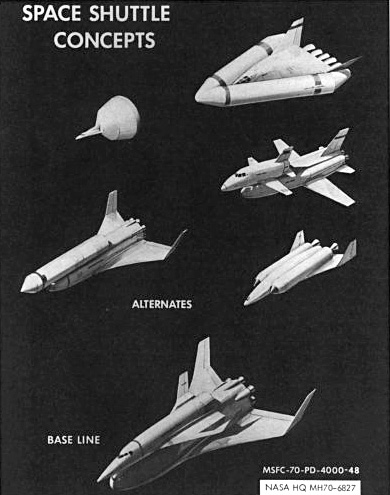
NASA envisioned a four-phase program of development for the STS. "Phase A" was a series of initial studies to select an overall technology path, and development contracts for proposals were released in 1968 with the proposals expected back in the fall of 1969. A number of designs were presented from a variety of industry partners. Almost universally, the designs were small, fully reusable, and based around delta wing or lifting body spaceplanes.
Chrysler Aerospace won contract NAS8-26341 for their entry into the Phase A series, forming a team under Charles Tharratt. Their 1969 report, NASA-CR-148948, outlined the SERV design, preliminary performance measures, and basic mission profiles. This report described a 23 foot (7.0 m) wide cargo bay Tharratt was convinced that SERV offered better flexibility than any of the winged platforms, allowing it to launch both crewed and uncrewed missions, and being much smaller overall.
Hub AI
Chrysler SERV AI simulator
(@Chrysler SERV_simulator)
Chrysler SERV
SERV, short for Single-stage Earth-orbital Reusable Vehicle, was a proposed space launch system designed by Chrysler's Space Division for the Space Shuttle project. SERV was radically different from the two-stage spaceplanes that almost every other competitor entered into the Shuttle development process and was never given serious consideration for the shuttle program.
SERV was to be a single-stage to orbit spacecraft that would take off from the existing Saturn V complexes and land vertically at Kennedy for re-use. SERV looked like a greatly expanded Apollo capsule, with an empty central core able to carry 125,000 lb (57,000 kg) of cargo. SERV could be launched uncrewed for cargo missions, ejecting a cargo capsule and returning to Earth. For crewed missions, a separate spaceplane, MURP (Manned Upper-stage Reusable Payload), could be carried atop the vehicle.
The name "SERV" was also used by an entirely unrelated NASA project, the "Space Emergency Re-entry Vehicle".
In 1966 the US Air Force started a study effort that explored a variety of crewed spacecraft and associated launchers. As the proposals were studied, they broke them down into one of three classes, based on the level of reusability. On the simpler end of the development scale were the "Class I" vehicles that placed a spaceplane on top of an existing or modified ICBM-based launcher. "Class II" vehicles added partial reusability for some of the launcher components, while the "Class III" vehicles were fully reusable. The USAF had already started work on a Class I design in their X-20 Dyna Soar program, which had been cancelled in December 1963, but were interested in the Lockheed Star Clipper Class II design as a possible future development. Nothing ever came of the study effort, as the USAF wound down their interest in crewed space programs.
At the time, NASA was in the midst of winding down the Project Apollo build-out, as the vehicles progressed to flight. Looking into the future, a number of NASA offices started programs to explore crewed missions in the 1970s and beyond. Among the many proposals, a permanently crewed space station was a favorite. These plans generally assumed the use of the existing Saturn rockets to launch the stations, and even the crews, but the Saturn systems were not set up for the sort of constant supply and crew turnaround being envisioned. The idea of a simple and inexpensive crewed launcher, a "ferry and logistics vehicle", developed out of the space station studies almost as an afterthought, the first mention of it being in the fiscal year 1967 budgets.
Design of a low cost, reusable Space Transportation System (STS) started in earnest in December 1967, when George Mueller organized a one-day brainstorming session on the topic. He jump-started the discussion by inviting the USAF to attend, even keeping the original USAF acronym for the project, "ILRV". Like the original USAF studies, a small vehicle was envisioned, carrying replacement crews and basic supplies, with an emphasis on low cost of operations and fast turnarounds. Unlike the USAF, however, NASA's Space Task Force quickly decided to move directly to the Class III designs.
NASA envisioned a four-phase program of development for the STS. "Phase A" was a series of initial studies to select an overall technology path, and development contracts for proposals were released in 1968 with the proposals expected back in the fall of 1969. A number of designs were presented from a variety of industry partners. Almost universally, the designs were small, fully reusable, and based around delta wing or lifting body spaceplanes.
Chrysler Aerospace won contract NAS8-26341 for their entry into the Phase A series, forming a team under Charles Tharratt. Their 1969 report, NASA-CR-148948, outlined the SERV design, preliminary performance measures, and basic mission profiles. This report described a 23 foot (7.0 m) wide cargo bay Tharratt was convinced that SERV offered better flexibility than any of the winged platforms, allowing it to launch both crewed and uncrewed missions, and being much smaller overall.