



Community hub
Recent from talks
Knowledge base stats:
Talk channels stats:
Members stats:
Space Shuttle design process
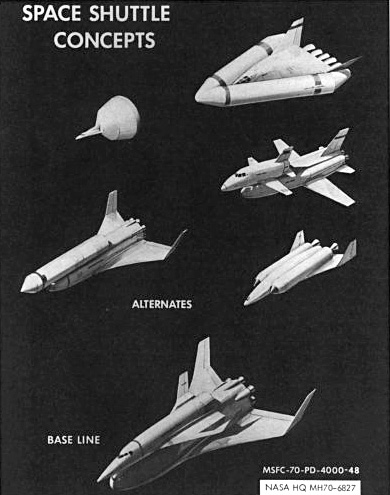
Before the Apollo 11 Moon landing in 1969, NASA began studies of Space Shuttle designs as early as October 1968. The early studies were denoted "Phase A", and in June 1970, "Phase B", which were more detailed and specific. The primary intended use of the Phase A Space Shuttle was supporting the future space station, ferrying a minimum crew of four and about 20,000 pounds (9,100 kg) of cargo, and being able to be rapidly turned around for future flights, with larger payloads like space station modules being lifted by the Saturn V.
Two designs emerged as front-runners. One was designed by engineers at the Manned Spaceflight Center, and championed especially by George Mueller. This was a two-stage system with delta-winged spacecraft, and generally complex. An attempt to re-simplify was made in the form of the DC-3, designed by Maxime Faget, who had designed the Mercury capsule among other vehicles. Numerous offerings from a variety of commercial companies were also considered but generally fell by the wayside as each NASA lab pushed for its own version.
All of this was taking place in the midst of other NASA teams proposing a wide variety of post-Apollo missions, a number of which would cost as much as Apollo or more.[citation needed] As each of these projects fought for funding, the NASA budget was at the same time being severely constrained. Three were eventually presented to United States Vice President Spiro Agnew in 1969. The shuttle project rose to the top, largely due to tireless campaigning by its supporters.[citation needed] By 1970 the shuttle had been selected as the one major project for the short-term post-Apollo time frame.
When funding for the program came into question, there were concerns that the project might be canceled. This became especially pressing as it became clear that the Saturn V would no longer be produced, which meant that the payload to orbit needed to be increased in both mass - all the way to 60,600 pounds (27,500 kg) - and size to supplement its heavy-lift capabilities, necessary for planned interplanetary probes and space station modules, which meant a bigger and costlier vehicle was needed during Phase B. Therefore, NASA tried to interest the US Air Force and a variety of other customers in using the shuttle for their missions as well. To lower the development costs of the proposed designs, boosters were added, a throw-away fuel tank was adopted, and many other changes were made that greatly lowered the reusability and greatly added to the vehicle and operational costs.
In 1969, United States Vice President Spiro Agnew chaired the National Aeronautics and Space Council, which discussed post-Apollo options for human space activities. The recommendations of the Council would heavily influence the decisions of the administration. The Council considered four major options:
Based on the advice of the Space Council, President Nixon made the decision to pursue the low Earth orbital infrastructure option. This program mainly consisted of the construction of a space station, along with the development of a Space Shuttle. Funding restrictions precluded pursuing the development of both programs simultaneously, however. NASA chose to develop the Space Shuttle program first, and then planned to use the shuttle in order to construct and service a space station.
During the early shuttle studies, there was a debate over the optimal shuttle design that best-balanced capability, development cost, and operational cost. Initially, a fully reusable design was preferred. This involved a very large winged crewed booster which would carry a smaller winged crewed orbiter. The booster vehicle would lift the orbiter to a certain altitude and speed, then separate. The booster would return and land horizontally, while the orbiter continued into low Earth orbit. After completing its mission, the winged orbiter would re-enter and land horizontally on a runway. The idea was that full reusability would promote lower operating costs.
However, further studies showed a huge booster was needed to lift an orbiter with the desired payload capability. In space and aviation systems, the cost is closely related to mass, so this meant the overall vehicle cost would be very high. Both booster and orbiter would have rocket engines plus jet engines for use within the atmosphere, plus separate fuel and control systems for each propulsion mode. In addition, there were concurrent discussions about how much funding would be available to develop the program.
Hub AI
Space Shuttle design process AI simulator
(@Space Shuttle design process_simulator)
Space Shuttle design process
Before the Apollo 11 Moon landing in 1969, NASA began studies of Space Shuttle designs as early as October 1968. The early studies were denoted "Phase A", and in June 1970, "Phase B", which were more detailed and specific. The primary intended use of the Phase A Space Shuttle was supporting the future space station, ferrying a minimum crew of four and about 20,000 pounds (9,100 kg) of cargo, and being able to be rapidly turned around for future flights, with larger payloads like space station modules being lifted by the Saturn V.
Two designs emerged as front-runners. One was designed by engineers at the Manned Spaceflight Center, and championed especially by George Mueller. This was a two-stage system with delta-winged spacecraft, and generally complex. An attempt to re-simplify was made in the form of the DC-3, designed by Maxime Faget, who had designed the Mercury capsule among other vehicles. Numerous offerings from a variety of commercial companies were also considered but generally fell by the wayside as each NASA lab pushed for its own version.
All of this was taking place in the midst of other NASA teams proposing a wide variety of post-Apollo missions, a number of which would cost as much as Apollo or more.[citation needed] As each of these projects fought for funding, the NASA budget was at the same time being severely constrained. Three were eventually presented to United States Vice President Spiro Agnew in 1969. The shuttle project rose to the top, largely due to tireless campaigning by its supporters.[citation needed] By 1970 the shuttle had been selected as the one major project for the short-term post-Apollo time frame.
When funding for the program came into question, there were concerns that the project might be canceled. This became especially pressing as it became clear that the Saturn V would no longer be produced, which meant that the payload to orbit needed to be increased in both mass - all the way to 60,600 pounds (27,500 kg) - and size to supplement its heavy-lift capabilities, necessary for planned interplanetary probes and space station modules, which meant a bigger and costlier vehicle was needed during Phase B. Therefore, NASA tried to interest the US Air Force and a variety of other customers in using the shuttle for their missions as well. To lower the development costs of the proposed designs, boosters were added, a throw-away fuel tank was adopted, and many other changes were made that greatly lowered the reusability and greatly added to the vehicle and operational costs.
In 1969, United States Vice President Spiro Agnew chaired the National Aeronautics and Space Council, which discussed post-Apollo options for human space activities. The recommendations of the Council would heavily influence the decisions of the administration. The Council considered four major options:
Based on the advice of the Space Council, President Nixon made the decision to pursue the low Earth orbital infrastructure option. This program mainly consisted of the construction of a space station, along with the development of a Space Shuttle. Funding restrictions precluded pursuing the development of both programs simultaneously, however. NASA chose to develop the Space Shuttle program first, and then planned to use the shuttle in order to construct and service a space station.
During the early shuttle studies, there was a debate over the optimal shuttle design that best-balanced capability, development cost, and operational cost. Initially, a fully reusable design was preferred. This involved a very large winged crewed booster which would carry a smaller winged crewed orbiter. The booster vehicle would lift the orbiter to a certain altitude and speed, then separate. The booster would return and land horizontally, while the orbiter continued into low Earth orbit. After completing its mission, the winged orbiter would re-enter and land horizontally on a runway. The idea was that full reusability would promote lower operating costs.
However, further studies showed a huge booster was needed to lift an orbiter with the desired payload capability. In space and aviation systems, the cost is closely related to mass, so this meant the overall vehicle cost would be very high. Both booster and orbiter would have rocket engines plus jet engines for use within the atmosphere, plus separate fuel and control systems for each propulsion mode. In addition, there were concurrent discussions about how much funding would be available to develop the program.