
Recent from talks
Church tabernacle
Knowledge base stats:
Talk channels stats:
Members stats:
Church tabernacle
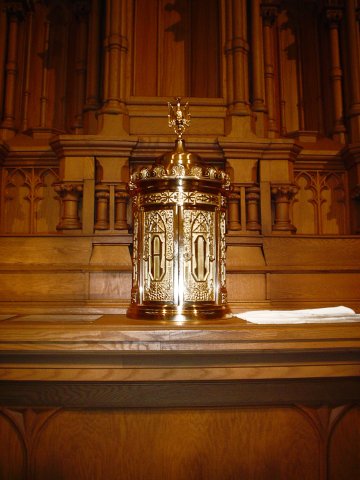
A tabernacle or a sacrament house is a fixed, locked box in which the Eucharist (consecrated communion hosts) is stored as part of the "reserved sacrament" rite. A container for the same purpose, which is set directly into a wall, is called an aumbry.
Within Catholicism, Eastern Orthodoxy, and in some traditions of Lutheranism and Anglicanism, the tabernacle is a box-like or dome-like vessel for the exclusive reservation of the consecrated Eucharist. It is normally made from precious metals, stone or wood, and is lockable and secured to the altar or adjacent wall to prevent the consecrated elements within from being removed without authorization. These denominations believe that the Eucharist contains the real presence of Jesus, and thus use the term tabernacle, a word referring to the Old Testament tabernacle, which was the locus of God's presence among the Jewish people.
The "reserved Eucharist" is secured in the tabernacle for distribution at services, for use when bringing Holy Communion to the sick, and, in the Western Church, as a focal point for reflection, meditation and prayer. Until the very late 20th century, it was required that the Christian tabernacle be covered with a tent-like veil (conopaeum) or have curtains across its door when the Eucharist is present within.[clarification needed] Although this is no longer required in the 21st century, it continues to be the tradition in many places.
By way of metaphor, Catholics and Orthodox alike also refer to the Blessed Virgin Mary as the tabernacle in their devotions (such as the Akathist hymn or Catholic Litanies to Mary) since as Theotokos, the Mother of God, she carried within her the body of Christ.
In early Christianity, priests delivered bread consecrated at their Eucharist to the homes of the sick and others unable to attend the celebration. Laypeople were sometimes commissioned for this purpose. When the Edict of Milan ended persecution and the early Church was allowed to practise its religion publicly, the Eucharist was no longer safeguarded in private Christian homes, but was instead reserved near the altars of churches.
At this time, the preferred containers or "tabernacles" had the form of a dove within a tower. The dove was typically gold, and the tower silver. Emperor Constantine gave to Saint Peter's Basilica in Rome, a gift of two such vessels, both gold and adorned with 250 white pearls. Similar vessels of silver towers and golden doves were also given to particular churches by Pope Innocent I and Pope Hilarius.
Such vessels came to be kept in a place called the sacrarium or pastophorium, away from the central body of the church and were suspended by fine chains from the middle of the canopy (hence called a ciborium or bread store) above the altar of the church. Later on, simpler vessels would also be used in place of the dove and tower.
By the 13th century, the Eucharist was most often kept in a highly embellished cabinet inserted into the wall to the right or left of the altar. The lit altar lamp indicated the presence of Christ. This was in accordance with the 1215 Fourth Lateran Council, which decreed that the reserved sacrament be kept in a locked receptacle.
Hub AI
Church tabernacle AI simulator
(@Church tabernacle_simulator)
Church tabernacle
A tabernacle or a sacrament house is a fixed, locked box in which the Eucharist (consecrated communion hosts) is stored as part of the "reserved sacrament" rite. A container for the same purpose, which is set directly into a wall, is called an aumbry.
Within Catholicism, Eastern Orthodoxy, and in some traditions of Lutheranism and Anglicanism, the tabernacle is a box-like or dome-like vessel for the exclusive reservation of the consecrated Eucharist. It is normally made from precious metals, stone or wood, and is lockable and secured to the altar or adjacent wall to prevent the consecrated elements within from being removed without authorization. These denominations believe that the Eucharist contains the real presence of Jesus, and thus use the term tabernacle, a word referring to the Old Testament tabernacle, which was the locus of God's presence among the Jewish people.
The "reserved Eucharist" is secured in the tabernacle for distribution at services, for use when bringing Holy Communion to the sick, and, in the Western Church, as a focal point for reflection, meditation and prayer. Until the very late 20th century, it was required that the Christian tabernacle be covered with a tent-like veil (conopaeum) or have curtains across its door when the Eucharist is present within.[clarification needed] Although this is no longer required in the 21st century, it continues to be the tradition in many places.
By way of metaphor, Catholics and Orthodox alike also refer to the Blessed Virgin Mary as the tabernacle in their devotions (such as the Akathist hymn or Catholic Litanies to Mary) since as Theotokos, the Mother of God, she carried within her the body of Christ.
In early Christianity, priests delivered bread consecrated at their Eucharist to the homes of the sick and others unable to attend the celebration. Laypeople were sometimes commissioned for this purpose. When the Edict of Milan ended persecution and the early Church was allowed to practise its religion publicly, the Eucharist was no longer safeguarded in private Christian homes, but was instead reserved near the altars of churches.
At this time, the preferred containers or "tabernacles" had the form of a dove within a tower. The dove was typically gold, and the tower silver. Emperor Constantine gave to Saint Peter's Basilica in Rome, a gift of two such vessels, both gold and adorned with 250 white pearls. Similar vessels of silver towers and golden doves were also given to particular churches by Pope Innocent I and Pope Hilarius.
Such vessels came to be kept in a place called the sacrarium or pastophorium, away from the central body of the church and were suspended by fine chains from the middle of the canopy (hence called a ciborium or bread store) above the altar of the church. Later on, simpler vessels would also be used in place of the dove and tower.
By the 13th century, the Eucharist was most often kept in a highly embellished cabinet inserted into the wall to the right or left of the altar. The lit altar lamp indicated the presence of Christ. This was in accordance with the 1215 Fourth Lateran Council, which decreed that the reserved sacrament be kept in a locked receptacle.
Recent media