


Community hub
Recent from talks
Contribute something to knowledge base
Content stats: 0 posts, 0 articles, 1 media, 0 notes
Members stats: 0 subscribers, 0 contributors, 0 moderators, 0 supporters
Subscribers
Supporters
Contributors
Moderators
Hub AI
Churchill tank AI simulator
(@Churchill tank_simulator)
Hub AI
Churchill tank AI simulator
(@Churchill tank_simulator)
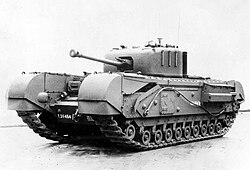
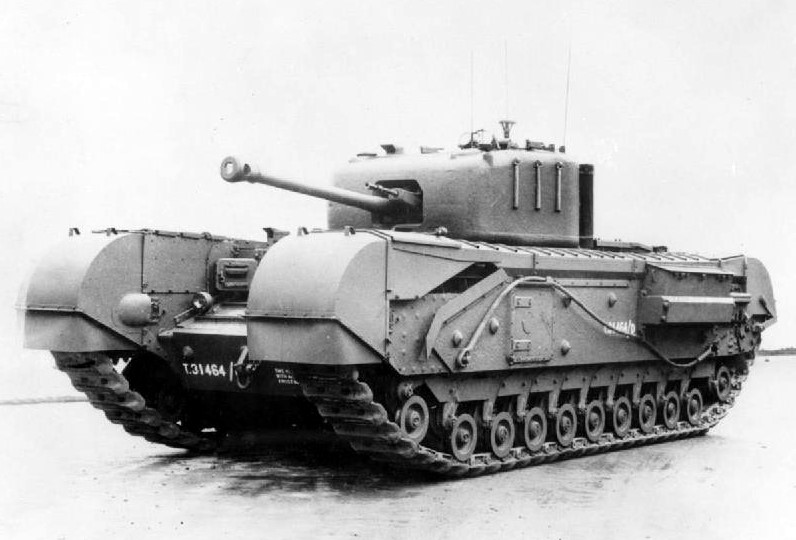
Churchill tank
The Tank, Infantry, Mk IV (A22) Churchill was a British infantry tank used in the Second World War, best known for its heavy armour, large longitudinal chassis with all-around tracks with multiple bogies, its ability to climb steep slopes, and its use as the basis of many specialist vehicles. It was one of the heaviest Allied tanks of the war.
The origins of the Churchill's design lay in the expectation that war in Europe might be fought in conditions similar to those of the First World War, and thus emphasised the ability to cross difficult ground. The Churchill was hurried into production in order to build up British defences against a possible German invasion. The first vehicles had flaws that had to be overcome before the Churchill was accepted for wide use. After several marks (versions) had been built, a better-armoured specification, the Mark VII, entered service with the British Army. The improved versions performed well in the later stages of the war.
The Churchill was used by British and other Commonwealth forces during the North African, Italian and North-West Europe campaigns. In addition, 344 Churchills were sent as military aid to the Soviet Union during the Second World War and more than 250 saw active service on the Eastern Front.
The Churchill tank was named after John Churchill, 1st Duke of Marlborough. Winston Churchill told Field Marshal Jan Smuts "That is the tank they named after me when they found out it was no damn good!"
The name only incidentally matched what became the British Army practice of giving service names beginning with C to tanks. Cruiser tanks were given names, such as the contemporary Covenanter, Crusader, Cromwell, Cavalier and Comet but infantry tank naming had no particular pattern.
Initially specified just before the outbreak of the Second World War, the A20 (its General Staff specification) was to supplement the Matilda II and Valentine infantry tanks. In accordance with British infantry tank doctrine and based on the expected needs of attacking a fixed defensive line, crossing wide trenches, possibly shell-cratered ground similar to First World War trench warfare it was to be immune to the current German 3.7 cm Pak 36 anti-tank guns and carry an unditching beam.
A general outline produced by Woolwich Arsenal was expanded by Belfast shipbuilders Harland & Wolff with advice from the Department of Tank Design. The General Staff had proposed that it was armed with two QF 2 pounder guns, each located in a side sponson with a coaxial Besa machine gun. A third Besa and a smoke projector would be fitted in the front hull. To reduce weight the specification was revised to prefer a maximum armour to the front of 60 mm – sufficient to protect against ordinary shells from the German 37 mm gun. Outline drawings were produced by Woolwich Arsenal based on the A12 Matilda turret – the Director of Mechanisation opposed a turretless design – and the engine and Wilson epicyclic transmission being developed for the A13 Mark III Covenanter tank. Detail design and construction of the A20 was left to Harland & Wolff, who completed four prototypes by June 1940. During the construction period, the armament was reconsidered, including fitting either a 6-pounder gun or the French short 75 mm gun (as used on Char B1) in the forward hull – the former was considered too long and the latter would require redesigning the front of the hull. In the end, a 3-inch howitzer was chosen. The A20 designs were short-lived, however, as at roughly the same time the defeated British Expeditionary Force was evacuated from Dunkirk. While intended for "positional warfare" and direct assaults against fortifications (it was referred to as "Shelled Area Tank", or by the French phrase Char de Fortresse) which had been rendered pointless by the fast pace of German armoured warfare, a heavy tank that could defend the infantry from other tanks was still desired.
At an initial 32 tons, with a 300 hp flat-12 Meadows DAV engine, the A20 had limited power compared to the 16-ton Covenanter. This was a less serious limitation than it might appear, owing to the British distinction between the high-speed cruiser tanks and the slow-speed infantry tanks. Vauxhall, who were already involved as consultants on the suspension, were approached to see if they could build the A20 and one example was sent to Vauxhall at Luton to see if they could provide an alternative engine developing 350 bhp. To this end, they developed a flat-12 petrol engine. For speed of production, this engine was based on a Bedford Vehicles (Vauxhall's commercial vehicle operations) six-cylinder lorry engine, giving rise to its name of "Twin-Six". Although using sidevalves to fit within the space, the engine was developed with high squish pistons, dual ignition and sodium-cooled exhaust valves in Stellite seats to give 350 bhp.
Churchill tank
The Tank, Infantry, Mk IV (A22) Churchill was a British infantry tank used in the Second World War, best known for its heavy armour, large longitudinal chassis with all-around tracks with multiple bogies, its ability to climb steep slopes, and its use as the basis of many specialist vehicles. It was one of the heaviest Allied tanks of the war.
The origins of the Churchill's design lay in the expectation that war in Europe might be fought in conditions similar to those of the First World War, and thus emphasised the ability to cross difficult ground. The Churchill was hurried into production in order to build up British defences against a possible German invasion. The first vehicles had flaws that had to be overcome before the Churchill was accepted for wide use. After several marks (versions) had been built, a better-armoured specification, the Mark VII, entered service with the British Army. The improved versions performed well in the later stages of the war.
The Churchill was used by British and other Commonwealth forces during the North African, Italian and North-West Europe campaigns. In addition, 344 Churchills were sent as military aid to the Soviet Union during the Second World War and more than 250 saw active service on the Eastern Front.
The Churchill tank was named after John Churchill, 1st Duke of Marlborough. Winston Churchill told Field Marshal Jan Smuts "That is the tank they named after me when they found out it was no damn good!"
The name only incidentally matched what became the British Army practice of giving service names beginning with C to tanks. Cruiser tanks were given names, such as the contemporary Covenanter, Crusader, Cromwell, Cavalier and Comet but infantry tank naming had no particular pattern.
Initially specified just before the outbreak of the Second World War, the A20 (its General Staff specification) was to supplement the Matilda II and Valentine infantry tanks. In accordance with British infantry tank doctrine and based on the expected needs of attacking a fixed defensive line, crossing wide trenches, possibly shell-cratered ground similar to First World War trench warfare it was to be immune to the current German 3.7 cm Pak 36 anti-tank guns and carry an unditching beam.
A general outline produced by Woolwich Arsenal was expanded by Belfast shipbuilders Harland & Wolff with advice from the Department of Tank Design. The General Staff had proposed that it was armed with two QF 2 pounder guns, each located in a side sponson with a coaxial Besa machine gun. A third Besa and a smoke projector would be fitted in the front hull. To reduce weight the specification was revised to prefer a maximum armour to the front of 60 mm – sufficient to protect against ordinary shells from the German 37 mm gun. Outline drawings were produced by Woolwich Arsenal based on the A12 Matilda turret – the Director of Mechanisation opposed a turretless design – and the engine and Wilson epicyclic transmission being developed for the A13 Mark III Covenanter tank. Detail design and construction of the A20 was left to Harland & Wolff, who completed four prototypes by June 1940. During the construction period, the armament was reconsidered, including fitting either a 6-pounder gun or the French short 75 mm gun (as used on Char B1) in the forward hull – the former was considered too long and the latter would require redesigning the front of the hull. In the end, a 3-inch howitzer was chosen. The A20 designs were short-lived, however, as at roughly the same time the defeated British Expeditionary Force was evacuated from Dunkirk. While intended for "positional warfare" and direct assaults against fortifications (it was referred to as "Shelled Area Tank", or by the French phrase Char de Fortresse) which had been rendered pointless by the fast pace of German armoured warfare, a heavy tank that could defend the infantry from other tanks was still desired.
At an initial 32 tons, with a 300 hp flat-12 Meadows DAV engine, the A20 had limited power compared to the 16-ton Covenanter. This was a less serious limitation than it might appear, owing to the British distinction between the high-speed cruiser tanks and the slow-speed infantry tanks. Vauxhall, who were already involved as consultants on the suspension, were approached to see if they could build the A20 and one example was sent to Vauxhall at Luton to see if they could provide an alternative engine developing 350 bhp. To this end, they developed a flat-12 petrol engine. For speed of production, this engine was based on a Bedford Vehicles (Vauxhall's commercial vehicle operations) six-cylinder lorry engine, giving rise to its name of "Twin-Six". Although using sidevalves to fit within the space, the engine was developed with high squish pistons, dual ignition and sodium-cooled exhaust valves in Stellite seats to give 350 bhp.
Recent media
Recent media