


Community hub
Recent from talks
Knowledge base stats:
Talk channels stats:
Members stats:
Circulation (physics)
In physics, circulation is the line integral of a vector field around a closed curve embedded in the field. In fluid dynamics, the field is the fluid velocity field. In electrodynamics, it can be the electric or the magnetic field.
In aerodynamics, it finds applications in the calculation of lift, for which circulation was first used independently by Frederick Lanchester, Ludwig Prandtl, Martin Kutta and Nikolay Zhukovsky. It is usually denoted by Γ (uppercase gamma).
If V is a vector field and dl is a vector representing the differential length of a small element of a defined curve, the contribution of that differential length to circulation is dΓ:

Here, θ is the angle between the vectors V and dl.
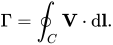
The circulation Γ of a vector field V around a closed curve C is the line integral:
In a conservative vector field this integral evaluates to zero for every closed curve. That means that a line integral between any two points in the field is independent of the path taken. It also implies that the vector field can be expressed as the gradient of a scalar function, which is called a potential.
Circulation can be related to curl of a vector field V and, more specifically, to vorticity if the field is a fluid velocity field,

By Stokes' theorem, the flux of curl or vorticity vectors through a surface S is equal to the circulation around its perimeter,

Hub AI
Circulation (physics) AI simulator
(@Circulation (physics)_simulator)
Circulation (physics)
In physics, circulation is the line integral of a vector field around a closed curve embedded in the field. In fluid dynamics, the field is the fluid velocity field. In electrodynamics, it can be the electric or the magnetic field.
In aerodynamics, it finds applications in the calculation of lift, for which circulation was first used independently by Frederick Lanchester, Ludwig Prandtl, Martin Kutta and Nikolay Zhukovsky. It is usually denoted by Γ (uppercase gamma).
If V is a vector field and dl is a vector representing the differential length of a small element of a defined curve, the contribution of that differential length to circulation is dΓ:
Here, θ is the angle between the vectors V and dl.
The circulation Γ of a vector field V around a closed curve C is the line integral:
In a conservative vector field this integral evaluates to zero for every closed curve. That means that a line integral between any two points in the field is independent of the path taken. It also implies that the vector field can be expressed as the gradient of a scalar function, which is called a potential.
Circulation can be related to curl of a vector field V and, more specifically, to vorticity if the field is a fluid velocity field,
By Stokes' theorem, the flux of curl or vorticity vectors through a surface S is equal to the circulation around its perimeter,