Hubbry Logo
Scalar potentialScalar potentialMain
Open search
Scalar potential
Community hub
Scalar potential
logo
8 pages, 0 posts
0 subscribers
Be the first to start a discussion here.
Contribute something
Scalar potential
Scalar potential
from Wikipedia

In mathematical physics, scalar potential describes the situation where the difference in the potential energies of an object in two different positions depends only on the positions, not upon the path taken by the object in traveling from one position to the other. It is a scalar field in three-space: a directionless value (scalar) that depends only on its location. A familiar example is potential energy due to gravity.

Vector field (right) and corresponding scalar potential (left).

A scalar potential is a fundamental concept in vector analysis and physics (the adjective scalar is frequently omitted if there is no danger of confusion with vector potential). The scalar potential is an example of a scalar field. Given a vector field F, the scalar potential P is defined such that: [1]

where P is the gradient of P and the second part of the equation is minus the gradient for a function of the Cartesian coordinates x, y, z.[a] In some cases, mathematicians may use a positive sign in front of the gradient to define the potential.[2] Because of this definition of P in terms of the gradient, the direction of F at any point is the direction of the steepest decrease of P at that point, its magnitude is the rate of that decrease per unit length.

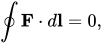
In order for F to be described in terms of a scalar potential only, any of the following equivalent statements have to be true:

  1. where the integration is over a Jordan arc passing from location a to location b and P(b) is P evaluated at location b.
  2. where the integral is over any simple closed path, otherwise known as a Jordan curve.
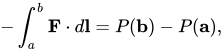
The first of these conditions represents the fundamental theorem of the gradient and is true for any vector field that is a gradient of a differentiable single valued scalar field P. The second condition is a requirement of F so that it can be expressed as the gradient of a scalar function. The third condition re-expresses the second condition in terms of the curl of F using the fundamental theorem of the curl. A vector field F that satisfies these conditions is said to be irrotational (conservative).

Gravitational potential well of an increasing mass where F = –∇P

Scalar potentials play a prominent role in many areas of physics and engineering. The gravity potential is the scalar potential associated with the force of gravity per unit mass, or equivalently, the acceleration due to the field, as a function of position. The gravity potential is the gravitational potential energy per unit mass. In electrostatics the electric potential is the scalar potential associated with the electric field, i.e., with the electrostatic force per unit charge. The electric potential is in this case the electrostatic potential energy per unit charge. In fluid dynamics, irrotational lamellar fields have a scalar potential only in the special case when it is a Laplacian field. Certain aspects of the nuclear force can be described by a Yukawa potential. The potential play a prominent role in the Lagrangian and Hamiltonian formulations of classical mechanics. Further, the scalar potential is the fundamental quantity in quantum mechanics.

Not every vector field has a scalar potential. Those that do are called conservative, corresponding to the notion of conservative force in physics. Examples of non-conservative forces include frictional forces, magnetic forces, and in fluid mechanics a solenoidal field velocity field. By the Helmholtz decomposition theorem however, all vector fields can be describable in terms of a scalar potential and corresponding vector potential. In electrodynamics, the electromagnetic scalar and vector potentials are known together as the electromagnetic four-potential.

Integrability conditions

[edit]

If F is a conservative vector field (also called irrotational, curl-free, or potential), and its components have continuous partial derivatives, the potential of F with respect to a reference point r0 is defined in terms of the line integral:

where C is a parametrized path from r0 to r,

The fact that the line integral depends on the path C only through its terminal points r0 and r is, in essence, the path independence property of a conservative vector field. The fundamental theorem of line integrals implies that if V is defined in this way, then F = –∇V, so that V is a scalar potential of the conservative vector field F. Scalar potential is not determined by the vector field alone: indeed, the gradient of a function is unaffected if a constant is added to it. If V is defined in terms of the line integral, the ambiguity of V reflects the freedom in the choice of the reference point r0.

Altitude as gravitational potential energy

[edit]
uniform gravitational field near the Earth's surface
Plot of a two-dimensional slice of the gravitational potential in and around a uniform spherical body. The inflection points of the cross-section are at the surface of the body.

An example is the (nearly) uniform gravitational field near the Earth's surface. It has a potential energy where U is the gravitational potential energy and h is the height above the surface. This means that gravitational potential energy on a contour map is proportional to altitude. On a contour map, the two-dimensional negative gradient of the altitude is a two-dimensional vector field, whose vectors are always perpendicular to the contours and also perpendicular to the direction of gravity. But on the hilly region represented by the contour map, the three-dimensional negative gradient of U always points straight downwards in the direction of gravity; F. However, a ball rolling down a hill cannot move directly downwards due to the normal force of the hill's surface, which cancels out the component of gravity perpendicular to the hill's surface. The component of gravity that remains to move the ball is parallel to the surface:


where θ is the angle of inclination, and the component of FS perpendicular to gravity is

This force FP, parallel to the ground, is greatest when θ is 45 degrees.

Let Δh be the uniform interval of altitude between contours on the contour map, and let Δx be the distance between two contours. Then
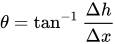
so that
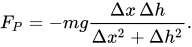
However, on a contour map, the gradient is inversely proportional to Δx, which is not similar to force FP: altitude on a contour map is not exactly a two-dimensional potential field. The magnitudes of forces are different, but the directions of the forces are the same on a contour map as well as on the hilly region of the Earth's surface represented by the contour map.

Pressure as buoyant potential

[edit]

In fluid mechanics, a fluid in equilibrium, but in the presence of a uniform gravitational field is permeated by a uniform buoyant force that cancels out the gravitational force: that is how the fluid maintains its equilibrium. This buoyant force is the negative gradient of pressure:

Since buoyant force points upwards, in the direction opposite to gravity, then pressure in the fluid increases downwards. Pressure in a static body of water increases proportionally to the depth below the surface of the water. The surfaces of constant pressure are planes parallel to the surface, which can be characterized as the plane of zero pressure.

If the liquid has a vertical vortex (whose axis of rotation is perpendicular to the surface), then the vortex causes a depression in the pressure field. The surface of the liquid inside the vortex is pulled downwards as are any surfaces of equal pressure, which still remain parallel to the liquids surface. The effect is strongest inside the vortex and decreases rapidly with the distance from the vortex axis.

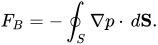
The buoyant force due to a fluid on a solid object immersed and surrounded by that fluid can be obtained by integrating the negative pressure gradient along the surface of the object:
Scalar potential in Euclidean space

[edit]

In 3-dimensional Euclidean space , the scalar potential of an irrotational vector field E is given by

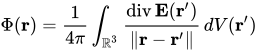
where dV(r') is an infinitesimal volume element with respect to r'. Then

This holds provided E is continuous and vanishes asymptotically to zero towards infinity, decaying faster than 1/r and if the divergence of E likewise vanishes towards infinity, decaying faster than 1/r 2.

Written another way, let
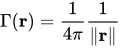
be the Newtonian potential. This is the fundamental solution of the Laplace equation, meaning that the Laplacian of Γ is equal to the negative of the Dirac delta function:

Then the scalar potential is the divergence of the convolution of E with Γ:

Indeed, convolution of an irrotational vector field with a rotationally invariant potential is also irrotational. For an irrotational vector field G, it can be shown that

Hence

as required.

More generally, the formula

holds in n-dimensional Euclidean space (n > 2) with the Newtonian potential given then by
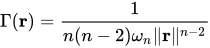
where ωn is the volume of the unit n-ball. The proof is identical. Alternatively, integration by parts (or, more rigorously, the properties of convolution) gives

See also

[edit]

Notes

[edit]

References

[edit]
[edit]
Revisions and contributorsEdit on WikipediaRead on Wikipedia
from Grokipedia
In physics, the scalar potential is a scalar field whose negative gradient yields a conservative vector field, such as the force per unit "charge" or mass in electrostatics or gravitation. This function simplifies the description of fields that derive from a single underlying potential, enabling path-independent calculations of work or energy changes. In electrostatics, the electric scalar potential ϕ(r)\phi(\mathbf{r}) is defined for a charge distribution ρ(r)\rho(\mathbf{r}') as ϕ(r)=14πϵ0ρ(r)rrdV\phi(\mathbf{r}) = \frac{1}{4\pi\epsilon_0} \int \frac{\rho(\mathbf{r}')}{|\mathbf{r} - \mathbf{r}'|} dV', where ϵ0\epsilon_0 is the permittivity of free space, and the electric field follows as E=ϕ\mathbf{E} = -\nabla \phi. This potential is a scalar quantity measured in volts, representing energy per unit charge, and it satisfies Poisson's equation 2ϕ=ρ/ϵ0\nabla^2 \phi = -\rho / \epsilon_0. For gravitation, the scalar potential Φ(r)\Phi(\mathbf{r}) analogously describes the field g=Φ\mathbf{g} = -\nabla \Phi, with Φ(r)=Gρm(r)rrdV\Phi(\mathbf{r}) = -G \int \frac{\rho_m(\mathbf{r}')}{|\mathbf{r} - \mathbf{r}'|} dV' for a mass density ρm\rho_m, where GG is the gravitational constant. In full electrodynamics, the scalar potential ϕ(r,t)\phi(\mathbf{r}, t) pairs with the A(r,t)\mathbf{A}(\mathbf{r}, t) to express time-dependent fields via E=ϕAt\mathbf{E} = -\nabla \phi - \frac{\partial \mathbf{A}}{\partial t} and B=×A\mathbf{B} = \nabla \times \mathbf{A}, satisfying the A+1c2ϕt=0\nabla \cdot \mathbf{A} + \frac{1}{c^2} \frac{\partial \phi}{\partial t} = 0 (with cc the ). These potentials obey wave equations derived from , 2ϕ1c22ϕt2=ρϵ0\nabla^2 \phi - \frac{1}{c^2} \frac{\partial^2 \phi}{\partial t^2} = -\frac{\rho}{\epsilon_0}, facilitating solutions in , magnetostatics, and relativistic contexts. The scalar potential's gauge freedom—allowing transformations ϕ=ϕχt\phi' = \phi - \frac{\partial \chi}{\partial t} and A=A+χ\mathbf{A}' = \mathbf{A} + \nabla \chi for arbitrary χ\chi—preserves physical observables while aiding computational flexibility.

Fundamentals

Definition and Properties

In physics, the scalar potential is defined as a scalar-valued function ϕ\phi such that a conservative vector field F\mathbf{F} can be expressed as the negative gradient of ϕ\phi, i.e., F=ϕ\mathbf{F} = -\nabla \phi. This convention is commonly used for force fields or fields like the electric field, where the negative sign ensures that the force points toward decreasing potential; alternatively, some mathematical contexts use F=ϕ\mathbf{F} = \nabla \phi without the negative sign. A necessary condition for the existence of such a potential is that the curl of the vector field vanishes, ×F=0\nabla \times \mathbf{F} = 0, which guarantees the field is irrotational and conservative. Key properties of the scalar potential include its up to an arbitrary additive constant, meaning that if ϕ\phi is a potential, then so is ϕ+C\phi + C for any constant CC, since the eliminates constants. The line integral of F\mathbf{F} along any path from point AA to point BB is path-independent and equals the difference in potential values, ABFdr=ϕ(A)ϕ(B)\int_A^B \mathbf{F} \cdot d\mathbf{r} = \phi(A) - \phi(B), reflecting the in the underlying physical system. Additionally, equipotential surfaces—where ϕ\phi is constant—are perpendicular to the field lines of F\mathbf{F}, as the ϕ\nabla \phi is normal to these surfaces and parallel (or antiparallel) to F\mathbf{F}. The concept of scalar potential was introduced in the late for gravitational fields by in 1777 and further developed in the for and conservative systems by figures such as George Green, who in 1828 formalized its use and attached the term "potential" to it.

Conservative Vector Fields

A conservative vector field F\mathbf{F} is one for which there exists a scalar function ϕ\phi, called the scalar potential, such that F=ϕ\mathbf{F} = \nabla \phi (or F=ϕ\mathbf{F} = -\nabla \phi in certain conventions, such as physics). This definition ensures that the work done by F\mathbf{F} along any path between two points is independent of the path chosen, depending solely on the initial and final positions, as the line integral CFdr=ϕ(b)ϕ(a)\int_C \mathbf{F} \cdot d\mathbf{r} = \phi(\mathbf{b}) - \phi(\mathbf{a}). Such fields are characterized in by the condition that ×F=0\nabla \times \mathbf{F} = \mathbf{0} in simply connected domains, where every closed curve can be contracted to a point without leaving the domain. This curl-free property is equivalent to the Fdr\mathbf{F} \cdot d\mathbf{r} being exact, meaning it is the total differential dϕd\phi of some scalar potential ϕ\phi, allowing the fundamental theorem of line integrals to apply directly. The extends this idea, stating that any sufficiently smooth F\mathbf{F} in R3\mathbb{R}^3 (with appropriate boundary conditions, such as vanishing at ) can be uniquely expressed as F=ϕ+×A\mathbf{F} = \nabla \phi + \nabla \times \mathbf{A}, where ϕ\nabla \phi is the irrotational (conservative) component and ×A\nabla \times \mathbf{A} is the solenoidal (divergence-free) component. This decomposition underscores that every has a conservative part derivable from a scalar potential, isolated via the curl-free condition. For example, the 2D field F(x,y)=(y,x)\mathbf{F}(x,y) = (-y, x) is non-conservative, as its curl is xx(y)y=1(1)=20\frac{\partial x}{\partial x} - \frac{\partial (-y)}{\partial y} = 1 - (-1) = 2 \neq \mathbf{0}, and the line integral around the unit circle yields 2π2\pi, confirming path dependence. In contrast, F(x,y)=(yx2+y2,xx2+y2)\mathbf{F}(x,y) = \left( -\frac{y}{x^2 + y^2}, \frac{x}{x^2 + y^2} \right) for (x,y)(0,0)(x,y) \neq (0,0) has curl 0\mathbf{0} but is conservative only in simply connected domains that do not enclose the origin (e.g., the plane minus a ray from the origin), where it arises as the gradient of a single-valued branch of the polar angle θ=arctan(y/x)\theta = \arctan(y/x).

Mathematical Conditions

Integrability Conditions

A vector field F\mathbf{F} defined on an open domain DR3D \subseteq \mathbb{R}^3 admits a scalar potential ϕ\phi such that F=ϕ\mathbf{F} = \nabla \phi only if F\mathbf{F} is irrotational, meaning ×F=0\nabla \times \mathbf{F} = \mathbf{0} everywhere in DD. This necessary condition follows directly from the vector identity ×(ϕ)=0\nabla \times (\nabla \phi) = \mathbf{0}, which holds for any sufficiently smooth scalar function ϕ\phi. In a simply connected domain DD—one where every closed curve can be continuously contracted to a point within DD—the condition ×F=0\nabla \times \mathbf{F} = \mathbf{0} is also sufficient for the existence of such a ϕ\phi. To see this, consider the CFdr\int_C \mathbf{F} \cdot d\mathbf{r} over any closed CC in DD. By , this equals S(×F)dS\iint_S (\nabla \times \mathbf{F}) \cdot d\mathbf{S} for a surface SS bounded by CC, which vanishes since ×F=0\nabla \times \mathbf{F} = \mathbf{0}. Thus, the line integral is path-independent, implying F\mathbf{F} is conservative and hence the gradient of a scalar potential. Given path independence, the scalar potential can be constructed explicitly as ϕ(x)=axFdr,\phi(\mathbf{x}) = \int_{\mathbf{a}}^{\mathbf{x}} \mathbf{F} \cdot d\mathbf{r}, where a\mathbf{a} is a fixed point in DD and the is along any path from a\mathbf{a} to x\mathbf{x}; the result is independent of the path chosen. Adding an arbitrary constant to ϕ\phi yields equivalent potentials, as gradients are unaffected by constants. However, in multiply connected domains—those containing "holes" or non-contractible loops—×F=0\nabla \times \mathbf{F} = \mathbf{0} remains necessary but insufficient for the existence of a single-valued scalar potential. Additional conditions require that the circulation CFdr=0\oint_C \mathbf{F} \cdot d\mathbf{r} = 0 for every closed curve CC generating the first homology group of the domain, ensuring path independence across all cycles. Failure of these conditions, as in the field F(x,y)=(y/(x2+y2),x/(x2+y2))\mathbf{F}(x,y) = (-y/(x^2 + y^2), x/(x^2 + y^2)) on the punctured plane, results in non-zero circulation around the origin despite zero curl elsewhere.

Uniqueness and Multi-Valued Potentials

In simply connected domains where a exists, the scalar potential ϕ\phi is unique an additive constant, meaning that if F=ϕ\mathbf{F} = -\nabla \phi and F=ψ\mathbf{F} = -\nabla \psi, then ϕψ=C\phi - \psi = C for some CRC \in \mathbb{R}. Fixing the value of ϕ\phi at a single reference point in the domain uniquely determines the potential everywhere, as the from that point to any other location yields the difference in potential values. In non-simply connected domains, such as those encircling a line singularity, the scalar potential may become multi-valued, requiring branch cuts to define it consistently along different paths. This arises when the line integral of the vector field around a non-contractible closed loop is nonzero, leading to a discontinuity or jump in ϕ\phi across the branch cut. For instance, in the magnetic scalar potential formulation for the field around an infinite straight current-carrying wire, where H=ϕ\mathbf{H} = -\nabla \phi in current-free regions, the potential takes the form ϕ=I2πθ\phi = -\frac{I}{2\pi} \theta in cylindrical coordinates, with θ\theta the azimuthal angle; encircling the wire increments ϕ\phi by II amperes. This multi-valued nature finds an analogy in the Aharonov-Bohm effect, where the electromagnetic phase shift for a encircling a mimics a multi-valued scalar potential due to the topological enclosure of , even in regions where fields vanish. In practical computations, normalization involves selecting a reference point or gauge—such as setting ϕ=0\phi = 0 on one side of the branch cut—to render the potential single-valued within the computational domain, often by introducing artificial cuts or using reduced scalar potentials that account for known multi-valued components.

Physical Applications

Gravitational Potential

In Newtonian , the scalar potential describes the as a conservative force field, where the g\mathbf{g} is the negative of the potential ϕ\phi, i.e., g=ϕ\mathbf{g} = -\nabla \phi. This formulation allows the work done by along any path to be path-independent, aligning with the general properties of scalar potentials for conservative fields. For a point mass MM, the gravitational potential at a distance rr from the is given by ϕ(r)=GMr\phi(r) = -\frac{GM}{r}, where GG is the . The corresponding gravitational force F\mathbf{F} on a test mm is then F=mϕ\mathbf{F} = -m \nabla \phi. The gravitational potential energy UU for this test is U=mϕU = m \phi, which is negative and approaches zero as rr \to \infty. Near the Earth's surface, where the potential varies approximately linearly with height, the altitude hh above a reference level can be approximated as hϕ/gh \approx -\phi / g, with gg being the local . In regions free of mass, the gravitational potential satisfies , 2ϕ=0\nabla^2 \phi = 0, indicating harmonic behavior. Within a mass distribution with ρ\rho, it obeys , 2ϕ=4πGρ\nabla^2 \phi = 4\pi G \rho, derived from the of the via . The concept of emerged from Isaac Newton's formulation of the universal law of gravitation in his 1687 Philosophiæ Naturalis Principia Mathematica, which established the inverse-square force law underpinning the potential. further developed the in his Mécanique Céleste (1799–1825), introducing mathematical tools like for . This framework is essential in , where the potential governs the motion of bodies under mutual gravitation, enabling solutions to problems like planetary orbits and trajectories.

Electrostatic Potential

In , the scalar potential manifests as the VV, a that relates to the E\mathbf{E} through the equation E=V\mathbf{E} = -\nabla V. This relationship holds because the electrostatic field is conservative, allowing the of E\mathbf{E} along any path to depend only on the endpoints. The potential VV at a point is defined as the work done per unit positive charge in bringing a test charge from a reference point (often , where V=0V = 0) to that point. For a distribution of static point charges, the electric potential is given by the superposition V(r)=14πϵ0dqrrV(\mathbf{r}) = \frac{1}{4\pi\epsilon_0} \int \frac{dq}{|\mathbf{r} - \mathbf{r}'|}, where ϵ0\epsilon_0 is the , dqdq is an charge element at position r\mathbf{r}', and the sums contributions from all charges. For a single point charge qq, this simplifies to V(r)=14πϵ0qrV(\mathbf{r}) = \frac{1}{4\pi\epsilon_0} \frac{q}{r}, where rr is the from the charge. The electric potential connects directly to through , derived by taking the of E=V\mathbf{E} = -\nabla V and applying E=ρ/ϵ0\nabla \cdot \mathbf{E} = \rho / \epsilon_0, yielding 2V=ρ/ϵ0\nabla^2 V = -\rho / \epsilon_0, where ρ\rho is the . In charge-free regions (ρ=0\rho = 0), this reduces to 2V=0\nabla^2 V = 0, which governs the potential in or insulators. Equipotential surfaces are loci of constant VV, and the electric field lines are everywhere perpendicular to these surfaces, reflecting the directional nature of E\mathbf{E} as the steepest descent of VV. This perpendicularity implies no work is done moving a charge along an equipotential. In practical applications, such as capacitors, the potential difference between two parallel conducting plates maintains a uniform field, with VV constant on each plate's surface. For conductors in electrostatic equilibrium, the entire surface and interior form an equipotential, as any internal field would cause charge redistribution until E=0\mathbf{E} = 0 inside. The unit of electric potential is the volt (V), defined as one joule per coulomb (J/C), quantifying the work done by the electrostatic field on a unit positive charge moved between points of potential difference. This unit underscores the potential's role in energy calculations, such as the kinetic energy gained by a charge accelerating through a potential difference.

Magnetic Scalar Potential

In magnetostatics, in regions free of currents, the magnetic field strength H\mathbf{H} can be derived from a magnetic scalar potential ψm\psi_m, defined such that H=ψm\mathbf{H} = -\nabla \psi_m. This approach is useful because the magnetic field is irrotational (×H=0\nabla \times \mathbf{H} = 0) and solenoidal (B=0\nabla \cdot \mathbf{B} = 0) in such regions, allowing ψm\psi_m to satisfy Laplace's equation 2ψm=0\nabla^2 \psi_m = 0 in current-free space or Poisson's equation 2ψm=μ0ρm\nabla^2 \psi_m = -\mu_0 \rho_m in the presence of magnetization density ρm\rho_m, where μ0\mu_0 is the permeability of free space and B=μ0(H+M)\mathbf{B} = \mu_0 (\mathbf{H} + \mathbf{M}). The simplifies calculations for permanent magnets or soft magnetic materials, analogous to the in . For example, for a uniformly magnetized , ψm\psi_m outside is similar to the electric potential of a . surfaces of ψm\psi_m are perpendicular to H\mathbf{H} field lines, and the potential difference relates to the , measured in amperes (A). This formulation is particularly applied in electromagnetic device design, such as transformers and relays, where current-free regions dominate.

Hydrostatic Pressure Potential

In , the in a balances the due to , given by the equation P=ρϕg\nabla P = -\rho \nabla \phi_g, where PP is the , ρ\rho is the , and ϕg\phi_g is the . This relation implies that the force per unit mass arising from the , 1ρP-\frac{1}{\rho} \nabla P, is conservative and equal to ϕg\nabla \phi_g. Consequently, serves as a scalar potential in , with the specific form Pρ-\frac{P}{\rho} acting as the potential for the -induced when is constant. For fluids with constant ρ0\rho_0, the hydrostatic simplifies along the vertical direction to dPdz=ρ0g\frac{dP}{dz} = -\rho_0 g, where gg is the and zz is the height coordinate. Integrating this yields P(z)=P0ρ0gzP(z) = P_0 - \rho_0 g z, demonstrating the linear decrease in with altitude. This altitude variation embodies the buoyant potential, as the difference across a submerged object drives the upward buoyant , effectively linking to an integrated gravitational effect in the fluid column. A key application is the derivation of , where the buoyant force on an object equals the weight of the displaced , arising directly from the hydrostatic distribution P=ρ0ϕg\nabla P = -\rho_0 \nabla \phi_g integrated over the object's surface. In atmospheric models assuming constant density, this profile approximates near-surface conditions, though more general barotropic cases extend the pressure potential to w(P)=dPρ(P)w(P) = \int \frac{dP}{\rho(P)}, forming an H=ϕg+w(P)H = \phi_g + w(P) that remains constant in equilibrium. This framework underscores the scalar nature of in maintaining stability under .

Geometric Contexts

Scalar Potential in Euclidean Space

In Euclidean space, the scalar potential is a scalar field ϕ\phi defined on Rn\mathbb{R}^n (typically n=3n=3 for physical applications) such that a conservative vector field F\mathbf{F} can be expressed as F=ϕ\mathbf{F} = -\nabla \phi. This formulation assumes flat geometry with the standard Euclidean metric, where the potential simplifies the description of irrotational fields. In Cartesian coordinates (x,y,z)(x, y, z), the scalar potential takes the form ϕ(x,y,z)\phi(x, y, z), and its is explicitly given by ϕ=(ϕx,ϕy,ϕz).\nabla \phi = \left( \frac{\partial \phi}{\partial x}, \frac{\partial \phi}{\partial y}, \frac{\partial \phi}{\partial z} \right). This coordinate representation leverages the orthogonality of the basis vectors, allowing straightforward computation of partial derivatives without adjustments. The potential ϕ\phi is defined up to an additive constant, reflecting the path-independence of line integrals for conservative fields. In regions free of sources (where F=0\nabla \cdot \mathbf{F} = 0), the scalar potential satisfies 2ϕ=0\nabla^2 \phi = 0. Solutions to this equation are known as harmonic functions, which exhibit several key properties in . A fundamental characteristic is the mean value property: for a harmonic function ϕ\phi and any ball Br(x0)B_r(\mathbf{x}_0) of radius rr centered at x0\mathbf{x}_0 within the domain, ϕ(x0)=1Br(x0)Br(x0)ϕ(y)dSy=1Br(x0)Br(x0)ϕ(y)dVy,\phi(\mathbf{x}_0) = \frac{1}{| \partial B_r(\mathbf{x}_0) |} \int_{\partial B_r(\mathbf{x}_0)} \phi(\mathbf{y}) \, dS_y = \frac{1}{|B_r(\mathbf{x}_0)|} \int_{B_r(\mathbf{x}_0)} \phi(\mathbf{y}) \, dV_y, where the first integral is the surface average over the sphere and the second is the volume average over the ball. This property implies that harmonic functions achieve their maximum and minimum values on the boundary of the domain, a consequence of the derived from the mean value formula. Harmonic functions are infinitely differentiable (analytic) in , ensuring smooth behavior away from singularities. When sources are present, the scalar potential obeys Poisson's equation 2ϕ=ρ\nabla^2 \phi = -\rho in Euclidean space, where ρ\rho represents the source density (in units where constants like ϵ0\epsilon_0 or 4πG4\pi G are absorbed). The general solution in unbounded R3\mathbb{R}^3 is obtained using the Green's function G(r,r)=14πrrG(\mathbf{r}, \mathbf{r}') = \frac{1}{4\pi |\mathbf{r} - \mathbf{r}'|}, which satisfies 2G=δ(rr)\nabla^2 G = -\delta(\mathbf{r} - \mathbf{r}'). Thus, the potential is ϕ(r)=14πR3ρ(r)rrdV.\phi(\mathbf{r}) = \frac{1}{4\pi} \int_{\mathbb{R}^3} \frac{\rho(\mathbf{r}')}{|\mathbf{r} - \mathbf{r}'|} \, dV'. This integral form directly inverts the Laplacian operator in free space, with the 1/rr1/|\mathbf{r} - \mathbf{r}'| kernel arising from the fundamental solution in three dimensions. For bounded domains, the full Green's function incorporates boundary corrections to account for the domain's geometry. To solve for the scalar potential in a bounded ΩR3\Omega \subset \mathbb{R}^3, boundary value problems are formulated to ensure existence and uniqueness. In the , ϕ\phi is specified on the boundary Ω\partial \Omega (i.e., ϕ=g\phi = g on Ω\partial \Omega); the solution to 2ϕ=ρ\nabla^2 \phi = -\rho in Ω\Omega is unique, as differences between any two solutions would satisfy the homogeneous Laplace equation with zero boundary values, implying zero everywhere by the . For the Neumann problem, the normal derivative ϕ/n=h\partial \phi / \partial n = h is prescribed on Ω\partial \Omega; uniqueness holds up to a constant, provided the compatibility condition ΩhdS=ΩρdV\int_{\partial \Omega} h \, dS = -\int_\Omega \rho \, dV is satisfied, reflecting conservation of flux. Mixed problems combine both conditions on different boundary portions, with similar uniqueness guarantees under appropriate constraints. These formulations rely on to establish solvability.

Scalar Potential in Non-Euclidean Spaces

In non-Euclidean spaces, the scalar potential generalizes to Riemannian manifolds, where a F\mathbf{F} is expressed as F=ϕ\mathbf{F} = -\nabla \phi, with \nabla denoting the of the scalar function ϕ\phi. The ϕ\nabla \phi is the unique satisfying g(ϕ,X)=dϕ(X)g(\nabla \phi, X) = d\phi(X) for all vectors XX, where gg is the . This formulation ensures that the work done by F\mathbf{F} along any path depends only on the endpoints, as the associated 1-form is on simply connected domains. In the gravitational context of , scalar potentials appear in the weak-field approximation to the metric, where the approximates the flat Minkowski form perturbed by curvature. Specifically, the time-time component of the metric is g001+2ϕc2g_{00} \approx 1 + \frac{2\phi}{c^2}, with ϕGMr\phi \approx -\frac{GM}{r} recovering the for a point mass in the Schwarzschild metric's weak-field limit. This identification links the scalar potential to effects and motion in weakly curved spacetimes. The Laplace equation governing source-free scalar potentials generalizes to the Laplace-Beltrami operator on manifolds: ΔBϕ=0\Delta_B \phi = 0, where ΔB\Delta_B is defined as ΔBϕ=1gi(ggijjϕ)\Delta_B \phi = \frac{1}{\sqrt{|g|}} \partial_i (\sqrt{|g|} g^{ij} \partial_j \phi)
Add your contribution
Related Hubs
Contribute something
User Avatar
No comments yet.