


Community hub
Recent from talks
Contribute something
Nothing was collected or created yet.
City Hall-County Building
View on Wikipedia
The City Hall-County Building, commonly known as City Hall, is a 12-story building in Chicago, Illinois, that houses the seats of government of the City of Chicago and Cook County.[1][2] The building's west side (City Hall, 121 N. LaSalle St.)[3] holds the offices of the mayor, city clerk, and city treasurer; some city departments; offices of alderpersons of Chicago's 50 wards; and the Chicago City Council's chambers.[4][5][6] The building's east side (County Building, 118 N. Clark St.)[7] houses offices of the Government of Cook County, including the Cook County Board of Commissioners' chambers.[8]
Key Information


The building spans a city block bounded by Randolph Street to the north, Washington Street to the south, Clark Street to the east, and LaSalle Street to the west.[9] It is the seventh building to serve as Chicago's city hall, the fourth built at its location, and the third shared by the governments of Chicago and Cook County.[10][11] Its location has served as the seat of the city and county governments since 1853, except for a period from 1871—when the Great Chicago Fire destroyed the building—to 1885.[10][11]
The building was designed by the architectural firm Holabird & Roche in the classical revival style.[1] Its two sections were finished three years apart: the county building (east) was completed in 1908; the city hall (west) was completed in 1911.[1] It was officially dedicated on February 27, 1911.[12]
The "fifth floor" is sometimes used as a metonym for the office and power of the mayor, whose office is located on the fifth floor of the building.[13]
History
[edit].jpg)

Past buildings (1837–1908)
[edit]The first Chicago City Hall in 1837 was in leased chambers in the Saloon Building on the corner of Lake and Clark Streets.[11] The city next leased space in a building owned by Nancy Chapman, from 1842 until 1848, when Old Market Hall was constructed in LaSalle Street.[12] The city owned market hall held city council business on its second floor, with shops below until 1853. A new combined city hall and county courthouse was then constructed in the public square made by Randolph, LaSalle, Washington, and Clark Streets (this building, which later burned, is sometimes referred to as, Old Chicago Courthouse). President Abraham Lincoln's body lay in state at the old courthouse city hall prior to his burial in Springfield in 1865.[11] The courthouse bell was rung in 1871 to raise the alarm during the Great Chicago Fire before the hall burned to the ground.[14]
A hastily constructed hall nicknamed the 'old rookery' was built around a water tank that survived the fire at LaSalle and Adams streets—today, that site houses the Rookery Building (built 1888). In 1885, the city and county completed construction of a new combined building in the French Empire style at the present site (and the site of the old courthouse). This building was demolished and replaced in 1905 by the present and larger classical revival structure.[14]
Holabird & Roche Building (1908–present)
[edit]The city and county jointly sponsored an architectural competition that Holabird & Roche won by unanimous vote.[12] Construction of the county building (east wing) began in 1905, and by 1907 some county offices were already beginning to move in.[12] Construction of city hall (the west wing) was delayed until 1909 because the city had to wait for the State to increase its borrowing authority.[12] Despite the delay, the two wings were easily linked together because the builders of the first wing arranged all necessary steel structural connections on its westernmost wall (where the wings meet) in anticipation of the second wing.[12] Four construction workers died during the demolition of the old building and construction of the new one.[12]

The building is distinguished by its colossal, 118 feet-tall, 9 feet-wide Woodbury granite Corinthian orders – among the largest ever built.[12][15] The columns are hollow and were built in 5 feet-high segments.[12] Altogether, the outer walls and orders are clad in 180,000 cubic feet of granite weighing 30 million pounds.[12]
The ground floor lobby is clad in solid polished Botticino marble.[12]
The exterior cornice was removed in 1948 [16] and on March 21, 1957, a fire destroyed the original, Italian Renaissance-style City Council Chamber, which featured murals by Frederick Clay Bartlett and oak paneling imported from England.[12][17] A completely remodeled, contemporary-style chamber reopened in 1958.[12]

During a major renovation project initiated in 1967, seventy-five percent of the interior of the building from basement to roof was renovated, including new suspended ceilings, partitions, flooring, lighting, wall finishes, bathrooms and boilers.[12] The renovation was overseen by the Office of the City Architect with Holabird & Root serving as consulting architect.[12]
The adjacent Richard J. Daley Center was constructed as an annex in the 1960s as the city and county governments outgrew the city hall-county building.[12]
Holabird & Roche (later known as Holabird & Root) also designed the Northwestern Mutual Life Insurance Co. building at 720 E Wisconsin Avenue in Milwaukee.[18] The Northwestern Mutual Life Building, which opened in 1914, bears striking similarity to Chicago City Hall, particularly its five-story colonnade and three grand entryways.[18]
Features
[edit]Entrance reliefs
[edit]The main (west) City Hall entrance features four reliefs sculpted by John Flanagan.[19] Each of the panels represents one of four principal concerns of city government: playgrounds, schools, parks, and water supply.[19]
The main (east) County Building entrance features four additional high reliefs: a man studying a scroll; a man holding a sailing ship and fishing net; and two near-identical reliefs depicting an older version of the county seal flanked by two young men.[1]
- City Hall Reliefs
-

-

-

-

.jpg)
.jpg)
.jpg)
.jpg)
- County Building Reliefs
-

-

-

-


.jpg)
_(cropped).jpg)
.jpg)
Green roof
[edit]In 2001, 38,800 square feet (3,600 m2) roof gardens were completed atop the west wing serving as a pilot project to assess the impact green roofs would have on the heat island effect in urban areas, rainwater runoff, and the effectiveness of differing types of green roofs and plant species for Chicago's climate.[citation needed] Although the rooftop is not normally accessible to the public, it is visually accessible from 33 taller buildings in the area. The Garden consists of 20,000 plants of more than 150 species, including shrubs, vines and two trees. The green roof design team was headed by the Chicago area firm Conservation Design Forum in conjunction with noted "green" architect William McDonough. With an abundance of flowering plants on the rooftop, beekeepers harvest approximately 200 pounds (91 kg) of honey each year from hives installed on the rooftop. Tours of the green roof are by special arrangement only. The Chicago City Hall Green Roof won the Merit Design Award of the American Society of Landscape Architecture (ASLA) competition in 2002.
-
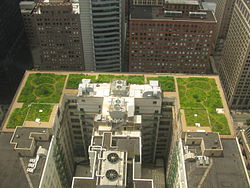 Roof garden atop city hall
 -
 Botticino marble lobby
 -
 City Hall-County Building as seen in the January 1919 issue of National Geographic
 -
 A fasces decoration above an entrance


In media
[edit]The exterior and parts of the interior of the building were featured in the climax of the 1980 comedy film The Blues Brothers, in which the titular characters, Jake and Elwood Blues, race to the building to beat a property tax deadline while being chased by police officers, firefighters, and the U.S. Military.[citation needed]
The building's interiors of were featured in the 1993 blockbuster movie The Fugitive, where Richard Kimble (played by Harrison Ford) is chased down the stairs by U.S. Marshal Samuel Gerard (Tommy Lee Jones), until spilling into the lobby, where Kimble narrowly escapes being apprehended by Gerard and his men.[20]
Agencies
[edit].jpg)
The Following Agencies are located in the building:
- Elected Offices:
- Office of the Mayor – 5th Floor
- Mayor's Office for People with Disabilities
- City Council – 2nd Floor (Council Chambers)
- City Clerk – 1st Floor
- Treasurer – Room 106
- Office of the Mayor – 5th Floor
- Buildings Department – Room 900
- Department of Finance – 7th Floor
- Department of Law – Suite 600
- Business Affairs and Consumer Protection – 8th Floor
- Department of Planning and Development – 10th Floor
- Department of Streets and Sanitation – Room 1107
- Office of Emergency Management and Communications
- Department of Procurement Services – Room 806
- Department Human Resources
References
[edit]- ^ a b c d "City Hall-County Building". City of Chicago – Chicago Landmarks. Retrieved December 10, 2023.
- ^ "Green Roofs on Historic Buildings: City Hall, Chicago, Illinois (U.S. National Park Service)". www.nps.gov. Retrieved December 10, 2023.
- ^ "Contact Us". www.chicago.gov. Retrieved February 9, 2024.
- ^ "Office of the Mayor". www.chicago.gov. Retrieved December 10, 2023.
- ^ "Contact Chicago Treasurer's Office | Treasurer Melissa Conyears-Ervin". Chicago Treasurer's Office | Melissa Conyears-Ervin – Chicago Treasurer | CTO | Chicago Illinois. Retrieved December 10, 2023.
- ^ "Ward Offices". www.chicago.gov. Retrieved December 10, 2023.
- ^ "Cook County Facilities – County Building". cookcountyil.gov. Retrieved February 8, 2024.
- ^ "Secretary to the Board of Commissioners". www.cookcountyil.gov. December 12, 2023. Retrieved December 10, 2023.
- ^ "9. First floor plan, published in 'Architectural Record', Vol 31, No. 4, April 1912, p 356, courtesy of the Art Institute of Chicago – Chicago City Hall, 121 North LaSalle Street, Chicago, Cook County, IL". Library of Congress, Washington, D.C. 20540 USA. Retrieved December 10, 2023.
- ^ a b "CHICAGO'S SEVEN CITY HALLS". WTTW Chicago. November 22, 2013. Retrieved December 10, 2023.
- ^ a b c d "Then and Now: Chicago's City Halls". WTTW Chicago. December 2, 2013. Retrieved December 10, 2023.
- ^ a b c d e f g h i j k l m n o p Viehe-Naess, Ivan (September 1, 1981). "Chicago City Hall" (PDF). Library of Congress. America's City Halls. National Park Service. Retrieved December 10, 2023.
- ^ Shepard, Steven. "Black women make history in Chicago mayoral election". Retrieved February 27, 2019.
- ^ a b "The City Hall and Courthouse Buildings". chicagology.com. Retrieved March 1, 2018.
- ^ Wood, Paul (August 6, 2007). "Woodbury Granite Co.: a rural industrial giant". Times Argus. Retrieved December 10, 2023.
- ^ http://lcweb2.loc.gov/master/pnp/habshaer/il/il0400/il0439/data/il0439data.pdf [bare URL PDF]
- ^ "CHICAGO CITY HALL DAMAGED BY FIRE; No One Injured as Firemen Rescue Trapped Women-- Loss Set at $200,000". The New York Times. March 22, 1957. ISSN 0362-4331. Retrieved December 10, 2023.
- ^ a b "720 E WISCONSIN AVE | Property Record". Wisconsin Historical Society. January 1, 2012. Retrieved December 26, 2024.
- ^ a b Reardon, Patrick T. (July 27, 2004). "Street smarts". Chicago Tribune. Retrieved January 10, 2024.
- ^ "Here Now, Every Chicago Location in The Fugitive Mapped – Curbed Chicago". March 13, 2015.
External links
[edit]
- Chicago Landmarks: City Hall-County Building
- Historic American Buildings Survey: Chicago City Hall, National Park Service, 1981
- ASLA Merit Award 2002: Chicago City Hall Green Roof


| International | |
|---|---|
| National | |
| Geographic | |

City Hall-County Building
View on GrokipediaHistory
Pre-1908 Structures
Cook County's first courthouse, constructed in 1835 at the northeast corner of Clark and Randolph Streets, was a one-story Greek Revival structure of red brick featuring four wooden Doric columns; it initially served county judicial needs but also accommodated early city government functions following Chicago's incorporation in 1837.[3][4] By 1853, a combined county courthouse and city hall replaced it on the block bounded by Randolph, Clark, Washington, and LaSalle Streets, designed by John M. Van Osdel in Greek Revival style using stone from Lockport, New York; the two-story building with a cupola gained an Italianate third floor during 1858–1859 expansions.[3][4] This structure was destroyed in the Great Chicago Fire of October 1871.[3] Post-fire, municipal operations relocated to temporary sites, including the Rookery Building, which housed city hall functions for twelve years until the completion of a permanent replacement.[2] The sixth city hall and county courthouse, built from 1877 to 1885 at the prior site under architect James J. Egan in Second Empire style with limestone and granite facades and 35-foot Corinthian columns at a cost of $5 million, addressed ongoing needs but ultimately proved structurally inadequate, prompting demolition beginning in August 1908 after the city council's final meeting there in July.[3][4][2]Construction and Early Use (1905–1911)
In January 1905, an explosion and fire damaged the existing county facilities, prompting the Cook County Board to propose a new building; voters approved a $5 million bond issue on April 4, 1905, to fund construction.[2] Excavation for the County Building (east wing) began on January 18, 1906, with its cornerstone laid on March 21, 1906; the first county offices were occupied by July 6, 1906, and the structure was completed in 1908.[2] [1] The architectural firm Holabird & Roche, known for Chicago School designs, was commissioned in 1907 to plan the adjacent City Hall (west wing).[2] Demolition of the prior City Hall commenced on August 11, 1908, with the site cleared by the end of that year; the Noel Construction Company received the general contract and began work on January 1, 1909, completing the foundation by April 15, 1909, and laying the cornerstone on July 20, 1909.[2] [5] Intended for completion by October 15, 1910, at a cost of $5 million, the project faced delays from labor disputes and investigations, extending occupancy to 1911; the structure incorporated 21 million pounds of steel, over 33,000 cubic yards of concrete, and 180,000 cubic feet of granite, employing up to 750 workers across trades.[5] The City Hall wing was dedicated on February 27, 1911.[2] [1] From its opening, the combined City Hall-County Building served as the primary seat for Chicago city government offices in the west wing and Cook County administrative functions in the east wing, emphasizing efficient governmental operations on the shared site used since 1853.[1] [2] Early occupancy highlighted the design's focus on functionality, though capacity concerns arose shortly after for city operations.[2]Post-Construction Developments and Modifications
Following its dedication in 1911, the City Hall-County Building experienced ongoing maintenance to address structural and aesthetic deterioration from environmental factors, including pollution and weathering, though specific early modifications remain sparsely documented in public records. By the late 20th century, preservation efforts intensified amid urban renewal pressures in Chicago's Loop district.[6] On January 21, 1982, the building received designation as a Chicago Landmark by the City Council, recognizing its architectural significance and continuous governmental role since the 19th century, which imposed regulations on alterations to protect its historic fabric.[1] A prominent environmental modification came in 2001 with the installation of a green roof on the City Hall section, covering 38,800 square feet across the 10th through 12th floors. Initiated under Mayor Richard M. Daley as part of a broader sustainability push inspired by European examples, the $2.5 million project—funded via a settlement with Commonwealth Edison—was designed to reduce urban heat island effects, manage stormwater, and demonstrate green roofing viability in a dense cityscape. It features drought-resistant sedums and native plants adapted to the rooftop's harsh conditions, serving as an early municipal test plot in collaboration with the U.S. Environmental Protection Agency.[7][8][9] Subsequent work has focused on facade preservation, including engineered repairs to terra cotta cladding, brick masonry, granite bases, and backup walls, addressing distress from age and exposure while adhering to landmark standards. These interventions, involving removal and restoration of thousands of terra cotta pieces alongside tuckpointing and steel reinforcements, have been essential to maintaining the structure's integrity without compromising its classical design.[6][10]Architecture and Design
Overall Structure and Materials
The City Hall-County Building occupies an entire city block in downtown Chicago, bounded by LaSalle, Washington, Clark, and Randolph Streets, with a nearly square footprint of 374 feet by 314 feet.[2] Constructed as two interconnected sections—the eastern Cook County Building completed in 1908 and the western City Hall portion finished in 1911—the structure rises 11 stories to a height of 205 feet from sidewalk to coping, or 253 feet including the sub-basement.[1][2] Designed by the architectural firm Holabird & Roche in a Classical Revival style with Beaux-Arts influences, it features a monumental facade organized around a two-story base topped by attached Corinthian columns spanning from the third to ninth stories, conveying stability and civic grandeur.[1][3][2] The building's structural framework relies on a steel skeleton with reinforced concrete floors and hollow-tile partitions, anchored by 124 concrete caissons—112 extending 114 feet to bedrock and 12 to hardpan—capable of supporting heavy loads for office and courtroom functions.[2] Exterior cladding uses durable Woodbury gray granite for the column shafts, pilasters, capitals, and base elements, paired with matte-glazed green and gray terra cotta for window surrounds, spandrels, the attic story, and cornice to achieve fine detailing and weather resistance.[2][10][11] Although secondary accounts occasionally describe the facing as primarily limestone with granite accents, Historic American Buildings Survey documentation confirms granite and terra cotta as the principal materials, selected for their longevity in a harsh urban environment.[2][3] Internally, the design incorporates functional steel and concrete elements for floors and stairs, with public areas featuring polished Botticino marble wainscoting, walls, and vaulted ceilings for aesthetic elevation, alongside iron balustrades and later oak paneling in chambers.[2] This combination of robust engineering and classical ornamentation enables efficient multi-level operations while symbolizing governmental authority through proportional massing and high-quality, low-maintenance materials.[1][2]Exterior and Entrance Features
The City Hall-County Building exhibits a facade in the style of monumental classicism, employing the Corinthian order, with construction completed between 1909 and 1911 under architects Holabird & Roche.[2] The exterior primarily utilizes Woodbury gray granite for the facade up to the capitals, complemented by terra cotta elements for the cornice, attic story, and window surrounds, spandrels, and mullions.[2] [6] Rising 11 stories to a height of 205 feet from sidewalk to coping, the structure features a base of three stories with simple fenestration rising 70 feet, a shaft section spanning the fourth through ninth floors articulated by long colonnades of colossal Corinthian columns measuring 9 feet in diameter, and corner pilasters, topped by a 24-foot entablature and 17-foot attic.[2] The columns, hollow without internal cores, rest on molded plinths 6 feet high and extend to capitals 12.5 feet tall, providing a rhythmic emphasis to the verticality of the design.[2] Entrances access the lobbies from LaSalle, Clark, Washington, and Randolph Streets, with the main west entrance on LaSalle Street distinguished by symbolic ornamentation.[2] Above this entrance, a fasces—a bundle of rods symbolizing strength through unity, derived from Roman imperial iconography—adorns the facade, appearing in various government buildings to denote authority and cohesion.[12] Flanking the entrance are four low-relief granite panels sculpted by John Flanagan, each depicting one of the principal civic functions: education (schools), recreation (playgrounds and parks), transportation, and public health (water supply).[13] [14] These panels, carved in granite to match the facade material, integrate neoclassical symbolism with practical municipal themes, executed during the building's early 20th-century construction phase.[13] The dark terra cotta contrasts with the granite, enhancing the visibility of window frames and decorative detailing across the exterior.[2]Interior Layout and Green Roof
The interior of the City Hall-County Building is divided into western (city) and eastern (county) halves, each with independent central light courts to facilitate natural illumination and efficient space utilization.[2] The first-floor lobbies and hallways extend axially from LaSalle Street to Clark Street, featuring polished Botticino marble walls, wainscots rising to 5 feet in corridors, and flattened groin vault ceilings supported by self-supporting marble ribs over reinforced concrete arches finished in marble mosaic.[2] Stair halls incorporate 3-foot-high Botticino marble wainscots, complemented by 14 electric passenger elevators with capacities ranging from 3,500 to 5,000 pounds, serving up to 238 feet in height, alongside additional elevators for freight and service.[2] Key functional spaces include the two-story City Council Chamber, measuring 65 by 96 feet and spanning the second through fourth floors with an adjoining gallery and a 20-by-80-foot oak-paneled retiring room on the Randolph Street side.[2] The mayor's office occupies a 40-by-90-foot suite on the fifth floor, featuring oak-paneled ceilings.[2] The seventh floor houses the Health Department across three-quarters of its area, equipped with laboratories and 600 feet of specialized tile and concrete piping for utilities.[2] A vault floor between the third and fourth levels provides 48,000 square feet of fireproof storage, while the sub-basement, 38 feet below grade, contains coal-fired boilers and ash-handling systems.[2] The building's green roof, a semi-extensive vegetated system covering 38,800 square feet, was constructed starting in April 2000 following a year of planning initiated in 1998 at a cost of $1.5 million.[7][8] Installed primarily on the south-facing sections as a demonstration project under Mayor Richard M. Daley's administration, it aimed to test reductions in urban heat island effects, stormwater runoff, and improvements in air quality through an Environmental Protection Agency-backed initiative.[9][15] The roof incorporates drought-tolerant native plants and shallow soil layers, contributing to energy savings and biodiversity in a dense urban environment, with initial planting completed by 2001.[7][15]Governmental Role
City Government Functions
The west wing of the City Hall-County Building, known as City Hall at 121 N. LaSalle Street, functions as the primary seat of Chicago's municipal government, housing the executive offices of the mayor, legislative chambers for the City Council, and administrative support for essential city operations.[16][17] The mayor, as chief executive, operates from offices within the building to oversee approximately 35 city departments, enforce ordinances, prepare the annual budget exceeding $16 billion as of fiscal year 2025, and appoint department heads subject to City Council approval.[16] City Council meetings, comprising 50 aldermen representing individual wards, convene in the second-floor Council Chambers to deliberate and vote on legislation, including zoning amendments, bond issuances, and the city budget; sessions typically occur monthly on the third Wednesday at 10:00 a.m., with public comment periods.[17][18] The Council holds authority over local ordinances under the Illinois Municipal Code, approving measures on public safety, infrastructure, and land use that directly impact the city's 2.7 million residents.[19] The Office of the City Clerk, located in Room 107, manages official records, issues business licenses, and administers municipal elections, processing over 100,000 documents annually including ordinances and contracts.[20] The City Treasurer's office, also housed in the building, handles revenue collection, debt management, and investment of city funds, safeguarding assets totaling billions in taxes, fees, and grants.[21] Additional administrative functions include offices for the Department of Buildings at Suite 900, which reviews construction permits and enforces building codes, and select units of the Department of Streets and Sanitation in Room 1107 for oversight of maintenance services.[22] These operations facilitate daily governance, from policy execution to public service delivery, though many specialized departments maintain primary facilities elsewhere in the city.[21]Cook County Functions
The east wing of the City Hall-County Building, designated as the County Building at 118 N. Clark Street, primarily houses key administrative offices for Cook County government, supporting functions such as legislative oversight, property taxation, and vital records management.[23] This arrangement dates to the building's completion in phases between 1908 and 1911, when Cook County selected the site for its central location in Chicago, the county seat, to consolidate operations previously scattered across multiple facilities.[2] The Cook County Board of Commissioners, the county's legislative body comprising 17 elected members, convenes regular meetings in the Board Room at 118 N. Clark Street, where it approves budgets, enacts ordinances, and oversees county departments serving approximately 5.2 million residents across 134 municipalities.[24] [25] The Office of the President, led by the county board president as chief executive, is located in Room 537, directing policy implementation, intergovernmental relations, and administrative coordination for services including public health, corrections, and infrastructure.[26] Financial administration is centralized with the Cook County Treasurer's Office in Room 112, responsible for collecting over $15 billion in annual property taxes, managing investments, and distributing funds to local governments and schools.[27] Adjacent, the Cook County Assessor's Office occupies Room 320, valuing roughly 1.7 million parcels for taxation, conducting appeals, and ensuring compliance with state assessment laws through on-site reviews and data analysis.[28] [29] Portions of the County Clerk's operations, including vital records issuance for births, marriages, and deaths since 1872, and election administration as the chief elections officer, maintain presence on the fourth floor, facilitating public access to documents and voter services.[30] [29] Additionally, the Clerk of the Circuit Court's County Division in Room 434 handles civil case filings, evictions, and name changes, processing thousands of documents annually under Illinois statutes.[31] These offices collectively enable Cook County's core governance, though some departments like the Sheriff's Office and courts have primary facilities elsewhere, such as the nearby Criminal Courts Building.[32]Political Influence and Operations
The City Hall-County Building functions as the operational headquarters for Chicago's executive and legislative branches, housing the mayor's office on the fifth floor, which oversees approximately 35 departments managing services from public works to law enforcement, with a 2024 city budget exceeding $16 billion. City Council proceedings, involving 50 aldermen representing wards, occur in dedicated chambers where ordinances on zoning, taxation, and contracts are debated and passed, though the mayor holds veto authority over legislation and influences committee assignments. In the adjacent County Building, Cook County's 17-member Board of Commissioners convenes to administer a $9.3 billion budget (fiscal year 2024) covering health services, juvenile detention, and property assessments across 134 municipalities, with the board president exerting executive-like control over appointments and procurement. This centralized setup amplifies the mayor's political dominance, a hallmark of Chicago's strong-mayor system where executive influence often supersedes council independence, as evidenced by low passage rates for alderman-initiated bills—only 12% under Mayor Rahm Emanuel from 2011 to 2019. Historically, the building epitomized the Democratic machine's patronage network under Richard J. Daley (mayor 1955–1976), who from City Hall dispensed jobs, contracts, and favors to secure loyalty, peaking machine control with over 40,000 city employees by 1970 and near-total Democratic sweeps in elections. His son, Richard M. Daley (1989–2011), similarly leveraged the venue for development deals, such as the 1990s privatization of parking meters, consolidating power through alliances with county officials in the shared structure.[33][34] County operations intersect with city politics via joint Democratic leadership, enabling coordinated policies on shared issues like public health crises—e.g., the building's offices managed the county's COVID-19 response alongside city mandates in 2020–2022—but also breeding conflicts of interest, as county contracts often favor city-aligned vendors. The machine's legacy persists in practices like ward-based deal-making, where aldermen trade support for infrastructure funds, contributing to Chicago's ranking among the most corrupt large U.S. cities per federal convictions (over 30 public officials since 1976). Federal probes, including the 2019 conviction of Alderman Edward Burke for bribery in the building's corridors, highlight how physical proximity facilitates influence peddling over transparent governance.[35][36]Cultural and Symbolic Impact
Representation in Media
The City Hall-County Building has appeared in several notable films, often representing Chicago's municipal government or as a backdrop for action sequences. In the 1980 comedy The Blues Brothers, directed by John Landis, protagonists Jake and Elwood Blues (played by John Belushi and Dan Aykroyd) scramble through adjacent Daley Plaza before entering the building's Clark Street entrance to secure funds for their orphanage, highlighting its role as a symbol of bureaucratic authority amid the film's chaotic chase.[37] [38] Filming in the plaza involved extensive coordination, including Sherman tanks, helicopters, and over 100 police officers, as approved by Mayor Jane Byrne to capture the climactic scene.[39] In the 1993 thriller The Fugitive, directed by Andrew Davis, Dr. Richard Kimble (Harrison Ford) visits a prisoner in the building's lock-up facilities before escaping across the exterior plaza, passing the iconic Picasso sculpture and blending into a St. Patrick's Day parade on Dearborn Street, underscoring the structure's dual role in city and county operations.[40] The building's exterior and plaza have served as establishing shots in other Chicago-set productions, evoking the city's administrative core, though interiors are less frequently depicted due to security constraints.[41] Earlier print media representations include a feature in the January 1919 issue of National Geographic magazine, which showcased the then-new building's architecture amid discussions of Chicago's urban development.[42] Such depictions emphasize its Classical Revival style and prominence as a governmental landmark, contrasting with modern cinematic uses that prioritize dramatic context over architectural detail.Public Perception and Landmark Status
The City Hall-County Building holds formal recognition as a Chicago Landmark, designated by the City Council on January 21, 1982, due to its neoclassical architecture by Holabird & Roche and its role as a continuous seat of municipal and county governance since its 1911 completion.[1] This status underscores its historical importance as the first major civic project aligned with the 1909 Plan of Chicago by Daniel Burnham, emphasizing grand public architecture to symbolize civic progress.[2] Public perception frames the structure as an iconic emblem of Chicago's governmental continuity and urban centrality, with its 11-story limestone facade and columned entrances evoking stability amid the city's dynamic Loop district.[6] Adjacent Daley Plaza serves as a focal point for civic gatherings, festivals, and demonstrations, enhancing its visibility and role in communal life since the 1960s plaza redesign.[43] Architectural observers note the building's enduring presence contrasts with Chicago's history of multiple prior city halls destroyed by fire or obsolescence, positioning it as a rare survivor of early 20th-century civic design.[44] Despite its landmark designation, the building lacks federal National Historic Landmark status, reflecting prioritization of local over national recognition for functional government structures.[45] Visitor and local accounts often highlight its imposing scale—spanning 373 feet in length—and Botticino marble interiors as markers of prestige, though maintenance challenges occasionally temper views of its upkeep.[6]Controversies and Criticisms
Architectural and Maintenance Issues
The City Hall-County Building's masonry facade, constructed primarily of granite on the lower levels and terra cotta accents in a classical revival style, has exhibited deterioration typical of early 20th-century structures exposed to Chicago's harsh weather. Observed distress includes cracking, spalling, and water infiltration in the granite, terra cotta, and brick elements, exacerbated by freeze-thaw cycles and aging backup construction.[6] As required by Chicago's Critical Facade Ordinance for buildings over 80 feet tall, engineering firm WJE Janney Elstner Associates Inc. conducted detailed inspections, including close-up examinations and petrographic laboratory analysis, to identify causes and inform repairs.[6] These efforts resulted in restoration designs encompassing masonry repointing, replacement of damaged elements, treatment of exposed metal components, and rehabilitation of original wood-frame windows to preserve structural integrity and aesthetic coherence.[6] The building's green roof, installed in 2001 on the City Hall portion as a 38,000-square-foot pilot project to mitigate urban heat island effects and reduce energy consumption by up to 30% in summer months, has presented ongoing maintenance challenges.[46] Initial implementation required adaptations to city codes for venting and drainage, with the Chicago Department of Transportation assuming responsibility for upkeep, including periodic weeding, membrane inspections, and plant replacements to combat stormwater overload in combined sewer systems.[46] Over time, the vegetative cover has evolved through phases of intensive care and reduced intervention, leading to shifts in plant composition—such as dominance of sedums and grasses over original prairie species—due to inconsistent watering, wind exposure, and natural succession, though overall performance has validated benefits like extended roof lifespan and biodiversity support.[47] These adaptations highlight the trade-offs in maintaining extensive green roofs on historic flat roofs without disrupting parapets or facades.[9] No major structural failures have been documented in the building's steel-framed core, designed to span large interior voids for courtrooms and offices, but the phased construction—County side completed in 1912, City side in 1925—necessitated robust framing solutions that continue to demand vigilant monitoring amid urban subsidence risks.[2] Routine compliance with facade inspection cycles every four to twelve years ensures proactive intervention, preventing hazards like falling debris, though costs for specialized historic repairs remain a persistent fiscal burden on city and county budgets.[48]Political Scandals and Corruption
The Chicago City Hall-County Building has been the epicenter of numerous political corruption scandals involving both city and county officials, reflecting a pattern of patronage, bribery, and abuse of authority that dates back over 150 years. In 1869, Cook County commissioners were imprisoned for rigging a contract to paint the original City Hall, marking one of the earliest documented instances of graft tied directly to the seat of local government.[49] This incident exemplified the systemic favoritism in procurement and contracts that persisted through the 19th and 20th centuries, fueled by the Democratic machine's control over hiring and awards in both city and county operations housed in the building.[50] During the mid-20th century, under Mayor Richard J. Daley's administration, City Hall became synonymous with patronage politics, where jobs, promotions, and contracts were doled out to loyalists, often violating civil service laws. Federal probes revealed ghost payrolls and kickbacks in departments overseen from the building, contributing to over 30 City Council aldermen facing corruption charges since the 1970s.[51] A University of Illinois Chicago analysis documented 1,750 public corruption convictions in the Chicago area from 1976 to 2016, more than any other U.S. city, with many stemming from aldermanic influence over zoning, permits, and development approvals processed at City Hall.[52] Cook County operations in the adjacent building have similarly been plagued by bid-rigging and nepotism, with a 2010 report identifying 146 convictions since the late 1800s, including schemes involving county board members and vendors.[50] Prominent recent cases underscore the ongoing risks of concentrated power. In December 2023, former Alderman Ed Burke, who chaired the Finance Committee and wielded significant influence over City Hall's legislative processes, was convicted on 10 federal counts of racketeering, bribery, and extortion for leveraging his position to solicit fees from developers seeking approvals, including threats to block permits unless his private law firm was hired.[53] Burke, serving 14th Ward from 1989 to 2019, was sentenced in June 2024 to two years in prison and fined $2 million, highlighting how aldermanic prerogative—unreviewed authority over local developments—enables self-dealing.[54][36] Such scandals, often exposed by federal investigations rather than local oversight, have eroded public trust, with studies attributing persistence to weak internal checks and one-party dominance in Cook County governance.[55]Recent Security Challenges
In response to the September 10, 2025, assassination of conservative activist Charlie Kirk, a Chicago native, nearly half of the City Council signed a letter demanding a comprehensive security review for City Hall, citing it as emblematic of deteriorating public discourse that has heightened risks to elected officials.[56][57] The letter highlighted over the preceding 18 months numerous instances of rancorous City Council meetings where members required police escorts to exit the building safely, alongside vandalism targeting ward offices with graffiti and guillotine stickers symbolizing threats of violence.[56][57] Alderman Andre Vasquez, representing the 40th Ward, publicly addressed a threatening note and vandalism incident at his office in September 2025, underscoring the personal risks faced by council members amid polarized debates on issues like immigration and public safety.[58] These events built on prior escalations, including enhanced lobby security protocols implemented during former Mayor Lori Lightfoot's administration (2019–2023), such as stanchions and police checkpoints, which were retained but deemed insufficient for evolving threats under Mayor Brandon Johnson.[57] Large-scale protests adjacent to the building, particularly at Daley Plaza, have compounded security demands; for instance, the June 15, 2025, "No Kings" rally against President Trump's policies drew tens of thousands, necessitating heightened police presence to manage crowds and prevent disruptions to city operations.[59] Similar demonstrations in 2025, including anti-ICE actions and Gaza-related marches through the Loop, have occasionally led to street closures and tensions with law enforcement, though no direct breaches of the City Hall-County Building were reported.[60][61] City officials have responded by affirming non-cooperation with federal agents in certain contexts, but critics argue this has not adequately addressed internal vulnerabilities like unauthorized access or targeted intimidation.[62]References
- https://commons.wikimedia.org/wiki/File:Chicago_City_Hall%2C_Chicago%2C_Illinois_%289179430367%29.jpg
- https://commons.wikimedia.org/wiki/File:Nationalgeograph351919nat.pdf