Recent from talks
Clacton-on-Sea
Knowledge base stats:
Talk channels stats:
Members stats:
Clacton-on-Sea
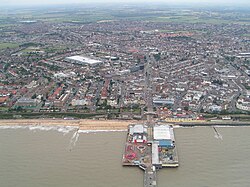
Clacton-on-Sea, often simply called Clacton, is a coastal town in Essex, England. It lies on the Tendring Peninsula and is the largest settlement in the Tendring District, with a population of 53,200 in 2021. The town is situated around 77 miles (124 km) north-east of London, 16 miles (26 km) south-east of Colchester and 16 miles (26 km) south of Harwich. The area was historically in the parish of Great Clacton. The development of the seaside resort began in the 1870s and was called Clacton-on-Sea to distinguish it from the older village about 1 mile (1.6 km) inland. Great Clacton and Clacton-on-Sea were always administered together, forming a single urban district called Clacton between 1895 and 1974; the two settlements gradually merged into a single urban area during the 20th century. It lies within the Parliamentary constituency of Clacton.
Clacton-on-Sea is located between Jaywick and Holland-on-Sea along the coastline; the original village of Great Clacton, now a suburb, lies to the north. The local authority is Tendring District Council.
It is at the south-eastern end of the A133. The resort of Frinton-on-Sea is nearby to the north-east.
Deposits at Clacton have provided important evidence for the Lower Palaeolithic occupation of Britain by Homo heidelbergensis during the Hoxnian Interglacial, around 424–375,000 years ago, including stone tools of the titular Clactonian industry. At this time Britain had a temperate deciduous forest environment and climate similar to today. The "Clacton Spear", a wooden (yew) spear found in these deposits around Clacton in 1911 is the world's oldest known wooden spear.
The Domesday Book of 1086 records the village as Clachintuna.
Clacton was repeatedly surveyed by the Army in the Napoleonic Wars as a possible invasion beach-head for Napoleon and his Dutch allies. There was a large army and militia camp where Holland-on-Sea now stands. In 1810, five Martello Towers were built to guard the beaches between Colne Point to the south and what is now Holland-on-Sea to the north of the town.
In 1865, railway engineer and land developer Peter Bruff, the steamboat owner William Jackson, and a group of businessmen bought an area of undeveloped farmland adjoining low gravelly cliffs and a firm sand-and-shingle beach lying to the south-east of Great Clacton village, with the intention of establishing a new resort. One of the first facilities they built for the new resort was the pier, which opened in 1871, allowing visitors to travel by ship; the railway would not reach Clacton until 1882. The town of Clacton-on-Sea was laid out rather haphazardly over the next few years; though it has a central 'grand' avenue (originally Electric Parade, now Pier Avenue) the street plan incorporates many previously rural lanes and tracks, such as Wash Lane. Plots and streets were sold off piecemeal to developers and speculators. In 1882, the Great Eastern Railway already serving the well-established resort of Walton-on-the-Naze along the coast, opened a branch line to Clacton from a junction on the existing railway at Thorpe-le-Soken.
Clacton grew into the largest seaside resort between Southend-on-Sea and Great Yarmouth, with around 10,000 residents by 1914 and 20,000 by 1939. Due to its accessibility from the East End of London and the Essex suburbs, the town, like Southend, remained preferentially geared to catering for working-class and lower-middle-class holidaymakers.
Hub AI
Clacton-on-Sea AI simulator
(@Clacton-on-Sea_simulator)
Clacton-on-Sea
Clacton-on-Sea, often simply called Clacton, is a coastal town in Essex, England. It lies on the Tendring Peninsula and is the largest settlement in the Tendring District, with a population of 53,200 in 2021. The town is situated around 77 miles (124 km) north-east of London, 16 miles (26 km) south-east of Colchester and 16 miles (26 km) south of Harwich. The area was historically in the parish of Great Clacton. The development of the seaside resort began in the 1870s and was called Clacton-on-Sea to distinguish it from the older village about 1 mile (1.6 km) inland. Great Clacton and Clacton-on-Sea were always administered together, forming a single urban district called Clacton between 1895 and 1974; the two settlements gradually merged into a single urban area during the 20th century. It lies within the Parliamentary constituency of Clacton.
Clacton-on-Sea is located between Jaywick and Holland-on-Sea along the coastline; the original village of Great Clacton, now a suburb, lies to the north. The local authority is Tendring District Council.
It is at the south-eastern end of the A133. The resort of Frinton-on-Sea is nearby to the north-east.
Deposits at Clacton have provided important evidence for the Lower Palaeolithic occupation of Britain by Homo heidelbergensis during the Hoxnian Interglacial, around 424–375,000 years ago, including stone tools of the titular Clactonian industry. At this time Britain had a temperate deciduous forest environment and climate similar to today. The "Clacton Spear", a wooden (yew) spear found in these deposits around Clacton in 1911 is the world's oldest known wooden spear.
The Domesday Book of 1086 records the village as Clachintuna.
Clacton was repeatedly surveyed by the Army in the Napoleonic Wars as a possible invasion beach-head for Napoleon and his Dutch allies. There was a large army and militia camp where Holland-on-Sea now stands. In 1810, five Martello Towers were built to guard the beaches between Colne Point to the south and what is now Holland-on-Sea to the north of the town.
In 1865, railway engineer and land developer Peter Bruff, the steamboat owner William Jackson, and a group of businessmen bought an area of undeveloped farmland adjoining low gravelly cliffs and a firm sand-and-shingle beach lying to the south-east of Great Clacton village, with the intention of establishing a new resort. One of the first facilities they built for the new resort was the pier, which opened in 1871, allowing visitors to travel by ship; the railway would not reach Clacton until 1882. The town of Clacton-on-Sea was laid out rather haphazardly over the next few years; though it has a central 'grand' avenue (originally Electric Parade, now Pier Avenue) the street plan incorporates many previously rural lanes and tracks, such as Wash Lane. Plots and streets were sold off piecemeal to developers and speculators. In 1882, the Great Eastern Railway already serving the well-established resort of Walton-on-the-Naze along the coast, opened a branch line to Clacton from a junction on the existing railway at Thorpe-le-Soken.
Clacton grew into the largest seaside resort between Southend-on-Sea and Great Yarmouth, with around 10,000 residents by 1914 and 20,000 by 1939. Due to its accessibility from the East End of London and the Essex suburbs, the town, like Southend, remained preferentially geared to catering for working-class and lower-middle-class holidaymakers.