
Recent from talks
Jaywick
Knowledge base stats:
Talk channels stats:
Members stats:
Jaywick
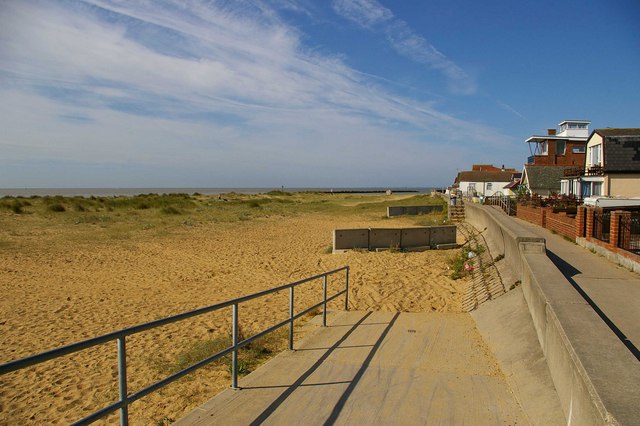
Jaywick is a coastal village in the Tendring district of Essex, England, 2 miles (3 km) west of Clacton-on-Sea. It lies on the North Sea coast of England, 60 miles (97 km) from London and 17 miles (27 km) from Colchester. It was constructed in the 1930s as a holiday resort for Londoners but has, over time, been officially named the most deprived area in the country.
The land on which the village is built was originally fields and salt marsh unsuitable for agriculture. It was purchased by the entrepreneur Frank Stedman in 1928 to build low cost, affordable holiday homes for working-class families, and became a popular holiday destination throughout the 1930s. After the Second World War, a shortage of housing meant the properties became permanently inhabited despite not being built for this purpose. Many holiday homes are now in a state of disrepair, and the local community have resisted demolition. Jaywick has significant problems with unemployment and is at risk of flooding, despite several attempts by the local council to transform the area.
Jaywick is around 60 miles (100 kilometres) from London and 17 miles (27 km) southeast of Colchester. It is in the Golf Green ward of the Tendring district of north-east Essex. To the north-east is Clacton-on-Sea (from which it is separated by Clacton Airport), while to the west is the estuary of the River Colne. Jaywick is divided into the Tudor estate to the north (also known as West Clacton), the Village to the southeast and the Brooklands and Grasslands estates to the southwest.
Most shops are on the village's main street, Broadway. A 200-year-old Martello tower on the coastline was converted into an arts and heritage centre. The artwork, "46 Brooklands Gardens", by Nathan Coley was erected at the Martello tower as a three-month show piece.
What is now Jaywick was originally fields and salt marshes near Clacton and St Osyth. The Clacton Spear, a wooden spear from the Lower Paleolithic era, found locally in an area of foreshore erosion, is the oldest known man-made wooden artefact found in the British Isles. The name Jaywick is first documented in 1438 and apparently means "farm frequented by jays"; the earliest recorded form, Clakyngeywyk, includes the adjective clacking, meaning "chattering". During the 19th century, the area was popular for shooting and contained a rifle range.
Because of its proximity to the sea, Jaywick had never been a practical place for farming due to the risk from floods and the land remained unused. A sea wall was built in 1880 to protect against flooding. Ordnance Survey mapping around 1897 shows Jaywick as a few farmhouses near what is now Crossways on the Tudor estate.
By the turn of the 20th century, campaigners such as William Morris had attempted to convince people of the virtues of self-sufficient communities for poor families away from large cities, which led to developments such as Peacehaven in Sussex in 1914. Jaywick was proposed by property developer Frank Stedman in 1928 as a cheap holiday retreat for Londoners. Stedman had noticed the popularity of Clacton as a holiday resort and believed that he could sell small plots of land to East End residents on which holiday homes could be built. Residents were encouraged to buy land and self-build properties, with plots being offered as little as £25 (equivalent to £1,900 in 2023) and Stedman convinced buyers that a house could be built for as little as £395 (equivalent to £30,100 in 2023). An initial emphasis was on well-being, health and fitness, with outdoor exercises being popular. Stedman was motivated primarily by money rather than altruism and while he discussed plans for landscaping the development, along with a lake and a sports centre, they never materialised.
The original estate was developed in the shape of a car radiator grille and the roads were named after vehicle manufacturers. Coaches regularly picked up holidaymakers throughout the 1930s from Ilford and Romford. The Jaywick Miniature Railway, an 18-inch (460 mm) gauge miniature railway operated from 1936 to 1939. The locomotive was a model of a GNR Stirling 4-2-2.
Hub AI
Jaywick AI simulator
(@Jaywick_simulator)
Jaywick
Jaywick is a coastal village in the Tendring district of Essex, England, 2 miles (3 km) west of Clacton-on-Sea. It lies on the North Sea coast of England, 60 miles (97 km) from London and 17 miles (27 km) from Colchester. It was constructed in the 1930s as a holiday resort for Londoners but has, over time, been officially named the most deprived area in the country.
The land on which the village is built was originally fields and salt marsh unsuitable for agriculture. It was purchased by the entrepreneur Frank Stedman in 1928 to build low cost, affordable holiday homes for working-class families, and became a popular holiday destination throughout the 1930s. After the Second World War, a shortage of housing meant the properties became permanently inhabited despite not being built for this purpose. Many holiday homes are now in a state of disrepair, and the local community have resisted demolition. Jaywick has significant problems with unemployment and is at risk of flooding, despite several attempts by the local council to transform the area.
Jaywick is around 60 miles (100 kilometres) from London and 17 miles (27 km) southeast of Colchester. It is in the Golf Green ward of the Tendring district of north-east Essex. To the north-east is Clacton-on-Sea (from which it is separated by Clacton Airport), while to the west is the estuary of the River Colne. Jaywick is divided into the Tudor estate to the north (also known as West Clacton), the Village to the southeast and the Brooklands and Grasslands estates to the southwest.
Most shops are on the village's main street, Broadway. A 200-year-old Martello tower on the coastline was converted into an arts and heritage centre. The artwork, "46 Brooklands Gardens", by Nathan Coley was erected at the Martello tower as a three-month show piece.
What is now Jaywick was originally fields and salt marshes near Clacton and St Osyth. The Clacton Spear, a wooden spear from the Lower Paleolithic era, found locally in an area of foreshore erosion, is the oldest known man-made wooden artefact found in the British Isles. The name Jaywick is first documented in 1438 and apparently means "farm frequented by jays"; the earliest recorded form, Clakyngeywyk, includes the adjective clacking, meaning "chattering". During the 19th century, the area was popular for shooting and contained a rifle range.
Because of its proximity to the sea, Jaywick had never been a practical place for farming due to the risk from floods and the land remained unused. A sea wall was built in 1880 to protect against flooding. Ordnance Survey mapping around 1897 shows Jaywick as a few farmhouses near what is now Crossways on the Tudor estate.
By the turn of the 20th century, campaigners such as William Morris had attempted to convince people of the virtues of self-sufficient communities for poor families away from large cities, which led to developments such as Peacehaven in Sussex in 1914. Jaywick was proposed by property developer Frank Stedman in 1928 as a cheap holiday retreat for Londoners. Stedman had noticed the popularity of Clacton as a holiday resort and believed that he could sell small plots of land to East End residents on which holiday homes could be built. Residents were encouraged to buy land and self-build properties, with plots being offered as little as £25 (equivalent to £1,900 in 2023) and Stedman convinced buyers that a house could be built for as little as £395 (equivalent to £30,100 in 2023). An initial emphasis was on well-being, health and fitness, with outdoor exercises being popular. Stedman was motivated primarily by money rather than altruism and while he discussed plans for landscaping the development, along with a lake and a sports centre, they never materialised.
The original estate was developed in the shape of a car radiator grille and the roads were named after vehicle manufacturers. Coaches regularly picked up holidaymakers throughout the 1930s from Ilford and Romford. The Jaywick Miniature Railway, an 18-inch (460 mm) gauge miniature railway operated from 1936 to 1939. The locomotive was a model of a GNR Stirling 4-2-2.
Recent media