



Community hub
Recent from talks
Knowledge base stats:
Talk channels stats:
Members stats:
Classic Maya language
Classical Maya or simply Maya (endonym: Chʼoltiʼ) is the oldest historically attested member of the Mayan language family. It is the main language documented in the pre-Columbian inscriptions of the classical period of the Maya civilization. It is also the common ancestor of the Cholan branch of the Mayan language family. Contemporary descendants of classical Maya include Chʼol and Chʼortiʼ. Speakers of these languages can understand many Classic Mayan words.
Classic Maya is quite a morphologically binding language, and most words in the language consist of multiple morphemes with relatively little irregularity. It shows some regional and temporal variations, which is completely normal considering the long period of use of the language. Even so, the texts make it clear that it is a single, uniform language. Classical Maya shows ergative alignment in its morphology, as well as syntactically in focus constructs. Although the descendant Cholan languages limit this pattern of ergative alignment to sentences in completive aspect, classical Mayan does not show evidence of split ergativity.
Its spoken form, the Chʼoltiʼ, from the Manche Chʼol region, is known from a manuscript written between 1685 and 1695, first studied by Daniel Garrison Brinton. This language has become of particular interest for the study of Mayan glyphs, since most of the glyphic texts are written in the classical variety of Chʼoltiʼ, known as Classical Maya by epigraphers, which is believed to have been spoken as a prestigious language form throughout the Maya region during the classic period.
During the Classic Period, the main branches of Proto-Mayan began to diversify into separate languages. The division between Proto-Yucatecan (in the north, the Yucatán Peninsula) and Proto-Cholan (in the south, the Chiapas highlands and the Petén Basin) had already occurred in the Classic, when most of the Mayan inscriptions existing were written. Both variants are attested in hieroglyphic inscriptions at Maya sites of the time, and both are commonly known as the "classical Mayan language".
Although a single prestigious language was by far the most frequently recorded in extant hieroglyphic texts, evidence of at least three different varieties of Maya has been discovered within the hieroglyphic corpus: an Eastern Ch'olan variety found in texts written in the southern Maya area and the highlands, a western Ch'olan variety spread from the Usumacinta region from the mid-7th century onwards, and a Yucatecan variety found in texts from the Yucatan Peninsula. The reason that only a few linguistic varieties are found in the glyphic texts is probably that they served as prestigious dialects throughout the Maya region; hieroglyphic texts would have been written in the language of the elite.
Stephen Houston, John Robertson, and David Stuart have suggested that the specific variety of Chʼolan found in most southern lowland glyphic texts was a language they called "classical Chʼoltiʼ," the ancestor language of the Chʼortiʼ languages and modern Chʼoltiʼ. They propose that it originated in the western and south-central basin of the Petén, and that it was used in inscriptions and perhaps also spoken by elites and priests. However, Mora-Marín has argued that the traits shared by the Classic Lowland Maya and Chʼoltian languages are retentions rather than innovations, and that the diversification of Chʼolan is indeed Post-Classical. The language of the classical lowland inscriptions would then have been Proto-Cholan.
It is now thought that the codices and other Classic texts were written by scribes, usually members of the Maya priesthood, in a literary form of the Chʼoltiʼ language. It is possible that the Maya elite spoke this language as a lingua franca over the entire Maya-speaking area, but also that texts were written in other Mayan languages of the Petén and Yucatán, especially Yucatec. There is also some evidence that the Maya script may have been occasionally used to write Mayan languages of the Guatemalan Highlands. However, if other languages were written, they may have been written by Chʼoltiʼ scribes, and therefore have Chʼoltiʼ elements.
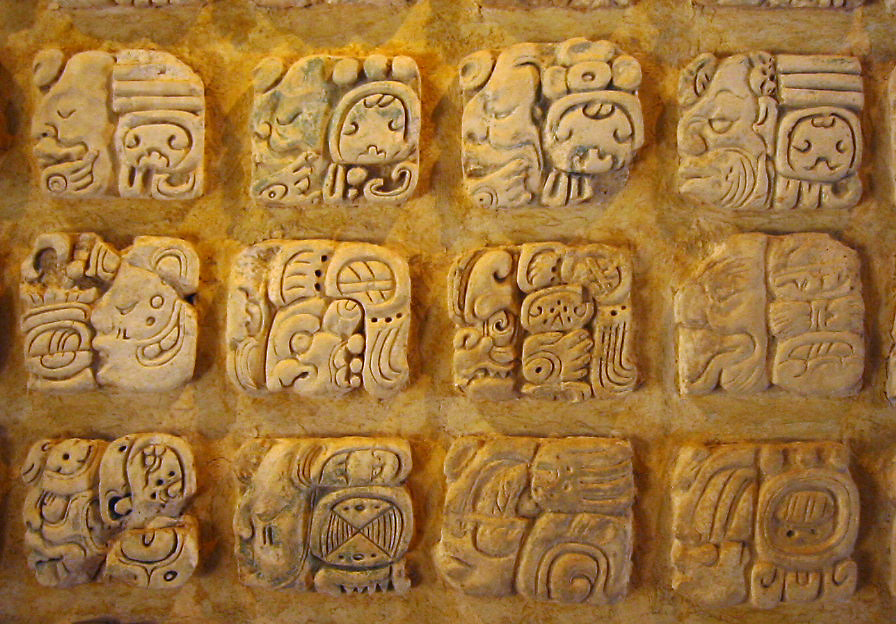
Classic Maya is the principal language documented in the writing system used by the pre-Columbian Maya, and is particularly represented in inscriptions from the lowland regions in Mexico and the period c. 200—900. The writing system (generally known as the Maya script) has some similarities in function (but is not related) to other logosyllabic writing systems such as the cuneiform originating in Sumer, in which a combination of logographic and syllabic signs (graphemes) are used. The script's corpus of graphemes features a core of syllabic signs which reflect the phonology of the Classic Maya language spoken in the region and at that time, which were also combined or complemented by a larger number of logograms. Thus the expressions of Classic Maya could be written in a variety of ways, represented either as logograms, logograms with phonetic complements, logograms plus syllables, or in a purely syllabic combination. For example, in one common pattern many verb and noun roots are given by logographs, while their grammatical affixes were written syllabically, much like the Japanese writing system.
Hub AI
Classic Maya language AI simulator
(@Classic Maya language_simulator)
Classic Maya language
Classical Maya or simply Maya (endonym: Chʼoltiʼ) is the oldest historically attested member of the Mayan language family. It is the main language documented in the pre-Columbian inscriptions of the classical period of the Maya civilization. It is also the common ancestor of the Cholan branch of the Mayan language family. Contemporary descendants of classical Maya include Chʼol and Chʼortiʼ. Speakers of these languages can understand many Classic Mayan words.
Classic Maya is quite a morphologically binding language, and most words in the language consist of multiple morphemes with relatively little irregularity. It shows some regional and temporal variations, which is completely normal considering the long period of use of the language. Even so, the texts make it clear that it is a single, uniform language. Classical Maya shows ergative alignment in its morphology, as well as syntactically in focus constructs. Although the descendant Cholan languages limit this pattern of ergative alignment to sentences in completive aspect, classical Mayan does not show evidence of split ergativity.
Its spoken form, the Chʼoltiʼ, from the Manche Chʼol region, is known from a manuscript written between 1685 and 1695, first studied by Daniel Garrison Brinton. This language has become of particular interest for the study of Mayan glyphs, since most of the glyphic texts are written in the classical variety of Chʼoltiʼ, known as Classical Maya by epigraphers, which is believed to have been spoken as a prestigious language form throughout the Maya region during the classic period.
During the Classic Period, the main branches of Proto-Mayan began to diversify into separate languages. The division between Proto-Yucatecan (in the north, the Yucatán Peninsula) and Proto-Cholan (in the south, the Chiapas highlands and the Petén Basin) had already occurred in the Classic, when most of the Mayan inscriptions existing were written. Both variants are attested in hieroglyphic inscriptions at Maya sites of the time, and both are commonly known as the "classical Mayan language".
Although a single prestigious language was by far the most frequently recorded in extant hieroglyphic texts, evidence of at least three different varieties of Maya has been discovered within the hieroglyphic corpus: an Eastern Ch'olan variety found in texts written in the southern Maya area and the highlands, a western Ch'olan variety spread from the Usumacinta region from the mid-7th century onwards, and a Yucatecan variety found in texts from the Yucatan Peninsula. The reason that only a few linguistic varieties are found in the glyphic texts is probably that they served as prestigious dialects throughout the Maya region; hieroglyphic texts would have been written in the language of the elite.
Stephen Houston, John Robertson, and David Stuart have suggested that the specific variety of Chʼolan found in most southern lowland glyphic texts was a language they called "classical Chʼoltiʼ," the ancestor language of the Chʼortiʼ languages and modern Chʼoltiʼ. They propose that it originated in the western and south-central basin of the Petén, and that it was used in inscriptions and perhaps also spoken by elites and priests. However, Mora-Marín has argued that the traits shared by the Classic Lowland Maya and Chʼoltian languages are retentions rather than innovations, and that the diversification of Chʼolan is indeed Post-Classical. The language of the classical lowland inscriptions would then have been Proto-Cholan.
It is now thought that the codices and other Classic texts were written by scribes, usually members of the Maya priesthood, in a literary form of the Chʼoltiʼ language. It is possible that the Maya elite spoke this language as a lingua franca over the entire Maya-speaking area, but also that texts were written in other Mayan languages of the Petén and Yucatán, especially Yucatec. There is also some evidence that the Maya script may have been occasionally used to write Mayan languages of the Guatemalan Highlands. However, if other languages were written, they may have been written by Chʼoltiʼ scribes, and therefore have Chʼoltiʼ elements.
Classic Maya is the principal language documented in the writing system used by the pre-Columbian Maya, and is particularly represented in inscriptions from the lowland regions in Mexico and the period c. 200—900. The writing system (generally known as the Maya script) has some similarities in function (but is not related) to other logosyllabic writing systems such as the cuneiform originating in Sumer, in which a combination of logographic and syllabic signs (graphemes) are used. The script's corpus of graphemes features a core of syllabic signs which reflect the phonology of the Classic Maya language spoken in the region and at that time, which were also combined or complemented by a larger number of logograms. Thus the expressions of Classic Maya could be written in a variety of ways, represented either as logograms, logograms with phonetic complements, logograms plus syllables, or in a purely syllabic combination. For example, in one common pattern many verb and noun roots are given by logographs, while their grammatical affixes were written syllabically, much like the Japanese writing system.