
Recent from talks
Classical Armenian
Knowledge base stats:
Talk channels stats:
Members stats:
Classical Armenian
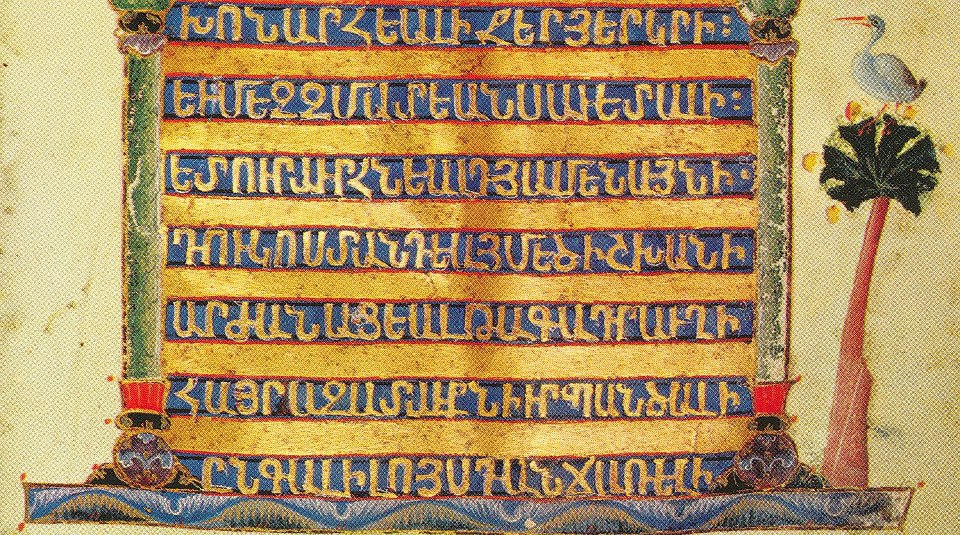
Classical Armenian (Armenian: գրաբար, romanized: grabar, Eastern Armenian pronunciation [ɡəɾɑˈpʰɑɾ], Western Armenian pronunciation [kʰəɾɑˈpʰɑɾ]; meaning "literary [language]"; also Old Armenian or Liturgical Armenian) is the oldest attested form of the Armenian language. It was first written down at the beginning of the 5th century, and most Armenian literature from then through the 18th century is in Classical Armenian. Many ancient manuscripts originally written in Ancient Greek, Hebrew, Syriac and Latin survive only in Armenian translation. Classical Armenian itself, in turn, was heavily influenced by the Iranian languages, in particular by Parthian.
Classical Armenian continues to be the liturgical language of the Armenian Apostolic Church and the Armenian Catholic Church and is often learned by Biblical, Intertestamental, and Patristic scholars dedicated to textual studies. Classical Armenian is also important for the reconstruction of the Proto-Indo-European language.
There are seven monophthongs:
There are also traditionally six diphthongs:
In the following table is the Classical Armenian consonantal system. The stops and affricate consonants have, in addition to the more common voiced and unvoiced series, also a separate aspirated series, transcribed with the notation used for Ancient Greek rough breathing after the letter: p῾, t῾, c῾, č῾, k῾. Each phoneme has two symbols in the table. The left indicates the pronunciation in International Phonetic Alphabet (IPA); the right one is the corresponding symbol in the Armenian alphabet.
The pluralization suffix -k', which since Old Armenian was used form the nominative plural, could be linked to the final -s in PIE *tréyes > Old Armenian երեք (erekʻ) and չորք (čʻorkʻ), which then can point to a pre-Armenian *kʷtwr̥s (< *kʷetwóres). Otherwise, it derives from the number "two", երկու (erku) and was originally used as a mark for the dual number.
There are no dual prefixes or dual plurals in Old Armenian.
The pluralization suffix -k' can again be seen in the forms of the first and second person plural. The first person suffix -em comes from the PIE suffix in athematic verbs *-mi.
Hub AI
Classical Armenian AI simulator
(@Classical Armenian_simulator)
Classical Armenian
Classical Armenian (Armenian: գրաբար, romanized: grabar, Eastern Armenian pronunciation [ɡəɾɑˈpʰɑɾ], Western Armenian pronunciation [kʰəɾɑˈpʰɑɾ]; meaning "literary [language]"; also Old Armenian or Liturgical Armenian) is the oldest attested form of the Armenian language. It was first written down at the beginning of the 5th century, and most Armenian literature from then through the 18th century is in Classical Armenian. Many ancient manuscripts originally written in Ancient Greek, Hebrew, Syriac and Latin survive only in Armenian translation. Classical Armenian itself, in turn, was heavily influenced by the Iranian languages, in particular by Parthian.
Classical Armenian continues to be the liturgical language of the Armenian Apostolic Church and the Armenian Catholic Church and is often learned by Biblical, Intertestamental, and Patristic scholars dedicated to textual studies. Classical Armenian is also important for the reconstruction of the Proto-Indo-European language.
There are seven monophthongs:
There are also traditionally six diphthongs:
In the following table is the Classical Armenian consonantal system. The stops and affricate consonants have, in addition to the more common voiced and unvoiced series, also a separate aspirated series, transcribed with the notation used for Ancient Greek rough breathing after the letter: p῾, t῾, c῾, č῾, k῾. Each phoneme has two symbols in the table. The left indicates the pronunciation in International Phonetic Alphabet (IPA); the right one is the corresponding symbol in the Armenian alphabet.
The pluralization suffix -k', which since Old Armenian was used form the nominative plural, could be linked to the final -s in PIE *tréyes > Old Armenian երեք (erekʻ) and չորք (čʻorkʻ), which then can point to a pre-Armenian *kʷtwr̥s (< *kʷetwóres). Otherwise, it derives from the number "two", երկու (erku) and was originally used as a mark for the dual number.
There are no dual prefixes or dual plurals in Old Armenian.
The pluralization suffix -k' can again be seen in the forms of the first and second person plural. The first person suffix -em comes from the PIE suffix in athematic verbs *-mi.
Recent media