


Community hub
Recent from talks
Contribute something to knowledge base
Content stats: 0 posts, 0 articles, 1 media, 0 notes
Members stats: 0 subscribers, 0 contributors, 0 moderators, 0 supporters
Subscribers
Supporters
Contributors
Moderators
Hub AI
Classical Guarani AI simulator
(@Classical Guarani_simulator)
Hub AI
Classical Guarani AI simulator
(@Classical Guarani_simulator)
Classical Guarani
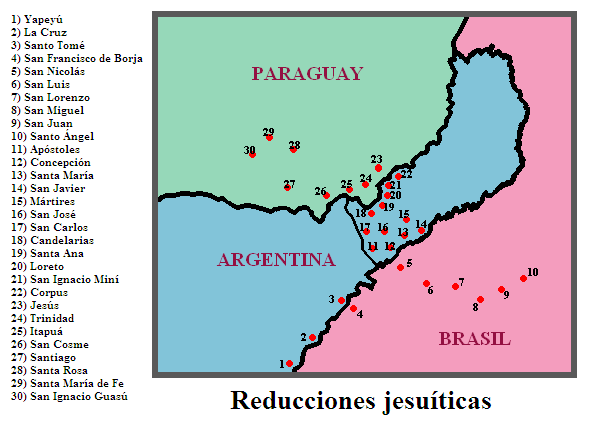
Classical Guarani, also known as Missionary Guarani or Old Guarani, is an extinct variant of the Guarani language. It was spoken in the region of the thirty Jesuit missions among the Guarani (current territories of Paraguay, Argentina and Brazil). The Jesuits studied the language for around 160 years, assigning it a writing system and consolidating several dialects into one unified language. Classical Guarani went extinct gradually after their suppression in 1767.
Despite its extinction, its bibliographical production and that of written documents was rich and is still mostly conserved. Therefore, it is considered an important literary branch in the history of Guarani.
Criollo Guarani has its roots in the Classical Guarani as spoken outside Jesuit missions, once the Society of Jesus was suppressed. Modern scholars have shown that Guarani has always been the main language of the Jesuit Guarani missions and, later on, to the whole Governorate of Paraguay which belonged to the Viceroyalty of the Río de la Plata.
After the expulsion of the Jesuits, the residents of the reductions emigrated gradually towards territories of current Paraguay, Corrientes, Uruguay, Entre Ríos and those to the North of Río Salado. These migratory moves caused a one-sided change in the language, making it stray far from the original dialect that the Jesuits had studied.
Classical Guarani kept away from Hispanicisms, favoring the use of the language's agglutinative nature to coin new terms. This process would often lead to the Jesuits using more complex and synthetic terms to transmit Western concepts. Criollo Guarani, on the other hand, has been characterized by a free influx, unregulated with regards to Hispanicisms which were often incorporated with a minimal phonological adaptation. Thus, the word for communion in Classical Guarani would be Tȗpȃ́rára whereas in Criollo Guarani it is komuño (from Spanish comunión).
Because of the emigration from the reductions, Classical and Criollo got to come to a wide contact with each other. Most speakers abandoned the Classical variant, more complicated and with more rules, in favor of the more practical Criollo.
The consonant phonemes of Classical Guarani are as follows:
Classical Guarani using letters from the Latin alphabet assigned to each phoneme by Jesuit missionaries.
Classical Guarani
Classical Guarani, also known as Missionary Guarani or Old Guarani, is an extinct variant of the Guarani language. It was spoken in the region of the thirty Jesuit missions among the Guarani (current territories of Paraguay, Argentina and Brazil). The Jesuits studied the language for around 160 years, assigning it a writing system and consolidating several dialects into one unified language. Classical Guarani went extinct gradually after their suppression in 1767.
Despite its extinction, its bibliographical production and that of written documents was rich and is still mostly conserved. Therefore, it is considered an important literary branch in the history of Guarani.
Criollo Guarani has its roots in the Classical Guarani as spoken outside Jesuit missions, once the Society of Jesus was suppressed. Modern scholars have shown that Guarani has always been the main language of the Jesuit Guarani missions and, later on, to the whole Governorate of Paraguay which belonged to the Viceroyalty of the Río de la Plata.
After the expulsion of the Jesuits, the residents of the reductions emigrated gradually towards territories of current Paraguay, Corrientes, Uruguay, Entre Ríos and those to the North of Río Salado. These migratory moves caused a one-sided change in the language, making it stray far from the original dialect that the Jesuits had studied.
Classical Guarani kept away from Hispanicisms, favoring the use of the language's agglutinative nature to coin new terms. This process would often lead to the Jesuits using more complex and synthetic terms to transmit Western concepts. Criollo Guarani, on the other hand, has been characterized by a free influx, unregulated with regards to Hispanicisms which were often incorporated with a minimal phonological adaptation. Thus, the word for communion in Classical Guarani would be Tȗpȃ́rára whereas in Criollo Guarani it is komuño (from Spanish comunión).
Because of the emigration from the reductions, Classical and Criollo got to come to a wide contact with each other. Most speakers abandoned the Classical variant, more complicated and with more rules, in favor of the more practical Criollo.
The consonant phonemes of Classical Guarani are as follows:
Classical Guarani using letters from the Latin alphabet assigned to each phoneme by Jesuit missionaries.
Recent media
Recent media