


Community hub
Recent from talks
Contribute something to knowledge base
Content stats: 0 posts, 0 articles, 1 media, 0 notes
Members stats: 0 subscribers, 0 contributors, 0 moderators, 0 supporters
Subscribers
Supporters
Contributors
Moderators
Hub AI
Classical complement pathway AI simulator
(@Classical complement pathway_simulator)
Hub AI
Classical complement pathway AI simulator
(@Classical complement pathway_simulator)
Classical complement pathway
The classical complement pathway is one of three pathways which activate the complement system, which is part of the immune system. The classical complement pathway is initiated by antigen-antibody complexes with the antibody isotypes IgG and IgM.
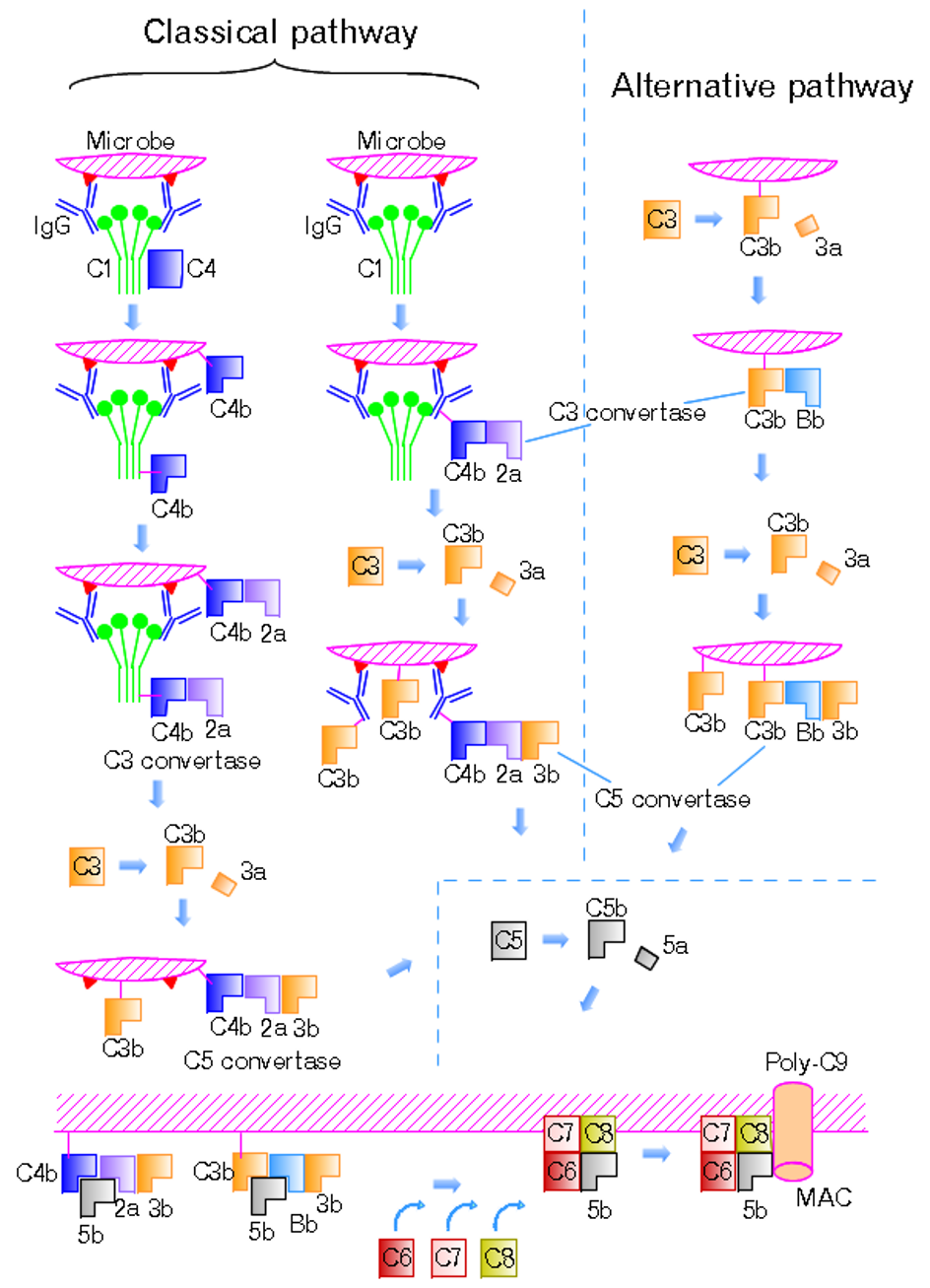
Following activation, a series of proteins are recruited to generate C3 convertase (C4b2b, historically referred C4b2a), which cleaves the C3 protein. The C3b component of the cleaved C3 binds to C3 convertase (C4b2b) to generate C5 convertase (C4b2b3b), which cleaves the C5 protein. The cleaved products attract phagocytes to the site of infection and tags target cells for elimination by phagocytosis. In addition, the C5 convertase initiates the terminal phase of the complement system, leading to the assembly of the membrane attack complex (MAC). The membrane attack complex creates a pore on the target cell's membrane, inducing cell lysis and death.
The classical complement pathway can also be activated by apoptotic cells, necrotic cells, and acute phase proteins.
The classical pathway is distinct from the other complement pathways in its unique activation triggers and cascade sequence. Activation of the complement pathway through the classical, lectin or alternative complement pathway is followed by a cascade of reactions eventually leading to the membrane attack complex.
The classical complement pathway can be initiated by the binding of antigen-antibody complexes to the C1q protein. The globular regions of C1q recognize and bind to the Fc region of antibody isotypes IgG or IgM. These globular regions of C1q can also bind to bacterial and viral surface proteins, apoptotic cells, and acute phase proteins. In the absence of these activation factors, C1q is part of the inactive C1 complex which consists of six molecules of C1q, two molecules of C1r, and two molecules of C1s.
The binding of C1q with pathogen surface or antigen-antibody immune complex leads to conformational changes and the activation of the serine protease C1r. The activated C1r then cleaves and activates the serine protease C1s. Activated C1s cleaves C4 into C4a and C4b.
The newly formed C4b cannot stay activated as a highly reactive thioester bond is revealed once C4 has been cleaved. The thioester bond is cleaved by water resulting in its cleavage permanently deactivating the C4b molecule. As a result of this C4b is restricted to only bind to pathogen surfaces. They would undergo rapid deactivation in the time it took to travel from the origin of activation where C1q is complexed with an antigen-antibody immune complex(IC) or where C1q is directly attached to the pathogens surface.
Surface-bound C4b acts as a receptor for the binding of C2. The binding of C2 and C4b results in C2 being cleaved by C1s into C2a and C2b. C2b diffuses into the plasma as a protein inflammatory mediator while C2a remains attached with C4b, forming the C3-convertase (C4b2a). The function of the membrane-bound C3-convertase is the cleavage of many many molecules of C3 into C3a and C3b. C3a is a smaller fragment of C3 is a potent inflammatory mediator.
Classical complement pathway
The classical complement pathway is one of three pathways which activate the complement system, which is part of the immune system. The classical complement pathway is initiated by antigen-antibody complexes with the antibody isotypes IgG and IgM.
Following activation, a series of proteins are recruited to generate C3 convertase (C4b2b, historically referred C4b2a), which cleaves the C3 protein. The C3b component of the cleaved C3 binds to C3 convertase (C4b2b) to generate C5 convertase (C4b2b3b), which cleaves the C5 protein. The cleaved products attract phagocytes to the site of infection and tags target cells for elimination by phagocytosis. In addition, the C5 convertase initiates the terminal phase of the complement system, leading to the assembly of the membrane attack complex (MAC). The membrane attack complex creates a pore on the target cell's membrane, inducing cell lysis and death.
The classical complement pathway can also be activated by apoptotic cells, necrotic cells, and acute phase proteins.
The classical pathway is distinct from the other complement pathways in its unique activation triggers and cascade sequence. Activation of the complement pathway through the classical, lectin or alternative complement pathway is followed by a cascade of reactions eventually leading to the membrane attack complex.
The classical complement pathway can be initiated by the binding of antigen-antibody complexes to the C1q protein. The globular regions of C1q recognize and bind to the Fc region of antibody isotypes IgG or IgM. These globular regions of C1q can also bind to bacterial and viral surface proteins, apoptotic cells, and acute phase proteins. In the absence of these activation factors, C1q is part of the inactive C1 complex which consists of six molecules of C1q, two molecules of C1r, and two molecules of C1s.
The binding of C1q with pathogen surface or antigen-antibody immune complex leads to conformational changes and the activation of the serine protease C1r. The activated C1r then cleaves and activates the serine protease C1s. Activated C1s cleaves C4 into C4a and C4b.
The newly formed C4b cannot stay activated as a highly reactive thioester bond is revealed once C4 has been cleaved. The thioester bond is cleaved by water resulting in its cleavage permanently deactivating the C4b molecule. As a result of this C4b is restricted to only bind to pathogen surfaces. They would undergo rapid deactivation in the time it took to travel from the origin of activation where C1q is complexed with an antigen-antibody immune complex(IC) or where C1q is directly attached to the pathogens surface.
Surface-bound C4b acts as a receptor for the binding of C2. The binding of C2 and C4b results in C2 being cleaved by C1s into C2a and C2b. C2b diffuses into the plasma as a protein inflammatory mediator while C2a remains attached with C4b, forming the C3-convertase (C4b2a). The function of the membrane-bound C3-convertase is the cleavage of many many molecules of C3 into C3a and C3b. C3a is a smaller fragment of C3 is a potent inflammatory mediator.
Recent media
Recent media