


Community hub
Recent from talks
Contribute something
Nothing was collected or created yet.
Clavariaceae
View on Wikipedia
| Clavariaceae | |
|---|---|

| |
| Clavulinopsis corallinorosacea | |
Scientific classification 
| |
| Kingdom: | Fungi |
| Division: | Basidiomycota |
| Class: | Agaricomycetes |
| Order: | Agaricales |
| Family: | Clavariaceae Chevall. (1826) |
| Type genus | |
| Clavaria | |
| Genera | |
|
Camarophyllopsis | |
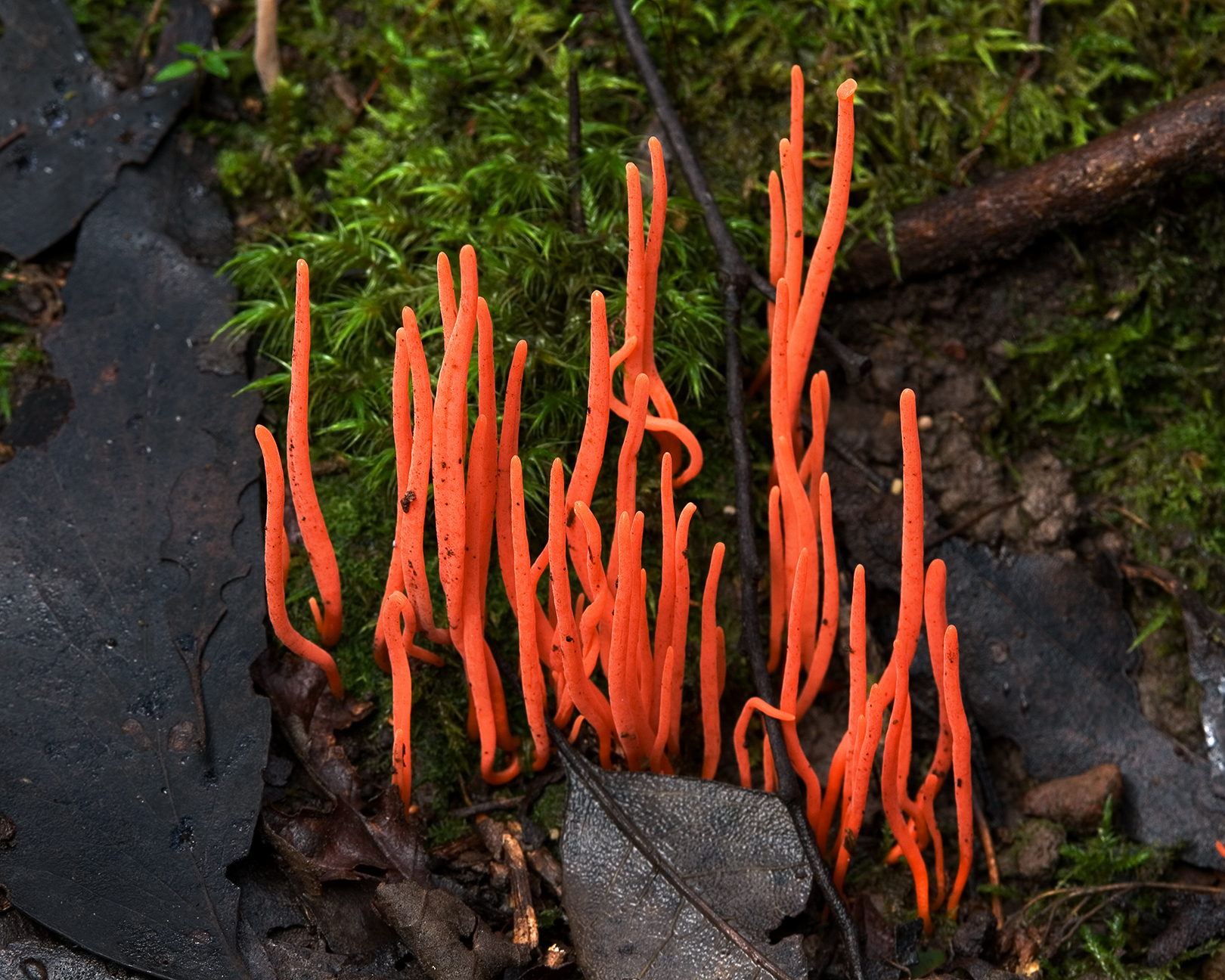
The Clavariaceae are a family of fungi in the order Agaricales. Originally the family contained most of the clavarioid fungi (club and coral fungi), but in its current sense is more restricted, albeit with a greater diversity of basidiocarp (fruit body) forms. Basidiocarps are variously clavarioid or agaricoid (mushroom-shaped), less commonly corticioid (effused, crust-like) or hydnoid (with pendant spines).
Taxonomy
[edit]History
[edit]Clavariaceae was originally circumscribed (as "Clavariae") by French botanist and mycologist François Fulgis Chevallier in 1826.[1] It was one of five families (along with the Agaricaceae, Hydnaceae, Polyporaceae, and Thelephoraceae) that Elias Fries used to divide the Agaricales and Aphyllophorales in his influential work Systema Mycologicum. The family served as a convenient placement for all genera containing species with superficially similar club or coral-like fruitbodies. It was first M.A. Donk and later E.J.H. Corner who realized that, in this broad sense, the family was not a natural phylogenetic assemblage of related species.[2] Corner published his world monograph in 1950 (revised in 1967 and updated in 1970), introducing modern concepts of many genera of clavarioid fungi.[3][4] Corner included three genera in his concept of the Clavariaceae: Clavaria, Clavulinopsis, and Ramariopsis.[3]
Current status
[edit]Molecular research, based on cladistic analysis of DNA sequences, has confirmed Corner's concept of the Clavariaceae, but has extended it to include agarics (gilled mushrooms) in the genera Camarophyllopsis,[5] Hodophilus,[6] and Lamelloclavaria.[7] The clavarioid genera Clavicorona,[8][9] Hirticlavula,[8] and a revised concept of Ceratellopsis[9] are also included, as is the hydnoid genus Mucronella[8][9] and the corticioid genus Hyphodontiella.[10]
_Figure_2a.png)

_Corner_95377_cropped.jpg)


Habitat and distribution
[edit]The family has a worldwide distribution, though many individual species are more localized. Basidiocarps of Hirticlavula, Hyphodontiella, and Mucronella occur on dead wood and are thus normally found in woodland. Species of the remaining genera may also be found in woodland, but in Europe are more typical of old, agriculturally unimproved waxcap grasslands.
Ecology
[edit]Lignicolous species are presumed to be saprotrophic, wood-decaying fungi; Ceratellopsis species occur on dead leaves and litter and are also presumed to be saprotrophic. The remaining members of the Clavariaceae are considered to be biotrophic, a few forming associations with ericaceous plants.[11][12]
See also
[edit]References
[edit]- ^ Chevallier FF. (1826). Flore Générale des Environs de Paris (in French). Vol. 1. Paris, France: Ferra Jeune. p. 102.
- ^ Donk MA. (1964). "A conspectus of the families of Aphyllophorales". Persoonia. 3 (2): 199–324 (see pp. 250–253).
- ^ a b Corner EJH. (1950). A Monograph of Clavaria and Allied Genera. Annals of Botany Memoirs. Vol. 1. Cambridge, UK: Cambridge University Press.
- ^ Corner EJH. (1970). Supplement to 'A Monograph of Clavaria and Allied Genera'. Nova Hedwigia Beihefte. Vol. 33. Lehre, Germany: J. Cramer.
- ^ Matheny PB, Curtis JM, Hofstetter V, Aime MC, Moncalvo JM, Ge ZW, Slot JC, Ammirati JF, Baroni TJ, Bougher NL, Hughes KW, Lodge DJ, Kerrigan RW, Seidl MT, Aanen DK, DeNitis M, Daniele GM, Desjardin DE, Kropp BR, Norvell LL, Parker A, Vellinga EC, Vilgalys R, Hibbett DS (2006). "Major clades of Agaricales: a multilocus phylogenetic overview" (PDF). Mycologia. 98 (6): 982–95. doi:10.3852/mycologia.98.6.982. PMID 17486974. Archived from the original (PDF) on 2016-03-03.
- ^ Adamčík S, Looney BP, Birkebak JM, Jančovičová S, Adamčíková K, Marhold K, Matheny PB (2016). "Circumscription of species of Hodophilus (Clavariaceae, Agaricales) in North America with naphthalene odours". Botany. 94 (10): 941–956. doi:10.1139/cjb-2016-0091. hdl:1807/73893.
- ^ Birkebak JM, Adamčík S, Looney BP, Matheny PB (2016). "Multilocus phylogenetic reconstruction of the Clavariaceae (Agaricales) reveals polyphyly of agaricoid members". Mycologia. 108 (5): 860–868. doi:10.3852/15-370. PMID 27549621. S2CID 21925466.
- ^ a b c Petersen JH, Davey ML, Læssøe T (2014). "Hirticlavula elegans, a new clavarioid fungus from Scandinavia". Karstenia. 54 (1): 1–8. doi:10.29203/ka.2014.459.
- ^ a b c Olariaga I, Huhtinen S, Læssøe T, Petersen JH, Hansen K (2020). "Phylogenetic origins and family classification of typhuloid fungi, with emphasis on Ceratellopsis, Macrotyphula and Typhula (Basidiomycota)". Stud. Mycol. 96: 155–184. doi:10.1016/j.simyco.2020.05.003. PMC 7388190. PMID 32774511.
- ^ Larsson K-H. (2007). "Re-thinking the classification of corticioid fungi". Mycological Research. 111 (9): 1040–63. doi:10.1016/j.mycres.2007.08.001. PMID 17981020.
- ^ Birkebak JM, Mayor JR, Ryberg KM, Matheny PB (2013). "A systematic, morphological and ecological overview of the Clavariaceae (Agaricales)" (PDF). Mycologia. 105 (4): 896–911. doi:10.3852/12-070. PMID 23396156. S2CID 27083890.
- ^ Englander L, Hull RJ (1980). "Reciprocal transfer of nutrients between ericaceous plants and a Clavaria sp". New Phytologist. 84 (4): 661–667. doi:10.1111/j.1469-8137.1980.tb04779.x.
| Authority control databases: National |
|---|
