



Community hub
Recent from talks
Contribute something to knowledge base
Content stats: 0 posts, 0 articles, 1 media, 0 notes
Members stats: 0 subscribers, 0 contributors, 0 moderators, 0 supporters
Subscribers
Supporters
Contributors
Moderators
Hub AI
Clavicle fracture AI simulator
(@Clavicle fracture_simulator)
Hub AI
Clavicle fracture AI simulator
(@Clavicle fracture_simulator)
Clavicle fracture
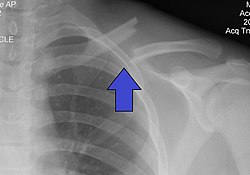
A clavicle fracture, also known as a broken collarbone, is a bone fracture of the clavicle. Symptoms typically include pain at the site of the break and a decreased ability to move the affected arm. Complications can include a collection of air in the pleural space surrounding the lung (pneumothorax), injury to the nerves or blood vessels in the area, and an unpleasant appearance.
It is often caused by a fall onto a shoulder, outstretched arm, or direct trauma. The fracture can also occur in a baby during childbirth. The middle section of the clavicle is most often involved. Diagnosis is typically based on symptoms and confirmed with X-rays.
Clavicle fractures are typically treated by putting the arm in a sling for one or two weeks. Pain medication such as paracetamol (acetaminophen) may be useful. It can take up to five months for the strength of the bone to return to normal. Reasons for surgical repair include an open fracture, involvement of the nerves or blood vessels, or severe displacement in a high-demand individual
Clavicle fractures most commonly occur in people under the age of 25 and those over the age of 70. Among the younger group males are more often affected than females. In adults they make up about 5% of all fractures while in children they represent about 13% of fractures.
Clavicle fractures are commonly known as a breaking of the collarbone, and they are usually a result of injury or trauma. The most common type of fracture occurs when a person falls vertically onto the shoulder or with an outstretched hand. A direct hit to the collarbone can also cause a break. In most cases, the direct hit occurs from the joint side towards the body side of the bone. The muscles involved in clavicle fractures include the deltoid, trapezius, subclavius, sternocleidomastoid, and sternohyoid. The ligaments involved include the conoid ligament and trapezoid ligament. Incidents that may lead to a clavicle fracture include automobile accidents, biking accidents (especially common in mountain biking), vertical falls on the shoulder joint, or contact sports such as football, rugby, hurling, or wrestling.
It is most often fractured in the middle third of its length which is its weakest point. The lateral fragment of the clavicle during a fracture is depressed by the weight of the arm and is pulled downward by the strong abductor muscles of the shoulder joint, especially the deltoid. The part of the clavicle near the center of the body is tilted upwards by the sternocleidomastoid muscle. Children and infants are particularly prone to it. Newborns often present clavicle fractures following a difficult delivery[citation needed].
After fracture of the clavicle, the sternocleidomastoid muscle elevates the medial fragment of the bone. The trapezius muscle is unable to hold up the distal fragment owing to the weight of the upper limb, thus the shoulder droops. The adductor muscles of the arm, such as the pectoralis major, may pull the distal fragment medially, causing the bone fragments to override.[citation needed]
The clavicle is the bone that connects the trunk of the body to the arm, and it is located directly above the first rib. A clavicle is located on each side of the front, upper part of the chest. The clavicle consists of a medial end, a shaft, and a lateral end. The medial end connects with the manubrium of the sternum and gives attachments to the fibrous capsule of the sternoclavicular joint, articular disc, and interclavicular ligament. The lateral end connects at the acromion of the scapula which is referred to as the acromioclavicular joint. The clavicle forms a slight S-shaped curve where it curves from the sternal end laterally and anteriorly for near half its length, then forming a posterior curve to the acromion of the scapula.[citation needed]
Clavicle fracture
A clavicle fracture, also known as a broken collarbone, is a bone fracture of the clavicle. Symptoms typically include pain at the site of the break and a decreased ability to move the affected arm. Complications can include a collection of air in the pleural space surrounding the lung (pneumothorax), injury to the nerves or blood vessels in the area, and an unpleasant appearance.
It is often caused by a fall onto a shoulder, outstretched arm, or direct trauma. The fracture can also occur in a baby during childbirth. The middle section of the clavicle is most often involved. Diagnosis is typically based on symptoms and confirmed with X-rays.
Clavicle fractures are typically treated by putting the arm in a sling for one or two weeks. Pain medication such as paracetamol (acetaminophen) may be useful. It can take up to five months for the strength of the bone to return to normal. Reasons for surgical repair include an open fracture, involvement of the nerves or blood vessels, or severe displacement in a high-demand individual
Clavicle fractures most commonly occur in people under the age of 25 and those over the age of 70. Among the younger group males are more often affected than females. In adults they make up about 5% of all fractures while in children they represent about 13% of fractures.
Clavicle fractures are commonly known as a breaking of the collarbone, and they are usually a result of injury or trauma. The most common type of fracture occurs when a person falls vertically onto the shoulder or with an outstretched hand. A direct hit to the collarbone can also cause a break. In most cases, the direct hit occurs from the joint side towards the body side of the bone. The muscles involved in clavicle fractures include the deltoid, trapezius, subclavius, sternocleidomastoid, and sternohyoid. The ligaments involved include the conoid ligament and trapezoid ligament. Incidents that may lead to a clavicle fracture include automobile accidents, biking accidents (especially common in mountain biking), vertical falls on the shoulder joint, or contact sports such as football, rugby, hurling, or wrestling.
It is most often fractured in the middle third of its length which is its weakest point. The lateral fragment of the clavicle during a fracture is depressed by the weight of the arm and is pulled downward by the strong abductor muscles of the shoulder joint, especially the deltoid. The part of the clavicle near the center of the body is tilted upwards by the sternocleidomastoid muscle. Children and infants are particularly prone to it. Newborns often present clavicle fractures following a difficult delivery[citation needed].
After fracture of the clavicle, the sternocleidomastoid muscle elevates the medial fragment of the bone. The trapezius muscle is unable to hold up the distal fragment owing to the weight of the upper limb, thus the shoulder droops. The adductor muscles of the arm, such as the pectoralis major, may pull the distal fragment medially, causing the bone fragments to override.[citation needed]
The clavicle is the bone that connects the trunk of the body to the arm, and it is located directly above the first rib. A clavicle is located on each side of the front, upper part of the chest. The clavicle consists of a medial end, a shaft, and a lateral end. The medial end connects with the manubrium of the sternum and gives attachments to the fibrous capsule of the sternoclavicular joint, articular disc, and interclavicular ligament. The lateral end connects at the acromion of the scapula which is referred to as the acromioclavicular joint. The clavicle forms a slight S-shaped curve where it curves from the sternal end laterally and anteriorly for near half its length, then forming a posterior curve to the acromion of the scapula.[citation needed]
Recent media
Recent media