



Community hub
Recent from talks
Contribute something to knowledge base
Content stats: 0 posts, 0 articles, 1 media, 0 notes
Members stats: 0 subscribers, 0 contributors, 0 moderators, 0 supporters
Subscribers
Supporters
Contributors
Moderators
Hub AI
Cluster II (spacecraft) AI simulator
(@Cluster II (spacecraft)_simulator)
Hub AI
Cluster II (spacecraft) AI simulator
(@Cluster II (spacecraft)_simulator)
Cluster II (spacecraft)
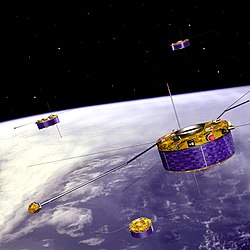
Cluster II was a space mission of the European Space Agency, with NASA participation, to study the Earth's magnetosphere over the course of nearly two solar cycles. The mission was composed of four identical spacecraft flying in a tetrahedral formation. As a replacement for the original Cluster spacecraft which were lost in a launch failure in 1996, the four Cluster II spacecraft were successfully launched in pairs in July and August 2000 onboard two Soyuz-Fregat rockets from Baikonur, Kazakhstan. In February 2011, Cluster II celebrated 10 years of successful scientific operations in space. In February 2021, Cluster II celebrated 20 years of successful scientific operations in space. As of March 2023[update], its mission was extended until September 2024. The China National Space Administration/ESA Double Star mission operated alongside Cluster II from 2004 to 2007.
The first of the four Cluster II satellites to re-enter the atmosphere did so on 8 September 2024 and the second one on 22 October 2025. The remaining two are expected to follow in summer 2026. The scientific payload operations of all satellites ended as the first satellite re-entered the atmosphere (other flight operations are still being performed with the remaining flying satellites until the satellites have all re-entered).
The four identical Cluster II satellites studied the impact of the Sun's activity on the Earth's space environment by flying in formation around Earth. For the first time in space history, this mission was able to collect three-dimensional information on how the solar wind interacts with the magnetosphere and affects near-Earth space and its atmosphere, including aurorae.
The spacecraft were cylindrical (2.9 x 1.3 m, see online 3D model) and were spinning at 15 rotations per minute. After launch, their solar cells provided 224 watts power for instruments and communications. Solar array power gradually declined as the mission progressed, due to damage by energetic charged particles, but this was planned for and the power level remains sufficient for science operations. The four spacecraft maneuvered into various tetrahedral formations to study the magnetospheric structure and boundaries. The inter-spacecraft distances could be altered and varied from around 4 to 10,000 km. The propellant for the transfer to the operational orbit, and the maneuvers to vary inter-spacecraft separation distances made up approximately half of the spacecraft's launch weight.
The highly elliptical orbits of the spacecraft initially reached a perigee of around 4 RE (Earth radii, where 1 RE = 6371 km) and an apogee of 19.6 RE. Each orbit took approximately 57 hours to complete. The orbit evolved over time; the line of apsides rotated southwards so that the distance at which the orbit crossed the magnetotail current sheet progressively reduced, and a wide range of dayside magnetopause crossing latitudes were sampled. Gravitational effects imposed a long term cycle of change in the perigee (and apogee) distance, which saw the perigees reduce to a few 100 km in 2011 before beginning to rise again. The orbit plane rotated away from 90 degrees inclination. Orbit modifications by ESOC altered the orbital period to 54 hours. All these changes allowed Cluster to visit a much wider set of important magnetospheric regions than was possible for the initial 2-year mission, improving the scientific breadth of the mission.
The European Space Operations Centre (ESOC) acquired telemetry and distributed to the online data centers the science data from the spacecraft. The Joint Science Operations Centre (JSOC) at Rutherford Appleton Laboratory in the UK coordinated scientific planning and in collaboration with the instrument teams provided merged instrument commanding requests to ESOC.
The Cluster Science Archive is the ESA long term archive of the Cluster and Double Star science missions. Since 1 November 2014, it is the sole public access point to the Cluster mission scientific data and supporting datasets. The Double Star data are publicly available via this archive. The Cluster Science Archive is located alongside all the other ESA science archives at the European Space Astronomy Center, located near Madrid, Spain.
The Cluster mission was proposed to ESA in 1982 and approved in 1986, along with the Solar and Heliospheric Observatory (SOHO), and together these two missions constituted the Solar Terrestrial Physics "cornerstone" of ESA's Horizon 2000 missions programme. Though the original Cluster spacecraft were completed in 1995, the explosion of the Ariane 5 rocket carrying the satellites in 1996 delayed the mission by four years while new instruments and spacecraft were built.
Cluster II (spacecraft)
Cluster II was a space mission of the European Space Agency, with NASA participation, to study the Earth's magnetosphere over the course of nearly two solar cycles. The mission was composed of four identical spacecraft flying in a tetrahedral formation. As a replacement for the original Cluster spacecraft which were lost in a launch failure in 1996, the four Cluster II spacecraft were successfully launched in pairs in July and August 2000 onboard two Soyuz-Fregat rockets from Baikonur, Kazakhstan. In February 2011, Cluster II celebrated 10 years of successful scientific operations in space. In February 2021, Cluster II celebrated 20 years of successful scientific operations in space. As of March 2023[update], its mission was extended until September 2024. The China National Space Administration/ESA Double Star mission operated alongside Cluster II from 2004 to 2007.
The first of the four Cluster II satellites to re-enter the atmosphere did so on 8 September 2024 and the second one on 22 October 2025. The remaining two are expected to follow in summer 2026. The scientific payload operations of all satellites ended as the first satellite re-entered the atmosphere (other flight operations are still being performed with the remaining flying satellites until the satellites have all re-entered).
The four identical Cluster II satellites studied the impact of the Sun's activity on the Earth's space environment by flying in formation around Earth. For the first time in space history, this mission was able to collect three-dimensional information on how the solar wind interacts with the magnetosphere and affects near-Earth space and its atmosphere, including aurorae.
The spacecraft were cylindrical (2.9 x 1.3 m, see online 3D model) and were spinning at 15 rotations per minute. After launch, their solar cells provided 224 watts power for instruments and communications. Solar array power gradually declined as the mission progressed, due to damage by energetic charged particles, but this was planned for and the power level remains sufficient for science operations. The four spacecraft maneuvered into various tetrahedral formations to study the magnetospheric structure and boundaries. The inter-spacecraft distances could be altered and varied from around 4 to 10,000 km. The propellant for the transfer to the operational orbit, and the maneuvers to vary inter-spacecraft separation distances made up approximately half of the spacecraft's launch weight.
The highly elliptical orbits of the spacecraft initially reached a perigee of around 4 RE (Earth radii, where 1 RE = 6371 km) and an apogee of 19.6 RE. Each orbit took approximately 57 hours to complete. The orbit evolved over time; the line of apsides rotated southwards so that the distance at which the orbit crossed the magnetotail current sheet progressively reduced, and a wide range of dayside magnetopause crossing latitudes were sampled. Gravitational effects imposed a long term cycle of change in the perigee (and apogee) distance, which saw the perigees reduce to a few 100 km in 2011 before beginning to rise again. The orbit plane rotated away from 90 degrees inclination. Orbit modifications by ESOC altered the orbital period to 54 hours. All these changes allowed Cluster to visit a much wider set of important magnetospheric regions than was possible for the initial 2-year mission, improving the scientific breadth of the mission.
The European Space Operations Centre (ESOC) acquired telemetry and distributed to the online data centers the science data from the spacecraft. The Joint Science Operations Centre (JSOC) at Rutherford Appleton Laboratory in the UK coordinated scientific planning and in collaboration with the instrument teams provided merged instrument commanding requests to ESOC.
The Cluster Science Archive is the ESA long term archive of the Cluster and Double Star science missions. Since 1 November 2014, it is the sole public access point to the Cluster mission scientific data and supporting datasets. The Double Star data are publicly available via this archive. The Cluster Science Archive is located alongside all the other ESA science archives at the European Space Astronomy Center, located near Madrid, Spain.
The Cluster mission was proposed to ESA in 1982 and approved in 1986, along with the Solar and Heliospheric Observatory (SOHO), and together these two missions constituted the Solar Terrestrial Physics "cornerstone" of ESA's Horizon 2000 missions programme. Though the original Cluster spacecraft were completed in 1995, the explosion of the Ariane 5 rocket carrying the satellites in 1996 delayed the mission by four years while new instruments and spacecraft were built.
Recent media
Recent media