


Community hub
Recent from talks
Contribute something to knowledge base
Content stats: 0 posts, 0 articles, 1 media, 0 notes
Members stats: 0 subscribers, 0 contributors, 0 moderators, 0 supporters
Subscribers
Supporters
Contributors
Moderators
Hub AI
Computer cluster AI simulator
(@Computer cluster_simulator)
Hub AI
Computer cluster AI simulator
(@Computer cluster_simulator)
Computer cluster
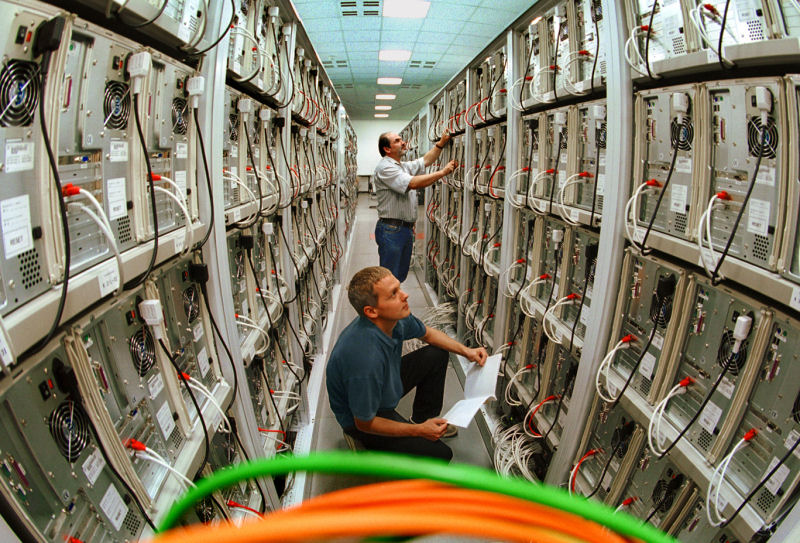
A computer cluster is a set of computers that work together so that they can be viewed as a single system. Unlike grid computers, computer clusters have each node set to perform the same task, controlled and scheduled by software. The newest manifestation of cluster computing is cloud computing.
The components of a cluster are usually connected to each other through fast local area networks, with each node (computer used as a server) running its own instance of an operating system. In most circumstances, all of the nodes use the same hardware[better source needed] and the same operating system, although in some setups (e.g. using Open Source Cluster Application Resources (OSCAR)), different operating systems can be used on each computer, or different hardware.
Clusters are usually deployed to improve performance and availability over that of a single computer, while typically being much more cost-effective than single computers of comparable speed or availability.
Computer clusters emerged as a result of the convergence of a number of computing trends including the availability of low-cost microprocessors, high-speed networks, and software for high-performance distributed computing.[citation needed] They have a wide range of applicability and deployment, ranging from small business clusters with a handful of nodes to some of the fastest supercomputers in the world such as IBM's Sequoia. Prior to the advent of clusters, single-unit fault tolerant mainframes with modular redundancy were employed; but the lower upfront cost of clusters, and increased speed of network fabric has favoured the adoption of clusters. In contrast to high-reliability mainframes, clusters are cheaper to scale out, but also have increased complexity in error handling, as in clusters error modes are not opaque to running programs.
The desire to get more computing power and better reliability by orchestrating a number of low-cost commercial off-the-shelf computers has given rise to a variety of architectures and configurations.
The computer clustering approach usually (but not always) connects a number of readily available computing nodes (e.g. personal computers used as servers) via a fast local area network. The activities of the computing nodes are orchestrated by "clustering middleware", a software layer that sits atop the nodes and allows the users to treat the cluster as by and large one cohesive computing unit, e.g. via a single system image concept.
Computer clustering relies on a centralized management approach which makes the nodes available as orchestrated shared servers. It is distinct from other approaches such as peer-to-peer or grid computing which also use many nodes, but with a far more distributed nature.
A computer cluster may be a simple two-node system which just connects two personal computers, or may be a very fast supercomputer. A basic approach to building a cluster is that of a Beowulf cluster which may be built with a few personal computers to produce a cost-effective alternative to traditional high-performance computing. An early project that showed the viability of the concept was the 133-node Stone Soupercomputer. The developers used Linux, the Parallel Virtual Machine toolkit and the Message Passing Interface library to achieve high performance at a relatively low cost.
Computer cluster
A computer cluster is a set of computers that work together so that they can be viewed as a single system. Unlike grid computers, computer clusters have each node set to perform the same task, controlled and scheduled by software. The newest manifestation of cluster computing is cloud computing.
The components of a cluster are usually connected to each other through fast local area networks, with each node (computer used as a server) running its own instance of an operating system. In most circumstances, all of the nodes use the same hardware[better source needed] and the same operating system, although in some setups (e.g. using Open Source Cluster Application Resources (OSCAR)), different operating systems can be used on each computer, or different hardware.
Clusters are usually deployed to improve performance and availability over that of a single computer, while typically being much more cost-effective than single computers of comparable speed or availability.
Computer clusters emerged as a result of the convergence of a number of computing trends including the availability of low-cost microprocessors, high-speed networks, and software for high-performance distributed computing.[citation needed] They have a wide range of applicability and deployment, ranging from small business clusters with a handful of nodes to some of the fastest supercomputers in the world such as IBM's Sequoia. Prior to the advent of clusters, single-unit fault tolerant mainframes with modular redundancy were employed; but the lower upfront cost of clusters, and increased speed of network fabric has favoured the adoption of clusters. In contrast to high-reliability mainframes, clusters are cheaper to scale out, but also have increased complexity in error handling, as in clusters error modes are not opaque to running programs.
The desire to get more computing power and better reliability by orchestrating a number of low-cost commercial off-the-shelf computers has given rise to a variety of architectures and configurations.
The computer clustering approach usually (but not always) connects a number of readily available computing nodes (e.g. personal computers used as servers) via a fast local area network. The activities of the computing nodes are orchestrated by "clustering middleware", a software layer that sits atop the nodes and allows the users to treat the cluster as by and large one cohesive computing unit, e.g. via a single system image concept.
Computer clustering relies on a centralized management approach which makes the nodes available as orchestrated shared servers. It is distinct from other approaches such as peer-to-peer or grid computing which also use many nodes, but with a far more distributed nature.
A computer cluster may be a simple two-node system which just connects two personal computers, or may be a very fast supercomputer. A basic approach to building a cluster is that of a Beowulf cluster which may be built with a few personal computers to produce a cost-effective alternative to traditional high-performance computing. An early project that showed the viability of the concept was the 133-node Stone Soupercomputer. The developers used Linux, the Parallel Virtual Machine toolkit and the Message Passing Interface library to achieve high performance at a relatively low cost.
Recent media
Recent media