Recent from talks
Contribute something
Nothing was collected or created yet.
Computer cluster
View on Wikipedia


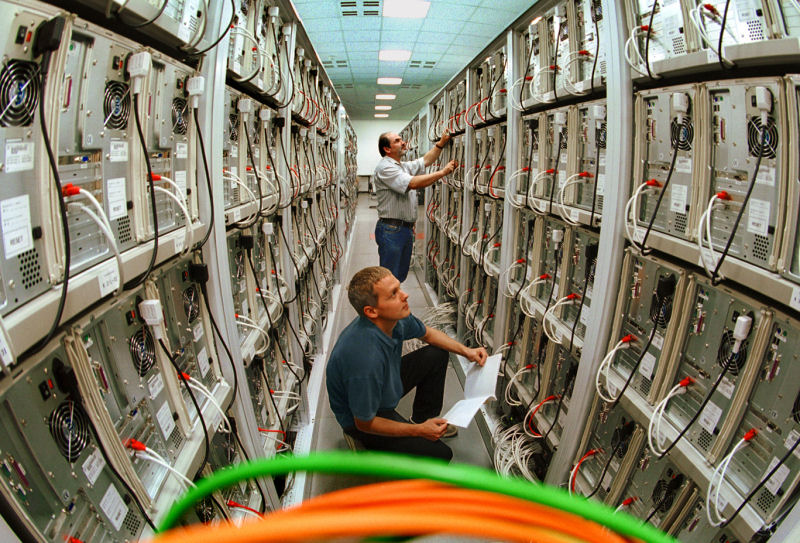
A computer cluster is a set of computers that work together so that they can be viewed as a single system. Unlike grid computers, computer clusters have each node set to perform the same task, controlled and scheduled by software. The newest manifestation of cluster computing is cloud computing.
The components of a cluster are usually connected to each other through fast local area networks, with each node (computer used as a server) running its own instance of an operating system. In most circumstances, all of the nodes use the same hardware[1][better source needed] and the same operating system, although in some setups (e.g. using Open Source Cluster Application Resources (OSCAR)), different operating systems can be used on each computer, or different hardware.[2]
Clusters are usually deployed to improve performance and availability over that of a single computer, while typically being much more cost-effective than single computers of comparable speed or availability.[3]
Computer clusters emerged as a result of the convergence of a number of computing trends including the availability of low-cost microprocessors, high-speed networks, and software for high-performance distributed computing.[citation needed] They have a wide range of applicability and deployment, ranging from small business clusters with a handful of nodes to some of the fastest supercomputers in the world such as IBM's Sequoia.[4] Prior to the advent of clusters, single-unit fault tolerant mainframes with modular redundancy were employed; but the lower upfront cost of clusters, and increased speed of network fabric has favoured the adoption of clusters. In contrast to high-reliability mainframes, clusters are cheaper to scale out, but also have increased complexity in error handling, as in clusters error modes are not opaque to running programs.[5]
Basic concepts
[edit]
The desire to get more computing power and better reliability by orchestrating a number of low-cost commercial off-the-shelf computers has given rise to a variety of architectures and configurations.
The computer clustering approach usually (but not always) connects a number of readily available computing nodes (e.g. personal computers used as servers) via a fast local area network.[6] The activities of the computing nodes are orchestrated by "clustering middleware", a software layer that sits atop the nodes and allows the users to treat the cluster as by and large one cohesive computing unit, e.g. via a single system image concept.[6]
Computer clustering relies on a centralized management approach which makes the nodes available as orchestrated shared servers. It is distinct from other approaches such as peer-to-peer or grid computing which also use many nodes, but with a far more distributed nature.[6]
A computer cluster may be a simple two-node system which just connects two personal computers, or may be a very fast supercomputer. A basic approach to building a cluster is that of a Beowulf cluster which may be built with a few personal computers to produce a cost-effective alternative to traditional high-performance computing. An early project that showed the viability of the concept was the 133-node Stone Soupercomputer.[7] The developers used Linux, the Parallel Virtual Machine toolkit and the Message Passing Interface library to achieve high performance at a relatively low cost.[8]
Although a cluster may consist of just a few personal computers connected by a simple network, the cluster architecture may also be used to achieve very high levels of performance. The TOP500 organization's semiannual list of the 500 fastest supercomputers often includes many clusters, e.g. the world's fastest machine in 2011 was the K computer which has a distributed memory, cluster architecture.[9]
History
[edit]
Greg Pfister has stated that clusters were not invented by any specific vendor but by customers who could not fit all their work on one computer, or needed a backup.[10] Pfister estimates the date as some time in the 1960s. The formal engineering basis of cluster computing as a means of doing parallel work of any sort was arguably invented by Gene Amdahl of IBM, who in 1967 published what has come to be regarded as the seminal paper on parallel processing: Amdahl's Law.
The history of early computer clusters is more or less directly tied to the history of early networks, as one of the primary motivations for the development of a network was to link computing resources, creating a de facto computer cluster.
The first production system designed as a cluster was the Burroughs B5700 in the mid-1960s. This allowed up to four computers, each with either one or two processors, to be tightly coupled to a common disk storage subsystem in order to distribute the workload. Unlike standard multiprocessor systems, each computer could be restarted without disrupting overall operation.

The first commercial loosely coupled clustering product was Datapoint Corporation's "Attached Resource Computer" (ARC) system, developed in 1977, and using ARCnet as the cluster interface. Clustering per se did not really take off until Digital Equipment Corporation released their VAXcluster product in 1984 for the VMS operating system. The ARC and VAXcluster products not only supported parallel computing, but also shared file systems and peripheral devices. The idea was to provide the advantages of parallel processing, while maintaining data reliability and uniqueness. Two other noteworthy early commercial clusters were the Tandem NonStop (a 1976 high-availability commercial product)[11][12] and the IBM S/390 Parallel Sysplex (circa 1994, primarily for business use).
Within the same time frame, while computer clusters used parallelism outside the computer on a commodity network, supercomputers began to use them within the same computer. Following the success of the CDC 6600 in 1964, the Cray 1 was delivered in 1976, and introduced internal parallelism via vector processing.[13] While early supercomputers excluded clusters and relied on shared memory, in time some of the fastest supercomputers (e.g. the K computer) relied on cluster architectures.
Attributes of clusters
[edit]
Computer clusters may be configured for different purposes ranging from general purpose business needs such as web-service support, to computation-intensive scientific calculations. In either case, the cluster may use a high-availability approach. Note that the attributes described below are not exclusive and a "computer cluster" may also use a high-availability approach, etc.
"Load-balancing" clusters are configurations in which cluster-nodes share computational workload to provide better overall performance. For example, a web server cluster may assign different queries to different nodes, so the overall response time will be optimized.[14] However, approaches to load-balancing may significantly differ among applications, e.g. a high-performance cluster used for scientific computations would balance load with different algorithms from a web-server cluster which may just use a simple round-robin method by assigning each new request to a different node.[14]
Computer clusters are used for computation-intensive purposes, rather than handling IO-oriented operations such as web service or databases.[15] For instance, a computer cluster might support computational simulations of vehicle crashes or weather. Very tightly coupled computer clusters are designed for work that may approach "supercomputing".
"High-availability clusters" (also known as failover clusters, or HA clusters) improve the availability of the cluster approach. They operate by having redundant nodes, which are then used to provide service when system components fail. HA cluster implementations attempt to use redundancy of cluster components to eliminate single points of failure. There are commercial implementations of High-Availability clusters for many operating systems. The Linux-HA project is one commonly used free software HA package for the Linux operating system.
Benefits
[edit]Clusters are primarily designed with performance in mind, but installations are based on many other factors. Fault tolerance (the ability of a system to continue operating despite a malfunctioning node) enables scalability, and in high-performance situations, allows for a low frequency of maintenance routines, resource consolidation (e.g., RAID), and centralized management. Advantages include enabling data recovery in the event of a disaster and providing parallel data processing and high processing capacity.[16][17]
In terms of scalability, clusters provide this in their ability to add nodes horizontally. This means that more computers may be added to the cluster, to improve its performance, redundancy and fault tolerance. This can be an inexpensive solution for a higher performing cluster compared to scaling up a single node in the cluster. This property of computer clusters can allow for larger computational loads to be executed by a larger number of lower performing computers.
When adding a new node to a cluster, reliability increases because the entire cluster does not need to be taken down. A single node can be taken down for maintenance, while the rest of the cluster takes on the load of that individual node.
If you have a large number of computers clustered together, this lends itself to the use of distributed file systems and RAID, both of which can increase the reliability and speed of a cluster.
Design and configuration
[edit]
One of the issues in designing a cluster is how tightly coupled the individual nodes may be. For instance, a single computer job may require frequent communication among nodes: this implies that the cluster shares a dedicated network, is densely located, and probably has homogeneous nodes. The other extreme is where a computer job uses one or few nodes, and needs little or no inter-node communication, approaching grid computing.
In a Beowulf cluster, the application programs never see the computational nodes (also called slave computers) but only interact with the "Master" which is a specific computer handling the scheduling and management of the slaves.[15] In a typical implementation the Master has two network interfaces, one that communicates with the private Beowulf network for the slaves, the other for the general purpose network of the organization.[15] The slave computers typically have their own version of the same operating system, and local memory and disk space. However, the private slave network may also have a large and shared file server that stores global persistent data, accessed by the slaves as needed.[15]
A special purpose 144-node DEGIMA cluster is tuned to running astrophysical N-body simulations using the Multiple-Walk parallel tree code, rather than general purpose scientific computations.[18]
Due to the increasing computing power of each generation of game consoles, a novel use has emerged where they are repurposed into High-performance computing (HPC) clusters. Some examples of game console clusters are Sony PlayStation clusters and Microsoft Xbox clusters. Another example of consumer game product is the Nvidia Tesla Personal Supercomputer workstation, which uses multiple graphics accelerator processor chips. Besides game consoles, high-end graphics cards too can be used instead. The use of graphics cards (or rather their GPU's) to do calculations for grid computing is vastly more economical than using CPU's, despite being less precise. However, when using double-precision values, they become as precise to work with as CPU's and are still much less costly (purchase cost).[2]
Computer clusters have historically run on separate physical computers with the same operating system. With the advent of virtualization, the cluster nodes may run on separate physical computers with different operating systems which are painted above with a virtual layer to look similar.[19][citation needed][clarification needed] The cluster may also be virtualized on various configurations as maintenance takes place; an example implementation is Xen as the virtualization manager with Linux-HA.[19]
Data sharing and communication
[edit]Data sharing
[edit]
As the computer clusters were appearing during the 1980s, so were supercomputers. One of the elements that distinguished the three classes at that time was that the early supercomputers relied on shared memory. Clusters do not typically use physically shared memory, while many supercomputer architectures have also abandoned it.
However, the use of a clustered file system is essential in modern computer clusters.[citation needed] Examples include the IBM General Parallel File System, Microsoft's Cluster Shared Volumes or the Oracle Cluster File System.
Message passing and communication
[edit]Two widely used approaches for communication between cluster nodes are MPI (Message Passing Interface) and PVM (Parallel Virtual Machine).[20]
PVM was developed at the Oak Ridge National Laboratory around 1989 before MPI was available. PVM must be directly installed on every cluster node and provides a set of software libraries that paint the node as a "parallel virtual machine". PVM provides a run-time environment for message-passing, task and resource management, and fault notification. PVM can be used by user programs written in C, C++, or Fortran, etc.[20][21]
MPI emerged in the early 1990s out of discussions among 40 organizations. The initial effort was supported by ARPA and National Science Foundation. Rather than starting anew, the design of MPI drew on various features available in commercial systems of the time. The MPI specifications then gave rise to specific implementations. MPI implementations typically use TCP/IP and socket connections.[20] MPI is now a widely available communications model that enables parallel programs to be written in languages such as C, Fortran, Python, etc.[21] Thus, unlike PVM which provides a concrete implementation, MPI is a specification which has been implemented in systems such as MPICH and Open MPI.[21][22]
Cluster management
[edit]
One of the challenges in the use of a computer cluster is the cost of administrating it which can at times be as high as the cost of administrating N independent machines, if the cluster has N nodes.[23] In some cases this provides an advantage to shared memory architectures with lower administration costs.[23] This has also made virtual machines popular, due to the ease of administration.[23]
Task scheduling
[edit]When a large multi-user cluster needs to access very large amounts of data, task scheduling becomes a challenge. In a heterogeneous CPU-GPU cluster with a complex application environment, the performance of each job depends on the characteristics of the underlying cluster. Therefore, mapping tasks onto CPU cores and GPU devices provides significant challenges.[24] This is an area of ongoing research; algorithms that combine and extend MapReduce and Hadoop have been proposed and studied.[24]
Node failure management
[edit]When a node in a cluster fails, strategies such as "fencing" may be employed to keep the rest of the system operational.[25][26] Fencing is the process of isolating a node or protecting shared resources when a node appears to be malfunctioning. There are two classes of fencing methods; one disables a node itself, and the other disallows access to resources such as shared disks.[25]
The STONITH method stands for "Shoot The Other Node In The Head", meaning that the suspected node is disabled or powered off. For instance, power fencing uses a power controller to turn off an inoperable node.[25]
The resources fencing approach disallows access to resources without powering off the node. This may include persistent reservation fencing via the SCSI3, fibre channel fencing to disable the fibre channel port, or global network block device (GNBD) fencing to disable access to the GNBD server.
Software development and administration
[edit]Parallel programming
[edit]Load balancing clusters such as web servers use cluster architectures to support a large number of users and typically each user request is routed to a specific node, achieving task parallelism without multi-node cooperation, given that the main goal of the system is providing rapid user access to shared data. However, "computer clusters" which perform complex computations for a small number of users need to take advantage of the parallel processing capabilities of the cluster and partition "the same computation" among several nodes.[27]
Automatic parallelization of programs remains a technical challenge, but parallel programming models can be used to effectuate a higher degree of parallelism via the simultaneous execution of separate portions of a program on different processors.[27][28]
Debugging and monitoring
[edit]Developing and debugging parallel programs on a cluster requires parallel language primitives and suitable tools such as those discussed by the High Performance Debugging Forum (HPDF) which resulted in the HPD specifications.[21][29] Tools such as TotalView were then developed to debug parallel implementations on computer clusters which use Message Passing Interface (MPI) or Parallel Virtual Machine (PVM) for message passing.
The University of California, Berkeley Network of Workstations (NOW) system gathers cluster data and stores them in a database, while a system such as PARMON, developed in India, allows visually observing and managing large clusters.[21]
Application checkpointing can be used to restore a given state of the system when a node fails during a long multi-node computation.[30] This is essential in large clusters, given that as the number of nodes increases, so does the likelihood of node failure under heavy computational loads. Checkpointing can restore the system to a stable state so that processing can resume without needing to recompute results.[30]
Implementations
[edit]The Linux world supports various cluster software; for application clustering, there is distcc, and MPICH. Linux Virtual Server, Linux-HA – director-based clusters that allow incoming requests for services to be distributed across multiple cluster nodes. MOSIX, LinuxPMI, Kerrighed, OpenSSI are full-blown clusters integrated into the kernel that provide for automatic process migration among homogeneous nodes. OpenSSI, openMosix and Kerrighed are single-system image implementations.
Microsoft Windows computer cluster Server 2003 based on the Windows Server platform provides pieces for high-performance computing like the job scheduler, MSMPI library and management tools.
gLite is a set of middleware technologies created by the Enabling Grids for E-sciencE (EGEE) project.
slurm is also used to schedule and manage some of the largest supercomputer clusters (see top500 list).
Other approaches
[edit]Although most computer clusters are permanent fixtures, attempts at flash mob computing have been made to build short-lived clusters for specific computations. However, larger-scale volunteer computing systems such as BOINC-based systems have had more followers.
See also
[edit]|
Basic concepts Distributed computing |
Specific systems Computer farms |
References
[edit]- ^ "Cluster vs grid computing". Stack Overflow.
- ^ Bader, David; Pennington, Robert (May 2001). "Cluster Computing: Applications". Georgia Tech College of Computing. Archived from the original on 2007-12-21. Retrieved 2017-02-28.
- ^ "Nuclear weapons supercomputer reclaims world speed record for US". The Telegraph. 18 Jun 2012. Archived from the original on 2022-01-12. Retrieved 18 Jun 2012.
- ^ Gray, Jim; Rueter, Andreas (1993). Transaction processing : concepts and techniques. Morgan Kaufmann Publishers. ISBN 978-1558601901.
- ^ a b c Enokido, Tomoya; Barolli, Leonhard; Takizawa, Makoto (23 August 2007). Network-Based Information Systems: First International Conference, NBIS 2007. p. 375. ISBN 978-3-540-74572-3.
- ^ William W. Hargrove, Forrest M. Hoffman and Thomas Sterling (August 16, 2001). "The Do-It-Yourself Supercomputer". Scientific American. Vol. 265, no. 2. pp. 72–79. Retrieved October 18, 2011.
- ^ Hargrove, William W.; Hoffman, Forrest M. (1999). "Cluster Computing: Linux Taken to the Extreme". Linux Magazine. Archived from the original on October 18, 2011. Retrieved October 18, 2011.
- ^ Yokokawa, Mitsuo; et al. (1–3 August 2011). The K computer: Japanese next-generation supercomputer development project. International Symposium on Low Power Electronics and Design (ISLPED). pp. 371–372. doi:10.1109/ISLPED.2011.5993668.
- ^ Pfister, Gregory (1998). In Search of Clusters (2nd ed.). Upper Saddle River, NJ: Prentice Hall PTR. p. 36. ISBN 978-0-13-899709-0.
- ^ Katzman, James A. (1982). "Chapter 29, The Tandem 16: A Fault-Tolerant Computing System". In Siewiorek, Donald P. (ed.). Computer Structure: Principles and Examples. U.S.A.: McGraw-Hill Book Company. pp. 470–485.
- ^ "History of TANDEM COMPUTERS, INC. – FundingUniverse". www.fundinguniverse.com. Retrieved 2023-03-01.
- ^ Hill, Mark Donald; Jouppi, Norman Paul; Sohi, Gurindar (1999). Readings in computer architecture. Gulf Professional. pp. 41–48. ISBN 978-1-55860-539-8.
- ^ a b Sloan, Joseph D. (2004). High Performance Linux Clusters. "O'Reilly Media, Inc.". ISBN 978-0-596-00570-2.
- ^ a b c d Daydé, Michel; Dongarra, Jack (2005). High Performance Computing for Computational Science – VECPAR 2004. Springer. pp. 120–121. ISBN 978-3-540-25424-9.
- ^ "IBM Cluster System : Benefits". IBM. Archived from the original on 29 April 2016. Retrieved 8 September 2014.
- ^ "Evaluating the Benefits of Clustering". Microsoft. 28 March 2003. Archived from the original on 22 April 2016. Retrieved 8 September 2014.
- ^ Hamada, Tsuyoshi; et al. (2009). "A novel multiple-walk parallel algorithm for the Barnes–Hut treecode on GPUs – towards cost effective, high performance N-body simulation". Computer Science – Research and Development. 24 (1–2): 21–31. doi:10.1007/s00450-009-0089-1. S2CID 31071570.
- ^ a b Mauer, Ryan (12 Jan 2006). "Xen Virtualization and Linux Clustering, Part 1". Linux Journal. Retrieved 2 Jun 2017.
- ^ a b c Milicchio, Franco; Gehrke, Wolfgang Alexander (2007). Distributed services with OpenAFS: for enterprise and education. Springer. pp. 339–341. ISBN 9783540366348.
- ^ a b c d e Prabhu, C.S.R. (2008). Grid and Cluster Computing. PHI Learning Pvt. pp. 109–112. ISBN 978-8120334281.
- ^ Gropp, William; Lusk, Ewing; Skjellum, Anthony (1996). "A High-Performance, Portable Implementation of the MPI Message Passing Interface". Parallel Computing. 22 (6): 789–828. CiteSeerX 10.1.1.102.9485. doi:10.1016/0167-8191(96)00024-5.
- ^ a b c Patterson, David A.; Hennessy, John L. (2011). Computer Organization and Design. Elsevier. pp. 641–642. ISBN 978-0-12-374750-1.
- ^ a b K. Shirahata; et al. (30 Nov – 3 Dec 2010). Hybrid Map Task Scheduling for GPU-Based Heterogeneous Clusters. Cloud Computing Technology and Science (CloudCom). pp. 733–740. doi:10.1109/CloudCom.2010.55. ISBN 978-1-4244-9405-7.
- ^ a b c "Alan Robertson Resource fencing using STONITH" (PDF). IBM Linux Research Center, 2010. Archived from the original (PDF) on 2021-01-05.
- ^ Vargas, Enrique; Bianco, Joseph; Deeths, David (2001). Sun Cluster environment: Sun Cluster 2.2. Prentice Hall Professional. p. 58. ISBN 9780130418708.
- ^ a b Aho, Alfred V.; Blum, Edward K. (2011). Computer Science: The Hardware, Software and Heart of It. Springer. pp. 156–166. ISBN 978-1-4614-1167-3.
- ^ Rauber, Thomas; Rünger, Gudula (2010). Parallel Programming: For Multicore and Cluster Systems. Springer. pp. 94–95. ISBN 978-3-642-04817-3.
- ^ Francioni, Joan M.; Pancake, Cherri M. (April 2000). "A Debugging Standard for High-performance computing". Scientific Programming. 8 (2). Amsterdam, Netherlands: IOS Press: 95–108. doi:10.1155/2000/971291. ISSN 1058-9244.
- ^ a b Sloot, Peter, ed. (2003). Computational Science: ICCS 2003: International Conference. pp. 291–292. ISBN 3-540-40195-4.
Further reading
[edit]- Baker, Mark; et al. (11 Jan 2001). "Cluster Computing White Paper". arXiv:cs/0004014.
- Marcus, Evan; Stern, Hal (2000-02-14). Blueprints for High Availability: Designing Resilient Distributed Systems. John Wiley & Sons. ISBN 978-0-471-35601-1.
- Pfister, Greg (1998). In Search of Clusters. Prentice Hall. ISBN 978-0-13-899709-0.
- Buyya, Rajkumar, ed. (1999). High Performance Cluster Computing: Architectures and Systems. Vol. 1. NJ, USA: Prentice Hall. ISBN 978-0-13-013784-5.
- Buyya, Rajkumar, ed. (1999). High Performance Cluster Computing: Architectures and Systems. Vol. 2. NJ, USA: Prentice Hall. ISBN 978-0-13-013785-2.
External links
[edit]- IEEE Technical Committee on Scalable Computing (TCSC)
- Reliable Scalable Cluster Technology, IBM
- Tivoli System Automation Wiki
- Large-scale cluster management at Google with Borg, April 2015, by Abhishek Verma, Luis Pedrosa, Madhukar Korupolu, David Oppenheimer, Eric Tune and John Wilkes
Computer cluster
View on GrokipediaFundamentals
Definition and Principles
A computer cluster is a set of loosely or tightly coupled computers that collaborate to perform computationally intensive tasks, appearing to users as a unified computing resource.[9] These systems integrate multiple independent machines, known as nodes, through high-speed networks to enable coordinated computation beyond the capabilities of a single device.[10] Unlike standalone computers, clusters distribute workloads across nodes to achieve enhanced performance for applications such as scientific simulations, data processing, and large-scale modeling.[9] The foundational principles of computer clusters revolve around parallelism, resource pooling, and high availability. Parallelism involves dividing tasks into smaller subtasks that execute simultaneously across multiple nodes, allowing for faster processing of complex problems by leveraging collective computational power.[9] Resource pooling combines the CPU, memory, and storage capacities of individual nodes into a shared reservoir, accessible via network interconnects, which optimizes utilization and scales resources dynamically to meet demand.[9] High availability is ensured through redundancy, where the failure of one node does not halt operations, as tasks can be redistributed to healthy nodes, minimizing downtime and maintaining continuous service.[11] Key concepts in cluster architecture include the distinction from symmetric multiprocessing (SMP) systems, basic load balancing, and the roles of nodes and head nodes. While SMP involves multiple processors sharing a common memory within a single chassis for tightly integrated parallelism, clusters use distributed memory across independent machines connected by networks, offering greater scalability at the cost of communication overhead.[12] Load balancing distributes workloads evenly among nodes to prevent bottlenecks and maximize efficiency, often managed by software that monitors resource usage and reallocates tasks as needed.[9] In a typical setup, compute nodes perform the core processing, while a head node (or gateway node) orchestrates job scheduling, user access, and system management.[9] Although rooted in 1960s multiprocessing innovations aimed at distributing tasks across machines for reliability and capacity, clusters evolved distinctly from single-system multiprocessors by emphasizing networked, scalable ensembles of commodity hardware.[9][13]Types of Clusters
Computer clusters can be classified based on their degree of coupling, which refers to the level of interdependence between the nodes in terms of hardware and communication. Tightly coupled clusters connect independent nodes with high-speed, low-latency networks to support workloads requiring frequent inter-process communication, such as high-performance computing applications using message-passing interfaces like MPI.[9] In contrast, loosely coupled clusters consist of independent nodes, each with its own memory and processor, communicating via message-passing protocols over a network, which promotes scalability but introduces higher latency.[14] Clusters are also categorized by their primary purpose, reflecting their intended workloads. High-performance computing (HPC) clusters are designed for computationally intensive tasks like scientific simulations and data analysis, aggregating resources to solve complex problems in parallel.[9] Load-balancing clusters distribute incoming requests across multiple nodes to handle high volumes of traffic, commonly used in web services and application hosting to ensure even resource utilization.[15] High-availability (HA) clusters provide redundancy and failover mechanisms, automatically switching to backup nodes during failures to maintain continuous operation for critical applications.[16] Among specialized types, Beowulf clusters represent a cost-effective approach to HPC, utilizing off-the-shelf commodity hardware interconnected via standard networks to form scalable parallel systems without proprietary components.[17] Storage clusters focus on distributed file systems for managing large-scale data, exemplified by Apache Hadoop's HDFS, which replicates data across nodes for fault-tolerant, parallel access in big data environments.[18] Database clusters employ techniques like sharding to partition data horizontally across nodes, enabling scalable query processing and storage for relational or NoSQL databases handling massive datasets.[19] Emerging types include container orchestration clusters, such as those managed by Kubernetes, which automate the deployment, scaling, and networking of containerized applications across a fleet of nodes for microservices architectures.[20] Additionally, AI and machine learning (AI/ML) training clusters are optimized for GPU parallelism, leveraging data parallelism—where model replicas process different data subsets—or model parallelism—where model components are distributed across devices—to accelerate training of large neural networks.[21]Historical Development
Early Innovations
The roots of computer clustering trace back to early multiprocessing systems in the early 1960s, which laid the groundwork for resource sharing and parallel execution concepts essential to later distributed architectures. The Atlas computer, developed at the University of Manchester and operational from 1962, introduced virtual memory and multiprogramming capabilities, allowing multiple programs to run concurrently on a single machine and influencing subsequent designs for scalable computing environments.[22] Similarly, the Burroughs B5000, released in 1961, featured hardware support for multiprogramming and stack-based processing, enabling efficient task switching and serving as a precursor to clustered configurations in its later iterations like the B5700, which supported up to four interconnected systems.[23] In the 1970s and 1980s, advancements in distributed systems and networking propelled clustering toward practical networked implementations, particularly for scientific applications. At Xerox PARC, researchers developed the Alto personal computer in 1973 as part of a vision for distributed personal computing, where multiple workstations collaborated over a local network, fostering innovations in resource pooling across machines.[24] The introduction of Ethernet in 1973 by Robert Metcalfe at Xerox PARC provided a foundational networking protocol for high-speed, shared-medium communication, enabling the interconnection of computers into clusters without proprietary hardware.[25] NASA employed parallel processing systems during this era for demanding space simulations and data processing, such as the Ames Research Center's Illiac-IV starting in the 1970s, an early massively parallel array processor used for complex aerodynamic and orbital computations.[26] The 1990s marked a pivotal shift with the emergence of affordable, commodity-based clusters, democratizing high-performance computing. The Beowulf project, initiated in 1993 by NASA researchers Thomas Sterling and Donald Becker at Goddard Space Flight Center, demonstrated a prototype cluster of off-the-shelf PCs interconnected via Ethernet, achieving parallel processing performance rivaling specialized supercomputers at a fraction of the cost.[27] This approach spurred the development of the first terascale clusters by the late 1990s, where ensembles of hundreds of standard processors delivered sustained teraflops of computational power for scientific workloads.[28] These innovations were primarily motivated by the need to reduce costs compared to expensive mainframes and vector supercomputers, fueled by Moore's Law, which predicted the doubling of transistor density roughly every two years, driving down hardware prices and making scalable clustering economically viable.[29][30]Modern Evolution
The 2000s marked the rise of grid computing, which enabled the aggregation of distributed computational resources across geographically dispersed systems to tackle large-scale problems previously infeasible on single machines.[31] This era also saw the emergence of early cloud computing prototypes, such as Amazon Web Services' Elastic Compute Cloud (EC2) launched in 2006, which provided on-demand virtualized clusters foreshadowing scalable infrastructure-as-a-service models.[32] Milestones in the TOP500 list highlighted cluster advancements, with IBM's Blue Gene/L supercomputer topping the ranking in November 2004 at 70.7 teraflops Rmax, establishing a benchmark for massively parallel, low-power cluster designs that paved the way for petaflop-scale performance by the decade's end.[33] In the 2010s, computer clusters evolved toward hybrid cloud architectures, integrating on-premises systems with public cloud resources to enhance flexibility and resource bursting for high-performance workloads.[34] Containerization revolutionized cluster management, beginning with Docker's open-source release in March 2013, which simplified application packaging and deployment across distributed environments. This was complemented by Kubernetes, introduced by Google in June 2014 as an orchestration platform for automating container scaling and operations in clusters. The proliferation of GPU-accelerated clusters for deep learning gained traction, exemplified by NVIDIA's DGX systems launched in 2016, which integrated multiple GPUs into cohesive units optimized for AI training and inference tasks. The 2020s brought exascale computing to fruition, with the Frontier supercomputer at Oak Ridge National Laboratory achieving 1.102 exaflops Rmax in May 2022, becoming the world's first recognized exascale system and demonstrating cluster scalability beyond 8 million cores.[35] Subsequent systems like Aurora at Argonne National Laboratory (2023) and El Capitan at Lawrence Livermore National Laboratory (2024, 1.742 exaflops Rmax as of November 2024) further advanced exascale capabilities.[36] Amid growing concerns over data center energy consumption contributing to carbon emissions—estimated to account for 1-1.5% of global electricity use—designs increasingly emphasized efficiency, as seen in Frontier's 52.73 gigaflops/watt performance, 32% better than its predecessor.[37] Edge clusters emerged as a key adaptation for Internet of Things (IoT) applications, distributing processing closer to data sources to reduce latency and bandwidth demands in real-time scenarios like smart cities and industrial monitoring.[34] Key trends shaping modern clusters include open-source standardization efforts, such as OpenStack's initial release in 2010, which facilitated interoperable cloud-based cluster management and has since supported hybrid deployments. The COVID-19 pandemic accelerated remote access to high-performance computing (HPC) resources, with international collaborations leveraging virtualized clusters for accelerated drug discovery and epidemiological modeling.[38] Looking ahead, projections indicate the integration of quantum-hybrid clusters by 2030, combining classical nodes with quantum processors to address optimization problems intractable for current systems, driven by advancements from vendors like IBM and Google.[39]Key Characteristics
Performance and Scalability
Performance in computer clusters is primarily evaluated using metrics that capture computational throughput, data movement, and response times. Floating-point operations per second (FLOPS) quantifies the raw arithmetic processing capacity, with modern supercomputer clusters achieving exaFLOPS scales for scientific simulations.[40] Bandwidth measures inter-node data transfer rates, often exceeding 100 GB/s in high-end interconnects like InfiniBand to support parallel workloads, while latency tracks communication delays, typically in the microsecond range, which can bottleneck tightly coupled applications.[40] For AI-oriented clusters, tensor operations per second (TOPS) serves as a key metric, evaluating efficiency in matrix multiplications and neural network inferences; systems like NVIDIA's DGX Spark deliver up to 1,000 TOPS at low-precision formats to handle large-scale models.[41] Scalability assesses how clusters handle increasing computational demands, distinguishing between strong and weak regimes. Strong scaling maintains a fixed problem size while adding processors, yielding speedup governed by Amdahl's Law, which limits gains due to inherently serial components:where is the speedup, the serial fraction of the workload, and the number of processors; for instance, with and , , illustrating diminishing returns from communication overhead as processors increase.[42] Weak scaling proportionally enlarges the problem size with processors, aligning with Gustafson's Law for more optimistic growth:
where speedup approaches for small , enabling near-linear efficiency in scalable tasks like climate modeling, though communication overhead remains a primary bottleneck in distributed clusters.[43][44] Efficiency metrics further contextualize cluster performance by evaluating resource and energy utilization. Cluster utilization rates, defined as the fraction of allocated compute time actively used, often hover below 50% for CPUs in GPU-accelerated jobs and show 15% idle GPU time across workloads, highlighting opportunities for better job scheduling to maximize throughput.[45] Power Usage Effectiveness (PUE), calculated as the ratio of total facility energy to IT equipment energy, benchmarks energy efficiency; efficient HPC data centers achieve PUE values of 1.2 or lower, with leading facilities like NREL's ESIF reaching 1.036 annually, minimizing overhead from cooling and power delivery.[46][47] Node homogeneity, where all compute nodes share identical hardware specifications, enhances overall performance by ensuring balanced load distribution and reducing inconsistencies that degrade speedup in heterogeneous setups.[48]
Reliability and Efficiency
Reliability in computer clusters is fundamentally tied to metrics such as mean time between failures (MTBF), which quantifies the average operational uptime before a component fails, often measured in hours for individual nodes but scaling down significantly in large systems due to the increased failure probability across thousands of components.[49] In practice, MTBF for cluster platforms can drop to minutes or seconds at exascale, prompting designs that incorporate redundancy levels like N+1 configurations, where one extra unit (e.g., power supply or node) ensures continuity if a primary fails, minimizing downtime without full duplication.[50] Checkpointing mechanisms further enhance fault tolerance by periodically saving job states to stable storage, enabling recovery from failures with minimal recomputation; for instance, coordinated checkpointing in parallel applications can restore progress after node crashes, though it introduces I/O overhead that must be balanced against failure rates.[51] Efficiency in clusters encompasses energy consumption models, such as floating-point operations per second (FLOPS) per watt, which measures computational output relative to power draw and has improved dramatically in high-performance computing (HPC) systems.[52] Leading examples include the JEDI supercomputer, achieving 72.7 GFlops/W through efficient architectures like NVIDIA Grace Hopper Superchips, highlighting how specialized hardware boosts energy proportionality.[52] Cooling strategies play a critical role, with air-based systems consuming up to 40% of total energy, while liquid cooling reduces this by directly dissipating heat from components, enabling higher densities and lower overall power usage in dense clusters.[53] Virtualization, used for resource isolation, incurs overheads of 5-15% in performance and power due to hypervisor layers, though lightweight alternatives like containers mitigate this in cloud-based clusters.[54] Balancing node count with interconnect costs presents key trade-offs, as adding nodes enhances parallelism but escalates expenses for high-bandwidth fabrics like InfiniBand, potentially limiting scalability if latency rises disproportionately.[55] Green computing initiatives address these by promoting sustainability; post-2020, the EU Green Deal has influenced data centers through directives mandating energy efficiency and waste heat reuse, aiming to cut sector emissions that contribute about 1% globally.[56] Carbon footprint calculations for clusters factor in operational emissions from power sources and embodied carbon from hardware, with models estimating total impacts via location-specific energy mixes; integration of renewables, such as solar or wind, can reduce this by up to 90% in hybrid setups, as demonstrated in frameworks optimizing workload scheduling around variable supply.[57][58]Advantages and Applications
Core Benefits
Computer clusters provide substantial economic advantages by utilizing commercial off-the-shelf (COTS) hardware, which leverages mass production and economies of scale to significantly lower acquisition and maintenance costs compared to custom-built supercomputers.[59] This approach allows organizations to assemble high-performance systems from readily available components, reducing overall infrastructure expenses while maintaining reliability through proven technologies.[60] Furthermore, clusters support incremental scalability, enabling the addition of nodes without necessitating a complete system overhaul, which optimizes capital expenditure over time.[61] On the functional side, clusters enhance fault tolerance by redistributing workloads across nodes in the event of a failure, achieving high availability levels such as 99.999% uptime essential for mission-critical operations.[62] For parallelizable tasks, they offer linear performance scaling, where computational throughput increases proportionally with the number of added nodes under ideal conditions, maximizing resource utilization.[63] This scalability attribute allows clusters to handle growing demands efficiently without proportional increases in complexity. Broader impacts include the democratization of high-performance computing (HPC), empowering small organizations to access powerful resources previously limited to large institutions through affordable cluster deployments in cloud environments.[64] Clusters also provide flexibility for dynamic workloads by dynamically allocating resources across nodes, adapting to varying computational needs in real time.[9] In modern contexts, edge computing clusters reduce latency by processing data locally at the network periphery, minimizing transmission delays for time-sensitive applications.[65] Additionally, cloud bursting models enable cost-effective scaling during peak loads by temporarily extending on-premises clusters to public clouds using pay-as-you-go pricing, avoiding overprovisioning while controlling expenses.[66]Real-World Use Cases
Computer clusters play a pivotal role in scientific computing, particularly for computationally intensive tasks like weather modeling and genomics analysis. The European Centre for Medium-Range Weather Forecasts (ECMWF) employs a supercomputer facility comprising four clusters with 7,680 compute nodes and over 1 million cores to perform high-resolution numerical weather predictions, enabling accurate forecasts by processing vast datasets of atmospheric data.[67] In genomics, clusters facilitate the automation of next-generation sequencing (NGS) pipelines, where raw sequencing data is processed into annotated genomes using distributed computing resources to handle the high volume of reads generated in large-scale studies.[68] In commercial applications, clusters underpin web hosting, financial modeling, and big data analytics. Google's search engine relies on massive clusters of commodity PCs to manage the enormous workload of indexing and querying the web, ensuring low-latency responses through fault-tolerant software architectures.[69] Financial modeling benefits from high-performance computing (HPC) clusters to simulate complex economic scenarios. Similarly, Netflix leverages GPU-based clusters for training machine learning models in its recommendation engine, processing petabytes of user data to personalize content delivery at scale.[70] Emerging uses of clusters extend to artificial intelligence, autonomous systems, and distributed ledgers. Training large language models like GPT requires GPU clusters scaled to tens of thousands of accelerators for efficient end-to-end model optimization. In autonomous vehicle development, simulation platforms on HPC clusters replicate real-world driving conditions, enabling safe validation of AI-driven navigation through digital twins before physical deployment.[71] For blockchain validation, cluster-based protocols enhance consensus mechanisms, such as random cluster practical Byzantine fault tolerance (RC-PBFT), which reduces communication overhead and improves block propagation efficiency in decentralized networks.[72] Post-2020 developments highlight clusters' role in addressing global challenges, including pandemic modeling and sustainable energy simulations. During the COVID-19 crisis, HPC clusters like those at Oak Ridge National Laboratory's Summit supercomputer powered drug discovery pipelines, screening millions of compounds via ensemble docking to accelerate therapeutic development.[73] In sustainable energy, the National Renewable Energy Laboratory (NREL) utilizes HPC facilities to support 427 modeling projects in FY2024, simulating grid integration for renewables like wind and solar to optimize energy efficiency and reliability.[74]Architecture and Design
Hardware Components
Computer clusters are composed of multiple interconnected nodes, each serving distinct roles to enable parallel processing and data handling. Compute nodes form the core of the cluster, equipped with high-performance central processing units (CPUs), graphics processing units (GPUs) for accelerated workloads, random access memory (RAM), and local storage to execute computational tasks. In high-performance GPU clusters, servers or racks with liquid cooling house the GPUs to manage thermal loads from intensive computations. These nodes are typically rack-mount servers designed for dense packing in data center environments, allowing scalability through the addition of identical or similar units. Storage nodes, often integrated with compute nodes or dedicated, handle data persistence and access, while head or management nodes oversee cluster coordination, job scheduling, and monitoring without participating in heavy computation.[75][76] The storage hierarchy in clusters balances speed, capacity, and accessibility. Local storage on individual nodes, such as hard disk drives (HDDs) or solid-state drives (SSDs), provides fast access for temporary data but lacks sharing across nodes. Shared storage solutions like network-attached storage (NAS) offer file-level access over networks for collaborative environments, whereas storage area networks (SAN) deliver block-level access for high-throughput demands in enterprise settings. Modern clusters increasingly adopt high-throughput NVMe SSD storage for model weights and datasets in GPU-accelerated workloads, alongside other SSDs and non-volatile memory express (NVMe) interfaces to reduce latency and boost I/O performance, enabling NVMe-over-Fabrics (NVMe-oF) for efficient shared storage in distributed systems.[77][78] Power and cooling systems are critical for maintaining hardware reliability in dense configurations. Rack densities in high-performance computing (HPC) clusters can reach 100-140 kW per rack for AI workloads as of 2025, necessitating redundant power supply units (PSUs) configured in N+1 setups, uninterruptible power supplies (UPS), and power distribution units (PDUs) to ensure failover without downtime. Cooling strategies, including air-based and liquid immersion, address heat dissipation from high-density racks, with liquid cooling supporting up to 200 kW per rack for sustained operation. Efficiency trends post-2020 include ARM-based nodes like the Ampere Altra processors, which provide up to 128 cores per socket with lower power consumption compared to traditional x86 architectures, optimizing for constrained environments.[79][80][81][82] Heterogeneous hardware integration enhances cluster versatility for specialized tasks. Field-programmable gate arrays (FPGAs) are incorporated as accelerator nodes alongside CPUs and GPUs, offering reconfigurable logic for low-latency applications like signal processing or cryptography, thereby improving energy efficiency in mixed workloads. This approach allows clusters to scale hardware resources dynamically, adapting to diverse computational needs without uniform node designs.[83][84]Network and Topology Design
In computer clusters, the network serves as the critical interconnect linking compute nodes, enabling efficient data exchange and collective operations essential for parallel processing. High-speed networking for low-latency interconnects is essential in high-performance GPU clusters. Design choices in network types and topologies directly influence overall system performance, balancing factors such as throughput, latency, and scalability to meet the demands of high-performance computing (HPC) and AI workloads.[85] Common network interconnects for clusters include Ethernet, InfiniBand, and Omni-Path, each offering distinct trade-offs in bandwidth and latency. Gigabit and 10 Gigabit Ethernet provide cost-effective, standards-based connectivity suitable for general-purpose clusters, delivering up to 10 Gbps per link with latencies around 5-10 microseconds, though they may introduce higher overhead due to protocol processing.[86] In contrast, InfiniBand excels in low-latency environments, achieving sub-microsecond latencies and bandwidths up to 400 Gbps (NDR) or 800 Gbps (XDR) per port as of 2025, making it ideal for tightly coupled HPC applications where rapid message passing is paramount.[85] Omni-Path, originally developed by Intel and continued by Cornelis Networks, targets similar HPC needs with latencies under 1 microsecond and bandwidths reaching up to 400 Gbps as of 2025, emphasizing high message rates for large-scale simulations while offering better power efficiency than InfiniBand in some configurations.[87][88] These trade-offs arise because Ethernet prioritizes broad compatibility and lower cost at the expense of latency, whereas InfiniBand and Omni-Path optimize for minimal overhead in bandwidth-intensive scenarios, often at higher deployment expenses.[89] Cluster topologies define how these interconnects are arranged to minimize contention and maximize aggregate bandwidth. The fat-tree topology, a multi-level switched hierarchy, is prevalent in HPC clusters for its ability to provide non-blocking communication through redundant paths, ensuring full bisection bandwidth where the total capacity between any two node sets equals the aggregate endpoint bandwidth.[90] In a fat-tree, leaf switches connect directly to nodes, while spine switches aggregate uplinks, scaling efficiently to thousands of nodes without performance degradation.[91] Mesh topologies, by comparison, employ direct or closely connected links between nodes, offering simplicity and low diameter for smaller clusters but potentially higher latency and wiring complexity at scale.[92] Torus topologies, often used in supercomputing, form a grid-like structure with wrap-around connections in multiple dimensions, providing regular, predictable paths that support efficient nearest-neighbor communication in scientific simulations, though they may underutilize bandwidth in irregular traffic patterns.[93] Switch fabrics in these topologies, such as Clos networks underlying fat-trees, enable non-blocking operation by oversubscribing ports judiciously to avoid hotspots.[94] Key design considerations include bandwidth allocation to prevent bottlenecks, quality of service (QoS) mechanisms for mixed workloads, and support for Remote Direct Memory Access (RDMA) to achieve low-latency transfers. In fat-tree or torus designs, bandwidth is allocated hierarchically, with higher-capacity links at aggregation levels to match traffic volumes, ensuring equitable distribution across nodes.[95] QoS features, such as priority queuing and congestion notification, prioritize latency-sensitive tasks like AI training over bulk transfers in heterogeneous environments.[96] RDMA enhances this by allowing direct memory-to-memory transfers over the network, bypassing CPU involvement to reduce latency to under 2 microseconds and boost effective throughput in bandwidth-allocated paths.[97] Recent advancements address escalating demands in AI-optimized clusters, including 800G Ethernet and emerging 1.6 Tbps standards for scalable, high-throughput fabrics alongside 400G Ethernet, and NVLink for intra- and inter-node GPU connectivity. 400G Ethernet extends traditional Ethernet's reach into HPC by delivering 400 Gbps per port with RDMA over Converged Ethernet (RoCE), enabling non-blocking topologies in large-scale deployments while maintaining compatibility with existing infrastructure.[86] NVLink, NVIDIA's high-speed interconnect, provides up to 1.8 TB/s (1800 GB/s) bidirectional bandwidth per GPU for recent generations like Blackwell as of 2025, extending via switches for all-to-all communication across clusters, optimizing AI workloads by minimizing data movement latency in multi-GPU fabrics.[98][99]| Interconnect Type | Typical Bandwidth (per port) | Latency (microseconds) | Primary Use Case |
|---|---|---|---|
| Ethernet (10G/800G) | 10-800 Gbps | 5-2 | Cost-effective scaling in mixed HPC/AI |
| InfiniBand | 100-800 Gbps | <1 | Low-latency HPC simulations |
| Omni-Path | 100-400 Gbps | <1 | High-message-rate large-scale computing |
Data and Communication
Shared Storage Methods
Shared storage methods in computer clusters enable multiple nodes to access and manage data collectively, facilitating high-performance computing and distributed applications by providing a unified view of storage resources. These methods typically involve network-attached or fabric-based architectures that abstract underlying hardware, allowing scalability while addressing data locality and access latency. Centralized approaches, such as Storage Area Networks (SANs), connect compute nodes to a dedicated pool of storage devices via high-speed fabrics like Fibre Channel, offering block-level access suitable for databases and virtualized environments.[100] In contrast, distributed architectures spread storage across cluster nodes, enhancing fault tolerance and parallelism through software-defined systems.[101] Key file system protocols include the Network File System (NFS), which provides a client-server model for mounting remote directories over TCP/IP, enabling seamless file sharing in clusters but often limited by single-server bottlenecks in large-scale deployments.[102] For parallel access, the Parallel Virtual File System (PVFS) stripes data across multiple disks and nodes, supporting collective I/O operations that improve throughput for scientific workloads on Linux clusters.[103] Distributed object-based systems like Ceph employ a RADOS (Reliable Autonomic Distributed Object Store) layer to manage self-healing storage pools, presenting data via block, file, or object interfaces with dynamic metadata distribution.[104] Similarly, GlusterFS aggregates local disks into a scale-out namespace using elastic hashing for file distribution, ideal for unstructured data in cloud environments without a central metadata server.[105] In big data ecosystems, the Hadoop Distributed File System (HDFS) replicates large files across nodes for fault tolerance, optimizing for sequential streaming reads in MapReduce jobs.[101] Consistency models in these systems balance availability and performance, with strong consistency ensuring linearizable operations where reads reflect the latest writes across all nodes, as seen in SANs and NFS with locking mechanisms.[106] Eventual consistency, prevalent in distributed filesystems like Ceph and HDFS, allows temporary divergences resolved through background synchronization, prioritizing scalability for write-heavy workloads.[107] These models trade off strict ordering for higher throughput, with applications selecting based on tolerance for staleness. Challenges in shared storage include I/O bottlenecks arising from network contention and metadata overhead, which can degrade performance in high-concurrency scenarios; mitigation often involves striping and caching strategies.[108] Data replication enhances fault tolerance by maintaining multiple copies across nodes, as in HDFS's default three-replica policy or Ceph's CRUSH algorithm for placement, but increases storage overhead and synchronization costs.[109] Object storage addresses unstructured data like media and logs by treating files as immutable blobs with rich metadata, enabling efficient scaling in systems like Ceph without hierarchical directories.[110] Emerging trends include serverless storage in cloud clusters, where elastic object stores like InfiniStore decouple compute from provisioned capacity, automatically scaling for bursty workloads via stateless functions.[111] Integration of NVMe-over-Fabrics (NVMe-oF) extends low-latency NVMe semantics over Ethernet or InfiniBand, reducing protocol overhead in disaggregated clusters for up to 10x bandwidth improvements in remote access.[112]Message-Passing Protocols
Message-passing protocols enable inter-node communication in computer clusters by facilitating the exchange of data between processes running on distributed nodes, typically over high-speed networks. These protocols abstract the underlying hardware, allowing developers to implement parallel algorithms without direct management of low-level network details. The primary standards for such communication are the Message Passing Interface (MPI) and the earlier Parallel Virtual Machine (PVM), which have shaped cluster computing since the 1990s.[113] The Message Passing Interface (MPI) is a de facto standard for message-passing in parallel computing, initially released in version 1.0 in 1994 by the MPI Forum, a consortium of over 40 organizations including academic institutions and vendors. Subsequent versions expanded its capabilities: MPI-1.1 (1995) refined the initial specification; MPI-2.0 (1997) introduced remote memory operations and dynamic process management; MPI-2.1 (2008) and MPI-2.2 (2009) addressed clarifications; MPI-3.0 (2012) enhanced non-blocking collectives and one-sided communication; MPI-3.1 (2015) added support for partitioned communication; MPI-4.0 (2021) improved usability for heterogeneous systems; MPI-4.1 (2023) provided corrections and clarifications; and MPI-5.0 (2025) introduced major enhancements including persistent handles, session management, and improved support for scalable and heterogeneous environments.[114] MPI supports both point-to-point and collective operations, with semantics ensuring portability across diverse cluster architectures.[115] In contrast, the Parallel Virtual Machine (PVM), developed in the early 1990s at Oak Ridge National Laboratory, provided a framework for heterogeneous networked computing by treating a cluster as a single virtual machine. PVM version 3, released in 1993, offered primitives for task spawning, messaging, and synchronization, but it was superseded by MPI due to the latter's standardization and performance advantages; PVM's last major update was around 2000, and it is now largely archival.[113][116] MPI's core paradigms distinguish between point-to-point operations, which involve direct communication between two processes, and collective operations, which coordinate multiple processes for efficient group-wide data exchange. Point-to-point operations include blocking sends (e.g.,MPI_Send) that wait for receipt completion and non-blocking variants (e.g., MPI_Isend) that return immediately to allow overlap with computation. Collective operations, such as broadcast (MPI_Bcast) for distributing data from one process to all others or reduce (MPI_Reduce) for aggregating results (e.g., sum or maximum), require all processes in a communicator to participate and are optimized for topology-aware execution to minimize latency.[117][118]
Messaging in MPI can be synchronous or asynchronous, impacting performance and synchronization. Synchronous modes (e.g., MPI_Ssend) ensure completion only after the receiver has posted a matching receive, providing rendezvous semantics to avoid buffer overflows but introducing potential stalls. Asynchronous modes decouple sending from completion, using requests (e.g., MPI_Wait) to check progress, which enables better overlap in latency-bound clusters but requires careful management to prevent deadlocks.[117][119]
Popular open-source implementations of MPI include Open MPI and MPICH, both conforming to MPI-5.0 and supporting advanced features like fault tolerance and GPU integration. Open MPI, initiated in 2004 by a consortium including Cisco and IBM, emphasizes modularity via its Modular Component Architecture (MCA) for runtime plugin selection, achieving up to 95% of native network bandwidth in benchmarks. MPICH, originating from Argonne National Laboratory in 1993, prioritizes portability and performance, with derivatives like Intel MPI widely used in many top supercomputers, including several in the TOP500 list as of 2023.[120][121]
Overhead in these implementations varies significantly with message size: for small messages (<1 KB), latency dominates due to protocol setup and synchronization, often adding 1-2 μs in non-data communication costs on InfiniBand networks, limiting throughput to thousands of messages per second. For large messages (>1 MB), bandwidth utilization prevails, with overheads below 5% on optimized paths, enabling gigabytes-per-second transfers but sensitive to network contention. These characteristics guide algorithm design, favoring collectives for small data dissemination to amortize setup costs.[122][123]
In modern AI and GPU-accelerated clusters, the NVIDIA Collective Communications Library (NCCL), released in 2017, extends MPI-like collectives for multi-GPU environments, supporting operations like all-reduce optimized for NVLink and InfiniBand with up to 10x speedup over CPU-based MPI for deep learning workloads. NCCL integrates with MPI via bindings, allowing hybrid CPU-GPU messaging in scales exceeding 1,000 GPUs.[124][125]
