



Community hub
Recent from talks
Knowledge base stats:
Talk channels stats:
Members stats:
Clyde Tombaugh
Clyde William Tombaugh (/ˈtɒmbaʊ/; February 4, 1906 – January 17, 1997) was an American astronomer and telescope maker, best known for discovering Pluto in 1930, marking the first detection of what would eventually be recognized as the Kuiper belt. At the time, Pluto was referred to as the ninth planet in the Solar System, a classification that stood for over seven decades.
Born in Illinois, and raised on farms in Kansas, Tombaugh was largely self-educated in astronomy and optical engineering, building his own telescopes from spare parts and grinding lenses by hand. His skill and determination led to a position at Lowell Observatory in Flagstaff, Arizona, where he conducted photographic surveys of the night sky. In addition to Pluto, Tombaugh identified hundreds of asteroids and a variety of star clusters, galaxies, and variable stars, thereby contributing significantly to the cataloguing of the night sky.
As a professor at New Mexico State University, he led the Planetary Patrol project, which helped determine Mercury's rotation period, monitored Jupiter's Great Red Spot, and developed new photographic techniques for satellite searches. After retiring in 1973, Tombaugh continued to construct telescopes, support observational programs, and advocated continued study of unidentified flying objects (UFOs).
Tombaugh was born in Streator, Illinois, son of Muron Dealvo Tombaugh, a farmer of Pennsylvania Dutch descent, and his wife Adella Pearl Chritton on February 4, 1906. He was the first of six children in the family with his sister, Esther being born 2+1⁄2 years after Clyde followed by his brother Roy in 1912, Charles in 1914, Robert in 1923 and Anita Rachel in 1929. Tombaugh's interest in astronomy appears to have begun when he visited the Yerkes Observatory in Lake Geneva, Wisconsin when he was 12 years old in 1918. His uncle Lee also helped spark his interest in astronomy as he was an amateur astronomer who used a 3-inch (76 mm) diameter non-achromatic refractor telescope and gave him several astronomy-related books.
The family's poor finances, due to years of bad weather on the farm and a bad corn harvest in 1921, caused them to move to a new farm in Burdett, Kansas in 1922. As the family had moved to the farm in August 1922 and the crops needed to be prepared urgently, Tombaugh had to drop out of high school for a year to help his father prepare the crops on the family farm. Tombaugh graduated from high school in 1925. Tombaugh's plans for attending college were frustrated when a hailstorm in June 1928 ruined his family's farm crops. Tombaugh read an article in Popular Astronomy in 1924 by an amateur astronomer named Latimer J. Wilson, titled "The Drift of Jupiter's Markings" showing sketches of Jupiter and decided he wanted to make his own telescope so he could see the features shown on Jupiter in sketches.
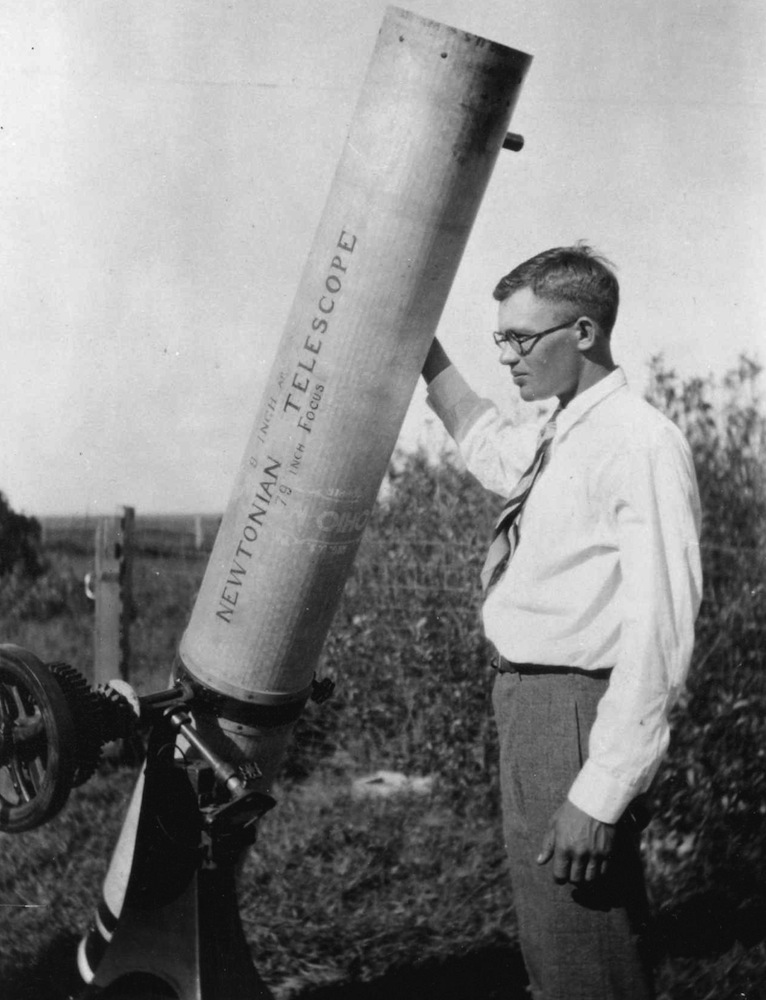
Beginning in 1926, he built several telescopes with lenses and mirrors by himself. To better test his telescope mirrors, Tombaugh, with just a pick and shovel, dug a pit 24 feet long, 8 feet deep, and 7 feet wide. This provided a constant air temperature, free of air currents, and was also used by the family as a root cellar and emergency shelter. He sent drawings of Jupiter and Mars to the Lowell Observatory, at Flagstaff, Arizona, which offered him a job. Tombaugh worked there from 1929 to 1945.
It was at Lowell in 1930 that Tombaugh discovered Pluto. Following his discovery, Tombaugh earned bachelor's and master's degrees in astronomy from the University of Kansas in 1936 and 1938. While a young researcher working for the Lowell Observatory in Flagstaff, Arizona, Tombaugh was given the job to perform a systematic search for a trans-Neptunian planet (also called Planet X), which had been predicted by Percival Lowell based on calculations performed by his student mathematician Elizabeth Williams and William Pickering.
Starting April 6, 1929, Tombaugh used the observatory's 13-inch (330 mm) astrograph to take photographs of the same section of sky several nights apart. He then used a blink comparator to compare the different images. When he shifted between the two images, a moving object, such as a planet, would appear to jump from one position to another, while the more distant objects such as stars would appear stationary. Tombaugh noticed such a moving object in his search, near the place predicted by Lowell, and subsequent observations showed it to have an orbit beyond that of Neptune. This ruled out classification as an asteroid, and they decided this was the ninth planet that Lowell had predicted. The discovery was made on Tuesday, February 18, 1930, using images taken the previous month.
Hub AI
Clyde Tombaugh AI simulator
(@Clyde Tombaugh_simulator)
Clyde Tombaugh
Clyde William Tombaugh (/ˈtɒmbaʊ/; February 4, 1906 – January 17, 1997) was an American astronomer and telescope maker, best known for discovering Pluto in 1930, marking the first detection of what would eventually be recognized as the Kuiper belt. At the time, Pluto was referred to as the ninth planet in the Solar System, a classification that stood for over seven decades.
Born in Illinois, and raised on farms in Kansas, Tombaugh was largely self-educated in astronomy and optical engineering, building his own telescopes from spare parts and grinding lenses by hand. His skill and determination led to a position at Lowell Observatory in Flagstaff, Arizona, where he conducted photographic surveys of the night sky. In addition to Pluto, Tombaugh identified hundreds of asteroids and a variety of star clusters, galaxies, and variable stars, thereby contributing significantly to the cataloguing of the night sky.
As a professor at New Mexico State University, he led the Planetary Patrol project, which helped determine Mercury's rotation period, monitored Jupiter's Great Red Spot, and developed new photographic techniques for satellite searches. After retiring in 1973, Tombaugh continued to construct telescopes, support observational programs, and advocated continued study of unidentified flying objects (UFOs).
Tombaugh was born in Streator, Illinois, son of Muron Dealvo Tombaugh, a farmer of Pennsylvania Dutch descent, and his wife Adella Pearl Chritton on February 4, 1906. He was the first of six children in the family with his sister, Esther being born 2+1⁄2 years after Clyde followed by his brother Roy in 1912, Charles in 1914, Robert in 1923 and Anita Rachel in 1929. Tombaugh's interest in astronomy appears to have begun when he visited the Yerkes Observatory in Lake Geneva, Wisconsin when he was 12 years old in 1918. His uncle Lee also helped spark his interest in astronomy as he was an amateur astronomer who used a 3-inch (76 mm) diameter non-achromatic refractor telescope and gave him several astronomy-related books.
The family's poor finances, due to years of bad weather on the farm and a bad corn harvest in 1921, caused them to move to a new farm in Burdett, Kansas in 1922. As the family had moved to the farm in August 1922 and the crops needed to be prepared urgently, Tombaugh had to drop out of high school for a year to help his father prepare the crops on the family farm. Tombaugh graduated from high school in 1925. Tombaugh's plans for attending college were frustrated when a hailstorm in June 1928 ruined his family's farm crops. Tombaugh read an article in Popular Astronomy in 1924 by an amateur astronomer named Latimer J. Wilson, titled "The Drift of Jupiter's Markings" showing sketches of Jupiter and decided he wanted to make his own telescope so he could see the features shown on Jupiter in sketches.
Beginning in 1926, he built several telescopes with lenses and mirrors by himself. To better test his telescope mirrors, Tombaugh, with just a pick and shovel, dug a pit 24 feet long, 8 feet deep, and 7 feet wide. This provided a constant air temperature, free of air currents, and was also used by the family as a root cellar and emergency shelter. He sent drawings of Jupiter and Mars to the Lowell Observatory, at Flagstaff, Arizona, which offered him a job. Tombaugh worked there from 1929 to 1945.
It was at Lowell in 1930 that Tombaugh discovered Pluto. Following his discovery, Tombaugh earned bachelor's and master's degrees in astronomy from the University of Kansas in 1936 and 1938. While a young researcher working for the Lowell Observatory in Flagstaff, Arizona, Tombaugh was given the job to perform a systematic search for a trans-Neptunian planet (also called Planet X), which had been predicted by Percival Lowell based on calculations performed by his student mathematician Elizabeth Williams and William Pickering.
Starting April 6, 1929, Tombaugh used the observatory's 13-inch (330 mm) astrograph to take photographs of the same section of sky several nights apart. He then used a blink comparator to compare the different images. When he shifted between the two images, a moving object, such as a planet, would appear to jump from one position to another, while the more distant objects such as stars would appear stationary. Tombaugh noticed such a moving object in his search, near the place predicted by Lowell, and subsequent observations showed it to have an orbit beyond that of Neptune. This ruled out classification as an asteroid, and they decided this was the ninth planet that Lowell had predicted. The discovery was made on Tuesday, February 18, 1930, using images taken the previous month.