



Community hub
Recent from talks
Knowledge base stats:
Talk channels stats:
Members stats:
Cochlear implant
A cochlear implant (CI) is a surgically implanted neuroprosthesis that provides a person who has moderate-to-profound sensorineural hearing loss with sound perception. With the help of therapy, cochlear implants may allow for improved speech understanding in both quiet and noisy environments. A CI bypasses acoustic hearing by direct electrical stimulation of the auditory nerve. Through everyday listening and auditory training, cochlear implants allow both children and adults to learn to interpret those signals as speech and sound.
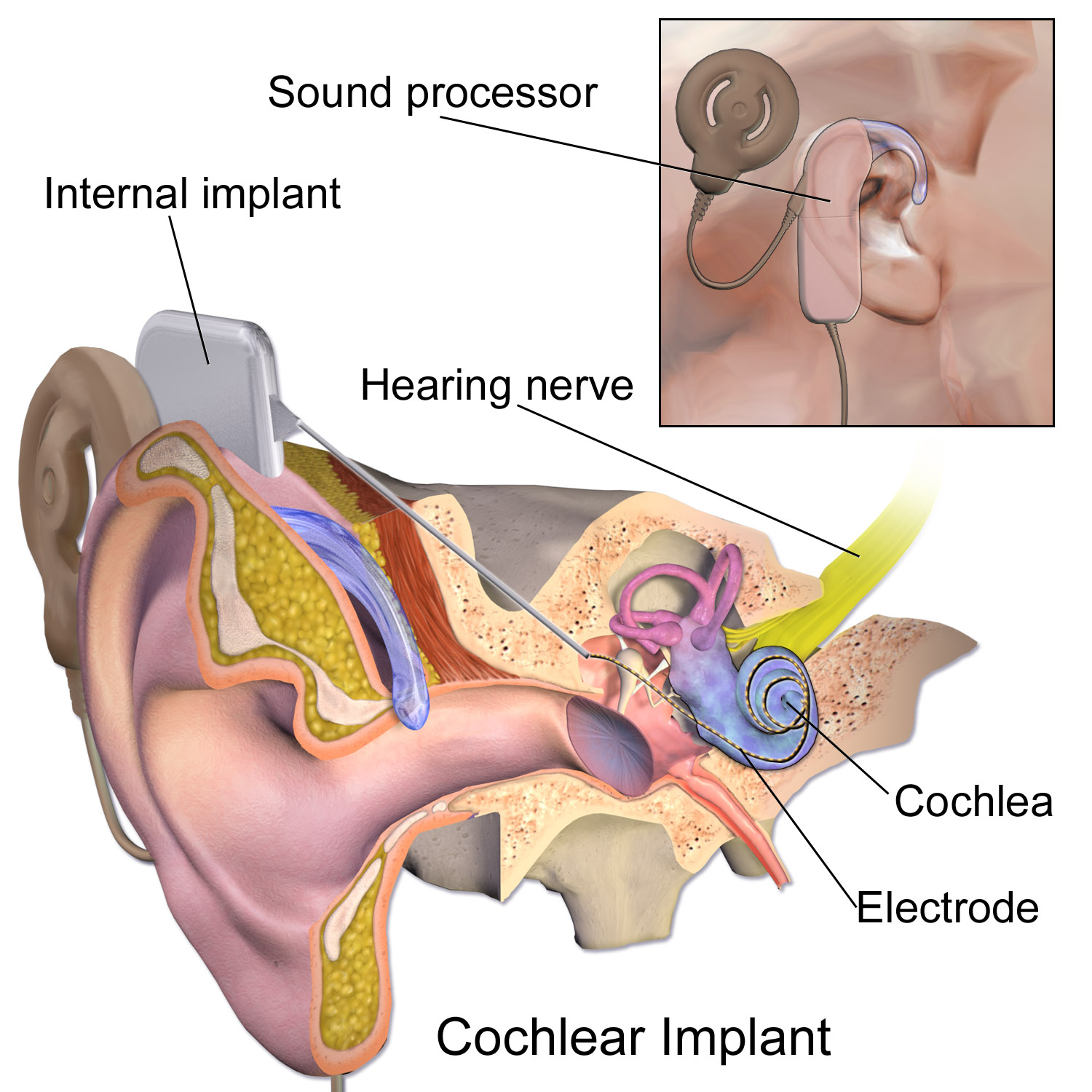
The implant has two main components. The outside component is generally worn behind the ear, but could also be attached to clothing, for example, in young children. This component, the sound processor, contains microphones, electronics that include digital signal processor (DSP) chips, battery, and a coil that transmits a signal to the implant across the skin. The inside component, the actual implant, has a coil to receive signals, electronics, and an array of electrodes which is placed into the cochlea, which stimulate the cochlear nerve.
The surgical procedure is performed under general anesthesia. Surgical risks are minimal and most individuals will undergo outpatient surgery and go home the same day. However, some individuals will experience dizziness, and on rare occasions, tinnitus or facial nerve bruising.
From the early days of implants in the 1970s and the 1980s, speech perception via an implant has steadily increased. More than 200,000 people in the United States had received a CI through 2019. Many users of modern implants gain reasonable to good hearing and speech perception skills post-implantation, especially when combined with lipreading. One of the challenges that remain with these implants is that hearing and speech understanding skills after implantation show a wide range of variation across individual implant users. Factors such as age of implantation, parental involvement and education level, duration and cause of hearing loss, how the implant is situated in the cochlea, the overall health of the cochlear nerve, and individual capabilities of re-learning are considered to contribute to this variation.
André Djourno and Charles Eyriès invented the original cochlear implant in 1957. Their design distributed stimulation using a single channel.
William House also invented a cochlear implant in 1961. In 1964, Blair Simmons and Robert L. White implanted a single-channel electrode in a patient's cochlea at Stanford University. However, research indicated that these single-channel cochlear implants were of limited usefulness because they cannot stimulate different areas of the cochlea at different times to allow differentiation between low and mid to high frequencies as required for detecting speech.
The next step in the development of the CI was its clinical trial on a cohort of patients. In the late 1960's Robin Michelson and colleague Melvin Bartz construct a cochlear device with biocompatible materials that can be implanted in human patients. This system is implanted in 4 patients, and the report of the hearing results represent a watershed for clinically applicable cochlear implants. Robin Michelson, Robert Schindler, and Michael Merzenich at the University of California, San Francisco, conducted these experiments in 1970 and 1971. Michelson, a clinical pioneer, and Merzenich, a talented basic scientist with a solid foundation in neurophysiology, was an integral element in the development of the UCSF cochlear implant team. Michelson was recognized for implanting a single-channel device into a congenitally deaf woman. She demonstrated auditory sensations from stimulation, as well as pitch perception for stimulus frequencies less than 600 Hz. Unfortunately, This patient had no word recognition. His pioneering work was presented, but not well-received at the 1971 annual meeting of the American Otological Society (Michelson, 1971 and Merzenich et al., 1973). In 1973, the first international conference on the "electrical stimulation of the acoustic nerve as a treatment for profound sensorineural deafness in man" was organized in San Francisco.
NASA engineer Adam Kissiah started working in the mid-1970s on what would become the modern cochlear implant. Kissiah used his knowledge learned while working as an electronics instrumentation engineer for NASA. This work took place over three years, when Kissiah would spend his lunch breaks and evenings in Kennedy Space Center's technical library, studying the impact of engineering principles on the inner ear. In 1977, NASA helped Kissiah obtain a patent for the cochlear implant; Kissiah later sold the patent rights.
Hub AI
Cochlear implant AI simulator
(@Cochlear implant_simulator)
Cochlear implant
A cochlear implant (CI) is a surgically implanted neuroprosthesis that provides a person who has moderate-to-profound sensorineural hearing loss with sound perception. With the help of therapy, cochlear implants may allow for improved speech understanding in both quiet and noisy environments. A CI bypasses acoustic hearing by direct electrical stimulation of the auditory nerve. Through everyday listening and auditory training, cochlear implants allow both children and adults to learn to interpret those signals as speech and sound.
The implant has two main components. The outside component is generally worn behind the ear, but could also be attached to clothing, for example, in young children. This component, the sound processor, contains microphones, electronics that include digital signal processor (DSP) chips, battery, and a coil that transmits a signal to the implant across the skin. The inside component, the actual implant, has a coil to receive signals, electronics, and an array of electrodes which is placed into the cochlea, which stimulate the cochlear nerve.
The surgical procedure is performed under general anesthesia. Surgical risks are minimal and most individuals will undergo outpatient surgery and go home the same day. However, some individuals will experience dizziness, and on rare occasions, tinnitus or facial nerve bruising.
From the early days of implants in the 1970s and the 1980s, speech perception via an implant has steadily increased. More than 200,000 people in the United States had received a CI through 2019. Many users of modern implants gain reasonable to good hearing and speech perception skills post-implantation, especially when combined with lipreading. One of the challenges that remain with these implants is that hearing and speech understanding skills after implantation show a wide range of variation across individual implant users. Factors such as age of implantation, parental involvement and education level, duration and cause of hearing loss, how the implant is situated in the cochlea, the overall health of the cochlear nerve, and individual capabilities of re-learning are considered to contribute to this variation.
André Djourno and Charles Eyriès invented the original cochlear implant in 1957. Their design distributed stimulation using a single channel.
William House also invented a cochlear implant in 1961. In 1964, Blair Simmons and Robert L. White implanted a single-channel electrode in a patient's cochlea at Stanford University. However, research indicated that these single-channel cochlear implants were of limited usefulness because they cannot stimulate different areas of the cochlea at different times to allow differentiation between low and mid to high frequencies as required for detecting speech.
The next step in the development of the CI was its clinical trial on a cohort of patients. In the late 1960's Robin Michelson and colleague Melvin Bartz construct a cochlear device with biocompatible materials that can be implanted in human patients. This system is implanted in 4 patients, and the report of the hearing results represent a watershed for clinically applicable cochlear implants. Robin Michelson, Robert Schindler, and Michael Merzenich at the University of California, San Francisco, conducted these experiments in 1970 and 1971. Michelson, a clinical pioneer, and Merzenich, a talented basic scientist with a solid foundation in neurophysiology, was an integral element in the development of the UCSF cochlear implant team. Michelson was recognized for implanting a single-channel device into a congenitally deaf woman. She demonstrated auditory sensations from stimulation, as well as pitch perception for stimulus frequencies less than 600 Hz. Unfortunately, This patient had no word recognition. His pioneering work was presented, but not well-received at the 1971 annual meeting of the American Otological Society (Michelson, 1971 and Merzenich et al., 1973). In 1973, the first international conference on the "electrical stimulation of the acoustic nerve as a treatment for profound sensorineural deafness in man" was organized in San Francisco.
NASA engineer Adam Kissiah started working in the mid-1970s on what would become the modern cochlear implant. Kissiah used his knowledge learned while working as an electronics instrumentation engineer for NASA. This work took place over three years, when Kissiah would spend his lunch breaks and evenings in Kennedy Space Center's technical library, studying the impact of engineering principles on the inner ear. In 1977, NASA helped Kissiah obtain a patent for the cochlear implant; Kissiah later sold the patent rights.