



Community hub
Cochlear implant
View on Wikipedia| Cochlear implant | |
|---|---|
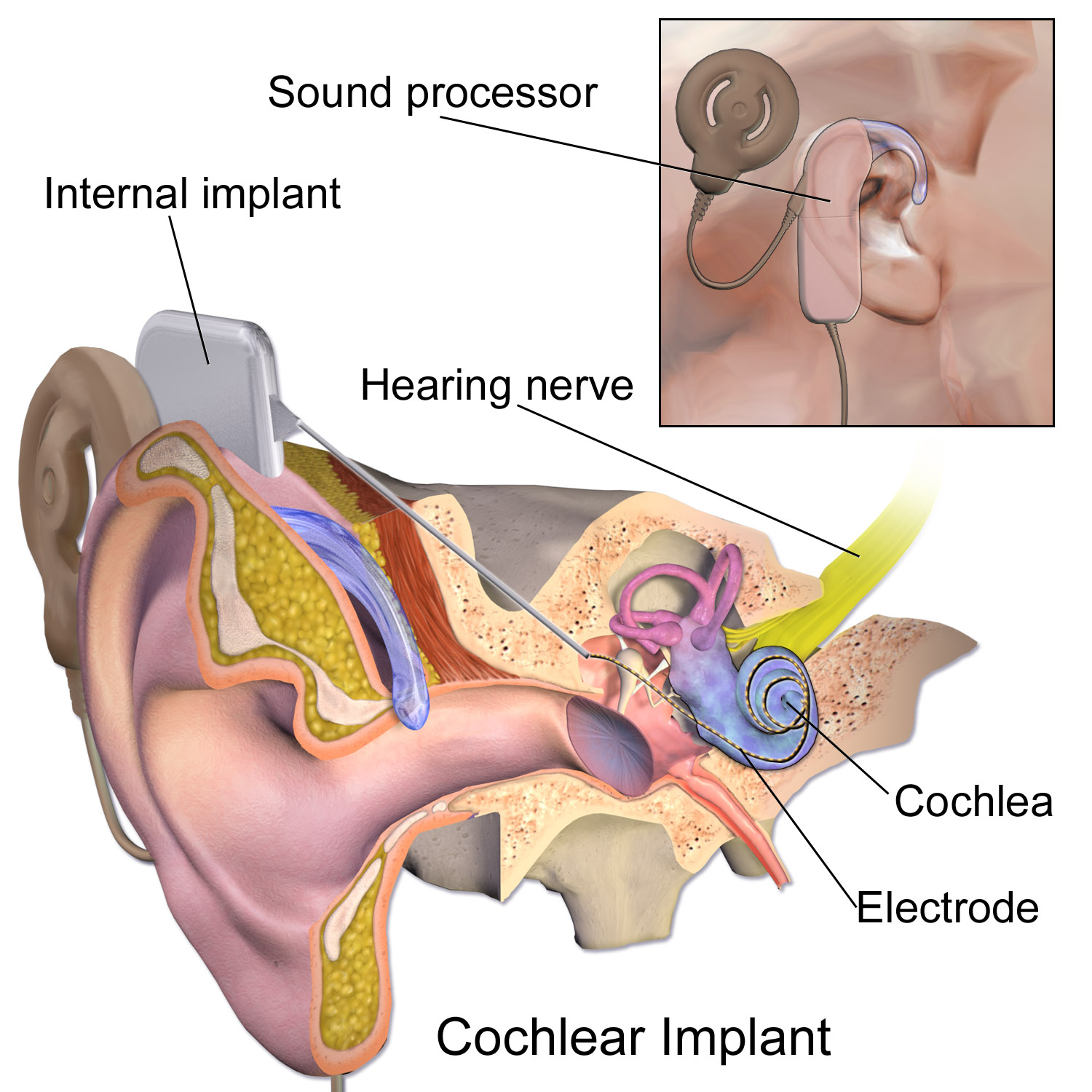
 Diagram of a cochlear implant |
A cochlear implant (CI) is a surgically implanted neuroprosthesis that provides a person who has moderate-to-profound sensorineural hearing loss with sound perception. With the help of therapy, cochlear implants may allow for improved speech understanding in both quiet and noisy environments.[1][2] A CI bypasses acoustic hearing by direct electrical stimulation of the auditory nerve.[2] Through everyday listening and auditory training, cochlear implants allow both children and adults to learn to interpret those signals as speech and sound.[3][4][5]
The implant has two main components. The outside component is generally worn behind the ear, but could also be attached to clothing, for example, in young children. This component, the sound processor, contains microphones, electronics that include digital signal processor (DSP) chips, battery, and a coil that transmits a signal to the implant across the skin. The inside component, the actual implant, has a coil to receive signals, electronics, and an array of electrodes which is placed into the cochlea, which stimulate the cochlear nerve.[6]
The surgical procedure is performed under general anesthesia. Surgical risks are minimal and most individuals will undergo outpatient surgery and go home the same day. However, some individuals will experience dizziness, and on rare occasions, tinnitus or facial nerve bruising.
From the early days of implants in the 1970s and the 1980s, speech perception via an implant has steadily increased. More than 200,000 people in the United States had received a CI through 2019. Many users of modern implants gain reasonable to good hearing and speech perception skills post-implantation, especially when combined with lipreading.[7][8] One of the challenges that remain with these implants is that hearing and speech understanding skills after implantation show a wide range of variation across individual implant users. Factors such as age of implantation, parental involvement and education level, duration and cause of hearing loss, how the implant is situated in the cochlea, the overall health of the cochlear nerve, and individual capabilities of re-learning are considered to contribute to this variation.[9][10][11][12]
History
[edit]

André Djourno and Charles Eyriès invented the original cochlear implant in 1957. Their design distributed stimulation using a single channel.[13]
William House also invented a cochlear implant in 1961.[14] In 1964, Blair Simmons and Robert L. White implanted a single-channel electrode in a patient's cochlea at Stanford University.[15] However, research indicated that these single-channel cochlear implants were of limited usefulness because they cannot stimulate different areas of the cochlea at different times to allow differentiation between low and mid to high frequencies as required for detecting speech.[16]

The next step in the development of the CI was its clinical trial on a cohort of patients. In the late 1960's Robin Michelson and colleague Melvin Bartz construct a cochlear device with biocompatible materials that can be implanted in human patients. This system is implanted in 4 patients, and the report of the hearing results represent a watershed for clinically applicable cochlear implants.[17] Robin Michelson, Robert Schindler, and Michael Merzenich at the University of California, San Francisco, conducted these experiments in 1970 and 1971. Michelson, a clinical pioneer, and Merzenich, a talented basic scientist with a solid foundation in neurophysiology, was an integral element in the development of the UCSF cochlear implant team. Michelson was recognized for implanting a single-channel device into a congenitally deaf woman. She demonstrated auditory sensations from stimulation, as well as pitch perception for stimulus frequencies less than 600 Hz. Unfortunately, This patient had no word recognition. His pioneering work was presented, but not well-received at the 1971 annual meeting of the American Otological Society (Michelson, 1971 and Merzenich et al., 1973).[18] In 1973, the first international conference on the "electrical stimulation of the acoustic nerve as a treatment for profound sensorineural deafness in man" was organized in San Francisco.[19]
NASA engineer Adam Kissiah started working in the mid-1970s on what would become the modern cochlear implant. Kissiah used his knowledge learned while working as an electronics instrumentation engineer for NASA. This work took place over three years, when Kissiah would spend his lunch breaks and evenings in Kennedy Space Center's technical library, studying the impact of engineering principles on the inner ear. In 1977, NASA helped Kissiah obtain a patent for the cochlear implant; Kissiah later sold the patent rights.[20]
The modern multi-channel cochlear implant was independently developed and commercialized by two separate teams—one led by Graeme Clark in Australia and another by Ingeborg Hochmair and her future husband, Erwin Hochmair in Austria, with the Hochmairs' device first implanted in a person in December 1977 and Clark's in August 1978.[21]
Parts
[edit]Cochlear implants bypass most of the peripheral auditory system which receives sound and converts that sound into movements of hair cells in the cochlea; the deflection of stereocilia causes an influx of potassium ions into the hair cells, and the depolarisation in turn stimulates calcium influx, which increases release of the neurotransmitter glutamate. Excitation of the cochlear nerve by the neurotransmitter sends signals to the brain, which creates the experience of sound. With an implant, instead, the devices pick up sound and digitize it, convert that digitized sound into electrical signals, and transmit those signals to electrodes embedded in the cochlea. The electrodes electrically stimulate the cochlear nerve, causing it to send signals to the brain.[22][23][24]
There are several systems available, but generally they have the following components:[22][24]
External:
- one or more microphones that pick up sound from the environment
- a speech processor which selectively filters sound to prioritize audible speech
- a transmitter that sends power and the processed sound signals across the skin to the internal device by radio frequency transmission
Internal:
- a receiver/stimulator, which receives signals from the speech processor and converts them into electric impulses
- an electrode array embedded in the cochlea
A totally implantable cochlear implant (TICI) is currently in development. This new type of cochlear implant incorporates all the current external components of an audio processor into the internal implant. The lack of external components makes the implant invisible from the outside and also means it is less likely to be damaged or broken.[25] On the other side, the development of a TICI faces especially two technical hurdles: the energy supply and the design of implantable microphone.[26][27] Initial clinical trials of TICIs have demonstrated safety and comparable performance to conventional cochlear implants. A study involving a research TICI indicated that users experienced high levels of hearing performance, although some challenges with microphone sensitivity were noted.[28]

Assistive listening devices
[edit]Most modern cochlear implants can be used with a range of assistive listening devices (ALDs), which help people to hear better in challenging listening situations. These situations could include talking on the phone, watching TV or listening to a speaker or teacher. With an ALD, the sound from devices including mobile phones or from an external microphone is sent to the audio processor directly, rather than being picked up by the audio processor's microphone. This direct transmission improves the sound quality for the user, making it easier to talk on the phone or stream music.
ALDs come in many forms, such as neckloops,[29] pens,[30] and specialist battery pack covers.[31] Modern ALDs are usually able to receive sound from any Bluetooth device, including phones and computers, before transmitting it wirelessly to the audio processor. Most cochlear implants are also compatible with older ALD technology, such as a telecoil.[32]
Surgical procedure
[edit]Surgical techniques
[edit]Implantation of children and adults can be done safely with few surgical complications and most individuals will undergo outpatient surgery and go home the same day.[33][34][35]
Occasionally, the very young, the very old, or patients with a significant number of medical diseases at once may remain for overnight observation in the hospital. The procedure can be performed in an ambulatory surgery center in healthy individuals.[36]
The surgical procedure most often used to implant the device is called mastoidectomy with facial recess approach (MFRA).[24]
The procedure is usually done under general anesthesia. Complications of the procedure are rare, but include mastoiditis, otitis media (acute or with effusion), shifting of the implanted device requiring a second procedure, damage to the facial nerve, damage to the chorda tympani, and wound infections.[37]
Cochlear implantation surgery is considered a clean procedure with an infection rate of less than 3%.[38] Guidelines suggest that routine prophylactic antibiotics are not required.[39] However, the potential cost of a postoperative infection is high (including the possibility of implant loss); therefore, a single preoperative intravenous injection of antibiotics is recommended.[40]
The rate of complications is about 12% for minor complications and 3% for major complications; major complications include infections, facial paralysis, and device failure.
Although up to 20 new cases of post-CI bacterial meningitis occur annually worldwide, data demonstrates a reducing incidence.[41] To avoid the risk of bacterial meningitis, the CDC recommends that adults and children undergoing CI receive age-appropriate vaccines that generate antibodies to Streptococcus pneumoniae.[42]
The rate of transient facial nerve palsy is estimated to be approximately 1%. Device failure requiring reimplantation is estimated to occur 2.5–6% of the time. Up to one-third of people experience disequilibrium, vertigo, or vestibular weakness lasting more than one week after the procedure; in people under 70 these symptoms generally resolve over weeks to months, but in people over 70 the problems tend to persist.[24]
In the past, cochlear implants were only approved for people who were deaf in both ears; as of 2014[update] a cochlear implant had been used experimentally in some people who had acquired deafness in one ear after they had learned how to speak, and none who were deaf in one ear from birth; clinical studies as of 2014[update] had been too small to draw generalizations.[43]
Alternative surgical technique
[edit]Other approaches, such as going through the suprameatal triangle, are used. A systematic literature review published in 2016 found that studies comparing the two approaches were generally small, not randomized, and retrospective so were not useful for making generalizations; it is not known which approach is safer or more effective.[37]
Endoscopic cochlear implantation
[edit]With the increased utilization of endoscopic ear surgery as popularized by professor Tarabichi, there have been multiple published reports on the use of endoscopic technique in cochlear implant surgery.[44] However, this has been motivated by marketing and there is clear indication of increased morbidity associated with this technique as reported by the pioneer of endoscopic ear surgery.[45]
Complications of cochlear implant surgery
[edit]As cochlear implant surgical techniques have advanced over the last four decades, the global complication rate for CI surgery in both children and adults has decreased from more than 35% in 1991 to less than 10% at present.[46][47][48] The risk of postoperative facial nerve injury has also decreased over the last several decades to less than 1%, most of which demonstrated complete return of function within six months. The rate of permanent paralysis is approximately 1 per 1,000 surgeries and likely less than that in experienced CI centers.[48]
The majority of complications following CI surgery are minor requiring only conservative medical management or prolongation of hospital stay. Less than 5% of all complications are major resulting in surgical intervention or readmission to the hospital.[48] Reported rates of revision cochlear implant surgery vary in adults and children from 3.8% to 8% with the most common indications being device failure, infection, and migration of the implant or electrode.[49] Disequilibrium and vertigo after CI surgery can occur but the symptoms tend to be mild and short-lived.[50] CI rarely results in significant or persistent adverse effects on the vestibular system when hearing conservation surgical techniques are practiced. Moreover, gait and postural stability may actually improve post-implantation.[51]
Outcomes
[edit]Cochlear implant outcomes can be measured using speech recognition ability and functional improvements measured using patient reported outcome measures.[52][53] While the degree of improvement after cochlear implantation may vary, the majority of patients who receive cochlear implants demonstrate a significant improvement in speech recognition ability compared to their preoperative condition.[52]
Multiple meta-analyses of the literature from 2018 showed that CI users have large improvements in quality of life after cochlear implantation.[54][55] This improvement occurs in many different facets of life that extends beyond communication including improved ability to engage in social activities; decreased mental effort from listening; and improved environmental sound awareness.[56][57][53] Deaf adolescents with cochlear implants attending mainstream educational settings report high levels of scholastic self-esteem, friendship self-esteem, and global self-esteem.[58] They also tend to hold mostly positive attitudes towards their cochlear implants,[59] and as a part of their identity, a majority either do "not really think about" their hearing loss, or are "proud of it."[60] Though advancements in cochlear implant technology have helped patients in their understanding of language, users are still unable to understand suprasegmental portions of language, which includes pitch.[61]
A study by Johns Hopkins University determined that for a three-year-old child who receives them, cochlear implants can save $30,000 to $50,000 in special-education costs for elementary and secondary schools as the child is more likely to be mainstreamed in school and thus use fewer support services than similarly deaf children.[62]
Efficacy
[edit]A 2019 study found that bilateral cochlear implantation was widely regarded as the most beneficial hearing intervention for acceptable candidates, although it is more likely to be performed in children than adults. The study also found that the efficacy of bilateral implantation could be improved by enhancing communication between the two implants and by developing sound coding strategies specifically for bilateral users.[63]
Early research reviews found that the ability to communicate in spoken language was better the earlier the implantation was performed. The reviews also found that, overall, while cochlear implants provide open-set speech understanding for the majority of implanted profoundly hearing-impaired children, it was not possible to accurately predict the specific outcome of the given implanted child.[64][65][66] Research since then has reported long-term socio-economic benefits for children as well as audiological outcomes including improved sound localization and speech perception.[67] A consensus statement from the European Bilateral Pediatric Cochlear Implant Forum also confirmed the importance of bilateral cochlear implantation in children.[68] In adults, new research shows that bilateral implantation can improve quality of life and speech intelligibility in quiet and noise.[69]
A 2015 review examined whether CI implantation to treat people with bilateral hearing loss had any effect on tinnitus. This review found the quality of evidence to be poor and the results variable: overall total tinnitus suppression rates for patients who had tinnitus prior to surgery varied from 8% to 45% of people who received CI; decrease of tinnitus was seen in 25% to 72%, of people; for 0% to 36% of the people there was no change; increase of tinnitus occurred in between 0% to 25% of patients; and, in between 0 and 10% of cases, people who did not have tinnitus before the procedure, got it.[70] Further research found that the electrical stimulation of the CI is at least partly responsible for the general reduction in symptoms. A 2019 study found that although tinnitus suppression in patients with CIs is multifactorial, simply having the CI switched on without any audiological input (while standing alone in a soundproof booth) reduced the symptoms of tinnitus. This would suggest that it is the electrical stimulation that explains the decrease in tinnitus symptoms for many patients, and not only the increased access to sound.[71]
A 2015 literature review on the use of CI for people with auditory neuropathy spectrum disorder found that, as of that date, description and diagnosis of the condition was too heterogeneous to make clear claims about whether CI is a safe and effective way to manage it.[72]
The data for cochlear implant outcomes in older adults differs. A 2016 research study found that age at implantation was highly correlated with post-operative speech understanding performance for various test measures. In this study, people who were implanted at age 65 or older performed significantly worse on speech perception testing in quiet and in noisy conditions compared to younger CI users.[73] Other studies have shown different outcomes, with some reporting that adults implanted at the age of 65 and older showed audiological and speech discrimination outcomes similar to younger adults.[74] While cochlear implants demonstrate substantial benefit across all age groups, results will depend on cognitive factors that are ultimately highly age dependent. However, studies have documented the benefit of cochlear implants in octogenarians.[75][76]
The effects of aging on central auditory processing abilities are thought to play an important role in impacting an individual's speech perception with a cochlear implant. The Lancet reported that untreated hearing loss in adults is the number one modifiable risk factor for dementia.[77] In 2017, a study also reported that adults using a cochlear implant had significantly improved cognitive outcomes including working memory, reaction time, and cognitive flexibility compared to people who were waiting to receive a cochlear implant.[78]
Prolonged duration of deafness is another factor that is thought to have a negative impact on overall speech understanding outcomes for CI users. However, a study found no statistical difference in the speech understanding abilities of CI patients over 65 who had been hearing impaired for 30 years or more prior to implantation.[73] In general, outcomes for CI patients are dependent upon the individual's level of motivation, expectations, exposure to speech stimuli and consistent participation in aural rehabilitation programs.
A 2016 systematic review of CI for people with unilateral hearing loss (UHL) found that of the studies conducted and published, none were randomized, only one evaluated a control group, and no study was blinded. After eliminating multiple uses of the same subjects, the authors found that 137 people with UHL had received a CI.[79] While acknowledging the weakness of the data, the authors found that CI in people with UHL improves sound localization compared with other treatments in people who lost hearing after they learned to speak; in the one study that examined this, CI did improve sound localization in people with UHL who lost hearing before learning to speak.[79] It appeared to improve speech perception and to reduce tinnitus.[79]
In terms of quality of life, several studies have shown that cochlear implants are beneficial in many aspects of quality of life, including communication improvements and positive effects on social, emotional, psychological and physical well-being. A 2017 narrative review also concluded that the quality of life scores of children using cochlear implants were comparable to those of children without hearing loss. Studies involving adults of all ages reported significant improvement in QoL after implantation when compared to adults with hearing aids. This was often independent of audiological performance.[80]
Society and culture
[edit]Usage
[edit]As of October 2010,[update] approximately 188,000 individuals had been fitted with cochlear implants worldwide.[81] As of December 2012,[update] the same publication cited approximately 324,000 cochlear implant devices having been surgically implanted. In the U.S., roughly 58,000 devices were implanted in adults and 38,000 in children.[23] As of 2016,[update] the Ear Foundation in the United Kingdom, estimates the number of cochlear implant recipients in the world to be about 600,000.[82] The American Cochlear Implant Alliance estimates that 217,000 people received CIs in the United States through the end of 2019.[83]
Cost and insurance
[edit]Cochlear implantation includes the medical device as well as related services and procedures including pre-operative testing, the surgery, and aftercare that includes audiology and speech language pathology services. These are provided over time by a team of clinicians with specialized training. All of these services, as well as the cochlear implant device and related peripherals, are part of the medical intervention and are typically covered by health insurance in the United States and many areas of the world. These medical services and procedures include candidacy evaluation, hospital services inclusive of supplies and medications used during surgery, surgeon and other physicians such as anesthesiologists, the cochlear implant device and system kit, and programming and (re)habilitation following the surgery.[citation needed] In many countries around the world, the cost of cochlear implantation and aftercare is covered by health insurance.[84][85] However, financial factors impact the evaluation selection process. Children with public health insurance or no health insurance are less likely to receive the implant before 2 years old.[86]
In the US, as cochlear implants have become more commonplace and accepted as a valuable and cost effective health intervention, insurance coverage has expanded to include private insurance, Medicare, Tricare, the VA System, other federal health plans, and Medicaid. In September 2022 the Centers for Medicare & Medicaid Services expanded coverage of cochlear implants for appropriate candidates under Medicare. Candidates must demonstrate limited benefit with appropriately fit hearing aids but with criteria now defined by test scores of less than or equal to 60% correct in the best-aided listening condition on recorded tests of open-set sentence recognition.[87] Just as there is with any medical procedure, there are typically co-pays which vary depending upon the insurance plan.[84][85]
In the United Kingdom, the NHS covers cochlear implants in full, as does Medicare in Australia, and the Department of Health[88] in Ireland, Seguridad Social in Spain, Sistema Sanitario Nazionale in Italy, Sécurité Sociale in France[89] and Israel, and the Ministry of Health or ACC (depending on the cause of deafness) in New Zealand. In Germany and Austria, the cost is covered by most health insurance organizations.[90][91]
Public health
[edit]6.1% of the world population live with hearing loss, and it is predicted that by 2050, more than 900 million people around the globe will have a disabling hearing loss.[92] According to a WHO report, unaddressed hearing loss costs the world 980 billion dollars annually. Particularly hard hit are the healthcare and educational sectors, as well as societal costs. 53% of these costs are attributable to low- and middle-income countries.[93]
The WHO reports that cochlear implants have been shown to be a cost-effective way to mitigate the challenges of hearing loss. In a low-to-middle-income setting, every dollar invested in unilateral cochlear implants has a return on investment of 1.46 dollars. This rises to a return on investment of 4.09 dollars in an upper-middle-income setting. A study in Colombia assessed the lifetime investments made in 68 children who received cochlear implants at an early age. Taking into account the cost of the device and any other medical costs, follow-up, speech therapy, batteries and travel, each child required an average investment of US$99 000 over the course of their life (assuming a life span of 78 years for women and 72 years for men). The study concluded that for every dollar invested in rehabilitation of a child with a cochlear implant, there was a return on investment of US$2.07.[93]
Manufacturers
[edit]As of 2021, four cochlear implant devices approved for use in the United States are manufactured by Cochlear Limited, the Advanced Bionics division of Sonova, MED-EL, and Oticon Medical.[94][95]
In Europe, Africa, Asia, South America, and Canada, an additional device manufactured by Neurelec (later acquired by Oticon Medical) was available. A device made by Nurotron (China) was also available in some parts of the world. Each manufacturer has adapted some of the successful innovations of the other companies to its own devices. There is no consensus that any one of these implants is superior to the others. Users of all devices report a wide range of performance after implantation.[citation needed]
Criticism and controversy
[edit]Much of the strongest objection to cochlear implants has come from within the deaf community, some of whom are pre-lingually deaf people whose first language is a sign language. Some in the deaf community call cochlear implants audist and an affront to their culture, which, as they view it, is a minority threatened by the hearing majority.[96] This is an old problem for the deaf community, going back as far as the 18th century with the argument of manualism vs. oralism. This is consistent with medicalisation and the standardisation of the "normal" body in the 19th century when differences between normal and abnormal began to be debated.[97] It is important to consider the sociocultural context, particularly in regards to the deaf community, which has its own unique language and culture.[98] This accounts for the cochlear implant being seen as an affront to their culture, as many do not believe that deafness is something that needs to be cured. However, it has also been argued that this does not necessarily have to be the case: the cochlear implant can act as a tool deaf people can use to access the "hearing world" without losing their deaf identity.[98]
Cochlear implants for congenitally deaf children are most effective when implanted at a young age.[99] Children who have had confirmed severe hearing loss can receive the implant as young as 9 months old.[100] Evidence shows that deaf children of deaf parents (or with fluent signers as daily caregivers) learn signed language as effectively as hearing peers. Some deaf-community advocates recommend that all deaf children should learn sign language from birth,[101] but more than 90% of deaf children are born to hearing parents. Since it takes years to become fluent in sign language, deaf children who grow up without amplification such as hearing aids or cochlear implants will not have daily access to fluent language models in households without fluent signers.
Critics of cochlear implants from deaf cultures also assert that the cochlear implant and the subsequent therapy often become the focus of the child's identity at the expense of language acquisition and ease of communication in sign language and deaf identity. They believe that measuring a child's success only by their mastery of speech will lead to a poor self-image as "disabled" (because the implants do not produce normal hearing) rather than having the healthy self-concept of a proudly deaf person.[102] However, these assertions are not supported by research. The first children to receive cochlear implants as infants are only in their 20s (as of 2020), and anecdotal evidence points to a high level of satisfaction in this cohort, most of whom don't consider their deafness their primary identity.[58][59][103]
Children with cochlear implants are most likely to be educated with listening and spoken language, without sign language and are often not educated with other deaf children who use sign language.[104] Cochlear implants have been one of the technological and social factors implicated in the decline of sign languages in the developed world.[105] Some Deaf activists have labeled the widespread implantation of children as a cultural genocide.[106]
As the trend for cochlear implants in children grows, deaf-community advocates have tried to counter the "either or" formulation of oralism vs. manualism with a "both and" or "bilingual-bicultural"[107] approach; some schools are now successfully integrating cochlear implants with sign language in their educational programs.[108] However, there is disagreement among researchers about the effectiveness of methods using both sign and speech as compared to sign or speech alone.[109][110]
Another point of controversy made by advocates are that there are racial disparities in the cochlear implantation evaluation process. Data taken from 2010-2020 at one academic tertiary care institution showed that 68.5% of patients referred for evaluation were White, 18.5% were Black, and 12.3% were Asian, however the institution's main service area was 46.9% White, 42.3% Black, and 7.7% Asian. It was also shown that the Black patients who were referred for evaluation to receive the implants had greater hearing loss compared to White patients who were also referred. Based on this study, it is shown that Black patients receive cochlear implants at a disproportionately lower rate than White patients.[111]
An additional criticism involves the cost of implant upgrades. The manufacturers introduce new models on a regular basis and stop servicing older models. When this happens, a user who wishes to ensure continued functioning of the implant is required to buy new equipment. This was evident in India for impoverished families whose children received cochlear implants.[112]
Notable recipients (partial list)
[edit]- Jack Ashley, Baron Ashley of Stoke - British MP
- Michael Chorost - American writer
- Dorinda Cox - Australian politician
- Lou Ferrigno - bodybuilder and actor
- Tasha Ghouri - English TV personality
- Daisy Kent - American TV personality
- Elena LaQuatra - WTAE-TV news anchor
- Mia le Roux - Miss South Africa 2024
- Rush Limbaugh - American conservative radio host
- Millicent Simmonds - American actress
- Heather Whitestone - 1995 Miss America
- Malala Yousafzai - Nobel peace prize recipient
See also
[edit]- 3D printing[113]
- Auditory brainstem response
- Auditory brainstem implant
- Bone-anchored hearing aid
- Bone conduction
- Brain implant
- Ear trumpet
- Electric Acoustic Stimulation
- Electrophonic hearing
- Neuroprosthetics
- Noise health effects
- Visual prosthesis
- Language deprivation § Deaf and Hard of Hearing Children
References
[edit]- ^ "NCD - Cochlear Implantation (50.3)". Centers for Medicare & Medicaid Services. Retrieved 2021-11-22.
- ^ a b "Cochlear Implants". NIDCD. 24 March 2021. Retrieved 2021-11-22.
- ^ Rayes H, Al-Malky G, Vickers D (May 2019). "Systematic Review of Auditory Training in Pediatric Cochlear Implant Recipients". Journal of Speech, Language, and Hearing Research. 62 (5): 1574–1593. doi:10.1044/2019_JSLHR-H-18-0252. PMID 31039327. S2CID 141503740.
- ^ Henshaw H, Ferguson MA (2013-05-10). "Efficacy of individual computer-based auditory training for people with hearing loss: a systematic review of the evidence". PLOS ONE. 8 (5) e62836. Bibcode:2013PLoSO...862836H. doi:10.1371/journal.pone.0062836. PMC 3651281. PMID 23675431.
- ^ Sweetow R, Palmer CV (July 2005). "Efficacy of individual auditory training in adults: a systematic review of the evidence". Journal of the American Academy of Audiology. 16 (7): 494–504. doi:10.3766/jaaa.16.7.9. PMID 16295236. NCBI NBK71453.
- ^ Naples JG, Ruckenstein MJ (February 2020). "Cochlear Implant". Otolaryngologic Clinics of North America. 53 (1): 87–102. doi:10.1016/j.otc.2019.09.004. PMID 31677740. S2CID 207890377.
- ^ Clark GM (April 2015). "The multi-channel cochlear implant: multi-disciplinary development of electrical stimulation of the cochlea and the resulting clinical benefit". Hearing Research. 322: 4–13. doi:10.1016/j.heares.2014.08.002. PMID 25159273.
- ^ Shannon RV (February 2012). "Advances in auditory prostheses". Current Opinion in Neurology. 25 (1): 61–66. doi:10.1097/WCO.0b013e32834ef878. PMC 4123811. PMID 22157109.
- ^ Blamey P, Artieres F, Başkent D, Bergeron F, Beynon A, Burke E, et al. (2013). "Factors affecting auditory performance of postlinguistically deaf adults using cochlear implants: an update with 2251 patients" (PDF). Audiology & Neuro-Otology. 18 (1): 36–47. doi:10.1159/000343189. PMID 23095305. S2CID 4668675.
- ^ Başkent D, Gaudrain E, Tamati TN, Wagner A (2016). "Perception and Psychoacoustics of Speech in Cochlear Implant Users". In Cacace AT, de Kleine E, Holt AG, van Dijk P (eds.). Scientific Foundations of Audiology: Perspectives from Physics, Biology, Modeling, and Medicine. Plural Publishing. pp. 285–319. hdl:11370/eef54b8f-af38-4c58-b14d-3ee376412a08. ISBN 978-1-59756-652-0. S2CID 33984881.
- ^ Pisoni DB, Kronenberger WG, Harris MS, Moberly AC (December 2017). "Three challenges for future research on cochlear implants". World Journal of Otorhinolaryngology–Head & Neck Surgery. 3 (4): 240–254. doi:10.1016/j.wjorl.2017.12.010. PMC 5956139. PMID 29780970.
- ^ "What Are Cochlear Implants for Hearing? | NIDCD". www.nidcd.nih.gov. 2024-05-06. Retrieved 2024-05-24.
- ^ Svirsky, Mario (August 2017). "Cochlear implants and electronic hearing". Physics Today. 70 (8): 52–58. Bibcode:2017PhT....70h..52S. doi:10.1063/PT.3.3661.
- ^ Martin D (December 15, 2012). "Dr. William F. House, Inventor of Pioneering Ear-Implant Device, Dies at 89". The New York Times. Retrieved 2012-12-16.
- ^ Mudry A, Mills M (May 2013). "The early history of the cochlear implant: a retrospective". JAMA Otolaryngology–Head & Neck Surgery. 139 (5): 446–453. doi:10.1001/jamaoto.2013.293. PMID 23681026.
- ^ Clark G (2009). "The multi-channel cochlear implant: past, present and future perspectives". Cochlear Implants International. 10 (Suppl 1): 2–13. doi:10.1179/cim.2009.10.Supplement-1.2. PMID 19127562. S2CID 30532987.
- ^ "Hearing Device Timeline". beckerexhibits.wustl.edu. Retrieved 2024-12-17.
- ^ Eshraghi, Adrien A.; Nazarian, Ronen; Telischi, Fred F.; Rajguru, Suhrud M.; Truy, Eric; Gupta, Chhavi (2012). "The Cochlear Implant: Historical Aspects and Future Prospects". The Anatomical Record. 295 (11): 1967–1980. doi:10.1002/ar.22580. ISSN 1932-8494. PMC 4921065. PMID 23044644.
- ^ Mudry, Albert; Mills, Mara (May 2013). "The early history of the cochlear implant: a retrospective". JAMA Otolaryngology–Head & Neck Surgery. 139 (5): 446–453. doi:10.1001/jamaoto.2013.293. ISSN 2168-619X. PMID 23681026.
- ^ "Hearing is Believing". Spinoff 2003: 100 Years of Powered Flight. Washington, D.C.: National Aeronautics and Space Administration. 2003. ISBN 978-0-16-067895-0.
- ^ "2013 Lasker~DeBakey Clinical Medical Research Award: Modern cochlear implant". The Lasker Foundation. Retrieved 14 July 2017.
- ^ a b Roche JP, Hansen MR (December 2015). "On the Horizon: Cochlear Implant Technology". Otolaryngologic Clinics of North America. 48 (6): 1097–1116. doi:10.1016/j.otc.2015.07.009. PMC 4641792. PMID 26443490.
- ^ a b "Cochlear Implants (No. 11-4798)". National Institute on Deafness and Other Communication Disorders. 2013-11-01. Retrieved February 18, 2016.
- ^ a b c d Yawn R, Hunter JB, Sweeney AD, Bennett ML (2015). "Cochlear implantation: a biomechanical prosthesis for hearing loss". F1000Prime Reports. 7: 45. doi:10.12703/P7-45. PMC 4447036. PMID 26097718.
- ^ Cohen N (April 2007). "The totally implantable cochlear implant". Ear and Hearing. 28 (2 Suppl): 100S – 101S. doi:10.1097/AUD.0b013e31803150f4. PMID 17496658. S2CID 38696317.
- ^ Trudel, Mathieu; Morris, David P. (2022-08-04). "The remaining obstacles for a totally implantable cochlear implant". Current Opinion in Otolaryngology & Head & Neck Surgery. 30 (5): 298–302. doi:10.1097/MOO.0000000000000840. ISSN 1068-9508. PMID 36004785.
- ^ Park, Steve; Guan, Xiying; Kim, Youngwan; Creighton, Francis (Pete) X.; Wei, Eric; Kymissis, Ioannis(John); Nakajima, Hideko Heidi; Olson, Elizabeth S. (January 2018). "PVDF-Based Piezoelectric Microphone for Sound Detection Inside the Cochlea: Toward Totally Implantable Cochlear Implants". Trends in Hearing. 22 2331216518774450. doi:10.1177/2331216518774450. ISSN 2331-2165. PMC 5987900. PMID 29732950.
- ^ Lefebvre, Philippe Pierre; Müller, Joachim; Mark, Gerhard; Schwarze, Florian; Hochmair, Ingeborg (2025-01-08). "Rehabilitation of human hearing with a totally implantable cochlear implant: a feasibility study". Communications Medicine. 5 (1) 10. doi:10.1038/s43856-024-00719-0. ISSN 2730-664X. PMC 11711238. PMID 39779916.
- ^ "Induction Neckloops - Bluetooth Neckloop". ADCO Hearing Products. Retrieved 2021-12-09.
- ^ "Phonak Roger Pen". www.ihear.co.uk. Archived from the original on 2021-12-09. Retrieved 2021-12-09.
- ^ "AudioStream - Connect Your MED-EL Cochlear Implant". www.medel.com. Retrieved 2021-12-09.
- ^ "Using the telephone". cochlear implant HELP. 2012-03-29. Retrieved 2021-12-09.
- ^ Hoff S, Ryan M, Thomas D, Tournis E, Kenny H, Hajduk J, Young NM (April 2019). "Safety and Effectiveness of Cochlear Implantation of Young Children, Including Those With Complicating Conditions". Otology & Neurotology. 40 (4): 454–463. doi:10.1097/MAO.0000000000002156. PMC 6426352. PMID 30870355.
- ^ "Hearing aids vs cohclear implants: What's the difference?". www.medicalnewstoday.com. 2021-05-28. Retrieved 2021-12-01.
- ^ Sivam, Sunthosh K.; Syms, Charles A.; King, Susan M.; Perry, Brian P. (March 2017). "Consideration for routine outpatient pediatric cochlear implantation: A retrospective chart review of immediate post-operative complications". International Journal of Pediatric Otorhinolaryngology. 94: 95–99. doi:10.1016/j.ijporl.2016.12.018. PMID 28167021.
- ^ Joseph, Aimee M.; Lassen, L. Frederick (February 2013). "Cochlear implant in an ambulatory surgery center". AANA Journal. 81 (1): 55–59. PMID 23513325.
- ^ a b Bruijnzeel H, Draaisma K, van Grootel R, Stegeman I, Topsakal V, Grolman W (April 2016). "Systematic Review on Surgical Outcomes and Hearing Preservation for Cochlear Implantation in Children and Adults". Otolaryngology–Head and Neck Surgery. 154 (4): 586–596. doi:10.1177/0194599815627146. PMID 26884363. S2CID 25594951.
- ^ Vijendren, Ananth; Ajith, Amritha; Borsetto, Daniele; Tysome, James R.; Axon, Patrick R.; Donnelly, Neil P.; Bance, Manohar L. (October 2020). "Cochlear Implant Infections and Outcomes: Experience From a Single Large Center". Otology & Neurotology. 41 (9): e1105 – e1110. doi:10.1097/MAO.0000000000002772. PMID 32925845.
- ^ Woods, R. K.; Dellinger, E. P. (June 1998). "Current guidelines for antibiotic prophylaxis of surgical wounds". American Family Physician. 57 (11): 2731–2740. PMID 9636336.
- ^ Anne, Samantha; Ishman, Stacey L.; Schwartz, Seth (November 2016). "A Systematic Review of Perioperative Versus Prophylactic Antibiotics for Cochlear Implantation". Annals of Otology, Rhinology & Laryngology. 125 (11): 893–899. doi:10.1177/0003489416660113. PMID 27443344.
- ^ Lalwani, Anil K.; Cohen, Noel L. (January 2012). "Does Meningitis After Cochlear Implantation Remain a Concern in 2011?". Otology & Neurotology. 33 (1): 93–95. doi:10.1097/MAO.0b013e31823dbb08. PMID 22143298.
- ^ "Use of 13-Valent Pneumococcal Conjugate Vaccine and 23-Valent Pneumococcal Polysaccharide Vaccine for Adults with Immunocompromising Conditions: Recommendations of the Advisory Committee on Immunization Practices (ACIP)". www.cdc.gov. Retrieved 2021-12-27.
- ^ Tokita J, Dunn C, Hansen MR (October 2014). "Cochlear implantation and single-sided deafness". Current Opinion in Otolaryngology & Head and Neck Surgery. 22 (5): 353–358. doi:10.1097/moo.0000000000000080. PMC 4185341. PMID 25050566.
- ^ Rajan, Philip; Teh, Hui Mon; Prepageran, Narayanan; Kamalden, Tengku Izam Tengku; Tang, Ing Ping (December 2017). "Endoscopic Cochlear Implant: Literature Review and Current Status". Current Otorhinolaryngology Reports. 5 (4): 268–274. doi:10.1007/s40136-017-0164-2.
- ^ Tarabichi M, Nazhat O, Kassouma J, Najmi M (March 2016). "Endoscopic cochlear implantation: Call for caution". The Laryngoscope. 126 (3): 689–692. doi:10.1002/lary.25462. PMID 26154143. S2CID 24799811.
- ^ Bhatia, Kunwar; Gibbin, Kevin P.; Nikolopoulos, Thomas P.; OʼDonoghue, Gerard M. (September 2004). "Surgical Complications and Their Management in a Series of 300 Consecutive Pediatric Cochlear Implantations". Otology & Neurotology. 25 (5): 730–739. doi:10.1097/00129492-200409000-00015. PMID 15354004.
- ^ Venail, Frederic; Sicard, Marielle; Piron, Jean Pierre; Levi, Ann; Artieres, Francoise; Uziel, Alain; Mondain, Michel (15 December 2008). "Reliability and Complications of 500 Consecutive Cochlear Implantations". Archives of Otolaryngology–Head & Neck Surgery. 134 (12): 1276–1281. doi:10.1001/archoto.2008.504. PMID 19075122.
- ^ a b c Farinetti, A.; Ben Gharbia, D.; Mancini, J.; Roman, S.; Nicollas, R.; Triglia, J.-M. (June 2014). "Cochlear implant complications in 403 patients: Comparative study of adults and children and review of the literature". European Annals of Otorhinolaryngology, Head and Neck Diseases. 131 (3): 177–182. doi:10.1016/j.anorl.2013.05.005. PMID 24889283.
- ^ Zeitler, Daniel M; Budenz, Cameron L; Roland, John Thomas (October 2009). "Revision cochlear implantation". Current Opinion in Otolaryngology & Head and Neck Surgery. 17 (5): 334–338. doi:10.1097/MOO.0b013e32832dd6ac. PMID 19502980.
- ^ Buchman, Craig A.; Joy, Jennifer; Hodges, Annelle; Telischi, Fred F.; Balkany, Thomas J. (October 2004). "Vestibular Effects of Cochlear Implantation". The Laryngoscope. 114 (S103): 1–22. doi:10.1097/00005537-200410001-00001. PMID 15454752.
- ^ Tsukada, Keita; Moteki, Hideaki; Fukuoka, Hisakuni; Iwasaki, Satoshi; Usami, Shin-ichi (November 2013). "Effects of EAS cochlear implantation surgery on vestibular function". Acta Oto-Laryngologica. 133 (11): 1128–1132. doi:10.3109/00016489.2013.824110. PMC 3809927. PMID 24007563.
- ^ a b Dornhoffer JR, Reddy P, Meyer TA, Schvartz-Leyzac KC, Dubno JR, McRackan TR (March 2021). "Individual Differences in Speech Recognition Changes After Cochlear Implantation". JAMA Otolaryngology–Head & Neck Surgery. 147 (3): 280–286. doi:10.1001/jamaoto.2020.5094. PMC 7791403. PMID 33410869.
- ^ a b McRackan TR, Velozo CA, Holcomb MA, Camposeo EL, Hatch JL, Meyer TA, et al. (October 2017). "Use of Adult Patient Focus Groups to Develop the Initial Item Bank for a Cochlear Implant Quality-of-Life Instrument". JAMA Otolaryngology–Head & Neck Surgery. 143 (10): 975–982. doi:10.1001/jamaoto.2017.1182. PMC 5710256. PMID 28772297.
- ^ McRackan TR, Bauschard M, Hatch JL, Franko-Tobin E, Droghini HR, Nguyen SA, Dubno JR (April 2018). "Meta-analysis of quality-of-life improvement after cochlear implantation and associations with speech recognition abilities". The Laryngoscope. 128 (4): 982–990. doi:10.1002/lary.26738. PMC 5776066. PMID 28731538.
- ^ McRackan TR, Bauschard M, Hatch JL, Franko-Tobin E, Droghini HR, Velozo CA, et al. (January 2018). "Meta-analysis of Cochlear Implantation Outcomes Evaluated With General Health-related Patient-reported Outcome Measures". Otology & Neurotology. 39 (1): 29–36. doi:10.1097/mao.0000000000001620. PMC 5728184. PMID 29227446.
- ^ Hughes SE, Hutchings HA, Rapport FL, McMahon CM, Boisvert I (September 2018). "Social Connectedness and Perceived Listening Effort in Adult Cochlear Implant Users: A Grounded Theory to Establish Content Validity for a New Patient-Reported Outcome Measure". Ear and Hearing. 39 (5): 922–934. doi:10.1097/AUD.0000000000000553. PMID 29424766. S2CID 46846059.
- ^ McRackan TR, Hand BN, Velozo CA, Dubno JR (September 2019). "Cochlear Implant Quality of Life (CIQOL): Development of a Profile Instrument (CIQOL-35 Profile) and a Global Measure (CIQOL-10 Global)". Journal of Speech, Language, and Hearing Research. 62 (9): 3554–3563. doi:10.1044/2019_JSLHR-H-19-0142. PMC 6808347. PMID 31479616.
- ^ a b Leigh IW, Maxwell-McCaw D, Bat-Chava Y, Christiansen JB (2008-07-16). "Correlates of psychosocial adjustment in deaf adolescents with and without cochlear implants: a preliminary investigation". Journal of Deaf Studies and Deaf Education. 14 (2): 244–259. doi:10.1093/deafed/enn038. PMID 18854552.
- ^ a b Most, Tova; Wiesel, Amatzia; Blitzer, Tamar (June 2007). "Identity and Attitudes towards Cochlear Implant Among Deaf and Hard of Hearing Adolescents". Deafness & Education International. 9 (2): 68–82. doi:10.1179/146431507790560002.
- ^ Dammeyer, Jesper; Chapman, Madeleine; Marschark, Marc (2018). "Experience of Hearing Loss, Communication, Social Participation, and Psychological Well-Being Among Adolescents With Cochlear Implants". American Annals of the Deaf. 163 (4): 424–439. doi:10.1353/aad.2018.0027. JSTOR 26529752. PMID 30344187. S2CID 53044702.
- ^ "Cochlear Implant (CI) Technology and Music: Music Perception, Music Enjoyment: Information for Audiologists | Iowa Head and Neck Protocols". medicine.uiowa.edu. Retrieved 2022-04-14.
- ^ Williams JM (2000-05-05). "Do Health-Care Providers Have to Pay for Assistive Tech?". Business Week. Archived from the original on August 15, 2000. Retrieved 2009-10-25.
- ^ Rak K, Völker J, Schendzielorz P, Shehata-Dieler W, Radeloff A, Hagen R (March 2019). "Bilateral cochlear implantation is regarded as very beneficial: results from a worldwide survey by online questionnaire". European Archives of Oto-Rhino-Laryngology. 276 (3): 679–683. doi:10.1007/s00405-018-05271-x. PMID 30617425. S2CID 57574659.
- ^ Kral A, O'Donoghue GM (October 2010). "Profound deafness in childhood". The New England Journal of Medicine. 363 (15): 1438–1450. doi:10.1056/NEJMra0911225. PMID 20925546. S2CID 13639137.
- ^ Niparko JK, Tobey EA, Thal DJ, Eisenberg LS, Wang NY, Quittner AL, Fink NE (April 2010). "Spoken language development in children following cochlear implantation". JAMA. 303 (15): 1498–1506. doi:10.1001/jama.2010.451. PMC 3073449. PMID 20407059.
- ^ Ganek H, McConkey Robbins A, Niparko JK (February 2012). "Language outcomes after cochlear implantation". Otolaryngologic Clinics of North America. 45 (1): 173–185. doi:10.1016/j.otc.2011.08.024. PMID 22115689.
- ^ Cheng LJ, Soon SS, Wu DB, Ju H, Ng K (2019-08-15). "Cost-effectiveness analysis of bilateral cochlear implants for children with severe-to-profound sensorineural hearing loss in both ears in Singapore". PLOS ONE. 14 (8) e0220439. Bibcode:2019PLoSO..1420439C. doi:10.1371/journal.pone.0220439. PMC 6695111. PMID 31415595.
- ^ Ramsden JD, Gordon K, Aschendorff A, Borucki L, Bunne M, Burdo S, et al. (June 2012). "European Bilateral Pediatric Cochlear Implant Forum consensus statement". Otology & Neurotology. 33 (4): 561–565. doi:10.1097/MAO.0b013e3182536ae2. PMID 22569146.
- ^ Sivonen V, Sinkkonen ST, Willberg T, Lamminmäki S, Jääskelä-Saari H, Aarnisalo AA, Dietz A (May 2021). "Improvements in Hearing and in Quality of Life after Sequential Bilateral Cochlear Implantation in a Consecutive Sample of Adult Patients with Severe-to-Profound Hearing Loss". Journal of Clinical Medicine. 10 (11): 2394. doi:10.3390/jcm10112394. PMC 8199295. PMID 34071662.
- ^ Ramakers GG, van Zon A, Stegeman I, Grolman W (November 2015). "The effect of cochlear implantation on tinnitus in patients with bilateral hearing loss: A systematic review". The Laryngoscope. 125 (11): 2584–2592. doi:10.1002/lary.25370. PMID 26153087. S2CID 19088970.
- ^ Mallen JR, Chiu J, Marquis H, Ottochian A, Perez E, Kuo CL, et al. (August 2020). "Quantifying tinnitus suppression in cochlear implantation using tinnitus interval-limited tracking". The Laryngoscope. 130 (8): 2047–2052. doi:10.1002/lary.28414. PMID 31800110. S2CID 208626263.
- ^ Harrison RV, Gordon KA, Papsin BC, Negandhi J, James AL (December 2015). "Auditory neuropathy spectrum disorder (ANSD) and cochlear implantation". International Journal of Pediatric Otorhinolaryngology. 79 (12): 1980–1987. doi:10.1016/j.ijporl.2015.10.006. PMID 26545793.
- ^ a b Beyea JA, McMullen KP, Harris MS, Houston DM, Martin JM, Bolster VA, et al. (October 2016). "Cochlear Implants in Adults: Effects of Age and Duration of Deafness on Speech Recognition". Otology & Neurotology. 37 (9): 1238–1245. doi:10.1097/MAO.0000000000001162. PMID 27466894. S2CID 10143665.
- ^ Schafer EC, Miller S, Manning J, Zhang Q, Lavi A, Bodish E, et al. (September 2021). "Meta-Analysis of Speech Recognition Outcomes in Younger and Older Adults With Cochlear Implants". American Journal of Audiology. 30 (3): 481–496. doi:10.1044/2021_AJA-20-00141. PMID 34106734. S2CID 235394974.
- ^ Cloutier, François; Bussières, Richard; Ferron, Pierre; Côté, Mathieu (January 2014). "OCTO "Outcomes of Cochlear Implant for the Octogenarians: Audiologic and Quality-of-Life"". Otology & Neurotology. 35 (1): 22–28. doi:10.1097/MAO.0b013e3182a5d113. PMID 24270725.
- ^ Bourn, Stephanie S.; Goldstein, Mary Rose; Morris, Sarah A.; Jacob, Abraham (January 2022). "Cochlear implant outcomes in the very elderly". American Journal of Otolaryngology. 43 (1) 103200. doi:10.1016/j.amjoto.2021.103200. PMID 34600410.
- ^ Livingston G, Huntley J, Sommerlad A, Ames D, Ballard C, Banerjee S, et al. (August 2020). "Dementia prevention, intervention, and care: 2020 report of the Lancet Commission". Lancet. 396 (10248): 413–446. doi:10.1016/S0140-6736(20)30367-6. PMC 7392084. PMID 32738937.
- ^ Speers A, George A, Toner J (January 2015). "An aging concern: A retrospective study comparing the audiological and speech outcome measures along with the surgical and quality-of-life outcomes in a group of geriatric patients with those of an adult control group". Cochlear Implants International. 16 (Suppl 1): S3 – S5. doi:10.1179/1467010014Z.000000000222. PMID 25614263. S2CID 39535771.
- ^ a b c Cabral Junior F, Pinna MH, Alves RD, Malerbi AF, Bento RF (January 2016). "Cochlear Implantation and Single-sided Deafness: A Systematic Review of the Literature". International Archives of Otorhinolaryngology. 20 (1): 69–75. doi:10.1055/s-0035-1559586. PMC 4687988. PMID 26722349.
- ^ Crowson MG, Semenov YR, Tucci DL, Niparko JK (2017). "Quality of Life and Cost-Effectiveness of Cochlear Implants: A Narrative Review". Audiology & Neuro-Otology. 22 (4–5): 236–258. doi:10.1159/000481767. PMID 29262414. S2CID 3843628.
- ^ "NIH Fact Sheets - Cochlear Implants". report.nih.gov. Archived from the original on 2011-10-22. Retrieved 2018-09-14.
- ^ "Cochlear Implant Information Sheet". The Ear Foundation. Archived from the original on 2017-07-11. Retrieved 2018-09-14.
- ^ "What is a Cochlear Implant". Archived from the original on 2017-11-21.
- ^ a b Sorkin DL (Mar 2013). "Cochlear implantation in the world's largest medical device market: Utilization and awareness of cochlear implants in the United States". Cochlear Implants International. 14 (Suppl 1): S4 – S12. doi:10.1179/1467010013Z.00000000076. PMC 3663290. PMID 23453146.
- ^ a b Sorkin, Donna L.; Buchman, Craig A. (February 2016). "Cochlear Implant Access in Six Developed Countries". Otology & Neurotology. 37 (2): e161 – e164. doi:10.1097/MAO.0000000000000946. PMID 26719962.
- ^ Liu, Xinliang; Rosa-Lugo, Linda I.; Cosby, Janel L.; Pritchett, Cedric V. (March 2021). "Racial and Insurance Inequalities in Access to Early Pediatric Cochlear Implantation". Otolaryngology–Head and Neck Surgery. 164 (3): 667–674. doi:10.1177/0194599820953381. PMID 32930656.
- ^ "NCA - Cochlear Implantation (CAG-00107R) - Decision Memo". Centers for Medicare & Medicaid Services. Retrieved 2022-11-27.
- ^ "Beaumont Hospital - Cochlear Implant - How to Refer".
- ^ "Coût de l'implant cochléaire". CISIC.fr (in French). Centre d'Information sur la Surdité et l'Implant Cochléaire.
- ^ "Cochlea-Implantat | AOK – Die Gesundheitskasse". www.aok.de (in German). Retrieved 2022-02-14.
- ^ "Kosten für ein Cochlea-Implantat". Leben mit hoerverlust.at (in German). 2020-09-24. Retrieved 2022-02-14.
- ^ D'Haese PS, Van Rompaey V, De Bodt M, Van de Heyning P (2019). "Severe Hearing Loss in the Aging Population Poses a Global Public Health Challenge. How Can We Better Realize the Benefits of Cochlear Implantation to Mitigate This Crisis?". Frontiers in Public Health. 7 227. Bibcode:2019FrPH....7..227D. doi:10.3389/fpubh.2019.00227. PMC 6707083. PMID 31475129.
- ^ a b Organization, World Health (2021). World report on hearing. World Health Organization. pp. 49, 104–105. hdl:10665/339913. ISBN 978-92-4-002048-1.[page needed]
- ^ "Cochlear Implants". American Speech-Language-Hearing Association. 2004. Retrieved 2022-01-07.
- ^ "FDA approves Oticon Medical's Neuro cochlear implant system". MassDevice. 2021-06-24. Retrieved 2022-01-07.
- ^ "The Cochlear Implant Controversy, Issues And Debates". CBS News. NEW YORK. September 4, 2001. Retrieved 2021-05-08.
- ^ Lock, M. and Nguyen, V-K., An Anthropology of Biomedicine, Oxford, Wiley-Blackwell, 2010.[page needed]
- ^ a b Power D (2005). "Models of deafness: cochlear implants in the Australian daily press". Journal of Deaf Studies and Deaf Education. 10 (4): 451–459. doi:10.1093/deafed/eni042. hdl:10072/4245. PMID 16000690.
- ^ Oginni P (2009-11-16). "UCI Research with Cochlear Implants No Longer Falling on Deaf Ears". New University. Retrieved 2009-11-18.
- ^ "Children's Cochlear Implants". www.hopkinsmedicine.org. 2023-10-27. Retrieved 2023-12-06.
- ^ Hall ML, Hall WC, Caselli NK (2019). "Deaf children need language, not (Just) speech". First Language. 39 (4): 367–395. doi:10.1177/0142723719834102. hdl:2144/39975. S2CID 140083091.
- ^ NAD Cochlear Implant Committee. "Cochlear Implants". Archived from the original on 2007-02-20.
- ^ Hicks K (2016-08-05). "We Are Not Language Deprived". BuzzFeed.
- ^ Ringo A (August 9, 2013). "Understanding Deafness: Not Everyone Wants to Be 'Fixed'". The Atlantic.
- ^ Johnston T (2004). "W(h)ither the deaf community? Population, genetics, and the future of Australian sign language". American Annals of the Deaf. 148 (5): 358–375. doi:10.1353/aad.2004.0004. PMID 15132016. S2CID 21638387.
- ^ Christiansen JB, Leigh IW, Spencer PE, Lucker JR (2001). Cochlear implants in children: ethics and choices ([Online-Ausg.] ed.). Washington, D.C.: Gallaudet University Press. pp. 304–305. ISBN 978-1-56368-116-5.
- ^ De Vera N, Dharer Y. "Bilingual-Bicultural Education of Deaf/Hard-of- Hearing Children". deafed. Retrieved 9 February 2020.
- ^ Denworth L (April 25, 2014). "Science Gave My Son the Gift of Sound". Time.
- ^ Geers, Ann E.; Mitchell, Christine M.; Warner-Czyz, Andrea; Wang, Nae-Yuh; Eisenberg, Laurie S. (July 2017). "Early Sign Language Exposure and Cochlear Implantation Benefits". Pediatrics. 140 (1) e20163489. doi:10.1542/peds.2016-3489. PMC 5495521. PMID 28759398.
- ^ Hall ML, Hall WC, Caselli NK (August 2019). "Deaf children need language, not (just) speech". First Language. 39 (4): 367–395. doi:10.1177/0142723719834102. hdl:2144/39975. S2CID 140083091.
- ^ Mahendran, Geethanjeli N.; Rosenbluth, Tyler; Featherstone, Miriam; Vivas, Esther X.; Mattox, Douglas E.; Hobson, Candace E. (2021-07-27). "Racial Disparities in Adult Cochlear Implantation". Otolaryngology–Head and Neck Surgery. 166 (6): 1099–1105. doi:10.1177/01945998211027340. PMID 34311626.
- ^ "Who Pays the Price when Cochlear Implants Go Obsolete?". 29 March 2023.
- ^ 3D microscaffold cochlear implant
Further reading
[edit]- Wilson BS, Finley CC, Lawson DT, Wolford RD, Eddington DK, Rabinowitz WM (July 1991). "Better speech recognition with cochlear implants". Nature. 352 (6332): 236–238. Bibcode:1991Natur.352..236W. doi:10.1038/352236a0. PMID 1857418. S2CID 4365005.
- Papsin, Blake C; Gordon, Karen A (February 2008). "Bilateral cochlear implants should be the standard for children with bilateral sensorineural deafness". Current Opinion in Otolaryngology & Head and Neck Surgery. 16 (1): 69–74. doi:10.1097/MOO.0b013e3282f5e97c. PMID 18197026.
Biderman, Beverly. Wired for Sound: A Journey into Hearing Rev. 2016 Briar Hill Publishing
External links
[edit] Media related to Cochlear implants at Wikimedia Commons
- Cochlear Implants information from the National Institutes of Health
- Cochlear Implants information from the U.S. Food & Drug Administration

