
Recent from talks
Cochliasanthus
Knowledge base stats:
Talk channels stats:
Members stats:
Cochliasanthus
Cochliasanthus caracalla is a leguminous flowering plant in the family Fabaceae that originates in tropical South America and Central America. The species is named caracalla, a corruption of the Portuguese caracol, meaning snail.. Thomas Jefferson called this plant "the most beautiful bean in the world".
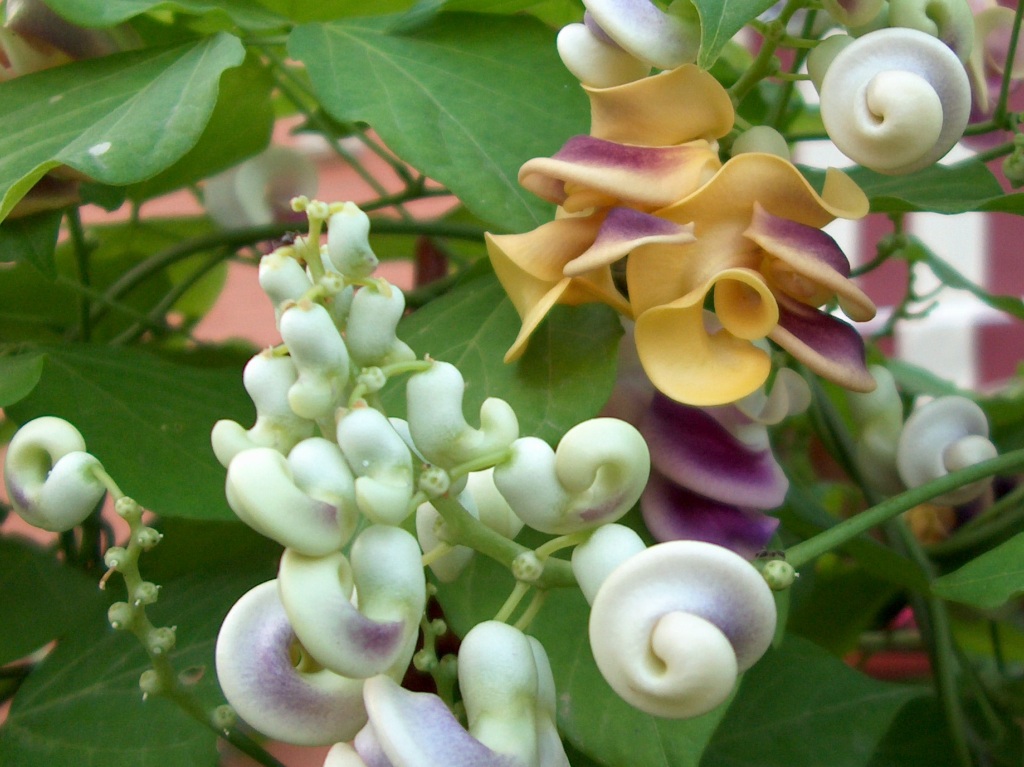
It is the only member of the genus Cochliasanthus and was formerly considered to belong to the genus Vigna. This perennial vine (when grown in a climate without frost) has fragrant flowers said to be reminiscent of hyacinths - with a distinctive curled shape, giving rise to the common names corkscrew vine, snail vine, snail creeper, snailflower or snail bean ; however, two very different plant species are sold and cultivated under the "snail-" names, the other one being Sigmoidotropis speciosa.
The purple, non-fragrant flowers of the Sigmoidotropis speciosa are said to have snail-shell shaped flowers, hence the origin of the common name. The multicolored, fragrant flowers of the Cochliasanthus caracalla are said to have corkscrew or nautilus-shell shaped flowers, hence the origin of that common name. Though some claim that the leaves of one species are darker and differently sized compared to the leaves of the other, it is difficult to distinguish between these two plants through foliage alone.
There have been multiple instances where both plants have been grown side by side for years and the discovery that they were not the same species was made only after the less mature plant finally bloomed. C. caracalla is pollinated by bumblebees and carpenter bees in its native range in Argentina.
The corkscrew vine, Cochliasanthus caracalla, has highly fragrant, multicolored, corkscrew or spiral shaped flowers and is not an invasive plant.
More specifically, the flowers are white with purple streaks that fade to cream and then to yellow with age. They hang in twelve-inch long clusters. The flowers are extremely wavy and immature blossoms very much resemble multicolored spirals or corkscrews. This plant grows white buds that produce nectar, which attracts ants, who then pollinate the flowers. The fragrance has been likened to Chinese wisteria, Jasmine, and Magnolia. It is claimed that the plant can be smelled from 15 feet away. The Corkscrew Vine is less frost tolerant than the Snail Vine.
This vine is hardy in zones 9 and above, liking full sun and consistently damp soil. It prefers high heat and humidity. In colder zones, it does well in a pot if it is overwintered inside.
Flowers typically bloom in late summer or autumn and, if pollination by bees is successful, seeds come soon after. Seeds grow inside pods, like pea pods. If the grower wants to cultivate them, pods should be removed from the plant while still green to prevent exposure to winter temperatures. The seeds, which are technically beans, could be edible. Parts of the true Corkscrew plant might be poisonous.
Hub AI
Cochliasanthus AI simulator
(@Cochliasanthus_simulator)
Cochliasanthus
Cochliasanthus caracalla is a leguminous flowering plant in the family Fabaceae that originates in tropical South America and Central America. The species is named caracalla, a corruption of the Portuguese caracol, meaning snail.. Thomas Jefferson called this plant "the most beautiful bean in the world".
It is the only member of the genus Cochliasanthus and was formerly considered to belong to the genus Vigna. This perennial vine (when grown in a climate without frost) has fragrant flowers said to be reminiscent of hyacinths - with a distinctive curled shape, giving rise to the common names corkscrew vine, snail vine, snail creeper, snailflower or snail bean ; however, two very different plant species are sold and cultivated under the "snail-" names, the other one being Sigmoidotropis speciosa.
The purple, non-fragrant flowers of the Sigmoidotropis speciosa are said to have snail-shell shaped flowers, hence the origin of the common name. The multicolored, fragrant flowers of the Cochliasanthus caracalla are said to have corkscrew or nautilus-shell shaped flowers, hence the origin of that common name. Though some claim that the leaves of one species are darker and differently sized compared to the leaves of the other, it is difficult to distinguish between these two plants through foliage alone.
There have been multiple instances where both plants have been grown side by side for years and the discovery that they were not the same species was made only after the less mature plant finally bloomed. C. caracalla is pollinated by bumblebees and carpenter bees in its native range in Argentina.
The corkscrew vine, Cochliasanthus caracalla, has highly fragrant, multicolored, corkscrew or spiral shaped flowers and is not an invasive plant.
More specifically, the flowers are white with purple streaks that fade to cream and then to yellow with age. They hang in twelve-inch long clusters. The flowers are extremely wavy and immature blossoms very much resemble multicolored spirals or corkscrews. This plant grows white buds that produce nectar, which attracts ants, who then pollinate the flowers. The fragrance has been likened to Chinese wisteria, Jasmine, and Magnolia. It is claimed that the plant can be smelled from 15 feet away. The Corkscrew Vine is less frost tolerant than the Snail Vine.
This vine is hardy in zones 9 and above, liking full sun and consistently damp soil. It prefers high heat and humidity. In colder zones, it does well in a pot if it is overwintered inside.
Flowers typically bloom in late summer or autumn and, if pollination by bees is successful, seeds come soon after. Seeds grow inside pods, like pea pods. If the grower wants to cultivate them, pods should be removed from the plant while still green to prevent exposure to winter temperatures. The seeds, which are technically beans, could be edible. Parts of the true Corkscrew plant might be poisonous.
Recent media