



Community hub
Recent from talks
Contribute something
Nothing was collected or created yet.
Programming complexity
View on WikipediaProgramming complexity (or software complexity) is a term that includes software properties that affect internal interactions. Several commentators distinguish between the terms "complex" and "complicated". Complicated implies being difficult to understand, but ultimately knowable. Complex, by contrast, describes the interactions between entities. As the number of entities increases, the number of interactions between them increases exponentially, making it impossible to know and understand them all. Similarly, higher levels of complexity in software increase the risk of unintentionally interfering with interactions, thus increasing the risk of introducing defects when changing the software. In more extreme cases, it can make modifying the software virtually impossible.
The idea of linking software complexity to software maintainability has been explored extensively by Professor Manny Lehman, who developed his Laws of Software Evolution. He and his co-author Les Belady explored numerous software metrics that could be used to measure the state of software, eventually concluding that the only practical solution is to use deterministic complexity models.[1]
Types
[edit]The complexity of an existing program determines the complexity of changing the program. Problem complexity can be divided into two categories:[2]
- Accidental complexity relates to difficulties a programmer faces due to the software engineering tools. Selecting a better tool set or a higher-level programming language may reduce it. Accidental complexity often results from not using the domain to frame the form of the solution.[citation needed] Domain-driven design can help minimize accidental complexity.
- Essential complexity is caused by the characteristics of the problem to be solved and cannot be reduced.
Measures
[edit]Several measures of software complexity have been proposed. Many of these, although yielding a good representation of complexity, do not lend themselves to easy measurement. Some of the more commonly used metrics are
- McCabe's cyclomatic complexity metric
- Halstead's software science metrics
- Henry and Kafura introduced "Software Structure Metrics Based on Information Flow" in 1981,[3] which measures complexity as a function of "fan-in" and "fan-out". They define fan-in of a procedure as the number of local flows into that procedure plus the number of data structures from which that procedure retrieves information. Fan-out is defined as the number of local flows out of that procedure plus the number of data structures that the procedure updates. Local flows relate to data passed to, and from procedures that call or are called by, the procedure in question. Henry and Kafura's complexity value is defined as "the procedure length multiplied by the square of fan-in multiplied by fan-out" (Length ×(fan-in × fan-out)²).
- Chidamber and Kemerer introduced "A Metrics Suite for Object-Oriented Design" in 1994,[4] focusing on metrics for object-oriented code. They introduce six OO complexity metrics: (1) weighted methods per class; (2) coupling between object classes; (3) response for a class; (4) number of children; (5) depth of inheritance tree; and (6) lack of cohesion of methods.
Several other metrics can be used to measure programming complexity:
- Branching complexity (Sneed Metric)
- Data access complexity (Card Metric)
- Data complexity (Chapin Metric)
- Data flow complexity (Elshof Metric)
- Decisional complexity (McClure Metric)
- Path Complexity (Bang Metric)
Tesler's Law is an adage in human–computer interaction stating that every application has an inherent amount of complexity that cannot be removed or hidden.
Chidamber and Kemerer Metrics
[edit] |
Chidamber and Kemerer[4] proposed a set of programing complexity metrics widely used in measurements and academic articles: weighted methods per class, coupling between object classes, response for a class, number of children, depth of inheritance tree, and lack of cohesion of methods, described below:
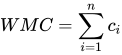
- Weighted methods per class ("WMC")
- n is the number of methods on the class
- is the complexity of the method
- Coupling between object classes ("CBO")
- number of other class which is coupled (using or being used)
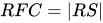
- Response for a class ("RFC")
- where
- is set of methods called by method i
- is the set of methods in the class
- Number of children ("NOC")
- sum of all classes that inherit this class or a descendant of it
- Depth of inheritance tree ("DIT")
- maximum depth of the inheritance tree for this class
- Lack of cohesion of methods ("LCOM")
- Measures the intersection of the attributes used in common by the class methods
- Where
- And
- With is the set of attributes (instance variables) accessed (read from or written to) by the -th method of the class









See also
[edit]References
[edit]- ^ MM Lehmam LA Belady; Program Evolution - Processes of Software Change 1985
- ^ In software engineering, a problem can be divided into its accidental and essential complexity [1].
- ^ Henry, S.; Kafura, D. IEEE Transactions on Software Engineering Volume SE-7, Issue 5, Sept. 1981 Page(s): 510 - 518
- ^ a b Chidamber, S.R.; Kemerer, C.F. IEEE Transactions on Software Engineering Volume 20, Issue 6, Jun 1994 Page(s):476 - 493
Programming complexity
View on GrokipediaOverview
Definition and Scope
Programming complexity, often referred to as software complexity, is defined as the degree to which a system or component has a design or implementation that is difficult to understand and verify.[4] This intricacy impacts essential software attributes, including understandability, maintainability, and performance, making it a central concern in software engineering. At its core, programming complexity arises from the interplay of algorithmic logic, structural organization, and systemic interactions within a software entity. The scope of programming complexity spans theoretical and practical dimensions. Theoretical complexity pertains to the inherent resource demands of algorithms, providing a foundational analysis of computational feasibility independent of specific implementations.[4] In contrast, practical complexity addresses real-world code-level and system-level challenges, incorporating factors such as codebase size, inter-module dependencies, and modularity levels that influence development and evolution.[5] These elements collectively determine how readily a software system can be comprehended, modified, or scaled, and extend to include reliability requirements, the distributed nature of systems, handling of real-world variability, fault tolerance, security, concurrency, backward compatibility, and engineering challenges like formal verification in safety-critical applications.[6][7] A pivotal distinction within programming complexity is between essential and accidental forms, as articulated by Frederick P. Brooks Jr. Essential complexity is intrinsic to the problem domain, stemming from the conceptual structures and changing requirements that software must address.[8] Accidental complexity, by comparison, emerges from artifacts of the development process, such as suboptimal tools, representations, or production methods.[8] For instance, a straightforward script performing basic data processing demonstrates minimal complexity, while a multifaceted application managing concurrent user interactions and external integrations reveals elevated complexity through layered abstractions and interconnections.[8]Historical Development
The foundations of programming complexity trace back to early theoretical work in computability, where Alan Turing's 1936 paper introduced the concept of computable numbers through a model of mechanical computation, laying groundwork for later ideas on the inherent limits and resource demands of algorithms.[9] This work influenced the development of complexity theory by highlighting the boundaries of what can be computed efficiently, setting a conceptual stage for measuring program intricacy beyond mere feasibility. In the 1960s, the structured programming movement emerged to address growing concerns over code maintainability, with Edsger W. Dijkstra's 1968 letter advocating the elimination of unstructured "go to" statements to reduce cognitive burdens on programmers and promote modular designs.[10] The 1970s marked the formal emergence of quantitative metrics for software complexity, driven by efforts to predict and manage program size and effort. Maurice H. Halstead's 1977 book Elements of Software Science proposed a set of measures based on operators and operands in source code, treating programming as a linguistic process to estimate development volume and difficulty.[11] Concurrently, Thomas J. McCabe introduced cyclomatic complexity in 1976 as a graph-theoretic approach to quantify the number of independent paths in a program's control flow, providing a tool for assessing testing needs and structural risks.[12] During the 1980s and 1990s, the rise of object-oriented programming shifted focus toward metrics suited to encapsulation and inheritance, while broader philosophical distinctions refined complexity analysis. Frederick P. Brooks Jr.'s 1986 essay distinguished "essential" complexity—arising from the problem domain itself—from "accidental" complexity due to implementation choices, arguing that no single technique could eliminate the former.[13] In 1994, Shyam R. Chidamber and Chris F. Kemerer developed a suite of metrics tailored for object-oriented designs, including weighted methods per class and depth of inheritance tree, to evaluate cohesion, coupling, and polymorphism impacts on maintainability.[14] From the 2000s onward, attention turned to human factors in complexity assessment, with cognitive complexity gaining prominence to better capture readability and mental load. SonarSource introduced its cognitive complexity model in 2017, which scores code based on nested control structures and branching depth to prioritize developer understandability over mere path counts.[15] This evolution has integrated complexity metrics into agile and DevOps workflows, enabling real-time analysis in continuous integration pipelines to support iterative refactoring and automated quality gates.[16]Types of Complexity
Computational Complexity
Computational complexity refers to the amount of computational resources, primarily time and space, required by an algorithm to solve a problem as the size of the input grows. This field classifies problems based on their inherent difficulty in terms of resource demands, focusing on whether solutions are feasible within reasonable bounds, such as polynomial time.[17] Asymptotic analysis provides a framework for describing these resource requirements by abstracting away constant factors and lower-order terms, emphasizing the growth rate relative to input size . Big O notation, , denotes an upper bound on the growth, indicating that the resource usage is at most proportional to for large ; for instance, linear search has a time complexity of in the worst case. In contrast, Big Omega, , provides a lower bound, showing growth at least as fast as , while Big Theta, , offers a tight bound by combining both upper and lower limits. A practical example is hash table lookups, which achieve average-case time complexity under ideal conditions, highlighting how different data structures affect efficiency.[17] Complexity classes further categorize problems: class P includes those solvable in polynomial time by a deterministic Turing machine, such as sorting algorithms like mergesort, which run in time and are thus tractable for large inputs. Class NP encompasses problems where a proposed solution can be verified in polynomial time, though finding one may be harder; the traveling salesman problem, seeking the shortest tour visiting all cities, is NP-complete, meaning it is among the hardest in NP and no known polynomial-time algorithm exists for it. The central P vs. NP question asks whether every problem in NP is also in P, with profound implications for optimization and cryptography if resolved affirmatively.[17] In practice, algorithm selection hinges on analyzing worst-case, average-case, and best-case scenarios to predict performance across input distributions. Worst-case analysis guarantees an upper bound, crucial for real-time systems where maximum delay must be bounded, as in quicksort's potential degradation. Average-case analysis, assuming typical inputs, often yields more optimistic polynomial bounds, like quicksort's , aiding everyday software design. Best-case provides a lower bound but is less informative for reliability; these analyses inform choices between algorithms, balancing trade-offs in time and space while relating to structural complexity through efficient implementation paths.[17]Structural Complexity
Structural complexity in programming refers to the degree of interconnection and interdependence among code elements within a program's architecture, which profoundly affects its modularity and testability. Unlike runtime behaviors, it focuses on static properties that determine how easily the code can be divided into independent units for development, testing, and evolution. High structural complexity arises when elements are overly intertwined, making it difficult to isolate changes or verify functionality without impacting unrelated parts.[18] Key aspects of structural complexity include the representation of program flow through control flow graphs, which model execution paths as directed graphs with nodes for statements and edges for transitions, highlighting potential bottlenecks in logic sequencing. Nesting levels of control structures, such as repeated embeddings of loops or conditionals, exacerbate this by creating deeper hierarchies that obscure traceability and increase the risk of errors in path analysis. Central to this are the interrelated concepts of coupling and cohesion: coupling quantifies inter-module dependencies, where high coupling—such as shared global variables—forces widespread ripple effects during modifications, while cohesion assesses intra-module relatedness, with low cohesion indicating scattered responsibilities that undermine unit integrity. These factors collectively determine how well a design supports decomposition without excessive entanglement.[19][20] Illustrative examples contrast monolithic architectures, where all functionality resides in a single, densely interconnected unit leading to elevated complexity and challenges in isolated testing, with modular designs that emphasize bounded components to foster independence and reusability. A notorious case is the goto statement, critiqued by Edsger Dijkstra for introducing arbitrary jumps that disrupt hierarchical control flow, resulting in "spaghetti code" that resists modular partitioning and heightens maintenance burdens. These structural elements also impose cognitive load by complicating mental models of the program's architecture during comprehension tasks. In practice, structural complexity involves trade-offs between fostering maintainability through simplified interconnections and achieving performance optimizations that may necessitate tighter integrations, such as in resource-constrained environments where modularity yields to efficiency.[21][22]Cognitive Complexity
Cognitive complexity serves as a subjective metric assessing the mental burden developers face when reading, comprehending, and reasoning about source code, emphasizing human-centric readability over purely structural properties.[15] It quantifies how elements in code disrupt linear thought processes, making it harder to grasp intent and behavior without deep analysis.[23] Key factors contributing to elevated cognitive complexity include deeply nested structures, such as conditional statements or loops within loops, which demand tracking multiple levels of abstraction simultaneously.[15] Long methods that accumulate numerous control flows or logical sequences exacerbate this by overwhelming short-term memory, while implicit dependencies—such as unapparent state changes or side effects—require additional effort to infer connections across the code.[24] In contrast to cyclomatic complexity, which treats all paths equally regardless of their arrangement, cognitive complexity recognizes that structural breaks like early returns or exceptions can mitigate difficulty by allowing developers to mentally "exit" nested contexts early, thus preserving comprehension.[15] A prominent model for measuring cognitive complexity is the metric developed by SonarSource and integrated into SonarQube in 2017, designed specifically to evaluate code understandability from a programmer's viewpoint.[15] This approach assigns scores incrementally: +1 for each branching construct (e.g., if, switch), looping mechanism (e.g., for, while), or sequential operator (e.g., && or || in conditions); deeper nesting adds +1 per level beyond the first; however, flow-breaking elements like return, break, or throw reset the nesting increment to zero, reflecting reduced mental load.[15] The resulting score thresholds, such as 15 for methods, guide refactoring to enhance maintainability.[25] Empirical research from the 2010s onward demonstrates that higher cognitive complexity correlates with elevated defect rates, as increased mental effort leads to comprehension errors during development and maintenance.[26] For example, a 2020 study using slice-based cognitive complexity metrics on open-source projects found that rises in these scores significantly increased defect counts in 94% of cases, outperforming traditional metrics in prediction accuracy by up to 11% in F-measure.[27] Further validation through meta-analysis of 427 code snippets across 10 experiments revealed moderate positive correlations with comprehension time (r = 0.54) and inverse associations with subjective understandability ratings (r = -0.29), underscoring how high cognitive load fosters bug-prone code.[28] These findings highlight cognitive complexity's role in predicting software quality issues tied to human factors.[26]Measures and Metrics
Time and Space Complexity
Time complexity refers to the computational resources required by an algorithm as a function of the input size , typically expressed using Big O notation to describe the upper bound on the growth rate of the running time . Formally, if there exist positive constants and such that for all , providing an asymptotic upper bound that focuses on the dominant term while ignoring lower-order terms and constants.[29] This notation, adapted from mathematical analysis, allows algorithm designers to compare efficiency without precise timing measurements.[30] To analyze time complexity for recursive algorithms, methods like the Master Theorem solve recurrence relations of the form , where , , and is the cost outside the recursive calls. The theorem classifies the solution into three cases based on the relationship between and : if for some , then ; if , then ; and if with regularity conditions, then .[29] For example, merge sort follows the recurrence , where , , and , so and the second case applies, yielding .[29] Space complexity measures the memory usage of an algorithm relative to input size , similarly bounded by Big O notation as . It distinguishes between total space, which includes input storage, and auxiliary space, the extra memory for variables, recursion stacks, or data structures beyond the input.[29] In-place algorithms like heapsort use auxiliary space by modifying the input array directly, while dynamic programming approaches, such as the standard Fibonacci computation, require auxiliary space for a table storing intermediate results, though optimizations can reduce this to .[29] Complexity is assessed through theoretical analysis, which derives bounds via recurrences or induction, or empirical profiling, which measures actual runtime or memory on test inputs to fit models like .[30] Tools such as the Trend Profiler automate empirical analysis by executing code on varying input sizes and regressing execution counts against complexity functions to estimate parameters empirically.[30] Theoretical methods provide worst-case guarantees independent of hardware, while empirical approaches capture real-world behaviors but depend on test cases and platforms. Big O analysis has limitations, as it disregards constant factors and lower-order terms, potentially misleading comparisons for small or when constants dominate, and it assumes uniform hardware without accounting for variations in cache efficiency or parallelism.[29]Cyclomatic Complexity
Cyclomatic complexity, introduced by Thomas J. McCabe in 1976, is a graph-theoretic metric that quantifies the number of linearly independent paths through a program's source code by analyzing its control flow graph.[2] In this representation, the program is modeled as a directed graph where nodes represent blocks of code and edges represent possible control flow transitions.[2] The metric, denoted V(G), is calculated using the formula: where is the number of edges, is the number of nodes, and is the number of connected components in the graph (typically for a single module).[2] For structured programs without unstructured jumps like GOTO statements, V(G) simplifies to the number of predicates (decision points such as IF or WHILE statements) plus one.[2] This measure serves as a tool for quantifying structural complexity by highlighting the density of decision logic, which correlates with potential error proneness and maintenance challenges.[31] Interpretation guidelines suggest that V(G) ≤ 10 represents a simple module with low risk of errors, while values between 11 and 20 indicate moderate risk requiring careful review, and >20 signal high risk due to increased difficulty in testing and understanding.[2][31] In terms of testing, decision coverage requires at least V(G) independent test cases to exercise all paths, ensuring comprehensive basis path testing.[31] To illustrate calculation, consider a simple if-then-else statement, which introduces one predicate and yields V(G) = 2, representing two possible paths through the code.[2] For nested loops, such as an outer for loop containing an inner for loop (each acting as a predicate), the complexity increases to V(G) = 3, accounting for the combined decision points.[2] Automated tools facilitate computation; for instance, PMD analyzes Java code for cyclomatic complexity during static analysis, and Lizard computes it across multiple languages like Python and C++. Despite its utility, cyclomatic complexity has been criticized for overlooking data flow dependencies and failing to account for nesting depth, where deeply nested structures increase cognitive load without raising V(G) proportionally; these limitations are addressed in alternative models like cognitive complexity.[32][33]Halstead Complexity Measures
Halstead complexity measures, introduced as part of software science theory, quantify program complexity by analyzing the lexical structure of source code through counts of operators and operands. Let be the number of distinct operators, where operators are symbols or keywords that specify actions, such as arithmetic operators (+, -, *, /) or control statements (if, while). Let be the number of distinct operands, which are the variables, constants, or literals upon which operations are performed. Let be the total occurrences of all operators in the code, and the total occurrences of all operands. These counts form the foundation for deriving higher-level metrics that estimate attributes like program size, difficulty, and development effort. From these basic counts, Halstead defined several key metrics. Program vocabulary is calculated as , representing the total distinct tokens in the program. Program length is , the overall count of tokens. Program volume measures the information content as , where higher values suggest greater potential for errors and maintenance challenges. Difficulty assesses the effort required to understand the code via , reflecting how operand reuse and operator diversity contribute to comprehension barriers. Finally, mental effort is , providing an estimate of the cognitive load during development.[34] These measures enable further interpretations of software quality. A high volume often indicates programs prone to maintenance issues due to increased information density. Halstead also proposed an estimated number of delivered bugs as , based on empirical observations that roughly one error occurs per 3000 bits of information. The predicted time to program is derived as seconds, assuming an average programmer processes 18 logical decisions per second. These derived metrics aim to predict development costs and reliability without executing the code. For illustration, consider a simple assignment statement likex = a + b;: here, distinct operators (= and +), distinct operands (x, a, b), total operators , and total operands , yielding a low volume and difficulty . In contrast, a complex expression such as result = a * b + c / d;: distinct operators (=, *, +, /), distinct operands (result, a, b, c, d), total operators , total operands , resulting in and , highlighting increased complexity from more diverse operators and limited operand reuse. Such examples demonstrate how Halstead metrics capture lexical intricacy.
Empirical validation of these measures, conducted in 1977, involved analyzing programs in languages like FORTRAN, confirming correlations between predicted effort and actual development times, as well as between volume and error rates across diverse software samples. These studies established the metrics' utility for procedural code assessment, though applicability varies by language and implementation details.[35]