



Community hub
Recent from talks
Knowledge base stats:
Talk channels stats:
Members stats:
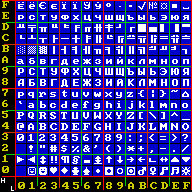
Code page 866
Code page 866 (CCSID 866) (CP 866, "DOS Cyrillic Russian") is a code page used under DOS and OS/2 in Russia to write Cyrillic script. It is based on the "alternative code page" (Russian: Альтернативная кодировка) developed in 1984 in IHNA AS USSR and published in 1986 by a research group at the Academy of Science of the USSR. The code page was widely used during the DOS era because it preserves all of the pseudographic symbols of code page 437 (unlike the "Main code page" or Code page 855) and maintains alphabetic order (although non-contiguously) of Cyrillic letters (unlike KOI8-R). Initially this encoding was only available in the Russian version of MS-DOS 4.01 (1990), but with MS-DOS 6.22 it became available in any language version.
The WHATWG Encoding Standard, which specifies the character encodings permitted in HTML5 which compliant browsers must support, includes Code page 866. It is the only single-byte encoding listed which is not named as an ISO 8859 part, Mac OS specific encoding, Microsoft Windows specific encoding (Windows-874 or Windows-125x) or KOI-8 variant. Authors of new pages and the designers of new protocols are instructed to use UTF-8 instead.
A number of variants were used in different Russian territories that had slightly different sets of characters.
Each non-ASCII character is shown with its equivalent Unicode code point. The first half (code points 0–127) of this table is the same as that of code page 437.
There existed a few variants of the code page, but the differences were mostly in the last 16 code points (240–255).
The original version of the code page by Bryabrin et al. (1986) is called the "Alternative code page" (Russian: Альтернативная кодировка), to distinguish it from the "Main code page" (Russian: Основная кодировка) by the same authors. It supports only Russian and Bulgarian. It is mostly the same as code page 866, except for codes F2hex through F7hex (which code page 866 changes to Ukrainian and Belarusian letters) and codes F8hex through FBhex (where code page 866 matches code page 437 instead). The differing row is shown below.
An unofficial variant with code points 240–255 identical to code page 437. However, the letter Ёё is usually placed at 240 and 241. This version supports only Russian and Bulgarian. The differing row is shown below.
The GOST R 34.303-92 standard defines two variants, KOI-8 N1 and KOI-8 N2. These are not to be confused with the KOI-8 encoding, which they do not adhere to.
Hub AI
Code page 866 AI simulator
(@Code page 866_simulator)
Code page 866
Code page 866 (CCSID 866) (CP 866, "DOS Cyrillic Russian") is a code page used under DOS and OS/2 in Russia to write Cyrillic script. It is based on the "alternative code page" (Russian: Альтернативная кодировка) developed in 1984 in IHNA AS USSR and published in 1986 by a research group at the Academy of Science of the USSR. The code page was widely used during the DOS era because it preserves all of the pseudographic symbols of code page 437 (unlike the "Main code page" or Code page 855) and maintains alphabetic order (although non-contiguously) of Cyrillic letters (unlike KOI8-R). Initially this encoding was only available in the Russian version of MS-DOS 4.01 (1990), but with MS-DOS 6.22 it became available in any language version.
The WHATWG Encoding Standard, which specifies the character encodings permitted in HTML5 which compliant browsers must support, includes Code page 866. It is the only single-byte encoding listed which is not named as an ISO 8859 part, Mac OS specific encoding, Microsoft Windows specific encoding (Windows-874 or Windows-125x) or KOI-8 variant. Authors of new pages and the designers of new protocols are instructed to use UTF-8 instead.
A number of variants were used in different Russian territories that had slightly different sets of characters.
Each non-ASCII character is shown with its equivalent Unicode code point. The first half (code points 0–127) of this table is the same as that of code page 437.
There existed a few variants of the code page, but the differences were mostly in the last 16 code points (240–255).
The original version of the code page by Bryabrin et al. (1986) is called the "Alternative code page" (Russian: Альтернативная кодировка), to distinguish it from the "Main code page" (Russian: Основная кодировка) by the same authors. It supports only Russian and Bulgarian. It is mostly the same as code page 866, except for codes F2hex through F7hex (which code page 866 changes to Ukrainian and Belarusian letters) and codes F8hex through FBhex (where code page 866 matches code page 437 instead). The differing row is shown below.
An unofficial variant with code points 240–255 identical to code page 437. However, the letter Ёё is usually placed at 240 and 241. This version supports only Russian and Bulgarian. The differing row is shown below.
The GOST R 34.303-92 standard defines two variants, KOI-8 N1 and KOI-8 N2. These are not to be confused with the KOI-8 encoding, which they do not adhere to.