Respect all members: no insults, harassment, or hate speech.
Be tolerant of different viewpoints, cultures, and beliefs. If you do not agree with others, just create separate note, article or collection.
Clearly distinguish between personal opinion and fact.
Verify facts before posting, especially when writing about history, science, or statistics.
Promotional content must be published on the “Related Services and Products” page—no more than one paragraph per service. You can also create subpages under the “Related Services and Products” page and publish longer promotional text there.
Do not post materials that infringe on copyright without permission.
Always credit sources when sharing information, quotes, or media.
Be respectful of the work of others when making changes.
Discuss major edits instead of removing others' contributions without reason.
If you notice rule-breaking, notify community about it in talks.
Do not share personal data of others without their consent.
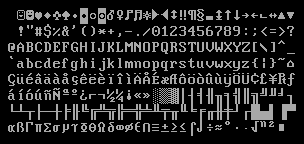
Code page 437 (CCSID 437) is the character set of the original IBM PC (personal computer).[2] It is also known as CP437, OEM-US, OEM 437,[3]PC-8,[4] or MS-DOS Latin US.[5] The set includes all printable ASCII characters as well as some accented letters (diacritics), Greek letters, icons, and line-drawing symbols. It is sometimes referred to as the "OEM font" or "high ASCII", or as "extended ASCII"[4] (one of many mutually incompatible ASCII extensions).
This character set remains the primary set in the core of any EGA and VGA-compatible graphics card. As such, text shown when a PC reboots, before fonts can be loaded and rendered, is typically rendered using this character set.[note 1] Many file formats developed at the time of the IBM PC are based on code page 437 as well.
All these display adapters have text modes in which each character cell contains an 8-bit character code point (see details), giving 256 possible values for graphic characters. All 256 codes were assigned a graphical character in ROM, including the codes from 0 to 31 that were reserved in ASCII for non-graphical control characters.
Various Eastern European PCs[which?] used different character sets, sometimes user-selectable via jumpers or CMOS setup. These sets were designed to match 437 as much as possible, for instance sharing the code points for many of the line-drawing characters, while still allowing text in a local language to be displayed.
A legacy of code page 437 is the number combinations used in Windows Alt codes.[6][7][8] A DOS user could enter a character by holding down the Alt key and entering the character code on the numpad[6] and many users memorized the numbers needed for CP437 (or for the similar CP850). Although Microsoft Windows used different character sets such as CP1252, the original numbers were emulated so users could continue to use them; Microsoft added the ability to type a code from the Windows character set by typing 0 before the digits.[6][9]
The following tables show code page 437. Each character is shown with its equivalent Unicode code point (when it is not equal to the character's code). A tooltip, generally available only when one points to the immediate left of the character, shows the Unicode code point name and the decimal Alt code. See also the notes below, as there are multiple equivalent Unicode characters for some code points.
Although the ROM provides a graphic for all 256 different possible 8-bit codes, some APIs will not print some code points, in particular the range 0-31 and the code at 127.[10] Instead, they will interpret them as control characters. For instance, many methods of outputting text on the original IBM PC would interpret hex codes 07, 08, 0A, and 0D as BEL, BS, LF, and CR, respectively. Many printers were also unable to print these characters.
When translating to Unicode some codes do not have a unique, single Unicode equivalent; the correct choice may depend upon context.
^0 draws a blank space, but usage as the C string terminator means it is more accurately translated as NUL. In their code-page-437-based implementation of C0-region graphics, Star Micronics printers re-purpose this code as a slashed zero.[15]
^14 (Ehex) Mapping as shown, to the beamed eighth notes [U+266B, ♫], follows data provided by the Unicode Consortium.[16] In IBM's GCGID (Graphic Character Global IDentifier) system of character IDs, this is SM910000, simply annotated as "Two Musical Notes";[12][13] however, the reference glyph shows two beamed sixteenth notes [U+266C, ♬].[12] In the specification for IBM Japanese Host code, SM910080 (i.e. SM910000 with the fullwidth attribute set) is explicitly mapped to U+266C, and accordingly shows two semiquavers.[17]
^124 (7Chex) The actual glyph at this position is a broken bar [U+00A6, ¦] in the original IBM PC and compatibles font, as rendered by the original MDA. This rendering was later adopted for CGA, EGA and VGA (see image at the beginning of the article). However, almost all software assumes this code is the ASCII character [U+007C, |]; for example, programming languages use it as "or". In the early 1990s, it was clarified[by whom?] that there is vertical bar in ASCII at this position and that the broken bar symbol is not part of ASCII.
^127 (7Fhex) is a "house" but was also sometimes used as Greek capital delta [U+0394, Δ].
^179 (B3hex) Could also serve as an integral extension [U+23AE, ⎮] in IBM's font.
^Comparison of characters in the E0 to EF range across various IBM products.225 (E1hex) is identified by IBM as Latin "Sharp s Small"[13] [U+00DF, ß] but is sometimes rendered in OEM fonts as Greek small beta [U+03B2, β]. The placement of this Latin character among Greek characters suggests intended multi-use.
^227 (E3hex) is identified by IBM as Greek "Pi Small" [U+03C0, π] but is sometimes rendered in OEM fonts as Greek capital pi [U+03A0, Π] or the n-aryproduct sign [U+220F, ∏].
^228 (E4hex) is identified by IBM as Greek "Sigma Capital" [U+03A3, Σ] but is also used as the n-arysummation sign [U+2211, ∑].
^230 (E6hex) is identified by IBM as Greek "Mu Small" [U+03BC, μ] but is also used as the micro sign [U+00B5, µ]. IBM's Greek GCGID table[18] maps the character in this code page to the Greek letter, but the cp437_DOSLatinUS to Unicode table[11] maps it to the micro sign.
^233 (E9hex) is identified by IBM as Greek "Theta Capital" [U+0398, Θ].[12][13] However, these symbols are for mathematics and physics, in which lowercase theta is much more commonly used (e.g. for polar coordinates).
^234 (EAhex) is identified by IBM as Greek "Omega Capital" [U+03A9, Ω] but is also used as the ohm sign [U+2126, Ω]. Unicode considers the characters to be equivalent and suggests that U+03A9 be used in both contexts.[19]
^235 (EBhex) is identified by IBM as Greek "Delta Small" [U+03B4, δ]. It was also unofficially used for the small eth [U+00F0, ð] and the partial derivative sign [U+2202, ∂]
^237 (EDhex) is identified by IBM as Greek "Phi Small (Closed Form)" [U+03D5, ϕ; or, from the italicized math set, U+1D719, 𝜙] but, Unicode maps it to the open (or "loopy") form [U+03C6, φ] in its cp437_DOSLatinUS table.[11] Comparison of IBM's Greek GCGID table[18] with Unicode's Greek code chart[20] shows where IBM, for example, reversed the open and closed forms when mapping to Unicode. This character is also used as the empty set sign [U+2205, ∅], the diameter sign [U+2300, ⌀], and the Latin letter O with stroke [U+00D8, Ø; and U+00F8, ø].
^238 (EEhex) is identified by IBM as Greek "Epsilon Small" [U+03B5, ε] but is sometimes rendered in OEM fonts as the element-of sign [U+2208, ∈]. It was often used as the euro sign [U+20AC, €]
^244 (F4hex) and 245 (F5hex) are the upper and lower portion of the integral symbol (∫), and they can be extended with the character 179 (B3hex), the vertical line of the box drawing block. 244 could also be used for the long s character [U+017F, ſ].
^249 (F9hex) and 250 (FAhex) are almost indistinguishable: the first is a slightly larger dot than the second, both were used as bullets, middle dot, and multiplication dot [U+2219, ∙]
^251 (FBhex) was also sometimes used as a check mark [U+2713, ✓].
^255 (FFhex) draws a blank space; the use as non-breaking space (NBSP) has precedent in word processors designed for the IBM PC.
The repertoire of code page 437 was taken from the character set of Wang word-processing machines, according to Bill Gates in an interview with Gates and Paul Allen that appeared in the 2 October 1995 edition of Fortune Magazine:
"... We were also fascinated by dedicated word processors from Wang, because we believed that general-purpose machines could do that just as well. That's why, when it came time to design the keyboard for the IBM PC, we put the funny Wang character set into the machine—you know, smiley faces and boxes and triangles and stuff. We were thinking we'd like to do a clone of Wang word-processing software someday."
According to an interview with David J. Bradley (developer of the PC's ROM-BIOS) the characters were decided upon during a four-hour meeting on a plane trip from Seattle to Atlanta by Andy Saenz (responsible for the video card), Lew Eggebrecht (chief engineer for the PC) and himself.[21]
The selection of graphic characters has some internal logic:
Table rows 0 and 1, codes 0 to 31 (00hex to 1Fhex), are assorted dingbats (complementary and decorative characters). The isolated character 127 (7Fhex) also belongs to this group.
Table rows 2 to 7, codes 32 to 126 (20hex to 7Ehex), are the standard ASCII printable characters.
Table rows 8 to 10, codes 128 to 175 (80hex to AFhex), are a selection of international text characters.
Table rows 11 to 13, codes 176 to 223 (B0hex to DFhex), are box drawing and block characters. This block is arranged so that characters 192 to 223 (C0hex to DFhex) contain all the right arms and right-filled areas. The original IBM PCMDA display adapter stored the code page 437 character glyphs as bitmaps eight pixels wide, but for visual enhancement displayed them every nine pixels on screen. This range of characters had the eighth pixel column duplicated by special hardware circuitry,[22] thus filling in gaps in lines and filled areas. The VGA adapter allows this behaviour to be turned on or off.[23]
Table rows 14 and 15, codes 224 to 254 (E0hex to FEhex) are devoted to mathematical symbols, where the first twelve are a selection of Greek letters commonly used in physics.
Most fonts for Microsoft Windows include the special graphic characters at the Unicode indexes shown, as they are part of the WGL4 set that Microsoft encourages font designers to support. (The monospaced raster font family Terminal was an early font that replicated all code page 437 characters, at least at some resolutions.) To draw these characters directly from these code points, a Microsoft Windows font called MS Linedraw[24] replicates all of the code page 437 characters, thus providing one way to display DOS text on a modern Windows machine as it was shown in DOS, with limitations.[25]
Code page 1055, also known as HP symbol set 0L,[26] is a subset which includes the box-drawing, half-blocks, black circles (the black circle replaces the bullet, which replaces the middle dot in this code page), and black square, and moves them to the upper half; the space is also included.[27]
Code page 437 has a series of international characters, mainly values 128 to 175 (80hex to AFhex). However, it only covers a few major Western European languages in full, including English, German and Swedish,[note 2] and so lacks several characters (mostly capital letters) important to many major Western European languages:
Danish/Norwegian: Ø and ø. Character number 237 (EDhex), the small phi (closed form), could be used as a surrogate even though it may not render well (furthermore, it tends to map to Unicode, and/or render in Unicode fonts, as the open-form phi or the closed-vertical-form phi, which are even further from the O with stroke). To compensate, the Danish/Norwegian and Icelandic code pages (865 and 861) replaced cent sign (¢) with ø and the yen sign (¥) with Ø.
Most Greek alphabet symbols were omitted, beyond the basic math symbols. (They were included in the Greek-language code pages 737 and 869. Some of the Greek symbols that were already in code page 437 had their glyphs changed from mathematical or scientific forms to match the actual use in Greek.)
Along with the cent (¢), pound sterling (£) and yen/yuan (¥) currency symbols, it has a couple of former European currency symbols: the florin (ƒ, Netherlands) and the peseta (₧, Spain). The presence of the last is unusual, since the Spanish peseta was never an internationally relevant currency, and also never had a symbol of its own; it was simply abbreviated as "Pt", "Pta", "Pts", or "Ptas". Spanish models of the IBM electric typewriter, however, also had a single position devoted to it.
Later DOS character sets, such as code page 850 (DOS Latin-1), code page 852 (DOS Central-European) and code page 737 (DOS Greek), filled the gaps for international use with some compatibility with code page 437 by retaining the single and double box-drawing characters, while discarding the mixed ones (e.g. horizontal double/vertical single). All code page 437 characters have similar glyphs in Unicode and in Microsoft's WGL4 character set, and therefore are available in most fonts in Microsoft Windows, and also in the default VGA font of the Linux kernel, and the ISO 10646 fonts for X11.
^Systems available in Eastern European, Arabic, and Asian countries often use a different set; however, these sets are designed to match 437 as much as possible. The designation "OEM", for "original equipment manufacturer", indicates that the set could be changed by the manufacturer to meet different markets.
^It also covers some less major Western European languages—as well as some other languages—in full, including Basque, Malay, and the pre-1999 TurkmenLatin alphabet, but this was likely unintended.
^Edwards, Benj (6 November 2015) [2011]. "Origins of the ASCII Smiley Character: An Email Exchange With Dr. David Bradley". Archived from the original on 28 November 2016. Retrieved 27 November 2016. If you look at the first 32 characters in the IBM PC character set you'll see lots of whimsical characters — smiley face, musical notes, playing card suits and others. These were intended for character based games [...] Since we were using 8-bit characters we had 128 new spots to fill. We put serious characters there — three columns of foreign characters, based on our Datamaster experience. Three columns of block graphic characters [...] many customers with Monochrome Display Adapter would have no graphics at all. [...] two columns had math symbols, greek letters (for math) and others [...] about the first 32 characters (x00-x1F)? [...] These characters originated with teletype transmission. But we could display them on the character based screens. So we added a set of "not serious" characters. They were intended as display only characters, not for transmission or storage. Their most probable use would be in character based games. [...] As in most things for the IBM PC, the one year development schedule left little time for contemplation and revision. [...] the character set was developed in a three person 4-hour meeting, and I was one of those on that plane from Seattle to Atlanta. There was some minor revision after that meeting, but there were many other things to design/fix/decide so that was about it. [...] the other participants in that plane trip were Andy Saenz — responsible for the video card, and Lew Eggebrecht — the chief engineer for the PC.
^Wilton, Richard (December 1987). Programmer's Guide to PC & PS/2 Video Systems: Maximum Video Performance Form the EGA, VGA, HGC, and MCGA (1st ed.). Microsoft Press. ISBN1-55615-103-9.
Code page 437, also designated as CP437 or IBM437, is an 8-bit character encoding standard that serves as the original code page for the IBM PC and compatible systems, extending the 7-bit ASCII character set with 128 additional characters tailored for text-based displays and international symbols in the United States English locale.[1][2] It functions as the default OEM (Original Equipment Manufacturer) code page for English-language MS-DOS installations, mapping byte values 0x00 through 0x7F directly to ASCII control and printable characters while assigning the extended range (0x80 through 0xFF) to line-drawing elements, block graphics, mathematical symbols, and accented Latin letters.[2]Developed in the early 1980s for the IBMPersonal Computer, code page 437 was integral to the system's BIOS ROM font, enabling the rendering of graphical user interfaces in character mode without graphical hardware, such as the box-drawing characters used in early DOS applications like word processors and games.[2] This encoding supported the needs of text-mode computing at the time, including semigraphics for borders, icons, and tables, and it became the basis for subsequent OEM code pages in multilingual variants.[2] Although largely superseded by Unicode in modern systems, code page 437 persists in Windows for console applications, legacy file name encoding in FAT file systems (FAT12, FAT16, and FAT32), and compatibility modes for older software.[2]Key characteristics of code page 437 include its compatibility with ASCII in the lower half, ensuring seamless integration with standard text protocols, while the upper half prioritizes utility characters over full international coverage—featuring elements like the cent sign (¢), degree symbol (°), and double-line horizontal (═) for visual structuring.[2] Unlike ISO 8859-1 (Latin-1), which emphasizes Western European languages, CP437's design reflects the hardware constraints and software paradigms of 1980s personal computing, with no formal standardization body but widespread adoption through IBM and Microsoft ecosystems.[2] Its enduring legacy is evident in emulators, retro computing, and tools that preserve the aesthetic of classic DOS interfaces.[2]
Overview
Definition and Characteristics
Code page 437, also known as CCSID 437, is the original character set for the IBM Personal Computer (IBM PC), serving as the default encoding for text-based operations on early PC systems.[3][4] It is officially designated by IBM with aliases including IBM437, cp437, and 437, and is commonly referred to in technical contexts as CP437, OEM-US, OEM 437, PC-8, or DOS Latin US.[5] This encoding standard was embedded in the IBM PC's Character Generator ROM to facilitate character rendering on video displays and printers.[3]The core characteristics of code page 437 include support for 256 single-byte characters, encoded from 0x00 to 0xFF, which extends the 7-bit ASCII set (codes 0x00 to 0x7F) by adding 128 additional code points for specialized glyphs.[3] The lower 128 characters align with standard ASCII, encompassing printable letters, digits, punctuation, and control codes, while the upper 128 introduce extensions such as block graphics, line-drawing elements, mathematical symbols, and icons to enable visual representations in text modes without dedicated graphics hardware.[3] These glyphs are rendered as 8x8 pixel patterns, supporting display resolutions like 80x25 text mode on monochrome or color/graphics adapters.[3]Designed primarily for text display in early PC environments, code page 437 allowed applications to produce formatted output, including business charts, tables, and simple interfaces, directly through the system's video and printing capabilities.[3] It includes non-printable control characters from the ASCII standard, such as 0x01 (Start of Heading, or SOH), which are visually represented in display ROM as glyphs like a smiley face to provide feedback during rendering or debugging.[3] This approach ensured compatibility for software development and user interfaces in resource-constrained hardware.[3]
Historical Significance
Code page 437 was introduced in August 1981 alongside the IBMPersonal Computer Model 5150, marking a pivotal shift in personal computing by providing an 8-bit extension to the 7-bit ASCII standard tailored for the new platform's display capabilities.[3] This character set, embedded in the system's ROM and BIOS, supported 256 characters including block graphics and symbols designed for enhanced text-mode rendering on early PC hardware.[6]As the default encoding for MS-DOS and compatible operating systems, code page 437 rapidly became ubiquitous among PC users, enabling innovative uses in software that shaped early digital culture.[2] Its inclusion of line-drawing characters facilitated the creation of graphical user interfaces in text-based applications, such as file managers employing box-drawing elements for visual organization.[6] Furthermore, the set's whimsical and graphical symbols, like the smiley face, were leveraged in character-based games such as Snipes, inspiring ASCII art communities and roguelike titles that relied on its extended glyphs for immersive, low-resolution visuals.[6]Code page 437 played a foundational role in evolving character encoding standards, serving as the prototype for subsequent OEM code pages that adapted it for international markets while preserving compatibility.[2] By extending ASCII with elements such as business-oriented block graphics, it bridged legacy enterprise computing with the ASCII-dominant personal computer era.[3] Microsoft formalized its status during DOS internationalization initiatives in the 1980s, cementing it as the reference for English-language OEM environments and influencing global software localization efforts.[2]
Technical Specifications
Encoding Structure
Code page 437 employs an 8-bit encoding scheme, utilizing a single byte per character to define 256 code points ranging from 0x00 to 0xFF. This structure partitions the code space into distinct ranges: control characters occupy 0x00–0x1F and 0x7F (such as 0x01 for Start of Heading (SOH) and 0x02 for Start of Text (STX), and 0x7F for Delete (DEL)), printable characters align with ASCII in 0x20–0x7E, and extended characters fill 0x80–0xFF with symbols, accented letters, and graphics elements.[7][2]The encoding ensures full compatibility with US-ASCII for code points 0x00–0x7F, where assignments match the 7-bit standard exactly, enabling direct interoperability with systems limited to 7-bit transmission or storage without data loss in the basic set.[7] This design allows Code page 437 text to fallback gracefully to ASCII environments, as the lower 128 code points remain unchanged.[2]In the extended range, code points 0x80–0xFF represent additional printable characters, including international diacritics and block-drawing symbols, with the high bit (bit 7) set to distinguish them from ASCII. This high-bit convention minimizes conflicts with ASCII-oriented printers, which often mask or ignore the high bit, causing extended characters to render as their ASCII counterparts (e.g., 0xC7 as Ç falling back to C).[7] Specific assignments in the lower control range repurposed for display include 0x03 for the heart symbol (♥) and 0x04 for the diamond (♦), where the code points retain control semantics but map to graphic glyphs in the system's character generator ROM.[7] The overall layout supports both textual and graphical applications on early PC hardware, with the full table defined in the BIOS character generator at offset 0xFA6E.[7]
Character Set Details
Code page 437 encompasses 256 characters, comprising the standard 7-bit US-ASCII set in positions 0x00 to 0x7F (with modifications for visual display of controls) and 128 extended characters in positions 0x80 to 0xFF that add support for accented letters, graphical elements, and symbols tailored to early personal computing needs.[8] These extended characters enable rudimentary text-based user interfaces, such as drawing borders and incorporating simple icons, while prioritizing compatibility with English and select Western European languages.[9]The character set features distinct categories, beginning with control characters in the ranges 0x00–0x1F and 0x7F, which include non-printable codes but are rendered with visible glyphs on compatible displays for diagnostic or illustrative purposes. For instance, 0x01 displays as the white smiley face ☺, serving as a visual stand-in for the Start of Heading (SOH) control, while 0x02 renders the black smiley ☻ for Start of Text (STX).[6] Similarly, 0x7F appears as a small house ⌂, acting as a placeholder for the Delete (DEL) control character to aid in visual debugging of data streams.[10] These glyphs originated from design decisions by IBM engineers during the 1981 development of the PC character set, repurposing control slots for memorable symbols influenced by terminal display conventions.[6]Basic Latin letters and punctuation occupy 0x20–0x7E, mirroring ASCII for uppercase and lowercase alphabets (A–Z at 0x41–0x5A, a–z at 0x61–0x7A), digits, and common symbols. The extended portion introduces accented Latin characters, such as Ç at 0x80 and ü at 0x81, along with additional letters like é (0x82) and ñ (0xA4), providing limited support for languages like French, German, and Spanish but without comprehensive diacritics for broader non-English scripts.[8]Graphical elements form a core strength, with box-drawing characters in 0xB0–0xDF enabling the creation of frames and tables in console applications; examples include the vertical line │ at 0xB3 and horizontal line ─ at 0xC4. This range also incorporates 32 block elements, such as light shade ░ (0xB0), medium shade ▒ (0xB1), and full block █ (0xDB), useful for filling areas or simulating shading in text-mode graphics. Mathematical symbols appear primarily in 0xE0–0xFF, including ± at 0xF1 and ÷ at 0xF6, alongside 14 dedicated operators like ∞ (0xEC) and ≤ (0xF3) for basic equations. Nine icons, such as the male symbol ♂ (0x11), female symbol ♀ (0x12), and musical note ♪ (0x13), enhance the set's versatility for informal text-based UIs, like early games or status indicators.[9] Overall, the 128 extended characters—encompassing these 32 block elements, 14 math symbols, and 9 icons—facilitate practical applications in resource-constrained environments without requiring advanced graphics hardware.[8]
Input and Output Methods
Alt Codes
Alt codes provide a method for entering extended characters from Code page 437 directly via the keyboard in DOS environments, allowing users to input non-standard symbols without additional software. The process involves holding down the Alt key while typing a decimal number on the numeric keypad, with the number corresponding to the character's byte value in the 0x00 to 0xFF range. Upon releasing the Alt key, the system interprets the decimal input as the specified byte and inserts the associated Code page 437 character into the active text buffer.[11][12]This input mechanism maps directly to the Code page 437 encoding, where decimal codes from 0 to 255 produce the full set of 256 characters, including control codes rendered as icons, accented letters, and block graphics. For instance, Alt+1 inserts ☺ (smiley face, byte 0x01), Alt+3 inserts ♥ (heart suit, byte 0x03), and Alt+255 inserts ÿ (small y with diaeresis, byte 0xFF). Other common examples include Alt+176 for ░ (light shade block, byte 0xB0) and Alt+219 for █ (full block, byte 0xDB), which were frequently used for creating simple text-based graphics and borders in applications like word processors or games.[11][13]The feature has specific limitations: it requires an IBM-compatible keyboard equipped with a numeric keypad, as the main keyboard number keys do not trigger the sequence, and it functions only in text-based console modes, not graphical user interfaces where input is handled differently. If a code exceeds 255, it is reduced modulo 256, so Alt+259 equates to Alt+3 (♥).[11][14]Alt codes were introduced with the original IBM PC in 1981 through the system's ROM-BIOS firmware, becoming standardized in PC-DOS 1.0 to enable straightforward user input of graphics and international characters without relying on specialized tools.[12][11]
Display Adapter Rendering
The rendering of Code page 437 characters on IBM PC display adapters varied significantly across hardware generations, primarily due to differences in font resolution, pixel dimensions, and glyph design stored in the adapter's ROM or BIOS. These variations affected the visual appearance of both standard ASCII characters and extended glyphs, including symbols, accented letters, and box-drawing elements, influencing the overall aesthetic of text-based interfaces in early DOS environments.[15]The Color Graphics Adapter (CGA), introduced in 1981, utilized blocky 8x8pixel fonts derived from the same character ROM as the Monochrome Display Adapter (MDA), supporting monochrome or 4-color text modes at resolutions of 320x200 (40 columns x 25 rows) or 640x200 (80x25). Box-drawing characters, such as 0xB3 (vertical line), appeared as thick, filled blocks due to the low resolution, creating a solid, less nuanced look for line graphics. Extended characters in the 0x80–0xFF range were rendered using dedicated glyphs from the Code page 437 set in the ROM, including symbols like hearts (0x03) and accented characters, though some implementations combined or modified ASCII patterns for these codes to fit the limited pixel grid. Color attributes allowed foreground and background RGB selection with brightness, but the fixed 8x8bitmap limited smoothness in curved icons.[16][15]With the Enhanced Graphics Adapter (EGA) in 1984, rendering improved through 8x14 or 9x14 pixel fonts loaded via RAM, enabling higher resolution text modes up to 640x350 in color. This allowed for smoother curves in iconic glyphs, such as the smiley face (0x01), which benefited from additional vertical pixels for better proportionality compared to CGA's blockier version. Box-drawing elements transitioned from filled blocks to more defined lines, enhancing clarity for applications like user interfaces, while the full Code page 437 glyph table was supported, with extended characters displaying accented letters and symbols in sharper detail. The adapter's programmable character generator permitted custom fonts, but default BIOS fonts standardized the improved rendering.[17][15]The Video Graphics Array (VGA), released in 1987 and used in subsequent adapters, employed 9x16 pixel scalable fonts from the video BIOS, establishing the iconic "IBM VGA" look in 80x25 text modes at 640x480 resolution. This higher fidelity enabled precise rendering of graphics characters, with box-drawing lines appearing as clean, thin strokes rather than blocks, and extended glyphs like diamonds (0x04) and international symbols achieving greater detail and scalability for larger displays. The 9-dot width per character improved aspect ratios, reducing distortion in proportional elements, and the design became a de facto standard for retro computing emulations due to its balance of resolution and compatibility with Code page 437's 256 glyphs. Adapter-specific glyph tables in VGA BIOS ensured consistent high-quality output across IBM PS/2 systems and compatibles.[18][15]
Development and Adoption
Origins
Code page 437 was developed in 1981 as part of the IBM Personal Computer (IBM PC) project, marking a shift from IBM's traditional EBCDIC encoding to an ASCII-based 8-bit character set for greater compatibility with emerging personal computing standards.[3] This decision was driven by the need to support text-based applications and data interchange in a microcomputer environment, extending the 7-bit ASCII standard with 128 additional characters to enable low-cost graphical elements without dedicated graphics hardware.[3]The character set's design was finalized during a brief four-hour meeting on a flight from Seattle to Atlanta, involving key IBM engineers David J. Bradley (responsible for the ROM BIOS), Andy Saenz (video adapter specialist), and Lew Eggebrecht (chief engineer).[6] Bradley, one of the original twelve engineers on the IBM PC team, later described the process as informal, with the first 32 characters (codes 0x00 to 0x1F) assigned whimsical display-only glyphs—such as the smiley face and musical notes—intended for visual appeal in text-based games like Snipes, rather than for data transmission or storage.[6]Glyph selections prioritized practical utility, incorporating box-drawing characters (codes 0xB0 to 0xDF) to facilitate menu interfaces and screen layouts on the PC's monochrome or color displays, alongside influences from prior systems like the ASCII foundation for basic compatibility and graphical inspirations from printer technologies for efficient text-based visuals.[3] The set was integrated into the IBM PC's ROM BIOS by March 1981, ahead of the system's April release, and was originally documented simply as the "IBM PC character set" without the "code page" terminology.[6] It was later formally designated as code page 437 in mid-1980s documentation, reflecting its adoption in MS-DOS environments.[15]
Evolution in IBM Systems
Code page 437 was integrated into the foundational software and hardware of early IBM personal computers, serving as the default character encoding for text display and input. With the release of the IBM PC 5150 in August 1981, it was embedded in the system's BIOS ROM and bundled with PC-DOS 1.0, enabling the rendering of 256 characters including ASCII extensions for graphics and accented letters on the original monochrome display adapter (MDA) and color graphics adapter (CGA).[10] This integration ensured consistent character handling across console output, file storage, and basic applications from the outset. Similarly, Microsoft's MS-DOS 1.0, released in 1981 for the IBM PC and compatible systems, maintained compatibility with IBM's ecosystem.[19]As IBM's hardware evolved, code page 437 remained the core encoding but underwent minor refinements to the font bitmaps in subsequent BIOS implementations, primarily for improved visual clarity without changing the underlying code point mappings. The Enhanced Graphics Adapter (EGA), introduced in 1984, featured updated 8x14 pixel fonts in its BIOS ROM that refined glyph shapes for better legibility on higher-resolution displays, such as smoothing curves in line-drawing characters. By 1987, the Video Graphics Array (VGA) in the IBM PS/2 line incorporated further tweaks to 9x16 pixel fonts, enhancing rendering quality for the extended character set while preserving the original structure; these changes addressed display artifacts on new monitors but did not introduce new characters until later internationalization efforts.[15] The encoding's stability during this period solidified its role as the de facto standard for PC clones, including Compaq's Portable PC released in 1983, which adopted identical BIOS fonts to ensure software portability across the growing compatible market.[19]A key milestone occurred in 1984 with the release of MS-DOS 3.0, whose technical documentation first explicitly designated the encoding as CP437, providing developers with a standardized reference for implementation in applications. This formalization facilitated its widespread adoption in productivity software, notably WordPerfect for DOS, which relied on CP437 for text processing and output in the U.S. market during the mid-1980s.[20] Code page 437 continued to underpin the IBM PS/2 series launched in 1987, supporting VGA-based systems and maintaining backward compatibility with earlier PCs. However, by the late 1980s, growing demands for multilingual support led to its gradual supplementation—and eventual phasing in non-U.S. contexts—with alternative code pages like 850 and 852, introduced in MS-DOS 3.3 to accommodate European languages without disrupting the core U.S. encoding.[2]
Variants and Standards
International Code Pages
Code page 437, designed primarily for English-language use on the original IBM PC, exhibited significant limitations for international applications due to its US-centric focus and insufficient support for accented characters and diacritics common in other Latin-based languages.[19] This shortfall prompted the development of adapted variants to accommodate non-English scripts while preserving core functionality like box-drawing characters for text-based interfaces.[19]A key adaptation was Code page 850 (CP850), introduced in 1987 as part of IBM's Multilingual Latin 1 set with the release of DOS 3.3, targeting Western European languages, Latin America, and Canada.[21] Unlike CP437, which allocated much of the 0x80-0x9F range to symbols and graphics, CP850 replaced many of these with additional Latin letters featuring diacritics to enable proper rendering of accented text; for instance, code point 0x80 maps to É (E with acute accent) in CP850, compared to Ç (C with cedilla) in CP437.[19] This shift prioritized readability for multilingual content over some graphical elements, though box-drawing characters in the 0xB0-0xDF range were largely retained for compatibility.[1]Other international variants built on CP437's foundation by modifying the extended character set (primarily 0x80-0xFF) to support non-Latin scripts while keeping box-drawing and line-drawing symbols intact for application compatibility. Code page 720 (CP720), oriented toward Arabic in regions like Egypt and Saudi Arabia, substituted many symbols with Arabic letters and diacritics, introduced around 1994 with later DOS versions.[19] Similarly, Code page 737 (CP737), designed for Greek and released circa 1993, replaced symbols with Greek characters such as Α (alpha) at 0x80, altering glyphs from CP437's original assignments without disrupting structural elements like borders.[1] These changes ensured that DOS applications could display region-specific text, though they often required hardware or software adjustments for bidirectional rendering in cases like Arabic.[19]The following table highlights key differences in selected code points from the 0x80-0xFF range across these variants, illustrating how symbols were adapted for linguistic needs while maintaining ASCII compatibility in 0x00-0x7F:
Hex Code
CP437 (US)
CP850 (Multilingual Latin 1)
CP720 (Arabic)
CP737 (Greek)
0x80
Ç
É
Alef with madda above (آ)
Α (alpha)
0x81
ü
â
Arabic letter beh (ب)
Β (beta)
0x82
é
ä
Arabic letter teh marbuta (ة)
Γ (gamma)
0x83
â
à
Arabic letter teh (ت)
Δ (delta)
0x84
ä
å
Arabic letter theh (ث)
Ε (epsilon)
0x85
à
ç
Arabic letter jeem (ج)
Ζ (zeta)
0x86
å
ê
Arabic letter haa (ح)
Η (eta)
0x87
ç
ë
Arabic letter khaa (خ)
Θ (theta)
0x88
ê
ì
Arabic letter daal (د)
Ι (iota)
0x89
ë
í
Arabic letter dhaal (ذ)
Κ (kappa)
0x8A
ì
î
Arabic letter rae (ر)
Λ (lambda)
0x8B
í
ï
Arabic letter zaay (ز)
Μ (mu)
0x8C
î
ð
Arabic letter seen (س)
Ν (nu)
0x8D
ï
ñ
Arabic letter sheen (ش)
Ξ (xi)
0x8E
ð
ò
Arabic letter saad (ص)
Ο (omicron)
Note: Box-drawing characters (e.g., 0xB3 for vertical line) remain identical across variants to preserve interface rendering.[19][22][23]IBM's 1987 code pagesystem, integrated into DOS 3.3, facilitated runtime switching between variants using DOS commands such as CHCP 850 to activate CP850 for the console, keyboard, and printer, allowing users to adapt the system dynamically without rebooting.[21] This mechanism, supported by utilities like NLSFUNC.EXE for national language settings, marked a pivotal step in internationalizing DOS.[21]Despite these advancements, CP437 persisted as the default for US markets, ensuring backward compatibility for American users and software. The proliferation of variants like CP850, CP720, and CP737 broadened DOS's reach globally, enabling localized text handling in diverse regions and sustaining its viability in international computing environments through the late 1980s and 1990s.[19][21]
Relation to Unicode
Code page 437 maintains compatibility with Unicode through standardized mapping tables that assign each of its 256 code points to specific Unicode code points, allowing legacy data to be accurately represented and converted in contemporary systems. These mappings, derived from IBM's Coded Character Set Identifier (CCSID) 437, were integrated into the Unicode Standard starting with version 1.0 in 1991, which included key elements like box-drawing characters in the range U+2500–U+257F and many symbols in blocks such as U+2600–U+26FF.[24][25] Subsequent updates, such as Unicode 1.1 in 1993, added further mappings, including the house symbol (⌂) at U+2302. The full table covers direct assignments for printable characters, ensuring round-trip compatibility where possible.[26]Representative mappings illustrate this scheme: the smiley face glyph at CP437 position 0x01 corresponds to U+263A WHITE SMILING FACE, while the light vertical line at 0xB3 maps to U+2502 BOX DRAWINGS LIGHT VERTICAL. Box-drawing elements from positions like 0xB0–0xDF are systematically placed in the Unicode Box Drawing block for structural integrity in text-based interfaces, and miscellaneous symbols (e.g., hearts, clubs from 0x03–0x06) align with the Miscellaneous Symbols block. Control characters in the range 0x00–0x1F and 0x7F are typically mapped to their standard ASCII control code points (e.g., 0x01 to U+0001 START OF HEADING), but a dedicated legacy graphics mapping reassigns these positions to visual glyphs for display purposes, such as 0x7F to U+2302 HOUSE.[27]Specific challenges arise in these mappings due to the dual nature of certain code points in CP437, where control semantics conflict with graphical renderings in original hardware contexts, necessitating context-dependent conversions to avoid data loss. For instance, while most glyphs have exact Unicode equivalents, some implementations resort to approximations or the Private Use Area (U+F000–U+FFFF) for niche symbols lacking precise matches, though standard mappings prioritize direct assignments to maintain fidelity. This approach supports robust legacy integration without speculation on unavailable equivalents.[27]These mappings underpin practical conversion utilities in programming environments; for example, Python's standard codecs module includes a 'cp437' encoder/decoder that transforms CP437 byte sequences to UTF-8, leveraging the Unicode assignments for seamless handling of legacy files and outputs.[28]
Legacy and Modern Use
Emulation in Software
DOS emulators such as DOSBox, first released in 2002, provide support for Code page 437 by default, emulating the original IBM PC character set through configurable keyboard layouts and code page selection via configuration files or in-emulator commands like KEYB and CHCP. Similarly, PCem, a cycle-accurate IBM PC emulator, handles Code page 437 via emulation of period-appropriate hardware, including ROM BIOS and display adapters that render the full 256-character set, with support for Alt codes through emulated keyboard input. These emulators allow users to load CP437-compatible fonts and adjust settings in configuration files to ensure accurate display of extended characters in the 0x80–0xFF range.[29]In modern operating systems, font support for Code page 437 is available through TrueType fonts and console configuration. On Windows, the command prompt can be set to Code page 437 using the chcp 437 command in cmd.exe, which activates OEM-US encoding and enables rendering of CP437 characters via built-in raster fonts like the Terminal font family.[30] On Linux, CP437 support in text consoles is achieved by loading PSF (PC Screen Font) files with setfont, such as those mapping Unicode to CP437 glyphs, allowing display of the full character set in UTF-8 terminals while handling high-bit (0x80+) characters through locale settings like LC_ALL=C.[31]Specific tools extend CP437 emulation for legacy applications. vDOS, a Windows-based DOS emulator, supports Code page 437 through DOS-specific NLS files and the CHCP command, enabling seamless execution of older Windows DOS applications with proper character translation.[32]FreeDOS, a free DOS-compatible OS, defaults to Code page 437 as its primary character set, incorporating CP437 ROM mappings for compatibility with original IBM PC software.[33] In UTF-8 terminals, tools like uni2asci in FreeDOS convert between Unicode and CP437 to manage extended characters without corruption.[33] As of 2025, Code page 437 remains relevant in virtual machines for legacy software testing; for instance, VMware Workstation supports DOS environments like FreeDOS images that use CP437 natively for accurate emulation of historical applications.[34] Additionally, databases such as PostgreSQL issue warnings in psql on Windows when the console code page is 437 but the system uses 1252, highlighting potential mismatches for 8-bit characters and recommending code page alignment via chcp for reliable data handling.[35]
Applications in Contemporary Contexts
In contemporary gaming, Code page 437 continues to influence roguelike titles and indie developments that evoke retro aesthetics. For instance, the roguelike game Caves of Qud incorporates CP437 symbols through modding, where developers use specific escape codes like � (for ♥) in XML or \x03 in C# to represent characters from the original IBM PC character set, enabling custom glyphs in gameplay elements such as names and tattoos as of 2025 updates.[36] Similarly, variants of NetHack support CP437 via the IBMgraphics symbol set, allowing players to configure terminals to display the extended characters for enhanced visual fidelity in text-based dungeons, a feature maintained in recent releases.[37] Indie titles often leverage CP437-inspired ASCII art for procedural maps and interfaces, as seen in Rust-based roguelike tutorials that emulate console rendering with these glyphs to preserve the nostalgic feel of early PC gaming.[38]In programming environments, CP437 remains relevant for handling legacy data and emulating vintage systems. The QB64 Phoenix Edition, updated in 2025, includes native support for CP437 input and output, allowing developers to work with extended ASCII characters in cross-platform BASIC applications while mapping them to Unicode equivalents.[39] In modern .NET frameworks, C# programmers use System.Text.Encoding.GetEncoding(437) to decode and process files from older DOS-era systems, ensuring accurate conversion of CP437-encoded text in applications dealing with historical databases or archives.Culturally, CP437 persists in ANSI art communities and retro computing enthusiasts who recreate the original IBM PC experience. Online archives and tools for ANSI art, which frequently employ CP437 for block and line-drawing characters, support ongoing creation and sharing of digital artworks reminiscent of 1980s bulletin board systems.[40] Retro computing projects distribute VGA font packs that faithfully reproduce the full CP437 glyph set in modern formats, enabling authentic rendering on emulators and virtual machines for preservation efforts.[41] Additionally, in Windows 11 command prompts, users invoke chcp 437 to switch to CP437 for displaying block characters in scripts or tools, facilitating compatibility with legacy console applications.As of 2025, database systems like PostgreSQL handle CP437 imports for legacy data migration, though console code page mismatches trigger warnings to encourage shifts toward Unicode standards, highlighting the encoding's transitional role in enterprise environments.[42]