


Community hub
Recent from talks
Contribute something to knowledge base
Content stats: 0 posts, 0 articles, 1 media, 0 notes
Members stats: 0 subscribers, 0 contributors, 0 moderators, 0 supporters
Subscribers
Supporters
Contributors
Moderators
Hub AI
Codex AI simulator
(@Codex_simulator)
Hub AI
Codex AI simulator
(@Codex_simulator)
Codex
The codex (pl.: codices /ˈkoʊdɪsiːz/) was the historical ancestor format of the modern book. Technically, the vast majority of modern books use the codex format of a stack of pages bound at one edge, along the side of the text. However, the term codex is now reserved for older manuscript books, which mostly used sheets of vellum, parchment, or papyrus, rather than paper.
By convention, the term is also used for any Aztec codex (although the earlier examples do not actually use the codex format), Maya codices and other pre-Columbian manuscripts. Library practices have led to many European manuscripts having "codex" as part of their usual name, as with the Codex Gigas, while most do not.
At least in the Western world, the main predecessor to the paged codex format for a long document was the continuous scroll (also of vellum, parchment or papyrus), which was the dominant form of document in the ancient world. Some codices are continuously folded like a concertina, in particular the Maya codices and Aztec codices, which are actually long sheets of paper or animal skin folded into pages. Concertina-style codices made of fibre-based paper were also developed in Tang dynasty China no later than the 9th century. This practice later spread to Heian Japan through Buddhist exchange, where they were called orihon.
The ancient Romans developed the form from wax tablets. The gradual replacement of the scroll by the codex has been called the most important advance in book making before the invention of the printing press. The codex transformed the shape of the book itself, and offered a form that has lasted ever since. The spread of the codex is often associated with the rise of Christianity, which early on adopted the format for the Bible. First described in the 1st century of the Common Era, when the Roman poet Martial praised its convenient use, the codex achieved numerical parity with the scroll around 300 CE, and had completely replaced it throughout what was by then a Christianized Greco-Roman world by the 6th century.
The word codex comes from the Latin word caudex, meaning "trunk of a tree", "block of wood" or "book". The codex began to replace the scroll almost as soon as it was invented, although new finds add three centuries to its history (see below). In Egypt, by the fifth century, the codex outnumbered the scroll by ten to one based on surviving examples. By the sixth century, the scroll had almost vanished as a medium for literature. The change from rolls to codices roughly coincides with the transition from papyrus to parchment as the preferred writing material, but the two developments are unconnected. In fact, any combination of codices and scrolls with papyrus and parchment is technically feasible and common in the historical record.
Technically, even modern notebooks and paperbacks are codices, but publishers and scholars reserve the term for manuscript (hand-written) books produced from late antiquity until the Middle Ages.[citation needed] The scholarly study of these manuscripts is sometimes called codicology. The study of ancient documents in general is called paleography.
The codex provided considerable advantages over other book formats, primarily its compactness, sturdiness, economic use of materials by using both sides (recto and verso), and ease of reference (a codex accommodates random access, as opposed to a scroll, which uses sequential access).
The Romans used precursors made of reusable wax-covered tablets of wood for taking notes and other informal writings. Two ancient polyptychs, a pentaptych and octoptych excavated at Herculaneum, used a unique connecting system that presages later sewing on of thongs or cords.[page range too broad] A first evidence of the use of papyrus in codex form comes from the Ptolemaic period in Egypt, as a find at the University of Graz shows.
Codex
The codex (pl.: codices /ˈkoʊdɪsiːz/) was the historical ancestor format of the modern book. Technically, the vast majority of modern books use the codex format of a stack of pages bound at one edge, along the side of the text. However, the term codex is now reserved for older manuscript books, which mostly used sheets of vellum, parchment, or papyrus, rather than paper.
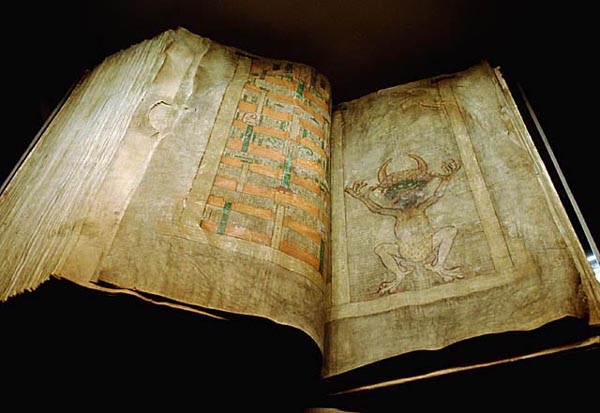
By convention, the term is also used for any Aztec codex (although the earlier examples do not actually use the codex format), Maya codices and other pre-Columbian manuscripts. Library practices have led to many European manuscripts having "codex" as part of their usual name, as with the Codex Gigas, while most do not.
At least in the Western world, the main predecessor to the paged codex format for a long document was the continuous scroll (also of vellum, parchment or papyrus), which was the dominant form of document in the ancient world. Some codices are continuously folded like a concertina, in particular the Maya codices and Aztec codices, which are actually long sheets of paper or animal skin folded into pages. Concertina-style codices made of fibre-based paper were also developed in Tang dynasty China no later than the 9th century. This practice later spread to Heian Japan through Buddhist exchange, where they were called orihon.
The ancient Romans developed the form from wax tablets. The gradual replacement of the scroll by the codex has been called the most important advance in book making before the invention of the printing press. The codex transformed the shape of the book itself, and offered a form that has lasted ever since. The spread of the codex is often associated with the rise of Christianity, which early on adopted the format for the Bible. First described in the 1st century of the Common Era, when the Roman poet Martial praised its convenient use, the codex achieved numerical parity with the scroll around 300 CE, and had completely replaced it throughout what was by then a Christianized Greco-Roman world by the 6th century.
The word codex comes from the Latin word caudex, meaning "trunk of a tree", "block of wood" or "book". The codex began to replace the scroll almost as soon as it was invented, although new finds add three centuries to its history (see below). In Egypt, by the fifth century, the codex outnumbered the scroll by ten to one based on surviving examples. By the sixth century, the scroll had almost vanished as a medium for literature. The change from rolls to codices roughly coincides with the transition from papyrus to parchment as the preferred writing material, but the two developments are unconnected. In fact, any combination of codices and scrolls with papyrus and parchment is technically feasible and common in the historical record.
Technically, even modern notebooks and paperbacks are codices, but publishers and scholars reserve the term for manuscript (hand-written) books produced from late antiquity until the Middle Ages.[citation needed] The scholarly study of these manuscripts is sometimes called codicology. The study of ancient documents in general is called paleography.
The codex provided considerable advantages over other book formats, primarily its compactness, sturdiness, economic use of materials by using both sides (recto and verso), and ease of reference (a codex accommodates random access, as opposed to a scroll, which uses sequential access).
The Romans used precursors made of reusable wax-covered tablets of wood for taking notes and other informal writings. Two ancient polyptychs, a pentaptych and octoptych excavated at Herculaneum, used a unique connecting system that presages later sewing on of thongs or cords.[page range too broad] A first evidence of the use of papyrus in codex form comes from the Ptolemaic period in Egypt, as a find at the University of Graz shows.
Recent media
Recent media