
Recent from talks
Codex Alexandrinus
Knowledge base stats:
Talk channels stats:
Members stats:
Codex Alexandrinus
The Codex Alexandrinus (London, British Library, Royal MS 1. D. V-VIII) is a manuscript of the Greek Bible, written on parchment. It is designated by the siglum A or 02 in the Gregory-Aland numbering of New Testament manuscripts, and δ 4 in the von Soden numbering of New Testament manuscripts. It contains the majority of the Greek Old Testament and the Greek New Testament. It is one of the four Great uncial codices (these being manuscripts which originally contained the whole of both the Old and New Testaments). Along with Codex Sinaiticus and Vaticanus, it is one of the earliest and most complete manuscripts of the Bible. Using the study of comparative writing styles (palaeography), it has been dated to the fifth century.
It derives its name from the city of Alexandria (in Egypt), where it resided for a number of years before it was brought by the Eastern Orthodox Patriarch Cyril Lucaris from Alexandria to Constantinople (modern day Istanbul in Turkey). It was then given to Charles I of England in the 17th century. Bishop Brian Walton assigned Alexandrinus the capital Latin letter A in the Polyglot Bible (a multi-language version of the Bible with the different languages placed in parallel columns) of 1657. This designation was maintained when the New Testament manuscript list system was standardized by Swiss theologian and textual critic Johann J. Wettstein in 1751. Thus Alexandrinus held the first position in the manuscript list.
Until the later purchase of Codex Sinaiticus, biblical scholar and textual critic Frederick H. A. Scrivener described it as the best manuscript of the Greek Bible deposited in Britain. Today, it rests along with Codex Sinaiticus in one of the showcases in the Sir John Ritblat Gallery of the British Library in London, U.K. A full photographic reproduction of the New Testament volume (Royal MS 1 D. viii) is available on the British Library's website.
The manuscript is a codex (precursor to the modern book) made from 773 vellum folios (specific name for pages in a codex) measuring 12.6 × 10.4 inches (32 × 26 cm), bound in quarto format (parchment leaves placed on top of each other, folded in half vertically, and then folded in half again horizontally, to make a single block, then stitched together with others to create a book), which now comprise four volumes. Most of the folios were originally gathered into quires of eight leaves each (this being eight parchment leaves placed on top of each other, then folded as per quarto above). Scholar B. H. Cowper describes the vellum as "thin, fine, and very beautiful". In modern times it was rebound into sets of six leaves each. Cowper's further description of the pages note they are "often discoloured at the edges", which have been damaged by age and more so through "the ignorance or carelessness of the modern binder, who has not always spared the text, especially at the upper inner margin". Scrivener noted that "[t]he vellum has fallen into holes in many places, and since the ink peels off for every age whensoever a leaf is touched a little roughly, no one is allowed to handle the manuscript except for good reasons." Three volumes contain the Septuagint (the Greek version of the Old Testament, also known as the LXX), of which the total count of folios for each volume is 279, 238, and 118 with ten leaves lost. The fourth volume contains the New Testament in the remaining 144 folios, with 31 leaves lost. In the fourth volume, 1 and 2 Clement are also missing leaves, perhaps 3.
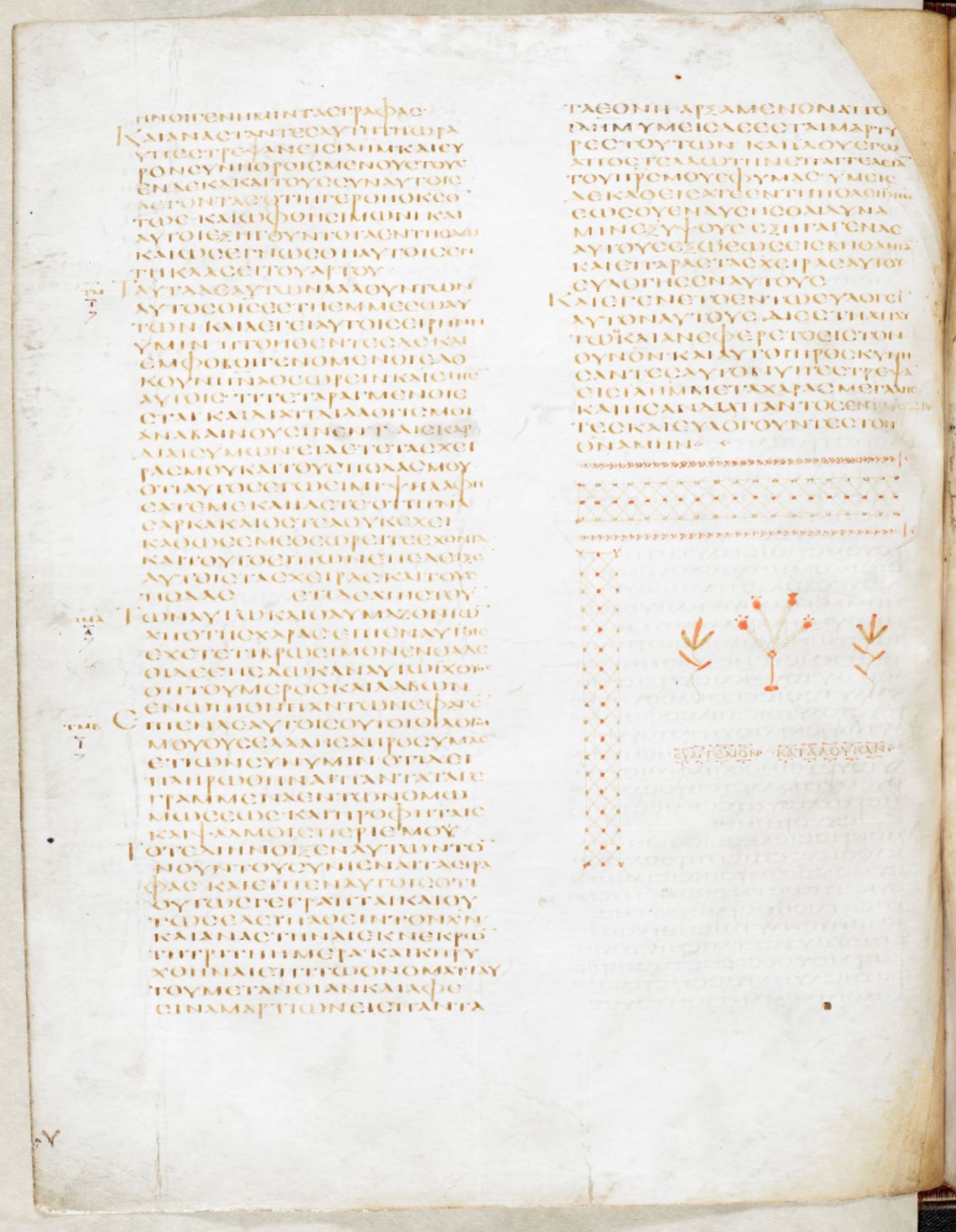
The text in the codex is written in two columns in uncial script, with between 49 and 51 lines per column, and 20 to 25 letters per line. The beginning lines of each book are written in red ink, and sections within the book are marked by a larger letter set into the margin. The text is written continuously, with no division of words (known as Scriptio continua), but some pauses are observed in places in which a dot should be between two words. There are no accents or breathing marks, except a few added by a later hand. The punctuation was written by the first hand. The poetical books of the Old Testament are written stichometrically (this being a new verse/phrase starting on a new line). The Old Testament quotations in the text of New Testament are marked in the margin by the sign 〉(known as a diplai).
The only decorations in the codex are tail-pieces at the end of each book (see illustration), and it also shows a tendency to increase the size of the first letter of each sentence. The larger letters at the beginning of the sections stand out in the margin as in codices Ephraemi and Basilensis. Codex Alexandrinus is the oldest manuscript to use larger letters to indicate new sections.
Iotacistic errors occur in the text: αὶ is exchanged for ε, εὶ for ὶ and η for ὶ. This is, however, no more than seen in other manuscripts of the same date. The letters Ν and Μ are occasionally confused, and the cluster ΓΓ (gg) is substituted with ΝΓ (ng). This may be an argument which points to Egypt as where the codex was produced, but it is not universally accepted.
The handwriting from the beginning of Luke to 1 Corinthians 10:8 differs from that in the rest of the manuscript. Some letters have Coptic shapes (f.e. Α (alpha), Μ (mu), Δ (delta), and Π (pi)). The letters are more widely spaced and are a little larger than elsewhere. Δ has extended base and Π has extended cross-stroke. Numerals are not expressed by letters except in Revelation 7:4; 21:17. In the past the codex had been judged to have been carelessly written, with many errors of transcription, but not so many as in Codex Sinaiticus, and no more than Codex Vaticanus.
Hub AI
Codex Alexandrinus AI simulator
(@Codex Alexandrinus_simulator)
Codex Alexandrinus
The Codex Alexandrinus (London, British Library, Royal MS 1. D. V-VIII) is a manuscript of the Greek Bible, written on parchment. It is designated by the siglum A or 02 in the Gregory-Aland numbering of New Testament manuscripts, and δ 4 in the von Soden numbering of New Testament manuscripts. It contains the majority of the Greek Old Testament and the Greek New Testament. It is one of the four Great uncial codices (these being manuscripts which originally contained the whole of both the Old and New Testaments). Along with Codex Sinaiticus and Vaticanus, it is one of the earliest and most complete manuscripts of the Bible. Using the study of comparative writing styles (palaeography), it has been dated to the fifth century.
It derives its name from the city of Alexandria (in Egypt), where it resided for a number of years before it was brought by the Eastern Orthodox Patriarch Cyril Lucaris from Alexandria to Constantinople (modern day Istanbul in Turkey). It was then given to Charles I of England in the 17th century. Bishop Brian Walton assigned Alexandrinus the capital Latin letter A in the Polyglot Bible (a multi-language version of the Bible with the different languages placed in parallel columns) of 1657. This designation was maintained when the New Testament manuscript list system was standardized by Swiss theologian and textual critic Johann J. Wettstein in 1751. Thus Alexandrinus held the first position in the manuscript list.
Until the later purchase of Codex Sinaiticus, biblical scholar and textual critic Frederick H. A. Scrivener described it as the best manuscript of the Greek Bible deposited in Britain. Today, it rests along with Codex Sinaiticus in one of the showcases in the Sir John Ritblat Gallery of the British Library in London, U.K. A full photographic reproduction of the New Testament volume (Royal MS 1 D. viii) is available on the British Library's website.
The manuscript is a codex (precursor to the modern book) made from 773 vellum folios (specific name for pages in a codex) measuring 12.6 × 10.4 inches (32 × 26 cm), bound in quarto format (parchment leaves placed on top of each other, folded in half vertically, and then folded in half again horizontally, to make a single block, then stitched together with others to create a book), which now comprise four volumes. Most of the folios were originally gathered into quires of eight leaves each (this being eight parchment leaves placed on top of each other, then folded as per quarto above). Scholar B. H. Cowper describes the vellum as "thin, fine, and very beautiful". In modern times it was rebound into sets of six leaves each. Cowper's further description of the pages note they are "often discoloured at the edges", which have been damaged by age and more so through "the ignorance or carelessness of the modern binder, who has not always spared the text, especially at the upper inner margin". Scrivener noted that "[t]he vellum has fallen into holes in many places, and since the ink peels off for every age whensoever a leaf is touched a little roughly, no one is allowed to handle the manuscript except for good reasons." Three volumes contain the Septuagint (the Greek version of the Old Testament, also known as the LXX), of which the total count of folios for each volume is 279, 238, and 118 with ten leaves lost. The fourth volume contains the New Testament in the remaining 144 folios, with 31 leaves lost. In the fourth volume, 1 and 2 Clement are also missing leaves, perhaps 3.
The text in the codex is written in two columns in uncial script, with between 49 and 51 lines per column, and 20 to 25 letters per line. The beginning lines of each book are written in red ink, and sections within the book are marked by a larger letter set into the margin. The text is written continuously, with no division of words (known as Scriptio continua), but some pauses are observed in places in which a dot should be between two words. There are no accents or breathing marks, except a few added by a later hand. The punctuation was written by the first hand. The poetical books of the Old Testament are written stichometrically (this being a new verse/phrase starting on a new line). The Old Testament quotations in the text of New Testament are marked in the margin by the sign 〉(known as a diplai).
The only decorations in the codex are tail-pieces at the end of each book (see illustration), and it also shows a tendency to increase the size of the first letter of each sentence. The larger letters at the beginning of the sections stand out in the margin as in codices Ephraemi and Basilensis. Codex Alexandrinus is the oldest manuscript to use larger letters to indicate new sections.
Iotacistic errors occur in the text: αὶ is exchanged for ε, εὶ for ὶ and η for ὶ. This is, however, no more than seen in other manuscripts of the same date. The letters Ν and Μ are occasionally confused, and the cluster ΓΓ (gg) is substituted with ΝΓ (ng). This may be an argument which points to Egypt as where the codex was produced, but it is not universally accepted.
The handwriting from the beginning of Luke to 1 Corinthians 10:8 differs from that in the rest of the manuscript. Some letters have Coptic shapes (f.e. Α (alpha), Μ (mu), Δ (delta), and Π (pi)). The letters are more widely spaced and are a little larger than elsewhere. Δ has extended base and Π has extended cross-stroke. Numerals are not expressed by letters except in Revelation 7:4; 21:17. In the past the codex had been judged to have been carelessly written, with many errors of transcription, but not so many as in Codex Sinaiticus, and no more than Codex Vaticanus.
Recent media