
Recent from talks
Cohen Plan
Knowledge base stats:
Talk channels stats:
Members stats:
Cohen Plan
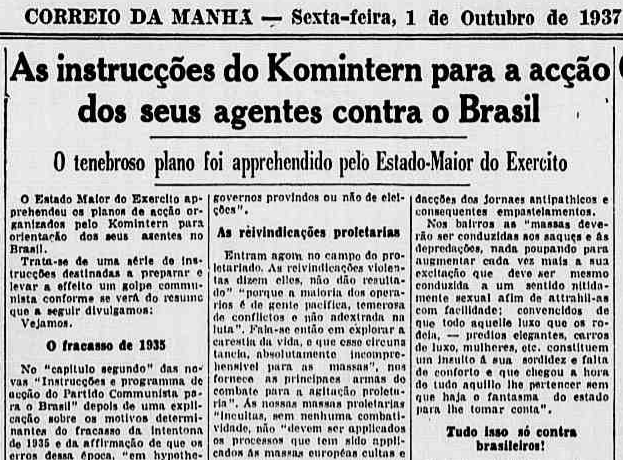
The Cohen Plan (Portuguese: Plano Cohen) was a document forged by the Brazilian military with the aim of establishing the Estado Novo dictatorship in November 1937. A conjunction between antisemitism and anti-communism in Brazilian politics, it was fraudulently attributed to the Communist International, which allegedly planned to overthrow the government through strikes, the burning of public buildings and popular demonstrations that would end in looting, chaos, and the murder of authorities. To introduce the fraud, it was "discovered" by the Armed Forces, immediately used to label the political opposition as communists, and then to legitimize the 1937 coup d'état.
With the approach of the presidential elections scheduled for 1938, the absence of a candidate that pleased the government and with the impossibility of extending his term, president Getúlio Vargas and general Eurico Gaspar Dutra began to plan a coup d'état; the coup would only work if it appeared to be a matter of national necessity. The government's military leadership identified the need to "reveal" new facts that would create a climate of insecurity and instability, and thus the idea of creating the Cohen Plan was born. The document was sent by general Pedro Aurélio de Góis Monteiro, chief of the Army's General Staff, to the country's main military authorities and, at an official meeting of military members of the government, it was presented as if it had been seized by the Armed Forces. Dutra and others present expressed their full conviction regarding the imminence of a communist coup and the need for the Armed Forces to act with vigor. The Cohen Plan was then publicized, triggering public commotion and a strong anti-communist campaign. Vargas took advantage of the false threat to pressure the National Congress to declare a state of war, which gave him powers to remove his opponents. On 10 November 1937, forty days after the release of the Cohen Plan, the Estado Novo dictatorship was implemented in the country.
Later, with the Estado Novo crisis in 1945, the same general Góis Monteiro who had helped to architect the 1937 coup started working to overthrow Vargas. He denounced the fraud that had taken place eight years earlier, claiming that the Cohen Plan had been handed over to the Army General Staff by captain Olímpio Mourão Filho, at the time head of the secret service of the Brazilian Integralist Action. Mourão Filho confirmed that he was the author of the document, but claimed to have prepared it as a mere simulation and accused Góis Monteiro of having appropriated and misused it. Góis Monteiro, in turn, claimed to have known about the falsity of the document from the beginning, but disclaimed any blame by suggesting that another member of the government had made it public and claimed that it was true. When asked about his silence during the 1937 coup d'état, Mourão claimed to have respected military discipline.
The revelation of the fraud surrounding the Cohen Plan caused consternation and shame in Brazilian society, which felt cheated. Although the conspiracy and involvement of the highest levels of the Armed Forces were quickly proven, the mutual accusations and third parties, raised by Mourão and, mainly, by Góis Monteiro, made it difficult to clearly establish the share of blame of each involved and what measures were to be taken against them. As part of its legacy, the Cohen Plan played a decisive role in phenomena that extend to the present day, such as the institutionalization of anti-communism as a central part of the identity of the Brazilian military and the establishment, in military cadres, of the idea that a temporary dictatorship could serve as an instrument of progress. By analogy, the conspiracy surrounding the Cohen Plan was equated with events such as the scare campaign launched on the eve of the 1964 coup d'état and continues to be mentioned in analysis of contemporary Brazilian politics.
The Cohen Plan and the conspiracy that involved it have been analyzed in a context of convergence of antisemitic and anti-communist conspiracy theories in the so-called "Jewish-communist myth"; of xenophobia in Brazil in the first decades of the 20th century and its intersection with the demonization of social movements and avant-garde ideological currents; of a tradition of important falsifications in Brazilian political history, involving the participation of the Armed Forces; and of a set of revolts and military coups from the 1920s onwards.
As part of a set of conspiracy theories based on a Manichean view of reality – including the belief in "diabolical forces bent on doing evil" – and possibly as a reaction to modernity and the anxieties and fears it unleashed, since at least the 19th century, conservative currents began to accuse the Jews of being "instigators of social disturbances and revolutions". Historically, antisemitism had focused primarily on religious and economic issues, and Jews had generally been tolerated for their role as "money agents in a traditional economy". However, the profound transformations brought about by modernity (especially the "urbanization, industrialization, emergence and strengthening of new social groups, liberal and democratizing reforms, changes in behavior, etc.") gave rise to very accentuated tensions, leading conservative segments to face them as negative changes. The Jews, being associated with the main characteristics of modernity, became one of the main targets of the hatred of these reactionary groups.
However, initially the association of Jews with communism was not clearly stated nor was it constant. Documents from the turn of the 20th century, such as the Protocols of the Elders of Zion, blame Jews for fomenting class hatred and for advocating forms of collectivism, but do not clearly associate them with communism. It was in the wake of the traumatic events of the early 20th century, including the Russian revolution of 1917 and the chaos that followed the First World War, that conservative discourse came to emphatically associate communism with the Jews. In parallel with the rise of Nazism and Fascism, and largely because of the action of these groups, these events were followed by an immense antisemitic and anti-Communist wave and the emergence of a myth of the "Jewish-Communist conspiracy" that quickly spread.
United around this conspiracy, and using a process of demonizing the left, Germany, Italy and Japan established the Anti-Comintern Pact in opposition to "democratic and Marxist international ideas [which gave] demonstrations of hatred and discord". Meanwhile, in Brazil, the Brazilian Integralist Action began to imagine that it would finally come to power; Francisco Campos was rapidly drafting a new constitution inspired by the Polish fascist model, and Getúlio Vargas surrounded himself with integralists and admirers of fascism and Nazism.
Hub AI
Cohen Plan AI simulator
(@Cohen Plan_simulator)
Cohen Plan
The Cohen Plan (Portuguese: Plano Cohen) was a document forged by the Brazilian military with the aim of establishing the Estado Novo dictatorship in November 1937. A conjunction between antisemitism and anti-communism in Brazilian politics, it was fraudulently attributed to the Communist International, which allegedly planned to overthrow the government through strikes, the burning of public buildings and popular demonstrations that would end in looting, chaos, and the murder of authorities. To introduce the fraud, it was "discovered" by the Armed Forces, immediately used to label the political opposition as communists, and then to legitimize the 1937 coup d'état.
With the approach of the presidential elections scheduled for 1938, the absence of a candidate that pleased the government and with the impossibility of extending his term, president Getúlio Vargas and general Eurico Gaspar Dutra began to plan a coup d'état; the coup would only work if it appeared to be a matter of national necessity. The government's military leadership identified the need to "reveal" new facts that would create a climate of insecurity and instability, and thus the idea of creating the Cohen Plan was born. The document was sent by general Pedro Aurélio de Góis Monteiro, chief of the Army's General Staff, to the country's main military authorities and, at an official meeting of military members of the government, it was presented as if it had been seized by the Armed Forces. Dutra and others present expressed their full conviction regarding the imminence of a communist coup and the need for the Armed Forces to act with vigor. The Cohen Plan was then publicized, triggering public commotion and a strong anti-communist campaign. Vargas took advantage of the false threat to pressure the National Congress to declare a state of war, which gave him powers to remove his opponents. On 10 November 1937, forty days after the release of the Cohen Plan, the Estado Novo dictatorship was implemented in the country.
Later, with the Estado Novo crisis in 1945, the same general Góis Monteiro who had helped to architect the 1937 coup started working to overthrow Vargas. He denounced the fraud that had taken place eight years earlier, claiming that the Cohen Plan had been handed over to the Army General Staff by captain Olímpio Mourão Filho, at the time head of the secret service of the Brazilian Integralist Action. Mourão Filho confirmed that he was the author of the document, but claimed to have prepared it as a mere simulation and accused Góis Monteiro of having appropriated and misused it. Góis Monteiro, in turn, claimed to have known about the falsity of the document from the beginning, but disclaimed any blame by suggesting that another member of the government had made it public and claimed that it was true. When asked about his silence during the 1937 coup d'état, Mourão claimed to have respected military discipline.
The revelation of the fraud surrounding the Cohen Plan caused consternation and shame in Brazilian society, which felt cheated. Although the conspiracy and involvement of the highest levels of the Armed Forces were quickly proven, the mutual accusations and third parties, raised by Mourão and, mainly, by Góis Monteiro, made it difficult to clearly establish the share of blame of each involved and what measures were to be taken against them. As part of its legacy, the Cohen Plan played a decisive role in phenomena that extend to the present day, such as the institutionalization of anti-communism as a central part of the identity of the Brazilian military and the establishment, in military cadres, of the idea that a temporary dictatorship could serve as an instrument of progress. By analogy, the conspiracy surrounding the Cohen Plan was equated with events such as the scare campaign launched on the eve of the 1964 coup d'état and continues to be mentioned in analysis of contemporary Brazilian politics.
The Cohen Plan and the conspiracy that involved it have been analyzed in a context of convergence of antisemitic and anti-communist conspiracy theories in the so-called "Jewish-communist myth"; of xenophobia in Brazil in the first decades of the 20th century and its intersection with the demonization of social movements and avant-garde ideological currents; of a tradition of important falsifications in Brazilian political history, involving the participation of the Armed Forces; and of a set of revolts and military coups from the 1920s onwards.
As part of a set of conspiracy theories based on a Manichean view of reality – including the belief in "diabolical forces bent on doing evil" – and possibly as a reaction to modernity and the anxieties and fears it unleashed, since at least the 19th century, conservative currents began to accuse the Jews of being "instigators of social disturbances and revolutions". Historically, antisemitism had focused primarily on religious and economic issues, and Jews had generally been tolerated for their role as "money agents in a traditional economy". However, the profound transformations brought about by modernity (especially the "urbanization, industrialization, emergence and strengthening of new social groups, liberal and democratizing reforms, changes in behavior, etc.") gave rise to very accentuated tensions, leading conservative segments to face them as negative changes. The Jews, being associated with the main characteristics of modernity, became one of the main targets of the hatred of these reactionary groups.
However, initially the association of Jews with communism was not clearly stated nor was it constant. Documents from the turn of the 20th century, such as the Protocols of the Elders of Zion, blame Jews for fomenting class hatred and for advocating forms of collectivism, but do not clearly associate them with communism. It was in the wake of the traumatic events of the early 20th century, including the Russian revolution of 1917 and the chaos that followed the First World War, that conservative discourse came to emphatically associate communism with the Jews. In parallel with the rise of Nazism and Fascism, and largely because of the action of these groups, these events were followed by an immense antisemitic and anti-Communist wave and the emergence of a myth of the "Jewish-Communist conspiracy" that quickly spread.
United around this conspiracy, and using a process of demonizing the left, Germany, Italy and Japan established the Anti-Comintern Pact in opposition to "democratic and Marxist international ideas [which gave] demonstrations of hatred and discord". Meanwhile, in Brazil, the Brazilian Integralist Action began to imagine that it would finally come to power; Francisco Campos was rapidly drafting a new constitution inspired by the Polish fascist model, and Getúlio Vargas surrounded himself with integralists and admirers of fascism and Nazism.
Recent media