


Community hub
Recent from talks
Contribute something to knowledge base
Content stats: 0 posts, 0 articles, 1 media, 0 notes
Members stats: 0 subscribers, 0 contributors, 0 moderators, 0 supporters
Subscribers
Supporters
Contributors
Moderators
Cold cream
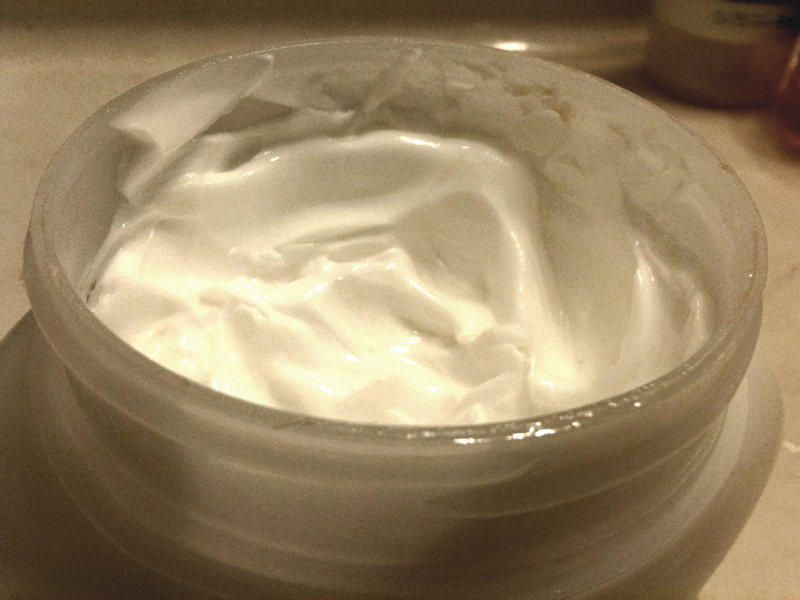
Cold cream, also known as ceratum refrigerans, is an emulsion of water and certain fats, usually including beeswax and various scent agents, designed to smooth skin and remove makeup. Cold cream is a water-in-oil emulsion (emulsion of small amount of water in a larger amount of oil), unlike the oil-in-water emulsion of vanishing cream, so-called because it seems to disappear when applied on skin. The name "cold cream" derives from the cooling feeling that the cream leaves on the skin. Variations of the product have been used for nearly 2000 years.
Cold cream is mainly used for skin treatment (such as a facial mask or lip balm), due to its moisturizing properties. It can also be used as shaving cream and as a makeup remover.
The invention of cold cream is credited to Galen, a physician in second century Greece. The original formulation involved rose water, beeswax, and either almond or olive oil. The beeswax is essential to a successful cream, as it is the emulsifying ingredient, but it is extremely inefficient compared to modern emulsifiers. Creams made with only beeswax require extensive mixing and can separate upon standing. Thus, small quantities of borax were later added in addition to the beeswax. Borax saponifies fatty acids in the beeswax and allows for a more stable cream, using the small quantities of soap created as the emulsifying agent.
This 1857 account relates:
The modern formula for cold cream is, however, quite a different thing to that given in the works of Galen, in point of odour and quality, although substantially the same--grease and water. In perfumery there are several kinds of cold cream, distinguished by their odour, such as that of camphor, almond, violet, roses, etc.
In France, this substance is still known as cérat de Galien ('Galen's Wax'). A copy of the London Dispensatory, edited by Nicholas Culpeper and published in the year 1650 included the following formula for this substance:
Take of white wax four ounces, oyl of roses omphacine a pound; melt in a double vessel, then powr it out into another, by degrees putting in cold water, and often powring it out of one vessel into another, stirring it till it be white ; last of all wash it in rose water, adding a little rose water and rose vineger.
— Nicholas Culpeper (1650), London Dispensatory
Cold cream
Cold cream, also known as ceratum refrigerans, is an emulsion of water and certain fats, usually including beeswax and various scent agents, designed to smooth skin and remove makeup. Cold cream is a water-in-oil emulsion (emulsion of small amount of water in a larger amount of oil), unlike the oil-in-water emulsion of vanishing cream, so-called because it seems to disappear when applied on skin. The name "cold cream" derives from the cooling feeling that the cream leaves on the skin. Variations of the product have been used for nearly 2000 years.
Cold cream is mainly used for skin treatment (such as a facial mask or lip balm), due to its moisturizing properties. It can also be used as shaving cream and as a makeup remover.
The invention of cold cream is credited to Galen, a physician in second century Greece. The original formulation involved rose water, beeswax, and either almond or olive oil. The beeswax is essential to a successful cream, as it is the emulsifying ingredient, but it is extremely inefficient compared to modern emulsifiers. Creams made with only beeswax require extensive mixing and can separate upon standing. Thus, small quantities of borax were later added in addition to the beeswax. Borax saponifies fatty acids in the beeswax and allows for a more stable cream, using the small quantities of soap created as the emulsifying agent.
This 1857 account relates:
The modern formula for cold cream is, however, quite a different thing to that given in the works of Galen, in point of odour and quality, although substantially the same--grease and water. In perfumery there are several kinds of cold cream, distinguished by their odour, such as that of camphor, almond, violet, roses, etc.
In France, this substance is still known as cérat de Galien ('Galen's Wax'). A copy of the London Dispensatory, edited by Nicholas Culpeper and published in the year 1650 included the following formula for this substance:
Take of white wax four ounces, oyl of roses omphacine a pound; melt in a double vessel, then powr it out into another, by degrees putting in cold water, and often powring it out of one vessel into another, stirring it till it be white ; last of all wash it in rose water, adding a little rose water and rose vineger.
— Nicholas Culpeper (1650), London Dispensatory
Recent media
Recent media