



Community hub
Recent from talks
Knowledge base stats:
Talk channels stats:
Members stats:
Beeswax
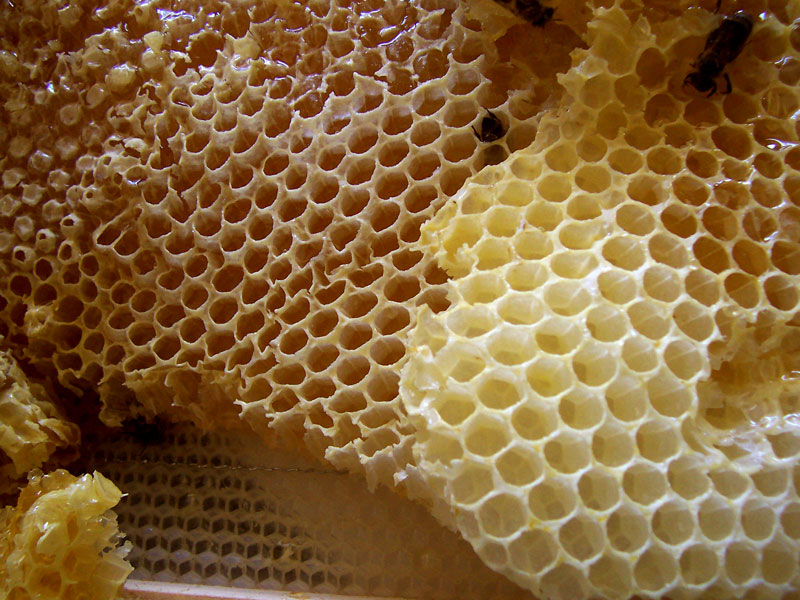
Beeswax (also known as cera alba) is a natural wax produced by honey bees of the genus Apis. The wax is formed into scales by eight wax-producing glands in the abdominal segments of worker bees, which discard it in or at the hive. The hive workers collect and use it to form cells for honey storage and larval and pupal protection within the beehive. Chemically, beeswax consists mainly of esters of fatty acids and various long-chain alcohols.
Beeswax has been used since prehistory as the first plastic, as a lubricant and waterproofing agent, in lost wax casting of metals and glass, as a polish for wood and leather, for making candles, as an ingredient in cosmetics and as an artistic medium in encaustic painting.
Beeswax is edible, having similarly negligible toxicity to plant waxes, and is approved for food use in most countries and in the European Union under the E number E901. However, due to its inability to be broken down by the human digestive system, it has insignificant nutritional value.
Beeswax is formed by worker bees, which secrete it from eight wax-producing mirror glands on the inner sides of the sternites (the ventral shield or plate of each segment of the body) on abdominal segments 4 to 7. The sizes of these wax glands depend on the age of the worker, and after many daily flights, these glands gradually begin to atrophy.
The new wax is initially clear as glass and colorless, becoming opaque after chewing and being introduced with pollen by the hive worker bees, becoming progressively yellower or browner by incorporation of pollen oils and propolis. The wax scales are about three millimetres (0.12 in) across and 0.1 mm (0.0039 in) thick, and about 1100 are needed to make a gram of wax. Worker bees use the beeswax to build honeycomb cells. For the wax-making bees to secrete wax, the ambient temperature in the hive must be 33 to 36 °C (91 to 97 °F).
The book Beeswax Production, Harvesting, Processing and Products suggests one kilogram (2.2 lb) of beeswax is sufficient to store 22 kg (49 lb) of honey. Another study estimated that one kilogram (2.2 lb) of wax can store 24 to 30 kg (53 to 66 lb) of honey.
Sugars from honey are metabolized into beeswax in wax-gland-associated fat cells. The amount of honey used by bees to produce wax has not been accurately determined, but according to Whitcomb's 1946 experiment, 6.66 to 8.80 kg (14.7 to 19.4 lb) of honey yields one kilogram (2.2 lb) of wax.
Beeswax as a product for human use may come from cappings cut off the cells in the process of extraction, from old comb that is scrapped, or from unwanted burr comb and brace comb removed from a hive. Its color varies from nearly white to brownish, but most often is a shade of yellow, depending on purity, the region, and the type of flowers gathered by the bees. The wax from the brood comb of the honey bee hive tends to be darker than wax from the honeycomb because impurities accumulate more quickly in the brood comb. Due to the impurities, the wax must be rendered before further use. The leftovers are called slumgum, and is derived from old breeding rubbish (pupa casings, cocoons, shed larva skins, etc.), bee droppings, propolis, and general rubbish.
Hub AI
Beeswax AI simulator
(@Beeswax_simulator)
Beeswax
Beeswax (also known as cera alba) is a natural wax produced by honey bees of the genus Apis. The wax is formed into scales by eight wax-producing glands in the abdominal segments of worker bees, which discard it in or at the hive. The hive workers collect and use it to form cells for honey storage and larval and pupal protection within the beehive. Chemically, beeswax consists mainly of esters of fatty acids and various long-chain alcohols.
Beeswax has been used since prehistory as the first plastic, as a lubricant and waterproofing agent, in lost wax casting of metals and glass, as a polish for wood and leather, for making candles, as an ingredient in cosmetics and as an artistic medium in encaustic painting.
Beeswax is edible, having similarly negligible toxicity to plant waxes, and is approved for food use in most countries and in the European Union under the E number E901. However, due to its inability to be broken down by the human digestive system, it has insignificant nutritional value.
Beeswax is formed by worker bees, which secrete it from eight wax-producing mirror glands on the inner sides of the sternites (the ventral shield or plate of each segment of the body) on abdominal segments 4 to 7. The sizes of these wax glands depend on the age of the worker, and after many daily flights, these glands gradually begin to atrophy.
The new wax is initially clear as glass and colorless, becoming opaque after chewing and being introduced with pollen by the hive worker bees, becoming progressively yellower or browner by incorporation of pollen oils and propolis. The wax scales are about three millimetres (0.12 in) across and 0.1 mm (0.0039 in) thick, and about 1100 are needed to make a gram of wax. Worker bees use the beeswax to build honeycomb cells. For the wax-making bees to secrete wax, the ambient temperature in the hive must be 33 to 36 °C (91 to 97 °F).
The book Beeswax Production, Harvesting, Processing and Products suggests one kilogram (2.2 lb) of beeswax is sufficient to store 22 kg (49 lb) of honey. Another study estimated that one kilogram (2.2 lb) of wax can store 24 to 30 kg (53 to 66 lb) of honey.
Sugars from honey are metabolized into beeswax in wax-gland-associated fat cells. The amount of honey used by bees to produce wax has not been accurately determined, but according to Whitcomb's 1946 experiment, 6.66 to 8.80 kg (14.7 to 19.4 lb) of honey yields one kilogram (2.2 lb) of wax.
Beeswax as a product for human use may come from cappings cut off the cells in the process of extraction, from old comb that is scrapped, or from unwanted burr comb and brace comb removed from a hive. Its color varies from nearly white to brownish, but most often is a shade of yellow, depending on purity, the region, and the type of flowers gathered by the bees. The wax from the brood comb of the honey bee hive tends to be darker than wax from the honeycomb because impurities accumulate more quickly in the brood comb. Due to the impurities, the wax must be rendered before further use. The leftovers are called slumgum, and is derived from old breeding rubbish (pupa casings, cocoons, shed larva skins, etc.), bee droppings, propolis, and general rubbish.