


Community Hub0 Subscribers
Community hub
Collision frequency
View on Wikipediafrom Wikipedia
Collision frequency describes the rate of collisions between two atomic or molecular species in a given volume, per unit time. In an ideal gas, assuming that the species behave like hard spheres, the collision frequency between entities of species A and species B is[1][better source needed] where
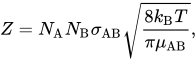
- is the number of A particles in the volume,
- is the number of B particles in the volume,
- is the collision cross section, the "effective area" seen by two colliding molecules (for hard spheres, , where is the radius of A, and is the radius of B),
- is the Boltzmann constant,
- is the thermodynamic temperature,
- is the reduced mass of A and B particles.





Collision in diluted solution
[edit]In the case of equal-size particles at a concentration in a solution of viscosity , an expression for collision frequency , where is the volume in question, and is the number of collisions per second, can be written as[2] where


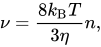
- is the Boltzmann constant,
- is the absolute temperature,
- is the viscosity of the solution,
- is the number density.

Here the frequency is independent of particle size, a result noted as counter-intuitive. For particles of different size, more elaborate expressions can be derived for estimating .[2]
References
[edit]- ^ "Collision Frequency". LibreTexts Chemistry. 2 October 2013.
- ^ a b Debye, P. (1942). "Reaction Rates in Ionic Solutions". Transactions of the Electrochemical Society. 82 (1): 265–272. doi:10.1149/1.3071413. ISSN 0096-4743.
Collision frequency
View on Grokipediafrom Grokipedia
Fundamentals
Definition
Collision frequency refers to the average number of collisions that a single particle undergoes per unit time within a system of interacting particles, such as molecules in a dilute gas.[4] This quantity captures the rate at which particles encounter one another due to their thermal motion, providing a key metric for the dynamics of molecular interactions in gaseous media.[5] The physical significance of collision frequency lies in its role as a fundamental measure of particle interactivity, which underpins the derivation of transport properties in kinetic theory. For instance, it influences phenomena like diffusion, where particle movement is impeded by collisions, and viscosity, which arises from momentum transfer during these encounters.[6] In essence, higher collision frequencies indicate denser or more energetic systems, directly affecting macroscopic behaviors such as fluid flow and heat conduction.[7] Typically expressed in units of s⁻¹ (collisions per second), collision frequency scales with factors like particle density and relative speeds, though its exact value depends on the system's conditions. The concept emerged in the 19th century as part of the Maxwell-Boltzmann kinetic theory, where James Clerk Maxwell's 1860 work laid the groundwork by modeling gas molecules as colliding hard spheres to explain pressure and thermal equilibrium.[8] Ludwig Boltzmann later expanded this framework in the 1870s, incorporating statistical distributions to quantify collision rates more rigorously.[9]Basic Principles
Collision frequency in gaseous systems is predicated on several foundational assumptions that simplify the modeling of particle interactions. Particles are treated as hard spheres, meaning they are impenetrable and interact only through brief, elastic collisions without deformation or internal structure. This model assumes random thermal motion, where particles move chaotically due to thermal energy, with no preferred direction or correlated velocities. Furthermore, interactions are limited to binary collisions between pairs of particles, excluding multi-body events or long-range forces beyond direct contact, which streamlines the analysis of collision dynamics.[10][11][12][13] A key prerequisite for understanding collision frequency is the statistical distribution of particle velocities, governed by the Boltzmann distribution, which describes the probabilistic spread of speeds in a system at thermal equilibrium. This distribution arises from the random partitioning of energy among particles, ensuring that velocities vary continuously rather than being uniform, and it underpins the concept of average relative speeds in collisions. Without such a distribution, the random nature of thermal motion could not be quantified statistically.[10][13][12] Temperature and pressure exert qualitative influences on collision rates through their effects on particle kinetics and density. Elevated temperature boosts the average kinetic energy, leading to higher speeds and thus more frequent collisions, while also increasing the energy available per collision. Higher pressure, by contrast, elevates particle density, which proportionally increases the likelihood of encounters without altering individual speeds. These factors highlight how environmental conditions modulate collision dynamics in idealized systems.[10][11][12][13] It is essential to distinguish collision frequency, which quantifies the average number of collisions experienced by a single particle per unit time, from the overall collision rate, defined as the total number of collisions occurring per unit volume per unit time across the system. The former focuses on individual particle behavior, while the latter scales with the total number density, providing a macroscopic perspective on interaction density. This differentiation is crucial for applying the concept across various media, with extensions to non-ideal cases involving additional interactions addressed in specialized contexts.[10][12][13]In Gaseous Systems
Collision Frequency in Ideal Gases
In ideal gases, the collision frequency $ Z $ represents the average number of collisions experienced by a single molecule per unit time, arising from the random thermal motions of molecules modeled by the Maxwell-Boltzmann velocity distribution.[14] This concept, foundational to kinetic theory, was developed by James Clerk Maxwell in his analysis of molecular interactions assuming hard-sphere collisions. To derive $ Z $, consider a test molecule moving through a gas of identical molecules with number density $ n $ (molecules per unit volume). A collision occurs if the centers of two molecules approach within a distance $ d $, the molecular diameter, defining the collision cross-section $ \sigma = \pi d^2 $. The rate at which the test molecule encounters others depends on their relative velocity. For identical molecules, the average relative speed $ \langle v_{\text{rel}} \rangle $ must account for the random directions of both velocities.[14] The Maxwell-Boltzmann distribution gives the average speed of a molecule as $ \langle v \rangle = \sqrt{\frac{8 k_B T}{\pi m}} $, where $ k_B $ is Boltzmann's constant, $ T $ is temperature, and $ m $ is molecular mass. For relative motion, the distribution of relative velocities follows a Maxwellian form with reduced mass $ \mu = m/2 $, yielding $ \langle v_{\text{rel}} \rangle = \sqrt{\frac{8 k_B T}{\pi \mu}} = \sqrt{2} \langle v \rangle $. This $ \sqrt{2} $ factor emerges from integrating the product of two Maxwell-Boltzmann distributions over all velocity pairs, effectively increasing the encounter rate by the square root of 2 compared to a fixed-target scenario.[14][4] The collision frequency is then the product of the encounter rate: $ Z = n \sigma \langle v_{\text{rel}} \rangle = \sqrt{2} , \pi d^2 n \langle v \rangle $. This formula assumes dilute conditions where interactions are binary and uncorrelated, valid for ideal gases.[14] It relates to the mean free path $ \lambda = 1 / (\sqrt{2} , \pi d^2 n) $ via $ Z = \langle v \rangle / \lambda $, providing a link between collision spacing and frequency.[4] For air molecules (primarily N₂ and O₂, effective $ d \approx 3.7 \times 10^{-10} $ m, $ m \approx 4.8 \times 10^{-26} $ kg) at standard temperature and pressure (STP: 273 K, 1 atm, $ n \approx 2.7 \times 10^{25} $ m⁻³), $ \langle v \rangle \approx 460 $ m/s, yielding $ Z \approx 7 \times 10^9 $ s⁻¹. This indicates each molecule undergoes about 7 billion collisions per second under these conditions.[4]Factors Influencing Gas Collisions
In real gaseous systems, collision frequency deviates from ideal predictions due to non-ideal effects stemming from intermolecular forces and molecular volume. At high densities, van der Waals attractions and repulsions modify the interaction potential, altering molecular trajectories and effectively increasing the collision cross-section compared to the hard-sphere approximation in ideal models. This increase occurs because attractive forces bend trajectories inward, allowing a larger range of impact parameters to lead to collisions.[15] The Enskog theory provides a framework for understanding these deviations in dense gases, extending the Boltzmann collision integral by incorporating a radial distribution function $ g(\sigma) $ that accounts for spatial correlations at contact distance $ \sigma $. For hard-sphere models, $ g(\sigma) > 1 $ at elevated densities, leading to an enhanced local collision probability, but when including soft van der Waals potentials, the effective cross-section $ \sigma $ is further adjusted, with attractions generally increasing it while repulsions limit close approaches, resulting in a net modification to the binary collision rate compared to volume exclusion alone.[16] Temperature influences collision frequency beyond the ideal gas scaling of average relative speed $ \langle v \rangle \propto \sqrt{T} $, particularly through its effect on intermolecular potentials and, for reactive collisions, activation energies. In non-ideal gases, higher temperatures weaken the relative impact of van der Waals attractions, partially restoring ideal-like behavior, while also increasing the fraction of collisions with sufficient energy to overcome potential barriers. For reactive processes, the effective collision frequency incorporates an Arrhenius factor $ e^{-E_a / RT} $, where $ E_a $ is the activation energy, exponentially amplifying the temperature dependence for collisions that lead to chemical change.[17] Pressure and density variations further modify collision dynamics in dense regimes. While ideal gas theory predicts collision frequency $ Z $ scaling linearly with number density $ n $ as $ Z \propto n \langle v \rangle \sigma $, real dense gases exhibit nonlinear behavior due to crowding effects. Increased pressure compresses the gas, amplifying $ g(\sigma) $ in Enskog theory, which causes $ Z $ to rise superlinearly with $ n $ as local densities near molecules exceed the average, though attractive forces modify this enhancement by altering interaction strengths.[3] Quantum effects become relevant in ultracold, degenerate gases, where statistical mechanics alters collision statistics. In Fermi gases, the Pauli exclusion principle blocks collisions between identical fermions occupying the same quantum state, suppressing the collision frequency relative to classical expectations. This Pauli blocking reduces the available phase space for scattering, with experimental observations in lithium-6 gases showing collision rates dropping by factors of up to 10 near the Fermi temperature, qualitatively altering transport and equilibration dynamics.[18]In Liquid Systems
Collision Frequency in Dilute Solutions
In dilute solutions, collision frequency describes the rate at which solute molecules encounter each other through diffusive motion in a viscous solvent, contrasting with the ballistic free-flight paths dominant in gaseous systems.[19] This diffusive regime arises because the solvent's high viscosity and molecular crowding restrict molecular trajectories to random walks, making transport governed by Brownian motion rather than mean free paths.[20] The Smoluchowski equation provides the foundational framework for quantifying this frequency in the diffusion-limited limit, applicable to low solute concentrations where interactions between solutes are negligible compared to solvent effects. The collision frequency $ Z $ for a solute molecule in a dilute solution is given by the Smoluchowski expression:
where $ R $ is the encounter distance (sum of molecular radii at which a collision is considered to occur), $ D $ is the relative diffusion coefficient of the colliding pair, and $ N/V $ is the number density of solute molecules.[19] This formula represents the number of encounters per unit time for a single molecule, derived under the assumption of steady-state diffusion and perfect absorption at the encounter boundary.[19] The relative diffusion coefficient $ D = D_A + D_B $ accounts for the independent Brownian motions of the two species, with each $ D_i $ related to the solvent viscosity $ \eta $ via the Stokes-Einstein relation $ D_i = k_B T / (6 \pi \eta r_i) $, where $ k_B $ is Boltzmann's constant, $ T $ is temperature, and $ r_i $ is the molecular radius.[20]
The derivation stems from Fick's first law of diffusion, which relates the diffusive flux $ \mathbf{J} = -D \nabla c $ to the concentration gradient $ \nabla c \nabla \cdot \mathbf{J} = 0 $).[19] Solving the resulting Laplace equation $ \nabla^2 c = 0 $ in spherical coordinates around a fixed target molecule, with boundary conditions $ c(R) = 0 $ (absorption at contact) and $ c(\infty) = c_0 $ (uniform concentration far away), yields the concentration profile $ c(r) = c_0 (1 - R/r) $.[19] The inward flux at $ r = R $ then integrates over the spherical surface to give the encounter rate $ 4 \pi R D c_0 $ for a single target molecule, where $ c_0 $ is the number density $ n = N/V $; thus $ Z = 4 \pi R D n $. This approach equivalently models the random walk statistics of Brownian particles in a continuum solvent.[19]
A representative application is in ion-pair formation within aqueous electrolytes, where oppositely charged ions diffuse to form transient pairs, with the Smoluchowski rate limiting the association kinetics at low concentrations.[21] For instance, in dilute HCl solutions, the encounter rate between H⁺ and Cl⁻ ions matches experimental spectroscopic data when using electrolyte-modified diffusion coefficients, highlighting the equation's utility in predicting association under diffusive control.[20]