
Recent from talks
Pauli exclusion principle
Knowledge base stats:
Talk channels stats:
Members stats:
Pauli exclusion principle
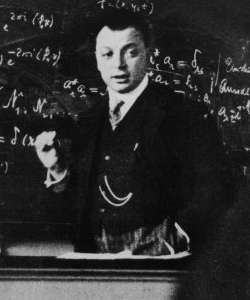
In quantum mechanics, the Pauli exclusion principle (German: Pauli-Ausschlussprinzip) states that two or more identical particles with half-integer spins (i.e. fermions) cannot simultaneously occupy the same quantum state within a system that obeys the laws of quantum mechanics. This principle was formulated by Austrian physicist Wolfgang Pauli in 1925 for electrons, and later extended to all fermions with his spin–statistics theorem of 1940.
In the case of electrons in atoms, the exclusion principle can be stated as follows: in a poly-electron atom it is impossible for any two electrons to have the same two values of all four of their quantum numbers, which are: n, the principal quantum number; ℓ, the azimuthal quantum number; mℓ, the magnetic quantum number; and ms, the spin quantum number. For example, if two electrons reside in the same orbital, then their values of n, ℓ, and mℓ are equal. In that case, the two values of ms (spin) pair must be different. Since the only two possible values for the spin projection ms are +1/2 and −1/2, it follows that one electron must have ms = +1/2 and one ms = −1/2.
Particles with an integer spin (bosons) are not subject to the Pauli exclusion principle. Any number of identical bosons can occupy the same quantum state, such as photons produced by a laser, or atoms found in a Bose–Einstein condensate.
A rigorous statement which justifies the exclusion principle is: under the exchange of two identical particles, the total (many-particle) wave function is antisymmetric for fermions and symmetric for bosons. This means that if the space and spin coordinates of two identical particles are interchanged, then the total wave function changes sign (from positive to negative or vice versa) for fermions, but does not change sign for bosons. So, if hypothetically two fermions were in the same state—for example, in the same atom in the same orbital with the same spin—then interchanging them would change nothing and the total wave function would be unchanged. However, the only way a total wave function can both change sign (which is required for fermions), and also remain unchanged, is that such a function must be zero everywhere, which means such a state cannot exist. This reasoning does not apply to bosons because the sign does not change.
The Pauli exclusion principle describes the behavior of all fermions (particles with half-integer spin), while bosons (particles with integer spin) are subject to other principles. Fermions include elementary particles such as quarks, electrons and neutrinos. Additionally, baryons such as protons and neutrons (subatomic particles composed from three quarks) and some atoms (such as helium-3) are fermions, and are therefore described by the Pauli exclusion principle as well. Atoms can have different overall spin, which determines whether they are fermions or bosons: for example, helium-3 has spin 1/2 and is therefore a fermion, whereas helium-4 has spin 0 and is a boson. The Pauli exclusion principle underpins many properties of everyday matter, from its large-scale stability to the chemical behavior of atoms.
Half-integer spin means that the intrinsic angular momentum value of fermions is (reduced Planck constant) times a half-integer (1/2, 3/2, 5/2, etc.). In the theory of quantum mechanics, fermions are described by antisymmetric states. In contrast, particles with integer spin (bosons) have symmetric wave functions and may share the same quantum states. Bosons include the photon, the Cooper pairs which are responsible for superconductivity, and the W and Z bosons. Fermions take their name from the Fermi–Dirac statistical distribution, which they obey, and bosons take theirs from the Bose–Einstein distribution.

In the early 20th century it became evident that atoms and molecules with even numbers of electrons are more chemically stable than those with odd numbers of electrons. In the 1916 article "The Atom and the Molecule" by Gilbert N. Lewis, for example, the third of his six postulates of chemical behavior states that the atom tends to hold an even number of electrons in any given shell, and especially to hold eight electrons, which he assumed to be typically arranged symmetrically at the eight corners of a cube. In 1919 chemist Irving Langmuir suggested that the periodic table could be explained if the electrons in an atom were connected or clustered in some manner. Groups of electrons were thought to occupy a set of electron shells around the nucleus. In 1922, Niels Bohr updated his model of the atom by assuming that certain numbers of electrons (for example 2, 8 and 18) corresponded to stable "closed shells".
Pauli looked for an explanation for these numbers, which were at first only empirical. At the same time he was trying to explain experimental results of the Zeeman effect in atomic spectroscopy and in ferromagnetism. He found an essential clue in a 1924 paper by Edmund C. Stoner, which pointed out that, for a given value of the principal quantum number (n), the number of energy levels of a single electron in the alkali metal spectra in an external magnetic field, where all degenerate energy levels are separated, is equal to the number of electrons in the closed shell of the noble gases for the same value of n. This led Pauli to realize that the complicated numbers of electrons in closed shells can be reduced to the simple rule of one electron per state if the electron states are defined using four quantum numbers. For this purpose he introduced a new two-valued quantum number, identified by Samuel Goudsmit and George Uhlenbeck as electron spin.
Hub AI
Pauli exclusion principle AI simulator
(@Pauli exclusion principle_simulator)
Pauli exclusion principle
In quantum mechanics, the Pauli exclusion principle (German: Pauli-Ausschlussprinzip) states that two or more identical particles with half-integer spins (i.e. fermions) cannot simultaneously occupy the same quantum state within a system that obeys the laws of quantum mechanics. This principle was formulated by Austrian physicist Wolfgang Pauli in 1925 for electrons, and later extended to all fermions with his spin–statistics theorem of 1940.
In the case of electrons in atoms, the exclusion principle can be stated as follows: in a poly-electron atom it is impossible for any two electrons to have the same two values of all four of their quantum numbers, which are: n, the principal quantum number; ℓ, the azimuthal quantum number; mℓ, the magnetic quantum number; and ms, the spin quantum number. For example, if two electrons reside in the same orbital, then their values of n, ℓ, and mℓ are equal. In that case, the two values of ms (spin) pair must be different. Since the only two possible values for the spin projection ms are +1/2 and −1/2, it follows that one electron must have ms = +1/2 and one ms = −1/2.
Particles with an integer spin (bosons) are not subject to the Pauli exclusion principle. Any number of identical bosons can occupy the same quantum state, such as photons produced by a laser, or atoms found in a Bose–Einstein condensate.
A rigorous statement which justifies the exclusion principle is: under the exchange of two identical particles, the total (many-particle) wave function is antisymmetric for fermions and symmetric for bosons. This means that if the space and spin coordinates of two identical particles are interchanged, then the total wave function changes sign (from positive to negative or vice versa) for fermions, but does not change sign for bosons. So, if hypothetically two fermions were in the same state—for example, in the same atom in the same orbital with the same spin—then interchanging them would change nothing and the total wave function would be unchanged. However, the only way a total wave function can both change sign (which is required for fermions), and also remain unchanged, is that such a function must be zero everywhere, which means such a state cannot exist. This reasoning does not apply to bosons because the sign does not change.
The Pauli exclusion principle describes the behavior of all fermions (particles with half-integer spin), while bosons (particles with integer spin) are subject to other principles. Fermions include elementary particles such as quarks, electrons and neutrinos. Additionally, baryons such as protons and neutrons (subatomic particles composed from three quarks) and some atoms (such as helium-3) are fermions, and are therefore described by the Pauli exclusion principle as well. Atoms can have different overall spin, which determines whether they are fermions or bosons: for example, helium-3 has spin 1/2 and is therefore a fermion, whereas helium-4 has spin 0 and is a boson. The Pauli exclusion principle underpins many properties of everyday matter, from its large-scale stability to the chemical behavior of atoms.
Half-integer spin means that the intrinsic angular momentum value of fermions is (reduced Planck constant) times a half-integer (1/2, 3/2, 5/2, etc.). In the theory of quantum mechanics, fermions are described by antisymmetric states. In contrast, particles with integer spin (bosons) have symmetric wave functions and may share the same quantum states. Bosons include the photon, the Cooper pairs which are responsible for superconductivity, and the W and Z bosons. Fermions take their name from the Fermi–Dirac statistical distribution, which they obey, and bosons take theirs from the Bose–Einstein distribution.
In the early 20th century it became evident that atoms and molecules with even numbers of electrons are more chemically stable than those with odd numbers of electrons. In the 1916 article "The Atom and the Molecule" by Gilbert N. Lewis, for example, the third of his six postulates of chemical behavior states that the atom tends to hold an even number of electrons in any given shell, and especially to hold eight electrons, which he assumed to be typically arranged symmetrically at the eight corners of a cube. In 1919 chemist Irving Langmuir suggested that the periodic table could be explained if the electrons in an atom were connected or clustered in some manner. Groups of electrons were thought to occupy a set of electron shells around the nucleus. In 1922, Niels Bohr updated his model of the atom by assuming that certain numbers of electrons (for example 2, 8 and 18) corresponded to stable "closed shells".
Pauli looked for an explanation for these numbers, which were at first only empirical. At the same time he was trying to explain experimental results of the Zeeman effect in atomic spectroscopy and in ferromagnetism. He found an essential clue in a 1924 paper by Edmund C. Stoner, which pointed out that, for a given value of the principal quantum number (n), the number of energy levels of a single electron in the alkali metal spectra in an external magnetic field, where all degenerate energy levels are separated, is equal to the number of electrons in the closed shell of the noble gases for the same value of n. This led Pauli to realize that the complicated numbers of electrons in closed shells can be reduced to the simple rule of one electron per state if the electron states are defined using four quantum numbers. For this purpose he introduced a new two-valued quantum number, identified by Samuel Goudsmit and George Uhlenbeck as electron spin.
Recent media