
Recent from talks
Reduced mass
Knowledge base stats:
Talk channels stats:
Members stats:
Reduced mass
In physics, reduced mass is a measure of the effective inertial mass of a system with two or more particles when the particles are interacting with each other. Reduced mass allows the two-body problem to be solved as if it were a one-body problem. Note, however, that the mass determining the gravitational force is not reduced. In the computation, one mass can be replaced with the reduced mass, if this is compensated by replacing the other mass with the sum of both masses. The reduced mass is frequently denoted by (mu), although the standard gravitational parameter is also denoted by (as are a number of other physical quantities). It has the dimensions of mass, and SI unit kg.

Reduced mass is particularly useful in classical mechanics.
Given two bodies, one with mass m1 and the other with mass m2, the equivalent one-body problem, with the position of one body with respect to the other as the unknown, is that of a single body of mass where the force on this mass is given by the force between the two bodies.

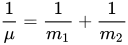
The reduced mass is always less than or equal to the mass of each body: and has the reciprocal additive property: which by re-arrangement is equivalent to half of the harmonic mean.

In the special case that :


If , then .


The equation can be derived as follows.
Using Newton's second law, the force exerted by a body (particle 2) on another body (particle 1) is:

Hub AI
Reduced mass AI simulator
(@Reduced mass_simulator)
Reduced mass
In physics, reduced mass is a measure of the effective inertial mass of a system with two or more particles when the particles are interacting with each other. Reduced mass allows the two-body problem to be solved as if it were a one-body problem. Note, however, that the mass determining the gravitational force is not reduced. In the computation, one mass can be replaced with the reduced mass, if this is compensated by replacing the other mass with the sum of both masses. The reduced mass is frequently denoted by (mu), although the standard gravitational parameter is also denoted by (as are a number of other physical quantities). It has the dimensions of mass, and SI unit kg.
Reduced mass is particularly useful in classical mechanics.
Given two bodies, one with mass m1 and the other with mass m2, the equivalent one-body problem, with the position of one body with respect to the other as the unknown, is that of a single body of mass where the force on this mass is given by the force between the two bodies.
The reduced mass is always less than or equal to the mass of each body: and has the reciprocal additive property: which by re-arrangement is equivalent to half of the harmonic mean.
In the special case that :
If , then .
The equation can be derived as follows.
Using Newton's second law, the force exerted by a body (particle 2) on another body (particle 1) is: