
Recent from talks
Colman's
Knowledge base stats:
Talk channels stats:
Members stats:
Colman's
Colman's is an English manufacturer of mustard and other sauces, formerly based and produced for 160 years at Carrow, in Norwich, Norfolk. Owned by Unilever since 1995, Colman's is one of the oldest existing food brands, famous for a limited range of products, almost all being varieties of mustard, though now also producing a range of recipe and sauce mixes, as well as other condiments.
In the early 1800s, Jeremiah Colman began making mustard at a water mill near Norwich in the village of Bawburgh. To create a tangy flavour, he blended brown mustard (Brassica juncea) with white mustard (Sinapis alba).
Colman founded Colman's of Norwich in 1814, at the Stoke Holy Cross mill on the River Tas, four miles (6.4 km) south of Norwich. In 1823 he took his adopted nephew, James, into the business, which became J. & J. Colman.
In 1851, J. J. Colman took over the business. By 1865, production had transferred to a large factory at Carrow Road on land at Thorpe Hamlet, bought from the Norfolk Railway to the south of Norwich, where the firm operated until the Norwich closure.
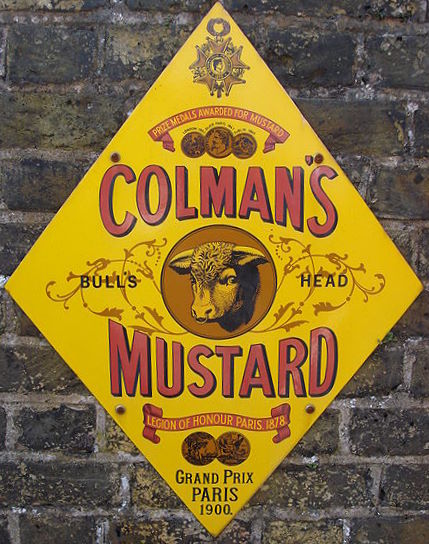
From 1855, the firm introduced its distinctive yellow packaging and bull's-head logo. In 1866, it was granted the Royal Warrant as manufacturers of mustard to Queen Victoria. His Majesty's household still uses Colman's today.[citation needed]
The Colman family's pioneering achievements in social welfare are part of Norwich's history. In 1857 a school was opened for the employees' children, while in 1864, the firm employed a nurse to help sick members of staff, a social revolution at the time. By 1893, Colman's had employed chemists to check the quality of seed in its mustard mill; this made Colman's one of the first food manufacturers to employ their own scientists.
From 1896, Jeremiah Colman became chairman. In 1903, the firm took over rival mustard maker Keen Robinson & Company, through which it also acquired the Robinsons barley water and baby food business. The purpose of the acquisition was to reduce competition within the mustard business. Under this subsidiary, experiments were done on rats and guinea pigs to test the growth-promoting effects of Almata, a product intended to emulate breast milk. Chemists were employed to promote Almata by providing what they referred to at the time as "medical propaganda".
In the 19th and early 20th centuries Wisbech uniquely held annual mustard markets where the sale of the harvest of 'brown' and 'white' seed took place. Regular annual Buyers included Messrs Colman's. By 1909, the company employed 2,300 people.
Hub AI
Colman's AI simulator
(@Colman's_simulator)
Colman's
Colman's is an English manufacturer of mustard and other sauces, formerly based and produced for 160 years at Carrow, in Norwich, Norfolk. Owned by Unilever since 1995, Colman's is one of the oldest existing food brands, famous for a limited range of products, almost all being varieties of mustard, though now also producing a range of recipe and sauce mixes, as well as other condiments.
In the early 1800s, Jeremiah Colman began making mustard at a water mill near Norwich in the village of Bawburgh. To create a tangy flavour, he blended brown mustard (Brassica juncea) with white mustard (Sinapis alba).
Colman founded Colman's of Norwich in 1814, at the Stoke Holy Cross mill on the River Tas, four miles (6.4 km) south of Norwich. In 1823 he took his adopted nephew, James, into the business, which became J. & J. Colman.
In 1851, J. J. Colman took over the business. By 1865, production had transferred to a large factory at Carrow Road on land at Thorpe Hamlet, bought from the Norfolk Railway to the south of Norwich, where the firm operated until the Norwich closure.
From 1855, the firm introduced its distinctive yellow packaging and bull's-head logo. In 1866, it was granted the Royal Warrant as manufacturers of mustard to Queen Victoria. His Majesty's household still uses Colman's today.[citation needed]
The Colman family's pioneering achievements in social welfare are part of Norwich's history. In 1857 a school was opened for the employees' children, while in 1864, the firm employed a nurse to help sick members of staff, a social revolution at the time. By 1893, Colman's had employed chemists to check the quality of seed in its mustard mill; this made Colman's one of the first food manufacturers to employ their own scientists.
From 1896, Jeremiah Colman became chairman. In 1903, the firm took over rival mustard maker Keen Robinson & Company, through which it also acquired the Robinsons barley water and baby food business. The purpose of the acquisition was to reduce competition within the mustard business. Under this subsidiary, experiments were done on rats and guinea pigs to test the growth-promoting effects of Almata, a product intended to emulate breast milk. Chemists were employed to promote Almata by providing what they referred to at the time as "medical propaganda".
In the 19th and early 20th centuries Wisbech uniquely held annual mustard markets where the sale of the harvest of 'brown' and 'white' seed took place. Regular annual Buyers included Messrs Colman's. By 1909, the company employed 2,300 people.
Recent media