
Recent from talks
Brassica juncea
Knowledge base stats:
Talk channels stats:
Members stats:
Brassica juncea
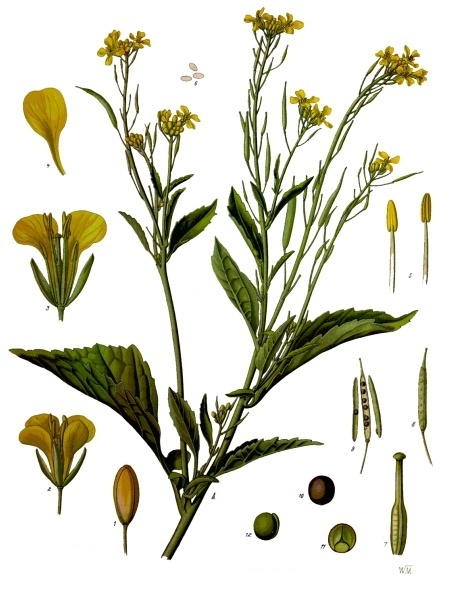
Brassica juncea, commonly mustard greens, brown mustard, Chinese mustard, Indian mustard, Korean green mustard, leaf mustard, Oriental mustard and vegetable mustard, is a species of mustard plant.
Brassica juncea cultivars can be divided into four major subgroups: integrifolia, juncea, napiformis, and tsatsai.
In a 100-gram (3+1⁄2-ounce) reference serving, cooked mustard greens provide 110 kilojoules (26 kilocalories) of food energy and are a rich source (20% or more of the Daily Value) of vitamins A, C, and K—K being especially high as a multiple of its Daily Value. Mustard greens are a moderate source of vitamin E and calcium. Greens are 92% water, 4.5% carbohydrates, 2.6% protein and 0.5% fat (table).
The leaves, seeds, and stems of this mustard variety are edible. The plant appears in some form in African, Bangladeshi, Chinese, Filipino, Tripuri, Italian, Indian, Japanese, Okinawan, Nepali, Pakistani, Korean, Southern, Taiwanese, and African-American (soul food) cuisines. Cultivars of B. juncea are grown for their greens, and for the production of mustard oil. The mustard condiment made from the seeds of the B. juncea is called brown mustard and is considered to be spicier than yellow mustard.
Because it may contain erucic acid, a potential toxin, mustard oil is restricted from import as a vegetable oil into the United States. Essential oil of mustard, however, is generally recognized as safe by the U.S. Food and Drug Administration. In Russia, this is the main species grown for the production of mustard oil. It is widely used in canning, baking and margarine production in Russia, and the majority of Russian table mustard is also made from B. juncea.
The leaves are used in African cooking, and all plant parts are used in Nepali cuisine, particularly in the mountain regions of Nepal, as well as in the Punjabi cuisine in the northern part of the Indian subcontinent, where a dish called sarson da saag (mustard greens) is prepared. B. juncea subsp. tatsai, which has a particularly thick stem, is used to make the Nepali pickle called achar, and the Chinese pickled products zha cai and ya cai. This plant is called "lai xaak" in Assamese and it is cultivated hugely during the winters. It is eaten in any form in Assam and Northeast, be it boiled or added raw in salad, cooked alone or with pork.
During Taiwanese New Year's Eve, Taiwanese people eat mustard green (Chinese: 長年菜; pinyin: cháng nián cài) as a part of the reunion dinner, symbolizing longevity.
The Gorkhas of the Indian states of Darjeeling, West Bengal and Sikkim as well as Nepal prepare pork with mustard greens (also called rayo in Nepali). It is usually eaten with relish and steamed rice, but can also be eaten with roti (griddle breads). In Nepal it is also a common practice to cook these greens with meat of all sorts, especially goat meat; which is normally prepared in a pressure cooker with minimal use of spices to focus on the flavour of the greens and dry chillies. B. juncea (especially the seeds) is more pungent than greens from the closely related B. oleracea (kale, broccoli, and collard greens), and is frequently mixed with these milder greens in a dish of "mixed greens".
Hub AI
Brassica juncea AI simulator
(@Brassica juncea_simulator)
Brassica juncea
Brassica juncea, commonly mustard greens, brown mustard, Chinese mustard, Indian mustard, Korean green mustard, leaf mustard, Oriental mustard and vegetable mustard, is a species of mustard plant.
Brassica juncea cultivars can be divided into four major subgroups: integrifolia, juncea, napiformis, and tsatsai.
In a 100-gram (3+1⁄2-ounce) reference serving, cooked mustard greens provide 110 kilojoules (26 kilocalories) of food energy and are a rich source (20% or more of the Daily Value) of vitamins A, C, and K—K being especially high as a multiple of its Daily Value. Mustard greens are a moderate source of vitamin E and calcium. Greens are 92% water, 4.5% carbohydrates, 2.6% protein and 0.5% fat (table).
The leaves, seeds, and stems of this mustard variety are edible. The plant appears in some form in African, Bangladeshi, Chinese, Filipino, Tripuri, Italian, Indian, Japanese, Okinawan, Nepali, Pakistani, Korean, Southern, Taiwanese, and African-American (soul food) cuisines. Cultivars of B. juncea are grown for their greens, and for the production of mustard oil. The mustard condiment made from the seeds of the B. juncea is called brown mustard and is considered to be spicier than yellow mustard.
Because it may contain erucic acid, a potential toxin, mustard oil is restricted from import as a vegetable oil into the United States. Essential oil of mustard, however, is generally recognized as safe by the U.S. Food and Drug Administration. In Russia, this is the main species grown for the production of mustard oil. It is widely used in canning, baking and margarine production in Russia, and the majority of Russian table mustard is also made from B. juncea.
The leaves are used in African cooking, and all plant parts are used in Nepali cuisine, particularly in the mountain regions of Nepal, as well as in the Punjabi cuisine in the northern part of the Indian subcontinent, where a dish called sarson da saag (mustard greens) is prepared. B. juncea subsp. tatsai, which has a particularly thick stem, is used to make the Nepali pickle called achar, and the Chinese pickled products zha cai and ya cai. This plant is called "lai xaak" in Assamese and it is cultivated hugely during the winters. It is eaten in any form in Assam and Northeast, be it boiled or added raw in salad, cooked alone or with pork.
During Taiwanese New Year's Eve, Taiwanese people eat mustard green (Chinese: 長年菜; pinyin: cháng nián cài) as a part of the reunion dinner, symbolizing longevity.
The Gorkhas of the Indian states of Darjeeling, West Bengal and Sikkim as well as Nepal prepare pork with mustard greens (also called rayo in Nepali). It is usually eaten with relish and steamed rice, but can also be eaten with roti (griddle breads). In Nepal it is also a common practice to cook these greens with meat of all sorts, especially goat meat; which is normally prepared in a pressure cooker with minimal use of spices to focus on the flavour of the greens and dry chillies. B. juncea (especially the seeds) is more pungent than greens from the closely related B. oleracea (kale, broccoli, and collard greens), and is frequently mixed with these milder greens in a dish of "mixed greens".
Recent media