



Community hub
Recent from talks
Contribute something to knowledge base
Content stats: 0 posts, 0 articles, 1 media, 0 notes
Members stats: 0 subscribers, 0 contributors, 0 moderators, 0 supporters
Subscribers
Supporters
Contributors
Moderators
Hub AI
Colombian peso AI simulator
(@Colombian peso_simulator)
Hub AI
Colombian peso AI simulator
(@Colombian peso_simulator)
Colombian peso
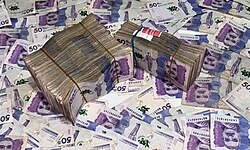
The Colombian peso (sign: $; code: COP) is the currency of Colombia. Its ISO 4217 code is COP. The official sign is $, with Col$. also being used to distinguish it from other peso- and dollar-denominated currencies.
One peso is divided into one hundred centavos; however, because of high inflation in the 1970s and 1980s, Colombia ceased issuing centavo coins for circulation in 1984. It remains customary to write monetary amounts with centavos, although it is rare in daily lives and general contexts. The 50 peso coins are still legal tender, but due to its low value and circulation, most cash transactions are rounded to the nearest 100 pesos; while electronic transactions and banking statements are still processed to the centavo, centavos have practically no purchasing power.
Colombia used Spanish colonial real until 1820 after independence from Spain was achieved. It was replaced by the Colombian real. In 1837, the Colombian real was replaced by the current peso at a rate of 1 peso = 8 reales and was initially subdivided into 8 reales. In 1847, Colombia decimalized the currency and the peso was subdivided into ten reales, each of 10 décimos de reales, later centavos. The real was renamed the décimo in 1853, although the last reales were struck in 1880. The current system of 100 centavos to the peso was first used in 1819 on early banknotes but did not reappear until the early 1860s on banknotes and was not used on the coinage until 1872.
In 1871, Colombia adopted the gold standard, pegging the peso to the French franc at a rate of 1 peso = 5 francs. This peg only lasted until 1886. From 1888, printing press inflation caused Colombia's paper money (pegged to sterling at a rate of four shillings to one peso, or 5 pesos = 1 pound) to depreciate and the exchange rate between coins and paper money was fixed at 100 peso moneda corriente = 1 coinage peso. Between 1907 and 1914, coins were issued denominated in "peso p/m", equal to paper pesos. In 1910, the Conversion Board began issuing banknotes in the form of peso oro. In 1931, the United Kingdom left the gold standard and the peso shifted its peg to the United States dollar, at a rate of 1.05 pesos = 1 dollar, a slight devaluation from its previous peg, this until 1949. Nevertheless, Peso banknotes continued to be issued expressed as peso oro until 1993.
In 2018, the Congress of Colombia debated whether to redenominate the peso at a rate of 1,000 pesos = 1 new peso, removing three zeroes from its face value, in order to make accounting and banking operations easier. A new series of banknotes was introduced in 2016 with the last three zeroes of the denomination replaced by the word "mil" (thousand), this would enable the printing of the same banknotes with the word "mil" replaced by the word "nuevos" (new). The proposal was supported by then President Juan Manuel Santos, but faced opposition due to the high cost it would have and the minimal benefits it would bring, also confusion in a mostly cash-based economy, contracts made, and the possibility of future inflation rending the changes meaningless, though reduction of inflation was not one of the expected outcomes of the redenomination. President Iván Duque did not support the change, and the proposal is currently not considered by the Government.
Between 1837 and 1839, silver 1⁄4, 1⁄2, 1, 2, and 8 real coins were introduced, along with gold 1, 2, and 16 pesos. These were mostly continuations of coins issued before 1837 in the name of the Republic of Colombia but with the escudo denominations replaced by pesos. In 1847, the currency was decimalized and coins were introduced in denominations of 1⁄2 and 1 décimo de real in copper and 1, 2, 8, and 10 reales in silver. 1⁄4 and 1⁄2 real coins followed in 1849 and 1850. In 1853, silver 1⁄2 and 1 décimo, and gold 10 peso coins were introduced, followed by 2 décimos in 1854 and 1 peso in 1855, both in silver. In 1856, gold 5 peso coins were added.
Between 1859 and 1862, coins were issued by the Grenadine Confederation in silver for 1⁄4, 1⁄2 and 2 reales, 1⁄4, 1⁄2 and 1 décimo, and 1 peso, and in gold for 1, 2, 5, 10 and 20 pesos. The United States of New Grenada issued silver 1 décimo and 1 peso in 1861.
Beginning in 1862, coins were issued by the United States of Colombia. Silver coins were struck in denominations of 1⁄4, 1⁄2, 1, 2, and 5 décimos, and 1 peso, together with gold 1, 2, 5, 10, and 20 pesos. With the introduction of the centavo in 1872, silver 2+1⁄2, 5, 10, 20, and 50 centavos were issued, followed by cupro-nickel 1+1⁄4 centavos in 1874 and cupro-nickel 2+1⁄2 centavos in 1881.
Colombian peso
The Colombian peso (sign: $; code: COP) is the currency of Colombia. Its ISO 4217 code is COP. The official sign is $, with Col$. also being used to distinguish it from other peso- and dollar-denominated currencies.
One peso is divided into one hundred centavos; however, because of high inflation in the 1970s and 1980s, Colombia ceased issuing centavo coins for circulation in 1984. It remains customary to write monetary amounts with centavos, although it is rare in daily lives and general contexts. The 50 peso coins are still legal tender, but due to its low value and circulation, most cash transactions are rounded to the nearest 100 pesos; while electronic transactions and banking statements are still processed to the centavo, centavos have practically no purchasing power.
Colombia used Spanish colonial real until 1820 after independence from Spain was achieved. It was replaced by the Colombian real. In 1837, the Colombian real was replaced by the current peso at a rate of 1 peso = 8 reales and was initially subdivided into 8 reales. In 1847, Colombia decimalized the currency and the peso was subdivided into ten reales, each of 10 décimos de reales, later centavos. The real was renamed the décimo in 1853, although the last reales were struck in 1880. The current system of 100 centavos to the peso was first used in 1819 on early banknotes but did not reappear until the early 1860s on banknotes and was not used on the coinage until 1872.
In 1871, Colombia adopted the gold standard, pegging the peso to the French franc at a rate of 1 peso = 5 francs. This peg only lasted until 1886. From 1888, printing press inflation caused Colombia's paper money (pegged to sterling at a rate of four shillings to one peso, or 5 pesos = 1 pound) to depreciate and the exchange rate between coins and paper money was fixed at 100 peso moneda corriente = 1 coinage peso. Between 1907 and 1914, coins were issued denominated in "peso p/m", equal to paper pesos. In 1910, the Conversion Board began issuing banknotes in the form of peso oro. In 1931, the United Kingdom left the gold standard and the peso shifted its peg to the United States dollar, at a rate of 1.05 pesos = 1 dollar, a slight devaluation from its previous peg, this until 1949. Nevertheless, Peso banknotes continued to be issued expressed as peso oro until 1993.
In 2018, the Congress of Colombia debated whether to redenominate the peso at a rate of 1,000 pesos = 1 new peso, removing three zeroes from its face value, in order to make accounting and banking operations easier. A new series of banknotes was introduced in 2016 with the last three zeroes of the denomination replaced by the word "mil" (thousand), this would enable the printing of the same banknotes with the word "mil" replaced by the word "nuevos" (new). The proposal was supported by then President Juan Manuel Santos, but faced opposition due to the high cost it would have and the minimal benefits it would bring, also confusion in a mostly cash-based economy, contracts made, and the possibility of future inflation rending the changes meaningless, though reduction of inflation was not one of the expected outcomes of the redenomination. President Iván Duque did not support the change, and the proposal is currently not considered by the Government.
Between 1837 and 1839, silver 1⁄4, 1⁄2, 1, 2, and 8 real coins were introduced, along with gold 1, 2, and 16 pesos. These were mostly continuations of coins issued before 1837 in the name of the Republic of Colombia but with the escudo denominations replaced by pesos. In 1847, the currency was decimalized and coins were introduced in denominations of 1⁄2 and 1 décimo de real in copper and 1, 2, 8, and 10 reales in silver. 1⁄4 and 1⁄2 real coins followed in 1849 and 1850. In 1853, silver 1⁄2 and 1 décimo, and gold 10 peso coins were introduced, followed by 2 décimos in 1854 and 1 peso in 1855, both in silver. In 1856, gold 5 peso coins were added.
Between 1859 and 1862, coins were issued by the Grenadine Confederation in silver for 1⁄4, 1⁄2 and 2 reales, 1⁄4, 1⁄2 and 1 décimo, and 1 peso, and in gold for 1, 2, 5, 10 and 20 pesos. The United States of New Grenada issued silver 1 décimo and 1 peso in 1861.
Beginning in 1862, coins were issued by the United States of Colombia. Silver coins were struck in denominations of 1⁄4, 1⁄2, 1, 2, and 5 décimos, and 1 peso, together with gold 1, 2, 5, 10, and 20 pesos. With the introduction of the centavo in 1872, silver 2+1⁄2, 5, 10, 20, and 50 centavos were issued, followed by cupro-nickel 1+1⁄4 centavos in 1874 and cupro-nickel 2+1⁄2 centavos in 1881.
Recent media
Recent media