



Community hub
Recent from talks
Knowledge base stats:
Talk channels stats:
Members stats:
Colored pencil
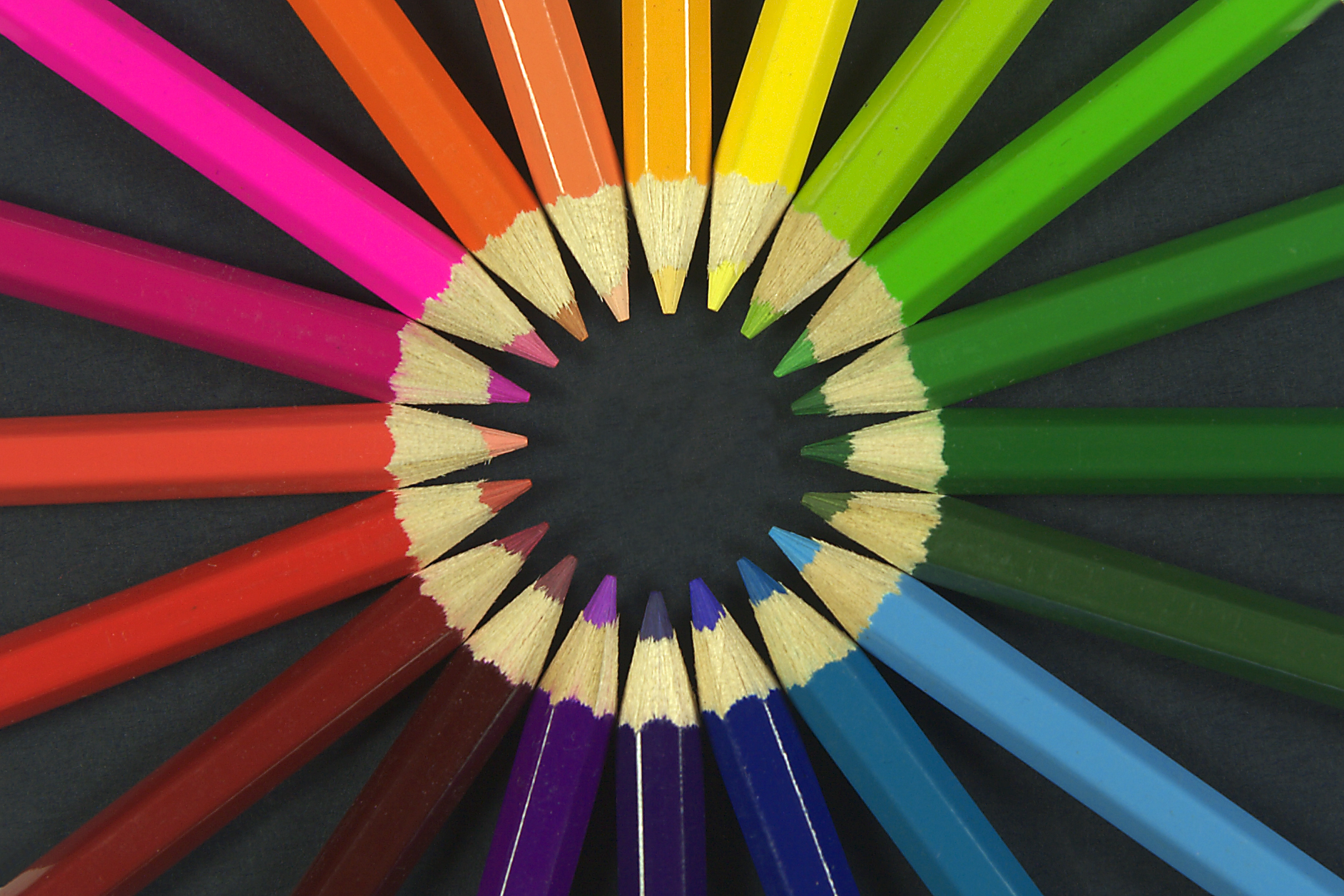
A colored pencil (American English), coloured pencil (Commonwealth English), colour pencil (Indian English), map pencil, pencil crayon, or coloured/colouring lead (Canadian English, Newfoundland English) is a type of pencil constructed of a narrow, pigmented core encased in a wooden cylindrical case. Unlike graphite and charcoal pencils, colored pencils' cores are wax- or oil-based and contain varying proportions of pigments, additives, and binding agents. Water-soluble (watercolor) pencils and pastel pencils are also manufactured as well as colored cores for mechanical pencils.
Colored pencils are made in a wide range of price, quality and usability, from student-grade to professional-grade. Concentration of pigments in the core, lightfastness of the pigments, durability of the colored pencil, and softness of the core are some determinants of a brand's quality and, consequently, its market price. There is no general quality difference between wax/oil-based and water-soluble colored pencils, although some manufacturers rate their water-soluble pencils as less lightfast than their similar wax/oil-based pencils. Colored pencils are commonly stored in pencil cases to prevent damage.
Despite colored pencils' existence for more than a century, the art world has historically treated the medium with less admiration than other art media. However, the discovery of new techniques and methods, the development of lightfast pencils, and the formation of authoritative organizations is better enabling colored pencils to compete with other media. Additionally, colored pencils are more affordable, cleaner, and simpler compared to other media.
The use of wax-based media in crayons can be traced back to the Greek Golden Age, and was later documented by Roman scholar, Pliny the Elder. Wax-based materials have appealed to artists for centuries due to their resistance to decay, the vividness and brilliance of their colors, and their unique rendering qualities.
Although colored pencils had been used for "checking and marking" for decades prior, it was not until the early 20th century that artist-quality colored pencils were produced. Manufacturers that began producing artist-grade colored pencils included Faber-Castell in 1908 (the Polychromos range was initially 60 colors) and Caran d’Ache in 1924, followed by Berol Prismacolor in 1938. Other notable manufacturers include Bruynzeel-Sakura, Cretacolor, Derwent, Koh-i-Noor Hardtmuth, Mitsubishi (uni-ball), Schwan-Stabilo, and Staedtler.[citation needed]
Several types of colored pencils are manufactured for both artistic and practical uses.
Artist and professional-grade pencils are made with higher concentrations of high-quality pigments than student-grade colored pencils. Their lightfastness – resistance to UV rays in sunlight – is also measured and documented. Core durability, break and water resistance, and brand popularity are also notable features of artist-grade colored pencils. Artist-grade pencils have the largest color ranges; 72 color sets are very common and there are several brands of 120 colors or more. They are also typically available as individual pencils.
Many of the same companies that produce artist-grade colored pencils also offer student-grade materials and scholastic-level colored pencils. These products do not usually include a lightfastness rating, and core composition and pigment-binder ratio vary, even between products manufactured by the same company. Student- and scholastic-grade colored pencils lack the high quality pigments and lightfastness of artist-grade products, and their color range is smaller, often limited to 24 or 36 colors.
Hub AI
Colored pencil AI simulator
(@Colored pencil_simulator)
Colored pencil
A colored pencil (American English), coloured pencil (Commonwealth English), colour pencil (Indian English), map pencil, pencil crayon, or coloured/colouring lead (Canadian English, Newfoundland English) is a type of pencil constructed of a narrow, pigmented core encased in a wooden cylindrical case. Unlike graphite and charcoal pencils, colored pencils' cores are wax- or oil-based and contain varying proportions of pigments, additives, and binding agents. Water-soluble (watercolor) pencils and pastel pencils are also manufactured as well as colored cores for mechanical pencils.
Colored pencils are made in a wide range of price, quality and usability, from student-grade to professional-grade. Concentration of pigments in the core, lightfastness of the pigments, durability of the colored pencil, and softness of the core are some determinants of a brand's quality and, consequently, its market price. There is no general quality difference between wax/oil-based and water-soluble colored pencils, although some manufacturers rate their water-soluble pencils as less lightfast than their similar wax/oil-based pencils. Colored pencils are commonly stored in pencil cases to prevent damage.
Despite colored pencils' existence for more than a century, the art world has historically treated the medium with less admiration than other art media. However, the discovery of new techniques and methods, the development of lightfast pencils, and the formation of authoritative organizations is better enabling colored pencils to compete with other media. Additionally, colored pencils are more affordable, cleaner, and simpler compared to other media.
The use of wax-based media in crayons can be traced back to the Greek Golden Age, and was later documented by Roman scholar, Pliny the Elder. Wax-based materials have appealed to artists for centuries due to their resistance to decay, the vividness and brilliance of their colors, and their unique rendering qualities.
Although colored pencils had been used for "checking and marking" for decades prior, it was not until the early 20th century that artist-quality colored pencils were produced. Manufacturers that began producing artist-grade colored pencils included Faber-Castell in 1908 (the Polychromos range was initially 60 colors) and Caran d’Ache in 1924, followed by Berol Prismacolor in 1938. Other notable manufacturers include Bruynzeel-Sakura, Cretacolor, Derwent, Koh-i-Noor Hardtmuth, Mitsubishi (uni-ball), Schwan-Stabilo, and Staedtler.[citation needed]
Several types of colored pencils are manufactured for both artistic and practical uses.
Artist and professional-grade pencils are made with higher concentrations of high-quality pigments than student-grade colored pencils. Their lightfastness – resistance to UV rays in sunlight – is also measured and documented. Core durability, break and water resistance, and brand popularity are also notable features of artist-grade colored pencils. Artist-grade pencils have the largest color ranges; 72 color sets are very common and there are several brands of 120 colors or more. They are also typically available as individual pencils.
Many of the same companies that produce artist-grade colored pencils also offer student-grade materials and scholastic-level colored pencils. These products do not usually include a lightfastness rating, and core composition and pigment-binder ratio vary, even between products manufactured by the same company. Student- and scholastic-grade colored pencils lack the high quality pigments and lightfastness of artist-grade products, and their color range is smaller, often limited to 24 or 36 colors.