
Recent from talks
Colt New Service
Knowledge base stats:
Talk channels stats:
Members stats:
Colt New Service
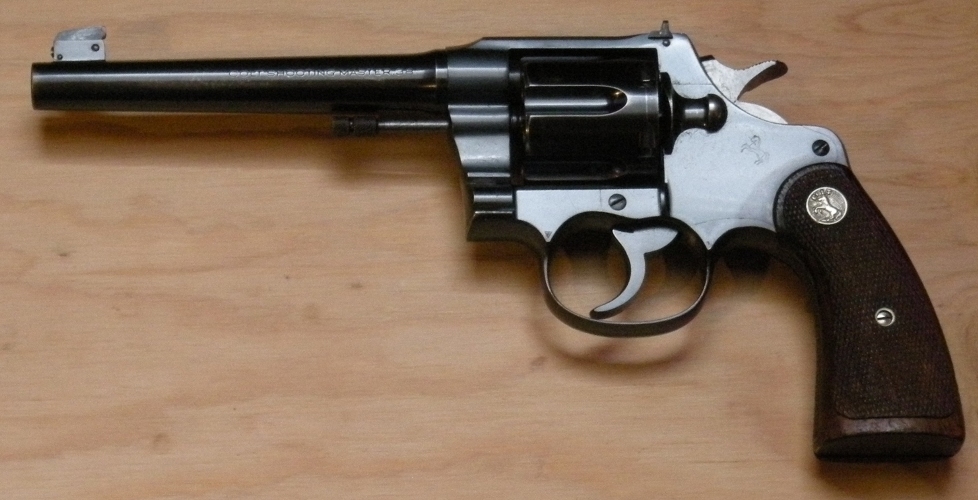
The Colt New Service is a large frame, large caliber, double-action revolver made by Colt from 1898 until 1941. Made in various calibers, the .45 Colt version with a 5+1⁄2-inch (140 mm) barrel was adopted by the U.S. Armed Forces as the Model 1909.
The Colt M1917 revolver was created to supplement insufficient stocks of M1911 pistols during World War I. It was simply a New Service re-chambered to take the .45 ACP cartridge and used half-moon clips to hold the rimless cartridges in position. After World War I, the revolver gained a strong following among civilian shooters. A commercial rimmed cartridge the .45 Auto Rim was also developed, that allowed the M1917 to be fired without the need for moon-clips.
In the 1930s, the New Service was chambered for .38 Special, and then .357 Magnum. As one of the most powerful handgun cartridges available at the time, it was easily capable of penetrating the automobile bodies and body armor used by public enemies such as gangsters, bank robbers, and fugitives of that era. As such, it became instantly popular with lawmen, state troopers and highway patrolmen.
The Colt New Service was introduced in 1898. It was an up-sized and strengthened Colt M1892 and Colt Firearms first large caliber revolver with a swing-out hand ejector cylinder. It was made in the popular large caliber revolver cartridges of the day: .38-40, .44-40, .44 Russian, .44 Special, .45 Colt, .450 Boxer, .455 Webley, and .476 Enfield. It was made with a blued finish or nickel plating, and with barrel lengths of 4, 4+1⁄2, 5, 5+1⁄2, 6 and 7+1⁄2 inches (100, 110, 130, 140, 150 and 190 mm). It also came with walnut or hard rubber grips.
The Colt M1892 revolver was thought of as a decent handgun for its time, but complaints soon arose concerning the stopping power of the .38 Long Colt. Beginning in 1899, combat reports from the Philippines campaign showed that the .38 caliber bullets repeatedly failed to stop Moro fighters, even when shot multiple times at close range. The complaints caused the U.S. Army to hurriedly re-issue the now retired .45 caliber Colt Single Action Army revolvers with a newly shortened 5+1⁄2-inch-barrel (140 mm) version, cut down from the original 7+1⁄2-inch (190 mm) barrels. These old revolvers easily stopped the kris- and bolo-wielding combatants and this played a central role in the Army's decision to replace the M1892 with the .45 caliber New Service revolver in 1909. The Model 1909 was also chambered for the .45 Calibre Revolver Ball Cartridge, Model of 1909, which was dimensionally similar to the original .45 Colt cartridge, but it has a rim that is .03 inches (0.76 mm) wider for a more positive ejection with the use of the swing-out cylinder's star extractor. It also played a key role in the Army's decision to adopt the new .45 ACP M1911 Colt pistol, only two years later in 1911. The Model 1909 in .45 Colt with a 5+1⁄2-inch (140 mm) barrel, was adopted by the U.S. Armed Forces as the "Model 1909 U.S. Army", the "Model 1909 U.S. Navy" and the "USMC Model 1909".
In 1899 Canada acquired a number of New Service revolvers (chambered in .45 Colt) for Boer War service, to supplement its existing M1878 Colt Double Action revolvers in the same caliber. In 1904 and 1905 the North-West Mounted Police in Canada also adopted the Colt New Service to replace the less-than satisfactory Enfield Mk II revolver in service since 1882.
New Service revolvers, designated as Pistol, Colt, .455-inch 5.5-inch barrel Mk. I, chambered for the .455 Webley cartridge were acquired for issue as "substitute standard" by the British War Department during World War I. British Empire Colt New Service Revolvers were stamped "NEW SERVICE .455 ELEY" on the barrel, to differentiate them from the .45 Colt versions used by the US (and Canada).
The Colt New Service was a popular revolver with British officers and many of them had privately purchased their own Colt New Service revolvers in the years prior to World War I as an alternative to the standard-issue Webley Revolver. British Empire and Canadian forces received 60,000 Colt New Service revolvers during World War I and they continued to see official service until the end of World War II.
Hub AI
Colt New Service AI simulator
(@Colt New Service_simulator)
Colt New Service
The Colt New Service is a large frame, large caliber, double-action revolver made by Colt from 1898 until 1941. Made in various calibers, the .45 Colt version with a 5+1⁄2-inch (140 mm) barrel was adopted by the U.S. Armed Forces as the Model 1909.
The Colt M1917 revolver was created to supplement insufficient stocks of M1911 pistols during World War I. It was simply a New Service re-chambered to take the .45 ACP cartridge and used half-moon clips to hold the rimless cartridges in position. After World War I, the revolver gained a strong following among civilian shooters. A commercial rimmed cartridge the .45 Auto Rim was also developed, that allowed the M1917 to be fired without the need for moon-clips.
In the 1930s, the New Service was chambered for .38 Special, and then .357 Magnum. As one of the most powerful handgun cartridges available at the time, it was easily capable of penetrating the automobile bodies and body armor used by public enemies such as gangsters, bank robbers, and fugitives of that era. As such, it became instantly popular with lawmen, state troopers and highway patrolmen.
The Colt New Service was introduced in 1898. It was an up-sized and strengthened Colt M1892 and Colt Firearms first large caliber revolver with a swing-out hand ejector cylinder. It was made in the popular large caliber revolver cartridges of the day: .38-40, .44-40, .44 Russian, .44 Special, .45 Colt, .450 Boxer, .455 Webley, and .476 Enfield. It was made with a blued finish or nickel plating, and with barrel lengths of 4, 4+1⁄2, 5, 5+1⁄2, 6 and 7+1⁄2 inches (100, 110, 130, 140, 150 and 190 mm). It also came with walnut or hard rubber grips.
The Colt M1892 revolver was thought of as a decent handgun for its time, but complaints soon arose concerning the stopping power of the .38 Long Colt. Beginning in 1899, combat reports from the Philippines campaign showed that the .38 caliber bullets repeatedly failed to stop Moro fighters, even when shot multiple times at close range. The complaints caused the U.S. Army to hurriedly re-issue the now retired .45 caliber Colt Single Action Army revolvers with a newly shortened 5+1⁄2-inch-barrel (140 mm) version, cut down from the original 7+1⁄2-inch (190 mm) barrels. These old revolvers easily stopped the kris- and bolo-wielding combatants and this played a central role in the Army's decision to replace the M1892 with the .45 caliber New Service revolver in 1909. The Model 1909 was also chambered for the .45 Calibre Revolver Ball Cartridge, Model of 1909, which was dimensionally similar to the original .45 Colt cartridge, but it has a rim that is .03 inches (0.76 mm) wider for a more positive ejection with the use of the swing-out cylinder's star extractor. It also played a key role in the Army's decision to adopt the new .45 ACP M1911 Colt pistol, only two years later in 1911. The Model 1909 in .45 Colt with a 5+1⁄2-inch (140 mm) barrel, was adopted by the U.S. Armed Forces as the "Model 1909 U.S. Army", the "Model 1909 U.S. Navy" and the "USMC Model 1909".
In 1899 Canada acquired a number of New Service revolvers (chambered in .45 Colt) for Boer War service, to supplement its existing M1878 Colt Double Action revolvers in the same caliber. In 1904 and 1905 the North-West Mounted Police in Canada also adopted the Colt New Service to replace the less-than satisfactory Enfield Mk II revolver in service since 1882.
New Service revolvers, designated as Pistol, Colt, .455-inch 5.5-inch barrel Mk. I, chambered for the .455 Webley cartridge were acquired for issue as "substitute standard" by the British War Department during World War I. British Empire Colt New Service Revolvers were stamped "NEW SERVICE .455 ELEY" on the barrel, to differentiate them from the .45 Colt versions used by the US (and Canada).
The Colt New Service was a popular revolver with British officers and many of them had privately purchased their own Colt New Service revolvers in the years prior to World War I as an alternative to the standard-issue Webley Revolver. British Empire and Canadian forces received 60,000 Colt New Service revolvers during World War I and they continued to see official service until the end of World War II.
Recent media