Hubbry Logo
KrisKrisMain
Open search
Kris
Community hub
Kris
logo
8 pages, 0 posts
0 subscribers
Be the first to start a discussion here.
Contribute something
Kris
Kris
from Wikipedia

Key Information

Indonesian Kris
CountryIndonesia
Reference00112
RegionAsia and the Pacific
Inscription history
Inscription2008 (3rd session)
ListRepresentative

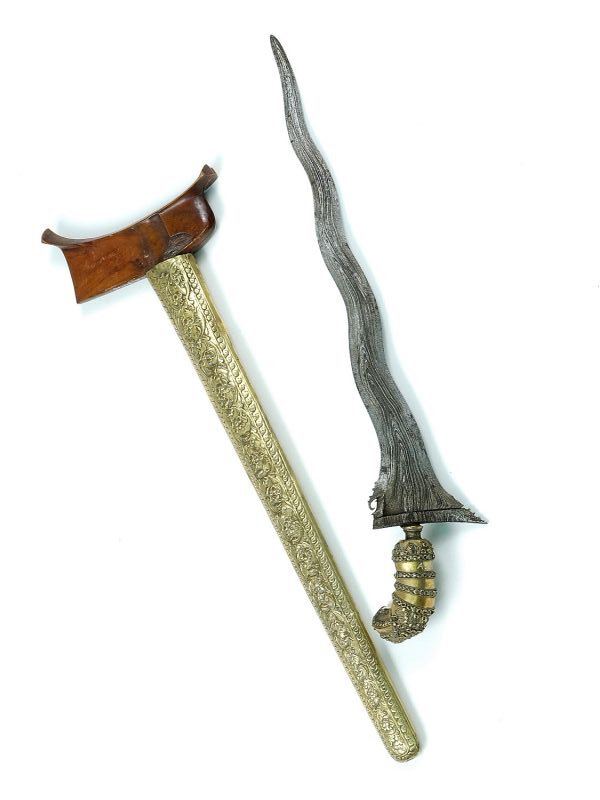
The kris or keris[n 1] is a Javanese asymmetrical dagger with a distinctive blade-patterning achieved through alternating laminations of iron and nickelous iron (pamor).[8] The kris is famous for its distinctive wavy blade, although many have straight blades as well, and is one of the weapons commonly used in the pencak silat martial art native to Indonesia. Kris have been produced in many regions of Indonesia for centuries, but nowhere—although the island of Bali comes close—is the kris so embedded in a mutually-connected whole of ritual prescriptions and acts, ceremonies, storied backgrounds, and epic poetry as in Central Java.[9]: 27  Within Indonesia the kris is commonly associated with Javanese culture, although other ethnicities in it and surrounding regions are familiar with the weapon as part of their cultures, such as the Balinese, Sundanese, Malay, Madurese, Banjar, Buginese, and Makassar people.[10] The kris itself is considered as a cultural symbol of Indonesia[2]: 266  and also neighbouring countries like Brunei, Malaysia,[11][12] Philippines, Singapore, and Thailand.

A kris can be divided into three parts: blade (bilah or wilah), hilt (hulu), and sheath (warangka). Each part of the kris is considered a piece of art, often carved in meticulous detail and made from various materials: metal, precious or rare types of wood, or gold or ivory. A kris's aesthetic value covers the dhapur (the form and design of the blade, with around 60 variants), the pamor (the pattern of metal alloy decoration on the blade, with around 250 variants), and tangguh referring to the age and origin of a kris.[13] Depending on the quality and historical value of the kris, it can fetch thousands of dollars or more.

Both a weapon and spiritual object, kris are often considered to have an essence or presence, considered to possess magical powers, with some blades possessing good luck and others possessing bad.[13] Kris are used for display, as talismans with magical powers, weapons, a sanctified heirloom (pusaka), auxiliary equipment for court soldiers, an accessory for ceremonial dress, an indicator of social status, a symbol of heroism, etc.[13] Legendary kris that possess supernatural power and extraordinary ability were mentioned in traditional folktales, such as those of Empu Gandring, Taming Sari, and Setan Kober.

In 2005, UNESCO included the Indonesian kris in the Representative List of the Intangible Cultural Heritage of Humanity.[13]

Etymology

[edit]

The word kris come from the Old Javanese term which means "dagger".[14] In Javanese, kris is known as keris (ꦏꦼꦫꦶꦱ꧀) in the ngoko register, dhuwung (ꦝꦸꦮꦸꦁ) in the krama register, and wangkingan (ꦮꦁꦏꦶꦁꦔꦤ꧀) in the krama inggil vocabulary.[7][14] In Malay (subsequently Indonesian[15] and Malaysian[16]), Sundanese, Balinese and Sasak, it is spelled keris (Pegon and Jawi: کريس). Other names include karih in Minangkabau, and sele (ᨔᨙᨒᨙ) in Buginese and Makassarese.

Two notable exceptions are the Philippines and Thailand. In the Philippines, the kris and similar stabbing daggers are known as gunong or gulok, while the much larger slashing sword versions are known as kalis or sundang. The larger kalis sword was introduced from the Sulu Sultanate of the Philippines back to Kalimantan and Sulawesi in Indonesia, where it became known as keris Sulu.[17][18]

In Thailand it is always spelled kris and pronounced either as kris or krit (กริช) in Thai, while in the Yala dialect, it is spelled kareh. In Cambodia it is spelled as kris (គ្រីស) in Khmer. Other alternative spellings used by Europeans include "cryse", "crise", "criss", "kriss" and "creese". In English, the plural form is often simply "kris" as well.

History

[edit]

Origin

[edit]
Possible kris depicted on 9th-century Borobudur bas-relief
Kris blacksmith's workshop depicted in 15th-century Candi Sukuh

The term kris was mentioned in several ancient Javanese inscriptions originating from Hindu-Buddhist Mataram Kingdom of Central Java, including Humanding inscription (707 Saka or 875 CE), Jurungan inscription and Haliwangbang inscription (708 Saka or 876 CE), Taji inscription (823 Saka or 901 CE), Poh inscription (827 Saka or 905 CE), and Rukam inscription (829 Saka or 907 CE).[2]: 266  Possible renderings of kris also appear on temple bas-reliefs such as of Borobudur (825) and Prambanan temples (850).[citation needed]

The description of a small dagger from Java reminiscent of kris can be found in Chinese source from the 10th century Song dynasty. In 992 the envoy from She-po (Java) arrived in Chinese court bearing a lot of gifts, consists of a dagger with exquisite hilt made of rhino horn and gold, silk woven with floral motifs made of gold threads, ivories, pearls, silk of various colours, fragrant sandalwood, cotton clothes of various colours, turtle shells, betel nut preparation kit, rattan mat with the image of white cockatoo, and a small model of house made of sandalwood adorned with valuable ornaments.[19]: 199 

The Kris of Knaud (1342 CE) from Majapahit period, exhibited at Tropenmuseum in Amsterdam

However, Raffles' (1817) study of the Candi Sukuh states that the kris recognized today came into existence around 1361 CE in the kingdom of Majapahit, East Java. The scene in bas relief of Sukuh Temple in Central Java, dated from the 15th century Majapahit era, shows the workshop of a Javanese keris blacksmith.[citation needed] The scene depicted Bhima as the blacksmith on the left forging the metal, Ganesha in the center, and Arjuna on the right operating the piston bellows to blow air into the furnace. The wall behind the blacksmith displays various items manufactured in the forge, including kris. These representations of the kris in the Candi Sukuh established the fact that by the year 1437, the kris had already gained an important place within Javanese culture.

In Yingya Shenglan—a record about Zheng He's expedition (1405–1433)—Ma Huan describes that

all men in Majapahit, from the king to commoners, from a boy aged three to elders, slipped pu-la-t'ou (belati or more precisely kris dagger) in their belts. The daggers are made entirely of steel with intricate motifs smoothly drawn. The handles are made of gold, rhino's horn or ivory carved with a depiction of a human or demon; the carving works are exquisite and skillfully made.[20]

This Chinese account also reported that public execution by stabbing using this type of dagger is common. Majapahit knows no caning for major or minor punishment. They tied the guilty men's hands in the back with rattan rope and paraded them for a few paces, and then stabbed the offender one or two times in the back on the gap between the floating ribs, which resulted in severe bleeding and instant death.

Currently, the Kris of Knaud is the oldest known surviving kris in the world.[21] Given to Charles Knaud, a Dutch physician, by Paku Alam V in the 19th century Yogyakarta in Java, the kris is on display at the Tropenmuseum, Amsterdam. The kris bears the date of 1264 Saka (which corresponds to 1342 CE) in its iron blade. Scientists suspect that due to its special features, the kris might be even older, but was decorated during Majapahit period to celebrate an important event.[22] The kris bears scenes from the Ramayana on an unusually thin copper layer which partially covers it.

Development and distribution

[edit]

Although the people of Southeast Asia were already familiar with this type of stabbing weapon, the development of the kris most probably took place in Java, Indonesia. From its origin in Java, the use of kris spread throughout the Indonesian archipelago, Singapore, Malaysia, Southern Thailand and the Philippines through diplomacy and trade.[2]: 267  The spread of the kris to other nations such as Thailand, Malaysia and the Philippines, some historians say, was credited to the growing influence of the Majapahit Empire in Java around the year 1492.[8]

The Sanghyang Siksa Kandang Karesian canto XVII, a Sundanese manuscript dated from Saka 1440 or 1518 CE, describes the kris as the weapon of kings, while the kujang is the weapon of farmers. There exist claims of earlier forms predating the Majapahit kris, but none are verifiable. In the past, the majority of kris had straight blades, but this became less frequent over time. Tomé Pires, in the early 16th century, describes the importance of the kris to the Javanese.[3]

Usage

[edit]

While it is commonly believed that kris were the primary weapons wielded by fighters in the past, they were actually carried by warriors as a secondary armament if they lost their main weapon, which was usually a spear. For commoners, however, kris were worn daily, especially when travelling, because it might be needed for self-defense. During times of peace, people wore kris as part of their ceremonial attire. Ceremonial kris were often meticulously decorated with intricate carving in gold and precious stones. Heirloom blades were handed down through successive generations and worn during special events such as weddings and other ceremonies. Men usually wore only one kris, but the admiral Hang Tuah is said in the Hikayat Hang Tuah to have armed himself with one short and one long kris. Women also wore kris, though usually of a smaller size than a man's. In battle, a fighter might have carried more than one kris; some carried three kris: his own, one from his father-in-law, and one as a family heirloom. The extra two served as parrying daggers, but if none were available, the sheath would serve the same purpose.

Kris were often broken in battle and required repairs. Yearly cleanings, known in Javanese tradition as jamasan, is required as part of the spirituality and mythology surrounding the weapon, often leaving ancient blades worn and thin. The repair materials depended on location, and it is quite usual to find a weapon with fittings from several areas. For example, a kris may have a blade from Java, a hilt from Bali and a sheath from Madura.

... every man in Java, whether he is rich or poor, must have a kris in his house ... and no man between the ages of 12 and 80 may go out of doors without a kris in his belt. They carry them at the back, as daggers used to be in Portugal ...

— Tome Pires, Suma Oriental

Varieties of Javanese keris, The History of Java, by Thomas Stamford Raffles (1817)

In many parts of Indonesia and the Malacca Sultanate, the kris used to be the choice weapon for an execution known as the hukuman salang. The executioner's kris had a long, straight, slender blade. The condemned knelt before the executioner, who placed a wad of cotton or similar material on the subject's shoulder or clavicle area. The blade was thrust through the padding, piercing the subclavian artery and the heart. Upon withdrawal, the cotton wiped the blade clean.[23]: 37  In the Malay world and Java, an honourable form of execution was death by kris to the heart.[24]: 141 

Kris were used commonly in battle during the early modern period, instead of having professional armies, most kings within the region relied on their courtiers to mobilize for war whenever required and since most Javanese, Malay and Makassarese would own a kris, the weapon would have seen regular combat.[24]: 127  During amok, the kris was used in a furious charge to scatter or kill a number of enemies even at the cost of one's own life.[24]: 125 

A lithograph depiction of kris blacksmith in Java, Dutch East Indies, c. 1854

In the 16th century, European colonial powers introduced firearms into the archipelago that contributed to the decline of using the kris as the weapon of choice in battle. The forging of edged weapons went into decline from the moment that the sultans or rajas were subjugated and their realms annexed by the British or Dutch East Indies colonial state. In some regions, a ban was placed on carrying of cutting and stabbing weapons.

In Java, the turning point was the end of the five-year-long Java War when the rebellious Prince Diponegoro was defeated and detained and had to hand his kris over to the Dutch in 1830. This event marked the disarmament of the kris as a combat weapon among the Javanese populace. Its ceremonial function, however, as part of traditional costumes, as sacred heirloom and as a protective personal amulet, remains.

However, the kris saw continuous use and forging in the Philippines, which comprised most of the Spanish East Indies. Kris-forgers and swordsmen were referred to as juramentados by the Spanish. Juramentados practice a ritual of sacrifice, a form of Jihad against not only Spanish soldiers but also against Christian Filipinos alike.

The early 20th century saw the decline of kris forging as carrying edged weapons was banned in the Dutch East Indies.[9]: 30  However its spiritual and ceremonial function still continues and is celebrated mainly in kraton and istana (courts) throughout Indonesia, Malaysia and the Muslim-inhabited parts of the southern Philippines.

Today

[edit]
Kris-making in Jakarta

In Java, the traditional art of kris-making is preserved in the Javanese culture heartland, the keraton (royal court) of Yogyakarta and Surakarta, and also the princedom of Mangkunegaran and Pakualaman. The Javanese kings and nobles of these courts are known to employ some kris blacksmiths (empu) and become the patrons of their works, although the activity of kris-making is declining. Until the 1990s, kris-making activities in Java had almost come to a standstill due to economic difficulties and changing socio-cultural values. However, thanks to several concerned kris experts, the tradition is being revived, and kris craftsmanship has increased again.

Over the past three decades, kris have lost their prominent social and spiritual meaning in society. Although active and honoured smiths who traditionally produce high-quality kris can still be found in some places such as Madura, Surakarta, Yogyakarta, Makassar and Palembang, their number is dramatically decreasing, and it is more difficult for them to find successors to whom they may transmit their skills.[13] The traditional kris-making industry still survives in some villages, such as Banyu Sumurup village in Imogiri subdistrict, Bantul, Yogyakarta, either specially made as a sacred amulet ordered by a kris enthusiast who seeks its spiritual power, or merely as souvenirs for tourists.[25]

Description

[edit]

Physically, the kris is a form of dagger with a blade measuring between 15 and 50 in (38 and 127 cm) long, typically not sharpened as it is meant for stabbing and tearing, broader and asymmetric shape near the hilt, made of a combination of several kinds of metals.[2]: 267  A kris's aesthetic value covers the dhapur (the form and design of the blade, with around 150 variants), the pamor (the pattern of metal alloy decoration on the blade, with around 60 variants), and tangguh referring to the age and origin of a kris.[13]

Blade

[edit]
A decorative kris with a figure of Semar as the handle. The blade has thirteen luk.

The kris blade is called a wilah or bilah. Kris blades are usually narrow with a wide, asymmetrical base, one rare kind of kris with a broad blade is the keris buah beko in Kelantan and Java copying the shape of the oroxylum seed pod.[26] The kris is famous for its wavy blade; however, older types of kris dated from the Majapahit era have straight blades,[27] as do more than half of all kris prior to the modern era.[28] The number of curves on the blade (known as luk or lok) is always odd.[29] Common numbers of luk range from three to thirteen waves, but some blades have up to 29.[30] In contrast to the older straight type, most kris today have a wavy blade which is supposed to increase the severity of wounds inflicted upon a victim.[29]

According to traditional Javanese kejawen, kris contain all the intrinsic elements of nature: tirta (water), bayu (wind), agni (fire), bantolo (earth, but also interpreted as metal or wood which both come from the earth), and aku (lit: "I" or "me", meaning that the kris has a spirit or soul). All these elements are present during the forging of kris. Earth is metal forged by fire being blown by pumped wind, and water to cool down the metal.[31] In Bali, the kris is associated with the nāga or dragon, which also symbolizes irrigation canals, rivers, springs, wells, spouts, waterfalls and rainbows; thus, the wavy blade symbolizes the movement of the serpent. Some kris have the head of a naga (dragon) carved near the base with the body and tail following the curves of the blade to the tip. A wavy kris is thus a naga in motion, aggressive and alive; a straight blade is one at rest, its power dormant but ready to come into action.[32]

In former times, kris blades were said to be infused with poison during their forging, ensuring that any injury was fatal. The poison used to polish kris blade is called warangan.[33] The process of chemical coating was done by warangan or jamas (washing) the blade with acid and minerals that contains arsenic compounds.[34] The process of doing so was kept secret among smiths. Different types of whetstones, the acidic juice of citrus fruits and poisonous arsenic bring out the contrast between the dark black iron and the light colored silvery nickel layers, which together form pamor, damascene patterns on the blade.

Pamor

[edit]
The shiny nickelous pattern (pamor) on dark iron background visible on kris' blade

The distinctive pamor patterns have specific meanings and names which indicate the mythical properties they are believed to impart. There are around 60 variants of pamor recognized today in traditional kris blades. Some examples of pamor include beras wutah, udan mas, kembang kacang, kembang pala and ladrang cendan. The kris blade forging uses iron with a small content of nickel to create this pattern. The faint pamor pattern has been found in the kris from Majapahit period, which was acquired from iron ores with small nickel content. Most probably this iron ore was imported from the island of Sulawesi, as the pamor Luwu from Luwu region is quite well known in Sulawesi and Java.

The best material for creating pamor, however, is acquired in a quite unusual way, as it is made from rare meteorite iron. Traditionally, the pamor material for the kris smiths connected with the courts of Yogyakarta and Surakarta originates from an iron meteorite that fell to earth at the end of the 18th century in the neighborhood of the Prambanan temple complex. The meteorite was excavated and transported to the keraton of Surakarta; from that time on the smiths of Vorstenlanden (the Royal territories) used small pieces of meteoric iron to produce pamor patterns in their kris, pikes, and other status weapons. After etching the blade with acidic substances, it is the small percentage of nickel present in meteoric iron that creates the distinctive silvery patterns that faintly light up against the dark background of iron or steel that become darkened by the effect of the acids.[9]: 19 

Hilt

[edit]
Richly decorated Balinese kris hilt coated with gold, adorned with rubies

The handle or hilt (hulu) is an object of art, often carved in meticulous detail and made from various materials: precious rare types of wood to gold or ivory. They were often carved to resemble various animals and Hindu deities, although this became less common with the introduction of Islam. In Bali, kris handles are made to resemble demons coated in gold and adorned with semi-precious and precious stones, such as rubies. In Java, kris handles are made in various types, the most common design being the abstract stylized representation of the human form. Examples of hilt designs include Tunggak Semi Putri Kinurung hilt from Surakarta, Batara Guru and Pulasir hilt from Madura, Punukan hilt from Palembang, Ratmaja from Bali, Pulungan hilt from Cirebon, Pekaka hilt from Pattani, and a seabird-like hilt from Lampung and Sulawesi.[35] The kris usually has a curved pistol-grip hilt that aids in stabbing strikes. It allows the palm of the holding hand to add pressure to the blade while stabbing. A kris only offers minimal protection for the hand by the broad blade at the hilt.

Sheath

[edit]
Kris sheath of Ladrang Surakarta style

As with the hilt, a kris' sheath (warangka) is also an object of art. It can be made from various materials, usually a wooden frame to hold the blade which can be coated with metals such as brass, iron, silver, or even gold, usually carved in sulur floral motifs. The upper part of the sheath formed a broad, curved handle made from wood or sometimes ivory. It could be adorned with precious or semi-precious stones.

Forging

[edit]

The making of a kris was the specialised duty of metalworkers called empu (lit. "possessor") or pandai besi (lit. "iron-skilled"). In Java, the honorary title empu refers to those ironsmiths who possess the special skill of forging the kris. According to Javanese beliefs, a kris empu should possess knowledge, technical skills and also spiritual prowess, since kris are believed to have physical and spiritual presence.[36] This was meant to differentiate the masters from common pandai besi that mostly create common metal tools or peasant's weapons like parang or golok. In old Majapahit, a kris bladesmith was referred to as pande and all were reputed to be able to work hot iron with their bare hands. The people of Majapahit would eventually flee to Bali where the occupation has been preserved by the Pande clan to this day, members of whom also make jewellery. A bladesmith makes the blade in layers of different iron ores and meteorite nickel. Some blades can be made in a relatively short time, while more intricate weapons take years to complete. In high-quality kris blades, the metal is folded dozens or hundreds of times and handled with the utmost precision. Empu are highly respected craftsmen with additional knowledge in literature, history, and the occult.[13]

Culture

[edit]
Various ways of wearing kris in Javanese culture

Kris were worn at special ceremonies, with heirloom blades being handed down through successive generations. Both men and women might wear them, though those for women are smaller. A rich spirituality and mythology developed around the weapon. Kris are used for display, as talismans with magical powers, as weapons, sanctified heirloom, auxiliary equipment for court soldiers, as an accessory for ceremonial dress, an indicator of social status, a symbol of heroism, etc.[13]

Barong dance performance with kris-wielding dancers and Rangda in Bali

In the Barong dance of Bali there is a segment called keris dance, in which the villain Rangda magically enchants Airlangga's soldiers to commit suicide, while another magician makes them invulnerable to sharp objects. In a trance state, the male dancers stab themselves in the chest with their own kris but remain unhurt.[37]

The kris dance is a potentially dangerous dance and can lead to fatal accidents. In February 2021, a 16-year-old kris dancer was stabbed to death in his heart by his own kris, during a Rangda dance performance in Denpasar, Bali.[38]

In Javanese culture the kris is revered as tosan aji (Javanese for "sacred heirloom weapon") and considered a pusaka. The kris is believed to have the ability to infuse bravery upon its holder: this property is known as piyandel in Javanese, which means "to add self-confidence". The pusaka kris or kris-tipped spear given by a Javanese king to nobles or his subjects was meant to symbolize the king's confidence bestowed upon the receiver and is considered a great honor. During the Javanese wedding ceremony, a kris is required to be adorned with chains of jasmine flower arrangement as an important part of the Javanese groom's wedding costume. The addition of the jasmine arrangement around the kris was meant as a symbol that a man should not easily be angry, cruel, fierce, too aggressive, tyrannical and abusive.[30]

19th-century studio portrait of a native Javanese warrior with an iron kris-tipped spear

Kris-makers did more than forge the weapon, they carried out the old rituals which could infuse the blade with mystical powers. For this reason, kris are considered almost alive because they may be vessels of spirits, either good or evil. Legends tell of kris that could move of their own volition and killed individuals at will. Some kris are rumored to stand upright when their real names are called by their masters. It was said that some kris helped prevent fires, death, agricultural failure, and many other problems. Likewise, they could also bring fortune, such as bountiful harvests. Many of these beliefs were derived from the possession of different kris by different people. For example, there is a type of kris in Java that was called Beras Wutah, which was believed to grant its possessor an easy life without famine. This kris was mainly assigned to government officers who were paid, in whole or in part, with foodstuffs such as rice.

There are several ways of testing whether a kris is lucky or not. A series of cuts on a leaf, based on blade width and other factors, could determine if a blade was good or bad. Also, if the owner slept with the blade under their pillow, the spirit of the kris would communicate with the owner via dream. If the owner had a bad dream, the blade was unlucky and had to be discarded, whereas if the owner had a good dream, the dagger would bring good fortune. However, just because a blade was bad for one person didn't mean it would be bad for another. Harmony between the weapon and its owner was critical.

Because some kris are considered sacred and believed to possess magical powers, specific rites needed to be completed to avoid calling down evil fates, which is the reason warriors often made offerings to their kris at a shrine. There is also the belief that pointing a kris at someone means they will die soon, so silat practitioners precede their demonstrations by touching the points of the blades to the ground so as to neutralise this effect.

Legendary and historic krises

[edit]

Several narratives linked to historical figures mention kris that possess supernatural powers and extraordinary abilities. Most of the magical kris are of Javanese origin, while the narratives are mainly derived from Javanese ancient manuscripts and Babad (Javanese chronicle).

Kris Mpu Gandring

[edit]

One of the most famous legends from Java comes from the Pararaton (Book of Kings). It describes a legendary bladesmith called Mpu Gandring or Empu Gandring and his impatient customer, Ken Arok, in the last days of the Kediri kingdom in the 13th century. The customer ordered a powerful kris to kill the mighty chieftain of Tumapel, Tunggul Ametung. Ken Arok eventually stabbed the old bladesmith to death because he kept delaying the scheduled completion of the kris. Dying, the bladesmith cursed the kris through prophecy that the unfinished or incomplete kris would kill seven men, including Ken Arok. Ken Arok used Mpu Gandring's cursed kris to assassinate Tunggul Ametung, cunningly put the blame on Kebo Ijo, and built a new kingdom of Singhasari. The prophecy finally came true, with four men enlisted as the kris' first death roll, including Mpu Gandring himself, Tunggul Ametung, Kebo Ijo to whom Ken Arok lent the weapon, and finally Ken Arok himself. The unfinished kris then disappeared.[39][40]

Another version of the tale describes that the kris passed to Ken Arok's stepson Anusapati who in turn killed his stepfather after recognising that his biological father was killed by Ken Arok with the same kris. The bloody feud continued on and on until the reign of Kertanegara, the last king of Singosari Empire

Kris Taming Sari

[edit]
The Kris Taming Sari as seen third from the left, among the rest of the Perak royal regalia, 1907

Taming Sari ("flower shield") is one of the most well-known kris in Malay literature, said to be so skilfully crafted that anyone wielding it was unbeatable. In some versions of the legend, the weapon would grant its user physical invulnerability. The legend took place sometime during the fall of Majapahit Empire and the rise of the Malacca Sultanate in the 15th century. Tun Sri Lanang's book, the Sejarah Melayu, tells that it was made by a Javanese empu and first used by the champion of Majapahit, a pendekar named Taming Sari. He was defeated in a duel to the death by the Melakan admiral Hang Tuah, after which the king of Majapahit presented the weapon to the victor.[41]

After being framed by a jealous official, Hang Tuah was ordered to be executed, but he managed to escape and go into hiding with the help of a minister who knew the truth. Hang Tuah's kris and title of Laksamana (admiral) were passed on to his comrade Hang Jebat. Furious that his best friend was unfairly put to death, Hang Jebat rebelled against the royalty and took over the palace. The desperate ruler of Melaka pardoned the minister so long as Hang Tuah could win him back the throne. Having trained under the same master since childhood, the two friends were nearly equals but of the two, Tuah was the superior fighter. However, even after a long battle in the palace, neither could best the other because the Kris Taming Sari evened the odds. Only after taking his weapon back did Hang Tuah manage to stab Jebat, who died soon after.

Kris Setan Kober

[edit]
Javanese kris and scabbard displayed in Museum Volkenkunde, Leiden, the Netherlands

Javanese folk story tells of Arya Penangsang, the mighty viceroy (adipati) of Jipang who was killed by his own kris called Setan Kober ("devil of the grave"). It was forged by Empu Bayu Aji in the kingdom of Pajajaran, and had 13 luk on its blade. Near its completion, when the empu tried to infuse the weapon with spiritual power, he was disturbed by a crying demon (djinn) from the graveyard. As a result, although powerful, the kris had a temperamental, evil nature that caused the wielder to be overly ambitious and impatient.

The story took place in the 16th century, during the fall of Demak Sultanate that had replaced Majapahit as the ruler of Java. Setan Kober was safely kept by Sunan Kudus, one of the nine Islamic saints of Java. However, Sunan Prawoto, son of Prince Trenggana and grandson of Raden Patah, stole it and used it to assassinate his uncle Raden Kikin by the river. Since then, Raden Kikin is also referred to as Sekar Seda Lepen (flower that fell by the river). Raden Trenggana rose as a sultan and later, after his death, was replaced by Sunan Prawoto. Kikin's son, Penangsang of Jipang with the help of his teacher, Sunan Kudus, took revenge by sending an assassin to kill Prawoto using the Setan Kober kris. Prawoto younger sister Ratu Kalinyamat seeks revenge on Penangsang, since Penangsang also murdered her husband. She urged her brother in-law, Hadiwijaya (Joko Tingkir) the ruler of Pajang, to kill Arya Penangsang. Hadiwijaya sent his adopted son and also his son in-law Sutawijaya, who would later become the first ruler of the Mataram dynasty.

Weapon of Java: Keris, The History of Java by Thomas Stamford Raffles (1817)

During a battle, Sutawijaya stabbed Penangsang with the Kyai Plered spear in the gut. However, Penangsang was believed to possess aji or kesaktian (spiritual power), he kept fighting with an open wound in the stomach. He encircled his hanging intestines on his kris hilt and continued to fight. When trying to attack his opponent, the reckless, fierce and impatient Panangsang pulled his Setan Kober off its sheath but accidentally cut his own intestines and died.

The Javanese tradition of putting jasmine garlands around the kris hilt, especially on the groom's kris during the wedding ceremony, is said to originate from this tale. It is to symbolize that the groom should not be reckless, easily get angry, impatient and abusive like Arya Panangsang.[30] To replace the intestine, the kris is coiled with a floral garland of jasmine chain that resembles intestine. The jasmine is to symbolize sacredness, patience, grace, humility, kindness and benevolence, the qualities lack in Panangsang. However another source mentioned that actually Sutawijaya admired Penangsang's fighting spirits, still fighting although his intestine encircled around his kris. Impressed by Penangsang's deed, later he command his male descendants to follow his step, adorned the kris with "intestine" made from the chain of jasmine, as a symbol of bravery. The story of Arya Penangsang has inspired and performed as Javanese ketoprak drama.[42]

Kris Diponegoro

[edit]

During the Royal Netherlands state visit to Indonesia in March 2020, King Willem-Alexander returned the kris of Prince Diponegoro to Indonesia, received by President Joko Widodo. Today considered as Indonesian national hero, Prince Diponegoro of Yogyakarta was the charismatic leader of the mass rebellion against Dutch colonial rule in Central Java, that was defeated and taken prisoner after the conclusion of Java War in 1830.[43] His kris was long considered lost, but has now been found, after being identified by the Dutch National Museum of Ethnology in Leiden. The kris of Prince Diponegoro represents a historic importance, as a symbol of Indonesian heroic resilience and the nation's struggle for independence. The extraordinary gold-inlaid Javanese dagger previously was held as the Dutch state collection, and is now part of the collection of the Indonesian National Museum.[44]

Symbolism

[edit]
Gusti Ngurah Ketut Djelantik, Lord of Buleleng, Bali (c. 1870), wore kris as a symbol of power and authority.

Throughout the archipelago, the kris is a symbol of heroism,[13] martial prowess, power and authority. As a cultural symbol, the meticulously decorated kris represent refinement, art and beauty, as the pride and prized possession for its owner;[30] however, as a weapon it is associated with violence, death and bloodshed. Probably for this reason, although the kris is widespread in Javanese culture, it is not used to symbolise Javanese culture or royalty, as Javanese tradition promotes harmony and discourages direct confrontation (hence the absence of knives on Indonesian dinner tables). This is also why the Javanese traditionally wear the kris on their back, to symbolize violence as the last resort. Balinese and Sundanese also wearing kris on their back. However, in other parts of archipelago, from Sumatra to the Malay Peninsula and to Sulawesi, the kris is worn on the front or left side on the hip.

The kris is depicted on different flags, emblems, coats and logos such as those of the Aceh Sultanate Mataram Sultanate, Riau Islands Province, Terengganu and Selangor. The former emblem of Siam uses the kris to represent the southern territories. It can also be seen on an obverse copper-zinc-tin RM1 coin with a songket pattern in the background. The Malaya and British Borneo dollar 1 cent coin of 1962 also depicted a pair of crossed kris.

In the British colonies of future Federation of Malaya, the kris has become a symbol of early Malay nationalism (see Malaya's proposed flag designs); especially of the ethno-majoritarian right-wing ketuanan Melayu strain decades on post-independence; it is incorporated into theSang Saka Bangsa, party flag of United Malays National Organisation once dominant in Malaysian politics.[45]

In the Philippines, the kalis, a larger sword variant of the kris, is a symbol of Moro and southern Filipino culture, and a resistance to Spanish rule and influence. It is incorporated into the flags of the Moro National Liberation Front and the Moro Islamic Liberation Front. It has also been incorporated into the flag of Bangsamoro Autonomous Region in Muslim Mindanao, historical flags of the Sultanate of Sulu, as well as the emblem of the Cotabato Province.

[edit]
[edit]
  • A kris is featured in the short story "The Crab Who Played with the Sea" from Rudyard Kipling's 1902 Just So Stories.[46]
  • In 2019, a kris was featured in season 6, episode 7 of the History Channel competition show Forged in Fire, as the round three finale weapon to be created.[47]
  • In the Mortal Kombat franchise the character Ashrah has a kris as her weapon.
  • Anya Melfissa from Hololive's Indonesian branch is based on a keris who has taken human form.[48]
  • A kris with mystical powers is a central feature in the Dutch TV thriller series De Kris Pusaka broadcast in 1977.
  • In the manga Demon Slayer: Kimetsu no Yaiba the character Obanai Iguro has a kris as his weapon.
  • "Kris" is the name of the knife-wielding protagonist of the videogame DELTARUNE - although the knife they use is a common kitchen knife and bears no physical resemblance to an actual kris.

See also

[edit]

Notes

[edit]

References

[edit]
[edit]
Revisions and contributorsEdit on WikipediaRead on Wikipedia
from Grokipedia

The kris, also spelled keris, is an asymmetrical thrusting originating from in the Indonesian archipelago, distinguished by its serpentine wavy blade (luk) featuring an odd number of undulations and intricate pamor patterns formed through layered forging of iron and nickelous steel followed by selective etching. Developed from earlier proto-forms influenced by Indian leaf-shaped blades during the Hindu-Buddhist classical period (circa 7th–9th centuries CE), the modern kris emerged in by the mid-14th century, transitioning to a thrusting suited for overarm use. Both a practical armament and revered , the kris holds profound cultural and spiritual value in Javanese society, often believed to embody supernatural qualities that protect or empower its bearer, and it spread across including to , , and the southern . In 2005, inscribed the Indonesian kris on the Representative List of the of Humanity, recognizing its role in forging traditions, social hierarchies, and ceremonial practices. Crafted by specialized smiths known as empu through labor-intensive , the blade's aesthetic and purported efficacy derive from empirical forging techniques rather than alone, though traditional attributions of magical properties persist in cultural narratives.

Etymology

Linguistic Origins

The word keris, denoting the asymmetrical dagger, derives from the Old Javanese term ngiris (Javanese script: ꦔꦶꦫꦶꦱ꧀), meaning "to slice," "to wedge," or "to stab," evoking the blade's thrusting and cutting action. Old Javanese, an Austronesian language prevalent in Java from the 9th to 15th centuries CE, provided this root, which persists in modern Javanese and Indonesian usage as keris. In Javanese speech levels, the term adapts for politeness: duwung in mid-level krama madya, while keris aligns with the plain ngoko register. European languages adopted "kris" around 1570 via Malay intermediaries during spice trade encounters, rendering the Javanese/Malay kĕris with a simplified 'k' and 's' to approximate Southeast Asian phonetics. This form spread through colonial records, distinguishing it from local variants like Filipino kalis, though the core etymon remains tied to Javanese origins rather than broader Austronesian diffusion. No evidence links it to non-Austronesian substrates, such as Sanskrit influences on blade design, underscoring its indigenous linguistic evolution.

Terminology Variations

The spelling kris represents the anglicized form, entering English in the 1570s from Malay, while keris adheres more closely to Indonesian and and is favored in native linguistic contexts. Historical European transliterations from the 16th to 19th centuries included variants such as creese, cryse, crise, criss, and kriss, reflecting phonetic approximations by colonial observers. These older forms, now obsolete, appeared in travelogues and accounts describing the weapon's use in and . In Javanese, the term romanizes as kris from the original script ꦏꦼꦫꦶꦱ꧀, underscoring its Austronesian roots without significant lexical divergence across core regions like , , and . Regional synonyms occasionally overlap with broader dagger classifications, such as in for straight-bladed kin, but the wavy keris retains distinct terminology tied to its asymmetrical design and spiritual attributes.

History

Ancient Origins

The kris emerged in ancient during the Sailendra dynasty, with the earliest known depictions appearing in the bas-reliefs of temple, constructed between 778 and 825 CE. These carvings portray daggers with asymmetrical blades held in thrusting grips, resembling proto-kris forms characterized by leaf-shaped or slightly curved edges rather than the later pronounced waves. Similar motifs occur in the nearby temple complex, dated to approximately 850 CE, indicating widespread use among warriors in the Mataram Kingdom. Archaeological evidence suggests these early kris served both as functional weapons and symbolic items in Hindu-Buddhist cosmology, often associated with divine figures or protective spirits in the relief narratives derived from texts like the Lalitavistara Sutra. A 10th-century Chinese account from the Song dynasty describes a Javanese "small dagger" with features akin to the kris, corroborating its presence in trade and diplomatic exchanges by that era. Inscriptions on bronze plates from Karangtengah, dated 748 CE, reference the term "kris," providing textual support for its antiquity in the region. While some scholars propose influences from Dong Son bronze daggers of (circa 300 BCE), transmitted via maritime networks, the distinctive Javanese form likely developed indigenously, blending local with Indian leaf-shaped blade motifs from the keris prototype. This evolution reflects adaptations for thrusting combat effectiveness against lightly armored foes in Southeast Asian warfare, prioritizing penetration over slashing. No intact physical specimens predate the , underscoring reliance on iconographic and epigraphic sources for tracing origins.

Medieval Development

The keris developed in medieval from predecessor leaf-shaped daggers of the early classical period (late 7th to late ), evolving into the keris buda form by around 700–900 AD in . This early variant featured straight blades with an asymmetric base and was primarily used for overarm stabbing, as depicted in bas-reliefs at from the early 10th century. Inscriptions referencing the term "keris" appear as early as 875 AD at Humanding and continue through 907 AD at Rukam, indicating its established nomenclature during the Mataram Kingdom era. From the 11th to 13th centuries in , the keris transitioned toward the modern form, becoming longer and lighter to suit thrusting techniques rather than chopping. By the mid-14th century during the era (1293–1527), it attained its characteristic asymmetrical, often wavy blade designed for underarm stabbing, marking the first such depictions in temple reliefs at Candi Panataran dated 1347 CE. This evolution reflected influences from Indian post-Gupta sword forms adapted to Javanese and , emphasizing both practical utility for warriors and symbolic prestige in royal courts. The keris's prominence in medieval stemmed from , spreading via trade and conquest, though its core refinements occurred within Javanese Hindu-Buddhist kingdoms before Islamic influences in later periods. As a thrusting , it complemented longer swords in close-quarters fighting, with blades forged from layered high-carbon to achieve the distinctive pamor patterns emerging in this era.

Colonial and Pre-Modern Usage

During the colonial era in the , the kris retained its dual role as a ceremonial heirloom and functional weapon within semi-autonomous Javanese courts such as those in and . These pusaka krisses, venerated for their supposed supernatural qualities, were worn by nobility in official attire to affirm authority and continuity of tradition under Dutch . Sultans like VI (r. 1855–1877) incorporated ornate krisses into royal regalia, symbolizing martial prowess and spiritual protection amid colonial oversight. In anti-colonial resistance, the kris embodied heroism and was deployed in combat. The (1825–1830), led by Prince against Dutch territorial encroachments, featured krisses alongside spears and firearms among rebel forces, highlighting their persistence in . Diponegoro's personal kris, Kyai Nogo Siluman, confiscated upon his surrender on March 8, 1830, served as a potent emblem of defiance; it remained in Dutch possession until restitution to on March 10, 2020, after decades lost in archives. European colonial administrators documented the kris's prevalence from the onward, with Dutch collections acquiring specimens as trophies or curiosities, reflecting both admiration and appropriation of local martial culture. In broader Southeast Asian contexts, such as and the under Spanish rule, analogous daggers saw ceremonial and occasional combat use, though Javanese variants predominated in documented Dutch encounters. This period marked a transition where the kris's mystical attributes coexisted with pragmatic adaptations to gunpowder-era conflicts, preserving its cultural centrality despite encroaching modernity.

Modern Preservation and Revival

In 2005, inscribed the Indonesian on its Representative List of the of Humanity, recognizing its role as both a and spiritual object imbued with magical powers, thereby promoting global awareness and safeguarding efforts. This designation, reaffirmed in subsequent listings, underscores the kris's cultural significance across , where it embodies philosophical values tied to Javanese cosmology and social hierarchy. Preservation initiatives include dedicated institutions such as the Museum Keris Nusantara in , , established in 2017 to educate contemporary Indonesians on the kris's historical and metaphysical attributes through exhibits, forging demonstrations, and philosophical discourse. Traditional empu (bladesmiths) continue to employ ancient meteoritic iron and pamor patterning techniques, often over 100 hammer strikes per session, to produce new kris blades, maintaining metallurgical continuity amid declining numbers. Revival efforts leverage digital platforms; for instance, Indonesian smith Mangmong Lembu Bara has shared proprietary forging secrets via since around 2023, countering the art's potential by attracting younger learners and global interest. Restoration practices, including chemical cleaning and edge sharpening without altering original damascene patterns, revive heirloom pieces for ceremonial use in dances like the Barong and modern cultural festivals. In , keris production persists in workshops, blending tradition with tourism-driven sales, ensuring economic viability for artisans. ![Hand-made Kris][float-right]

Design and Components

Blade Features

The blade of the kris, referred to as wilahan in Javanese tradition, is asymmetrical and double-edged, typically narrowing from a wide, flaring base to a pointed tip, with lengths ranging from 25 to 40 centimeters depending on regional variations and intended use. Its form falls into two primary types: straight (dapur lurus or dapur bener), symbolizing the mythical serpent-dragon Naga at rest, or wavy (dapur luk), representing Naga in motion, with the latter being more common and featuring an odd number of undulations (luk), usually between 3 and 13, counted from the first curve nearest the base. The wavy profile enhances the blade's thrusting and slashing capabilities while allowing for intricate details known as ricikan, including grooves, curls, teeth-like serrations, and sunken motifs near the base that contribute to its unique profile and perceived spiritual potency. Javanese blades often exhibit a more pronounced and fluid curves compared to Malaysian variants, which may feature subtler waves or regional subtypes like maleulla or pandai saras, reflecting local smithing traditions. The base (bokong or sungkur) is broadened for balance and grip transition, sometimes adorned with symbolic engravings, while the tang (lang) extends into the for secure mounting. In both Javanese and Malay contexts, blade quality is assessed by the evenness of the luk—fewer, tightly controlled waves indicate superior craftsmanship—and the absence of forging flaws, with straight blades reserved for ceremonial or lesser-status pieces. Historical examples, such as those from 14th-century , demonstrate early wavy forms in temple reliefs, underscoring the blade's evolution as a functional yet symbolically charged element.

Pamor Patterning

Pamor denotes the visible patterns on a kris blade, formed by the contrasting layers of metals employed in its forging. These motifs emerge from , wherein smiths layer iron with nickel-bearing alloys—historically sourced from containing up to 9.4% or local nickelous ores—and repeatedly fold, hammer, and manipulate the billet to distribute the materials unevenly. The patterns become apparent after polishing and selective etching with acidic mixtures, such as combined with lime or juice, which darkens the iron while leaving the nickel layers silvery and prominent. The forging techniques dictate the pamor type, with two primary orientations: pamor mlumah, featuring laminations parallel to the blade surface for straightforward, uniform effects often linked to tranquility; and pamor miring, where layers are angled to yield intricate, dynamic designs symbolizing glory or vitality. Patterns are further classified as rekan (deliberately crafted, such as floral or feather-like motifs) or tiban (emerging spontaneously during forging, viewed as a mystical endowment). Manipulations like shallow holes, twisting billets, or adding decorative inserts (e.g., for pamor titipan) enable diverse outcomes, with localized patterns sometimes confined to the blade base (sor-soran). Recognized variants number in the dozens, including beras wutah (scattered rice grains, often unplanned), bulu ayam (chicken feathers), wos utah, and sumsum buron. These configurations not only confer aesthetic distinction but are attributed metaphysical qualities, with the metal composition and pattern alignment believed to channel protective energies tailored to the wielder's attributes, such as or defense. In traditional Javanese and Balinese contexts, pamor exemplifies the smith's (empu) mastery, intertwining technical prowess with spiritual intent.

Hilt and Sheath

The hilt, known as in Javanese, serves both functional and symbolic purposes in the kris construction, typically carved to fit the hand while embodying spiritual attributes. Common materials include various woods such as kemuning for its fragrance, timoho for talismanic properties, and for durability, alongside from tusks or horn from buffalo and , each selected for inherent semangat or spiritual essence believed to imbue the wielder with strength or protection. Metals like iron, gold, or silver are used in elite examples, with gold signifying royalty and eternity; for instance, 14th-century Majapahit-era hilts often feature squatting human figures (sajen) carved from iron to represent divine ancestors. Shapes vary regionally, with Javanese jawa demam hilts depicting abstract figures like for mystical power, while symbolic designs such as lions denote bravery and . The sheath, termed warangka, encases the blade and comprises multiple components including the upper sampir () to accommodate the blade's fitting, the lower pendung (tip), and sometimes a middle gandik section, constructed to allow secure carrying tucked into a . Primarily made from light woods like timoho, sheaths are often reinforced with metal sleeves (pendok) of or silver, bound by cords (tali), or adorned with chiselled masks (topeng) for aesthetic and protective enhancement. The sampir's broad, curved form may evoke the moonboat of Javanese-Malay legends, emphasizing cultural motifs over mere utility. In higher-status examples, or overlays appear, with Javanese variants featuring lacquered surfaces and intricate bindings to denote rank. Regional differences persist, such as Madurese use of horn for transversal parts, reflecting adaptive material availability and symbolic preferences. Hilt-to-blade fittings, including metal stem covers and ferrules, ensure stability, often gilded in courtly krisses to amplify prestige. Both hilt and sheath are treated as integral pieces, with carvings and materials chosen not only for but to channel metaphysical energies, underscoring the kris's role beyond weaponry.

and Metallurgy

Traditional Techniques

Traditional kris forging is performed by specialized smiths known as empu, who employ to create the blade's distinctive pamor motifs. The process begins with the selection of iron and -rich materials, historically including meteoric for its high content, which produces silvery patterns against the darker iron base. Layers of these metals are alternated and welded together while red-hot, then repeatedly folded and hammered—often six or more times—to generate thousands of fine layers, resulting in bolder patterns compared to the finer laminations in Japanese sword-making. To achieve specific pamor designs, the empu manipulates the billet through techniques such as shallow holes to form bull's-eye structures, lines, or twisting the metal prior to final and flattening. The blade is then shaped into its characteristic asymmetrical, often wavy form (luk) by further heating and hammering, with the number of waves typically odd to symbolize male energy. This labor-intensive forging can involve hundreds of strikes and may span months for a single high-quality blade, blending metallurgical skill with ritualistic elements believed to imbue spiritual properties. Finishing involves grinding and the blade, followed by chemical using and juice or lime to differentially oxidize the metals, revealing the pamor as contrasting silvery lines against blackened iron. This highlights irregularities in layer thickness and orientation, where parallel layers appear as wide bands and acute cuts as narrow ones, allowing for interpretive patterns like faces or symbols. Traditional methods prioritize manual control over uniformity, ensuring each blade's unique internal structure manifests visibly.

Materials and Composition

The kris is primarily forged from iron and , with iron constituting the bulk of the structure and —typically high-carbon variants—used for the cutting edges to achieve and sharpness. These materials are layered through , creating a composite structure that enhances both durability and aesthetic patterning. Pamor, the characteristic damascene patterns visible on the surface, results from incorporating nickel-rich alloys or nickelous iron into the layered and iron billets, often folded repeatedly to produce contrasting light and dark motifs due to differential during finishing. Nickel content typically ranges from trace amounts to several percent in pamor regions, derived from either terrestrial ores or, in select cases, meteoritic iron, though indicates iron exceeds 99% overall, with minor elements like carbon, , and influencing microstructure and resistance. Traditional smiths sourced raw metals from local blooms or imported ingots, avoiding modern alloys to preserve the blade's heterogeneous composition, which microstructural studies reveal as a matrix of ferrite, , and phases tailored for flexibility in the core and rigidity at the edges. While some blades incorporate meteoritic material for its high and , this is not universal, as similar compositions can arise from nickel-bearing terrestrial iron processed through repeated folding and .

Authenticity and Forgeries

Authentic kris blades are identified by their adherence to traditional hand-forging techniques, including created through layering high- and low-carbon steels, and the presence of a gonjo (tang socket) that integrates seamlessly with the . These features reflect cultural manufacturing norms originating in pre-Islamic and spreading across , where were folded multiple times to achieve the characteristic wavy (dapur) form and contrasting pamor motifs. Legitimacy requires the to be produced within the keris-making tradition for indigenous use, not as tourist souvenirs, though even low-quality examples meeting morphological standards—such as an asymmetric double-edged profile—may qualify as culturally valid if hand-crafted. Forgeries proliferate in Indonesian markets and online sales, often involving modern blades artificially aged to mimic antiques, with acid baths creating uniform pitting and exaggerated to simulate centuries of . Genuine antique blades display , irregular on a relatively smooth surface, with pamor lines raised slightly above the iron matrix and edges showing uneven dulling from handling and environmental exposure, whereas fakes exhibit sharp, uniform edges, bright metallic contrasts from synthetic nickel-iron mixes, and repetitive acid-induced holes visible under . Pamor patterns in authentic pieces are forged integrally during smithing, avoiding drilled or painted simulations common in counterfeits, which fail to replicate the organic flow of traditional motifs like Udan Mas (golden dew). Provenance from reputable dealers or documented collections aids verification, as does metallurgical revealing layered microstructures absent in machine-stamped replicas. Collectors that tourist-market keris, comprising painted or sheet-metal blades without true forging, rarely hold value as antiques, emphasizing the need for expert appraisal to distinguish them from heirloom pieces dating to the era (13th–16th centuries). Despite these indicators, alone cannot confirm age or origin, as newly forged traditional keris may appear pristine yet remain genuine.

Cultural and Social Role

Warfare and Status Symbolism

The kris served as a primary close-quarters combat in Southeast Asian warfare, particularly among Javanese and Malay fighters from the 14th century onward, during the height of the Empire. Its asymmetrical, wavy design facilitated thrusting and slashing motions effective against lightly armored opponents, often employed in ambushes or melee engagements after ranged weapons were exhausted. Historical accounts from the Majapahit period describe kris-wielding warriors in formations, where the dagger's concealability allowed for surprise attacks. In later conflicts, such as the of 1825–1830, Prince Diponegoro utilized a kris named Kyai Nogo Siluman as both a personal weapon and emblem of resistance against Dutch colonial forces, underscoring its tactical role in guerrilla tactics. Moro variants of the kris were similarly deployed by Tausug and Samal warriors in the southern , emphasizing stabbing techniques in naval and land skirmishes against Spanish incursions from the . Beyond utility in battle, the kris functioned as a potent among and rulers in Javanese and Malay societies, often bestowed as pusaka heirlooms by kings to signify trust and authority. Elaborate hilts and pamor patterns on elite kris denoted rank, with sultans and princes wearing them tucked into sashes during audiences or processions to project power. In the , for instance, rulers like Sultan Hamengkubuwono VI (r. 1855–1877) incorporated ornate kris into royal attire, reinforcing hierarchical prestige. The weapon's possession by commoners was restricted, elevating it as a marker of social elevation; a finely crafted kris could accompany land grants or titles, embedding it in feudal obligations and lineage claims across sultanates from the 16th to 19th centuries. This dual martial and emblematic role persisted into colonial resistance, where kris symbolized defiance and elite continuity amid foreign domination.

Ceremonial Functions

The kris functions prominently in ceremonial contexts throughout Indonesian and Malaysian cultures, serving as an integral accessory to traditional dress worn by both men and women during special events. Heirloom varieties, termed pusaka, are venerated objects paraded in royal processions such as the Kirab Pusaka at palaces in and , where they symbolize dynastic continuity, heroic legacy, and supernatural guardianship. These midnight rituals, often conducted in silence and barefoot, involve carrying the kris alongside other sacred to reinforce communal spiritual bonds and historical reverence. In Javanese wedding rites, the groom's attire mandates a kris inserted into , customarily decorated with flower chains to embody purity, protection against evil influences, and the bestowal of upon the . This placement near the couple invokes the blade's reputed talismanic properties to safeguard the union from adversarial spirits. Balinese ceremonial dances exemplify the kris's ritual dynamism, particularly in the Barong and Kris performance, which dramatizes the eternal conflict between benevolent Barong and malevolent . Entranced dancers manipulate live kris blades in mock assaults, sometimes turning them inward without harm, attributing such feats to the weapon's inherent mystical potency and the performers' spiritual possession. Historically, the kris facilitated oaths of allegiance, especially in Sumatran traditions, where vassals pledged obedience to monarchs or chieftains by invoking the dagger's sanctity, thereby embedding it in rites of political fidelity and hierarchical affirmation.

Spiritual Attributions

In Javanese and broader Indonesian traditions, the kris is attributed with profound spiritual significance, viewed as a living entity possessing a soul or metaphysical essence known as kasekten, often characterized as feminine energy despite its association with . This belief stems from kejawen , where the kris embodies cosmic dualities, such as the union of (from forging) and water (symbolized by its serpentine form akin to the naga or ), representing complementary forces of nature including tirta (water), bayu (wind), and (). The blade's pamor patterns are held to channel specific supernatural attributes, with motifs like udan mas believed to attract prosperity and wos wetah to promote well-being and protection against malevolent influences. Empu (master forgers) infuse these properties through rituals involving mantras, whetstones, citrus juices, and arsenic during creation, drawing on occult knowledge to awaken the kris's inherent power or shakti. Heirloom pusaka kris, passed down generations, are revered as ancestral guardians with personalized names—such as Ki Sudamala for repelling negativity or Ki Baju Rante for safeguarding—functioning as talismans that demand respect, including periodic jamasan (bathing) rituals to sustain their vitality. Supernatural behaviors are ascribed to empowered kris, including autonomous rattling in the to signal needs like oiling, or even fleeing from incompatible owners, underscoring their perceived . In Balinese variants, kris receive offerings every 210 days on Tumpek Landep to honor deities like and Sanghyang Pasupati, enhancing sharpness and spiritual potency. These attributions position the kris as a conduit for invisible forces, integral to rituals for warding off evil, ensuring fertility, and invoking fortune, though empirical validation remains absent and interpretations vary by regional of , , and .

Symbolism and Interpretations

Metaphysical Properties

In Javanese and broader Indonesian cultural traditions, the keris is regarded as possessing an inherent spirit or essence, often termed semangat or jiwa, which endows it with qualities beyond its physical form as a . This belief stems from syncretic animistic, Hindu-Buddhist, and Islamic influences, where the blade is seen as a conduit for protective energies, capable of safeguarding its owner from harm, evil spirits, or misfortune. Traditional accounts describe the keris as able to vibrate or "sing" (ngorok) as a warning of impending danger, or even autonomously defend its bearer by leaping into action during threats, though such attributions remain rooted in without empirical verification. The pamor, the distinctive watery patterns formed during forging by layering nickel-rich iron, is central to these metaphysical attributions, interpreted as visual manifestations of the blade's spiritual potency. Specific pamor motifs, such as ulu semang (human head) or bendo gondo (twisted), are believed to confer targeted virtues like , , or invulnerability, with the patterns thought to trap and channel cosmic forces during the ritualistic smithing process. Empu (master smiths) invoke incantations and perform selamatan (offerings) to align the keris with benevolent spirits, enhancing its perceived efficacy as a for or prowess; conversely, poorly forged or malevolent blades (keris jahat) are said to bring calamity to unworthy owners. These properties elevate the keris to pusaka status, an object accumulating ancestral power over generations, passed down to maintain family lineage and spiritual harmony. Such metaphysical views underscore the keris's role in kejawen (Javanese mysticism), where possession of a spiritually attuned keris is linked to the owner's and karmic balance, potentially amplifying personal charisma or warding off sorcery (santet). However, ethnographic studies note variability, with powers contingent on the bearer's faith and rituals like periodic with oils or to "feed" the spirit, reflecting cultural practices rather than observable phenomena. In Balinese variants, the keris aligns with Shaivistic cosmology, symbolizing Shiva's and cosmic balance, further embedding it in temple rites for purification and divine favor.

Cross-Cultural Meanings

In Indonesian Javanese culture, the keris symbolizes spiritual potency and social hierarchy, with its intricate pamor (nickel-iron patterns) believed to encode metaphysical attributes such as fertility or protection, often requiring periodic feeding with flowers and to maintain with its indwelling spirit. This reflects a syncretic blending , , and , where the blade's luk (waves) count—ranging from 3 for commoners to over 13 for —dictates its auspiciousness and status across generations. Among Malay communities in and , the keris functions primarily as a marker of , , and cultural refinement, customarily worn at the small of the back in daily attire to signify completeness and preparedness, with its absence rendering a man symbolically "naked" or vulnerable. Royal variants, such as those borne by sultans, embody and divine mandate, historically surrendered in acts of or defeat, underscoring its role in diplomatic and martial protocols rather than esoteric . Balinese interpretations diverge through their Hindu-inflected rituals, where elongated keris forms—often exceeding 40 cm in blade length—serve in trance dances like the Barong to channel divine energy against chaos, positioned upside-down in scabbards during ceremonies to amplify protective forces against sorcery. This contrasts with Javanese inward-facing orientations, highlighting Bali's preservation of pre-Islamic temple and exorcistic practices amid regional Islamic dominance. In the , the kris (or ) adapts to Austronesian martial traditions, manifesting as longer, sword-like blades suited to warfare, symbolizing ancestral resilience and ethnic identity in regions like , where straight or minimally wavy profiles prioritize thrusting efficacy over ornamental pamor. Local lore attributes semi-autonomous agency to the weapon, akin to regional counterparts, but emphasizes communal forging guilds and anti-colonial symbolism over individualized spiritual attunement. Across these domains, the keris converges on talismanic —repelling malevolence, ensuring , and affirming lineage—rooted in shared precolonial metallurgy and cosmology, though colonial-era documentation, such as British surveys, often understates indigenous agency in favor of aesthetic typology. Disputes over prototypical origins persist, with Javanese claims prioritizing 9th-century reliefs versus Malay assertions of pan-Malayic , yet empirical blade morphology shows gradient evolutions rather than discrete .

Notable Examples

Legendary Kris

The Keris Mpu Gandring, originating from 13th-century Javanese folklore during the Kediri Kingdom's decline, is depicted as a cursed blade commissioned by from the blacksmith Mpu Gandring to assassinate the regent Tunggul Ametung. Impatient with the forging process, Ken Arok stabbed the unfinished keris into Mpu Gandring, prompting the dying smith to curse it to bring death to seven generations of wielders. According to the legend, the keris fulfilled this prophecy: it facilitated 's rise to found the Kingdom in 1222 CE, but subsequent owners, including Ken Arok's descendants, met violent ends, contributing to Singhasari's fall in 1292 CE and the tumultuous early history of the Empire. While rooted in the Pararaton chronicle's narrative of ambition and betrayal, no confirms the curse's supernatural agency; the story underscores Javanese beliefs in pusaka (heirloom) weapons possessing spiritual essence or semangat (soul force). The Keris , central to Malay hikayat (epic tales), is attributed to the 15th-century warrior of the , forged from 20 types of metal remnants, including those from a heavenly palace. Legends claim it granted invulnerability to its bearer, could fly autonomously to strike distant foes, and return like a , embodying protective ilmu (mystical knowledge). reportedly acquired it during service to or through divine favor, using it in battles that expanded Malaccan influence before 1511 CE. Variants persist in Sultanate claims of possession, though authenticity remains unverified beyond cultural symbolism. These attributions reflect animistic and Islamic-influenced views of keris as living entities, but historical records, such as Portuguese accounts of Malacca's fall, attribute 's successes to martial prowess rather than blade magic. Keris Kyai Setan Kober, linked to 16th-century Javanese , served as the pusaka of Arya Penangsang, adipati of Jipang, who wielded it to slay Trenggana of Demak around 1546 CE amid succession struggles. describes it as emanating intense heat, thirsting for noble blood, and capable of slaying foes without direct contact, its name (" Besmircher") evoking a malevolent spirit. The blade allegedly turned on Penangsang, contributing to his defeat by Pajang's forces in 1554 CE, after which it vanished, fueling tales of its in later conflicts. Attributed origins trace to Demak's Islamic-era forges, blending pre-Islamic with Javanese , yet Babad chronicles portray its "powers" as exaggerated amid political intrigue rather than verifiable . Such narratives highlight keris as conduits for kesaktian (potency), inherited through royal lineages, though modern analysis attributes reputed effects to pamor patterns and psychological factors in combat.

Historical Artifacts

The earliest visual evidence of kris-like daggers appears in the bas-reliefs of Javanese Hindu-Buddhist temples from the 9th century, including (circa 825 CE) and (circa 850 CE), where figures wield asymmetrical blades suggestive of proto-kris forms. These depictions, often in scenes of warfare or ritual, predate confirmed physical examples and indicate the weapon's emergence during the Sailendra and Mataram kingdoms' era, potentially evolving from straight Southeast Asian daggers influenced by Indian khanda or local metallurgical traditions. Later temples provide more explicit renderings; for instance, Temple (constructed 1437–1443 CE) features reliefs illustrating kris forging workshops, showcasing the blade's wavy pamor patterns and hilt construction techniques. Physical historical artifacts confirm the kris's prominence by the . The Kris of Knaud, dated to this period and linked to the Panataran Temple complex in (active circa 1347 CE), represents the oldest surviving dated specimen, featuring a classic sinuous blade and symbolic hilt. Acquired by Dutch collector Charles Knaud in the , it was long presumed lost but rediscovered through provenance research matching temple relief motifs. Panataran reliefs themselves depict unsheathed kris in Krishnayana narrative panels, dated precisely to 1269 Saka (1347 CE), underscoring the weapon's integration into Majapahit-era as both practical arm and spiritual emblem. Surviving kris from royal collections and museums further document historical craftsmanship. Examples from the end of the Hindu-Buddhist period (13th–15th centuries) in , preserved in institutions like the , exhibit meteoritic iron blades with intricate damascene patterns, reflecting advanced pamor forging techniques attributed to empu smiths. These artifacts, often sheathed in wood or ivory with symbolic motifs, were heirlooms (pusaka) symbolizing lineage and power, as seen in relics from the 19th century but tracing stylistic roots to earlier prototypes. Archaeological contexts remain sparse due to perishable organic components, but blade fragments from 10th-century sites align with -documented origins, affirming as the primary cradle of kris evolution before its dissemination across .

Controversies and Modern Context

Cultural Ownership Disputes

The inscription of the kris as an element of Indonesia's by in 2005, emphasizing its Javanese origins dating to the tenth century, has fueled debates over exclusive national ownership in . This recognition highlights the kris's development in , with early depictions in reliefs from sites like (circa 9th century CE) and its spread through trade and migration, but it has been critiqued for overlooking its adaptation and prominence in non-Indonesian contexts, such as Malay sultanates and Moro communities in the . Malaysian cultural advocates, drawing on historical use in figures like the legendary admiral , assert the kris as integral to Malay identity, viewing Indonesia's framing as an overreach amid broader bilateral tensions over shared Austronesian heritage elements like and . These disputes reflect nationalistic efforts to monopolize symbols of prestige and , despite archaeological and metallurgical evidence tracing the asymmetrical, pamor-patterned blade primarily to Javanese forges before its dissemination to the and southern by the 14th century. In , the kris features in national regalia and ceremonies, prompting accusations from Indonesian media of cultural appropriation, while Philippine Moro variants—termed sundang or kris—are tied to pre-colonial resistance against Spanish , leading some Filipino commentators to challenge Indonesian primacy by emphasizing local Islamic influences. Such claims often prioritize modern state narratives over diffusionist models, where the kris evolved from Indian-influenced daggers into a regional via maritime networks, resulting in stylistic variations like the straighter Moro blades versus Javanese luk-waved forms. Efforts at resolution, such as joint Indonesia-Malaysia on shared heritage, have been proposed but yield limited progress, as listings incentivize competitive registrations rather than collaborative acknowledgments. Critics argue that attributing the kris solely to one nation distorts its pan-Malayic role, yet empirical records, including inscriptions from the 9th century referencing ngiris (to slice), substantiate Indonesia's foundational claim while affirming its transcultural adoption. These contentions underscore tensions between verifiable historical diffusion and contemporary , with no formal legal arbitrations but persistent online and scholarly polemics. The possession and trade of kris daggers are subject to national weapons regulations in several countries, often classifying them as edged weapons requiring permits for carry or import due to blade lengths typically exceeding 20-30 cm. In , where the kris originates, domestic ownership is permitted for cultural or ceremonial purposes, but public carry is restricted under general laws to prevent misuse. of kris, particularly antiques, necessitates from the Ministry of Education, Culture, Research, and Technology to verify authenticity and cultural value, with unpermitted removal deemed illegal to safeguard national heritage. Violations can result in and fines, as reported by local authorities and collectors navigating customs. Repatriation efforts represent a significant legal contention, with asserting claims over historic kris acquired during colonial eras as wrongfully removed . The government has pursued diplomatic , exemplified by Fadli Zon's 2025 initiatives to recover royal artifacts including keris from foreign institutions. In September 2024, the returned 288 looted colonial-era items to under a bilateral agreement, encompassing weapons and textiles potentially including kris types, highlighting ongoing disputes over provenance and ownership rights under international heritage law. Indonesian legal frameworks, such as Law No. 11/2010 on , prioritize restitution for objects proven to originate from illicit export or colonial seizure, imposing obligations on possessors to facilitate return. Ethically, the proliferation of forged kris in global markets undermines trust in collections and exploits cultural reverence for the blade's pamor patterns and spiritual lore. Forgeries often mimic meteoritic or nickel-rich steel compositions, deceiving buyers and inflating prices for replicas passed as heirlooms; advanced techniques like neutron diffraction imaging have been developed to authenticate genuine examples by revealing internal laminations undetectable by . Preservation efforts further raise concerns over , where commercial reproduction marginalizes traditional forging knowledge despite UNESCO's 2005 designation of the Indonesian kris as , prompting calls for ethical sourcing that respects empirical artisan lineages over mass-produced imitations.

References

Add your contribution
Related Hubs
Contribute something
User Avatar
No comments yet.