


Community hub
Recent from talks
Knowledge base stats:
Talk channels stats:
Members stats:
Combat effectiveness
Combat effectiveness is the capacity or performance of a military force to succeed in undertaking an operation, mission or objective. Determining optimal combat effectiveness is crucial in the armed forces, whether they are deployed on land, air or sea. Combat effectiveness is an aspect of military effectiveness and can be attributed to the strength of combat support including the quality and quantity of logistics, weapons and equipment as well as military tactics, the psychological states of soldiers, level of influence of leaders, skill and motivation that can arise from nationalism to survival are all capable of contributing to success on the battlefield. Combat effectiveness is a function of these factors. Overall combat effectiveness or combat power is the product of a forces strength and the combat effectiveness of that force. Combat effectiveness explains how a numerically weak force can prevail over another that is much stronger. It also explains how relatively small units can have a significant impact on the outcome of a conflict.
Philip Hayward proposes a measure for combat effectiveness, concentrating on the "probability of success" in a combat environment in relation to factors such as manpower and military stratagem. Combat effectiveness can be represented as a real and continuous function, where and are two distinct military units. He analyses the measure against three main factors: capabilities—the quality and quantity of human and material resources of both friendly and enemy forces; environment—weather and terrain; and missions—region to hold in the specified objective and the latest time to do it while minimising the costs of achieving the objective. Hayward defines to be the average probability of success in combat, summarised as where is the capabilities of friendly forces, is the other factors, and is the probability of situation occurring in combat.
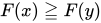





Another measure for combat effectiveness is developed by Youngwoo Lee and Taesik Lee who use a "meta-network representation" approach with regards to the opportunities available for military units to make an attack. The number of enemy casualties is one of the main indicators of success in combat and was used by the United States army in the Vietnam and Korean wars. According to Lee and Lee, there are two types of direct engagements with enemy forces in the network model: isolated attacks and coordinated attacks. Let and be two friendly force units and be an enemy unit. In an isolated attack between and , must carry out the responsibility of both detecting and advancing on . On the other hand, a coordinated attack allows to communicate the detection of to if does not have the capability or is not in a position to detect . If is in a position to engage , may carry out the attack through the organisation between the two friendly forces. Lee and Lee say that more complex combat situations can see these networks expand to include more combat units, locations, capabilities and actions, but the base structure is of an isolated or coordinated attack structure. The larger the network, the greater chance of opportunities for offensive action to become available.


The cohesiveness of the relationships formed between soldiers can affect their performance in combat and help them realise common goals. Cohesion relates to motivation and a group becomes stronger as they become more motivated. The organisation or structure of a military unit can contribute to cohesion, as William Henderson wrote in his work, Cohesion: The Human Element in Combat : a small unit creates stronger bonds between its members than a larger one and the higher the frequency of their interactions with one another, the stronger the bond. Soldiers become aware of the distinction between their groups through the structured associations between them.
During wartime, resources and supplies including food, medical aid and technical equipment may be limited which can affect a military unit's resilience. As well as access to a sufficient level of resources, the adequate fulfilment of social needs aids survival in periods of hardship. Henderson states that soldiers turn to their peers for mental support in the absence of family or other influences from home and as the unit becomes more cohesive, its members devote greater effort into maintaining and improving their goals. Johan M.G van der Dennen says they are more readily able to endure combat through the camaraderie formed from the need for comfort from peers and understanding of their shared suffering. Soldiers may endure combat for personal reasons including survival which, in most circumstances, is obtained from the survival of their group and fear of social exclusion from it can spur their motivation for group cooperation.
Henderson states that some soldiers may experience the urge to desert their duties or responsibilities for the return to civilian life before the duration of their service ends—if there are ways of attaining escape from service with little consequence or light punishment, a soldier's devotion to their unit may decrease. Soldiers who are unwilling to fight may face consequences of sanctions and in rare circumstances they are prosecuted for the refusal of deployment such as the case with British military members, Lance Corporal Glenton and Flight Lieutenant Kendall-Smith, who were charged and faced imprisonment for refusing to return to their deployments in Afghanistan and Iraq.
The level of a unit's morale and motivation can give them needed leverage in combat situations. This leverage is also advantageous if their fighting force is not strong in numbers. Sergio Catignani comments that the system of values an army upholds can boost morale and improve motivation. As an example, the Israeli Defence Force aims to uphold the values of "responsibility," "credibility," "professionalism" and "sense of mission." They place emphasis on strengthening the cohesion and spirit of their units through the oath a soldier takes at the beginning of their military service. Oaths for some brigades are taken at historically significant locations such as the Western Wall in Jerusalem where the 1948 Arab–Israeli War occurred, to reinforce accomplishments of past comrades. Leonard Wainstein says morale may be threatened by sudden or traumatic losses. These losses may involve individuals of a military force turned into casualties by their own weapons such as artillery and mines. The death of a commander could have a large effect on their unit as they are relied upon to lead. Morale can also be undermined by individual level factors such as fatigue resulting from a lack of sleep, fear, and stress.
The abilities of a soldier such as their skill in utilising firearms, tactics and communications can affect their success in accomplishing a mission, and is described by Kirstin J. H. Brathwaite in Effective in Battle: Conceptualizing Soldiers' Combat Effectiveness: the quality of communication between combat units are a determinant of how organised the mission will be while weapons handling and tactics employed determine the execution of the mission itself.
Hub AI
Combat effectiveness AI simulator
(@Combat effectiveness_simulator)
Combat effectiveness
Combat effectiveness is the capacity or performance of a military force to succeed in undertaking an operation, mission or objective. Determining optimal combat effectiveness is crucial in the armed forces, whether they are deployed on land, air or sea. Combat effectiveness is an aspect of military effectiveness and can be attributed to the strength of combat support including the quality and quantity of logistics, weapons and equipment as well as military tactics, the psychological states of soldiers, level of influence of leaders, skill and motivation that can arise from nationalism to survival are all capable of contributing to success on the battlefield. Combat effectiveness is a function of these factors. Overall combat effectiveness or combat power is the product of a forces strength and the combat effectiveness of that force. Combat effectiveness explains how a numerically weak force can prevail over another that is much stronger. It also explains how relatively small units can have a significant impact on the outcome of a conflict.
Philip Hayward proposes a measure for combat effectiveness, concentrating on the "probability of success" in a combat environment in relation to factors such as manpower and military stratagem. Combat effectiveness can be represented as a real and continuous function, where and are two distinct military units. He analyses the measure against three main factors: capabilities—the quality and quantity of human and material resources of both friendly and enemy forces; environment—weather and terrain; and missions—region to hold in the specified objective and the latest time to do it while minimising the costs of achieving the objective. Hayward defines to be the average probability of success in combat, summarised as where is the capabilities of friendly forces, is the other factors, and is the probability of situation occurring in combat.
Another measure for combat effectiveness is developed by Youngwoo Lee and Taesik Lee who use a "meta-network representation" approach with regards to the opportunities available for military units to make an attack. The number of enemy casualties is one of the main indicators of success in combat and was used by the United States army in the Vietnam and Korean wars. According to Lee and Lee, there are two types of direct engagements with enemy forces in the network model: isolated attacks and coordinated attacks. Let and be two friendly force units and be an enemy unit. In an isolated attack between and , must carry out the responsibility of both detecting and advancing on . On the other hand, a coordinated attack allows to communicate the detection of to if does not have the capability or is not in a position to detect . If is in a position to engage , may carry out the attack through the organisation between the two friendly forces. Lee and Lee say that more complex combat situations can see these networks expand to include more combat units, locations, capabilities and actions, but the base structure is of an isolated or coordinated attack structure. The larger the network, the greater chance of opportunities for offensive action to become available.
The cohesiveness of the relationships formed between soldiers can affect their performance in combat and help them realise common goals. Cohesion relates to motivation and a group becomes stronger as they become more motivated. The organisation or structure of a military unit can contribute to cohesion, as William Henderson wrote in his work, Cohesion: The Human Element in Combat : a small unit creates stronger bonds between its members than a larger one and the higher the frequency of their interactions with one another, the stronger the bond. Soldiers become aware of the distinction between their groups through the structured associations between them.
During wartime, resources and supplies including food, medical aid and technical equipment may be limited which can affect a military unit's resilience. As well as access to a sufficient level of resources, the adequate fulfilment of social needs aids survival in periods of hardship. Henderson states that soldiers turn to their peers for mental support in the absence of family or other influences from home and as the unit becomes more cohesive, its members devote greater effort into maintaining and improving their goals. Johan M.G van der Dennen says they are more readily able to endure combat through the camaraderie formed from the need for comfort from peers and understanding of their shared suffering. Soldiers may endure combat for personal reasons including survival which, in most circumstances, is obtained from the survival of their group and fear of social exclusion from it can spur their motivation for group cooperation.
Henderson states that some soldiers may experience the urge to desert their duties or responsibilities for the return to civilian life before the duration of their service ends—if there are ways of attaining escape from service with little consequence or light punishment, a soldier's devotion to their unit may decrease. Soldiers who are unwilling to fight may face consequences of sanctions and in rare circumstances they are prosecuted for the refusal of deployment such as the case with British military members, Lance Corporal Glenton and Flight Lieutenant Kendall-Smith, who were charged and faced imprisonment for refusing to return to their deployments in Afghanistan and Iraq.
The level of a unit's morale and motivation can give them needed leverage in combat situations. This leverage is also advantageous if their fighting force is not strong in numbers. Sergio Catignani comments that the system of values an army upholds can boost morale and improve motivation. As an example, the Israeli Defence Force aims to uphold the values of "responsibility," "credibility," "professionalism" and "sense of mission." They place emphasis on strengthening the cohesion and spirit of their units through the oath a soldier takes at the beginning of their military service. Oaths for some brigades are taken at historically significant locations such as the Western Wall in Jerusalem where the 1948 Arab–Israeli War occurred, to reinforce accomplishments of past comrades. Leonard Wainstein says morale may be threatened by sudden or traumatic losses. These losses may involve individuals of a military force turned into casualties by their own weapons such as artillery and mines. The death of a commander could have a large effect on their unit as they are relied upon to lead. Morale can also be undermined by individual level factors such as fatigue resulting from a lack of sleep, fear, and stress.
The abilities of a soldier such as their skill in utilising firearms, tactics and communications can affect their success in accomplishing a mission, and is described by Kirstin J. H. Brathwaite in Effective in Battle: Conceptualizing Soldiers' Combat Effectiveness: the quality of communication between combat units are a determinant of how organised the mission will be while weapons handling and tactics employed determine the execution of the mission itself.