



Community hub
Recent from talks
Contribute something
Nothing was collected or created yet.
Combining rules
View on WikipediaIn computational chemistry and molecular dynamics, the combination rules or combining rules are equations that provide the interaction energy between two dissimilar non-bonded atoms, usually for the part of the potential representing the van der Waals interaction.[1] In the simulation of mixtures, the choice of combining rules can sometimes affect the outcome of the simulation.[2]
Combining rules for the Lennard-Jones potential
[edit]The Lennard-Jones Potential is a mathematically simple model for the interaction between a pair of atoms or molecules.[3][4] One of the most common forms is
![{\displaystyle V_{LJ}=4\varepsilon \left[\left({\frac {\sigma }{r}}\right)^{12}-\left({\frac {\sigma }{r}}\right)^{6}\right]}](https://wikimedia.org/api/rest_v1/media/math/render/svg/d72ab40d235dc1e8c67fcc07afd7136ad05b18a5)
where ε is the depth of the potential well, σ is the finite distance at which the inter-particle potential is zero, r is the distance between the particles. The potential reaches a minimum, of depth ε, when r = 21/6σ ≈ 1.122σ.
Lorentz-Berthelot rules
[edit]The Lorentz rule was proposed by H. A. Lorentz in 1881:[5]
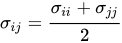
The Lorentz rule is only analytically correct for hard sphere systems. Intuitively, since loosely reflect the radii of particle i and j respectively, their averages can be said to be the effective radii between the two particles at which point repulsive interactions become severe.

The Berthelot rule (Daniel Berthelot, 1898) is given by:[6]
- .

Physically, this arises from the fact that is related to the induced dipole interactions between two particles. Given two particles with instantaneous dipole respectively, their interactions correspond to the products of . An arithmetic average of and will not however, result in the average of the two dipole products, but the average of their logarithms would be.


These rules are the most widely used and are the default in many molecular simulation packages, but are not without failings.[7][8][9]
Waldman-Hagler rules
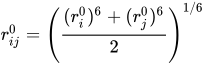
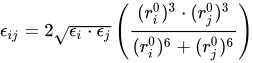
[edit]The Waldman-Hagler rules are given by:[10]
and
Fender-Halsey
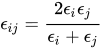
[edit]The Fender-Halsey combining rule is given by [11]
Kong rules
[edit]The Kong rules for the Lennard-Jones potential are given by:[12]
![{\displaystyle \epsilon _{ij}\sigma _{ij}^{12}=\left[{\frac {(\epsilon _{ii}\sigma _{ii}^{12})^{1/13}+(\epsilon _{jj}\sigma _{jj}^{12})^{1/13}}{2}}\right]^{13}}](https://wikimedia.org/api/rest_v1/media/math/render/svg/b0ecd99671fea39a893ae33114fc4fb6f061579d)
Others
[edit]Many others have been proposed, including those of Tang and Toennies[13] Pena,[14][15] Hudson and McCoubrey[16] and Sikora (1970).[17]
Combining rules for other potentials
[edit]Good-Hope rule
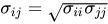
[edit]The Good-Hope rule for Mie–Lennard‐Jones or Buckingham potentials is given by:[18]
Hogervorst rules
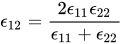
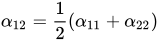
[edit]The Hogervorst rules for the Exp-6 potential are:[19]
and
Kong-Chakrabarty rules
[edit]The Kong-Chakrabarty rules for the Exp-6 potential are:[20]
![{\displaystyle \left[{\frac {\epsilon _{12}\alpha _{12}e^{\alpha _{12}}}{(\alpha _{12}-6)\sigma _{12}}}\right]^{2\sigma _{12}/\alpha _{12}}=\left[{\frac {\epsilon _{11}\alpha _{11}e^{\alpha _{11}}}{(\alpha _{11}-6)\sigma _{11}}}\right]^{\sigma _{11}/\alpha _{11}}\left[{\frac {\epsilon _{22}\alpha _{22}e^{\alpha _{22}}}{(\alpha _{22}-6)\sigma _{22}}}\right]^{\sigma _{22}/\alpha _{22}}}](https://wikimedia.org/api/rest_v1/media/math/render/svg/58b941220d1085c8bed2bef305e829cd1171dfd6)
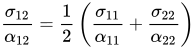
and
![{\displaystyle {\frac {\epsilon _{12}\alpha _{12}\sigma _{12}^{6}}{(\alpha _{12}-6)}}=\left[{\frac {\epsilon _{11}\alpha _{11}\sigma _{11}^{6}}{(\alpha _{11}-6)}}{\frac {\epsilon _{22}\alpha _{22}\sigma _{22}^{6}}{(\alpha _{22}-6)}}\right]^{\frac {1}{2}}}](https://wikimedia.org/api/rest_v1/media/math/render/svg/22dcb4eeb49e2bc11aee0fca6fb03074b13573fe)
Other rules for that have been proposed for the Exp-6 potential are the Mason-Rice rules[21] and the Srivastava and Srivastava rules (1956).[22]
Equations of state
[edit]Industrial equations of state have similar mixing and combining rules. These include the van der Waals one-fluid mixing rules
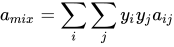
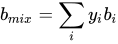
and the van der Waals combining rule, which introduces a binary interaction parameter ,

- .

There is also the Huron-Vidal mixing rule, and the more complex Wong-Sandler mixing rule, which equates excess Helmholtz free energy at infinite pressure between an equation of state and an activity coefficient model (and thus with liquid excess Gibbs free energy).
References
[edit]- ^ Halgren, Thomas A. (September 1992). "The representation of van der Waals (vdW) interactions in molecular mechanics force fields: potential form, combination rules, and vdW parameters". Journal of the American Chemical Society. 114 (20): 7827–7843. Bibcode:1992JAChS.114.7827H. doi:10.1021/ja00046a032.
- ^ Desgranges, Caroline; Delhommelle, Jerome (14 March 2014). "Evaluation of the grand-canonical partition function using expanded Wang-Landau simulations. III. Impact of combining rules on mixtures properties". The Journal of Chemical Physics. 140 (10): 104109. Bibcode:2014JChPh.140j4109D. doi:10.1063/1.4867498. PMID 24628154.
- ^ Fischer, Johann; Wendland, Martin (October 2023). "On the history of key empirical intermolecular potentials". Fluid Phase Equilibria. 573 113876. Bibcode:2023FlPEq.57313876F. doi:10.1016/j.fluid.2023.113876.
- ^ Lenhard, Johannes; Stephan, Simon; Hasse, Hans (June 2024). "On the History of the Lennard-Jones Potential". Annalen der Physik. 536 (6). doi:10.1002/andp.202400115. ISSN 0003-3804.
- ^ Lorentz, H. A. (1881). "Ueber die Anwendung des Satzes vom Virial in der kinetischen Theorie der Gase". Annalen der Physik. 248 (1): 127–136. Bibcode:1881AnP...248..127L. doi:10.1002/andp.18812480110.
- ^ Daniel Berthelot "Sur le mélange des gaz", Comptes rendus hebdomadaires des séances de l'Académie des Sciences, 126 pp. 1703-1855 (1898)
- ^ DELHOMMELLE, JÉRÔME; MILLIÉ, PHILIPPE (20 April 2001). "Inadequacy of the Lorentz-Berthelot combining rules for accurate predictions of equilibrium properties by molecular simulation". Molecular Physics. 99 (8): 619–625. Bibcode:2001MolPh..99..619D. doi:10.1080/00268970010020041. S2CID 94931352.
- ^ Boda, Dezső; Henderson, Douglas (20 October 2008). "The effects of deviations from Lorentz–Berthelot rules on the properties of a simple mixture". Molecular Physics. 106 (20): 2367–2370. Bibcode:2008MolPh.106.2367B. doi:10.1080/00268970802471137. S2CID 94289505.
- ^ Song, W.; Rossky, P. J.; Maroncelli, M. (2003). "Modeling alkane+perfluoroalkane interactions using all-atom potentials: Failure of the usual combining rules". The Journal of Chemical Physics. 119 (17): 9145–9162. Bibcode:2003JChPh.119.9145S. doi:10.1063/1.1610435.
- ^ Waldman, Marvin; Hagler, A.T. (September 1993). "New combining rules for rare gas van der waals parameters". Journal of Computational Chemistry. 14 (9): 1077–1084. doi:10.1002/jcc.540140909. S2CID 16732612.
- ^ Fender, B. E. F.; Halsey, G. D. (1962). "Second Virial Coefficients of Argon, Krypton, and Argon-Krypton Mixtures at Low Temperatures". The Journal of Chemical Physics. 36 (7): 1881–1888. Bibcode:1962JChPh..36.1881F. doi:10.1063/1.1701284.
- ^ Kong, Chang Lyoul (1973). "Combining rules for intermolecular potential parameters. II. Rules for the Lennard-Jones (12–6) potential and the Morse potential". The Journal of Chemical Physics. 59 (5): 2464–2467. Bibcode:1973JChPh..59.2464K. doi:10.1063/1.1680358.
- ^ Tang, K. T.; Toennies, J. Peter (March 1986). "New combining rules for well parameters and shapes of the van der Waals potential of mixed rare gas systems". Zeitschrift für Physik D. 1 (1): 91–101. Bibcode:1986ZPhyD...1...91T. doi:10.1007/BF01384663. S2CID 122224768.
- ^ Diaz Peña, M. (1982). "Combination rules for intermolecular potential parameters. I. Rules based on approximations for the long-range dispersion energy". The Journal of Chemical Physics. 76 (1): 325–332. Bibcode:1982JChPh..76..325D. doi:10.1063/1.442726.
- ^ Diaz Peña, M. (1982). "Combination rules for intermolecular potential parameters. II. Rules based on approximations for the long-range dispersion energy and an atomic distortion model for the repulsive interactions". The Journal of Chemical Physics. 76 (1): 333–339. Bibcode:1982JChPh..76..333D. doi:10.1063/1.442727.
- ^ Hudson, G. H.; McCoubrey, J. C. (1960). "Intermolecular forces between unlike molecules. A more complete form of the combining rules". Transactions of the Faraday Society. 56: 761. doi:10.1039/TF9605600761.
- ^ Sikora, P T (November 1970). "Combining rules for spherically symmetric intermolecular potentials". Journal of Physics B. 3 (11): 1475–1482. Bibcode:1970JPhB....3.1475S. doi:10.1088/0022-3700/3/11/008.
- ^ Good, Robert J. (1970). "New Combining Rule for Intermolecular Distances in Intermolecular Potential Functions". The Journal of Chemical Physics. 53 (2): 540–543. Bibcode:1970JChPh..53..540G. doi:10.1063/1.1674022.
- ^ Hogervorst, W. (January 1971). "Transport and equilibrium properties of simple gases and forces between like and unlike atoms". Physica. 51 (1): 77–89. Bibcode:1971Phy....51...77H. doi:10.1016/0031-8914(71)90138-8.
- ^ Kong, Chang Lyoul; Chakrabarty, Manoj R. (October 1973). "Combining rules for intermolecular potential parameters. III. Application to the exp 6 potential". The Journal of Physical Chemistry. 77 (22): 2668–2670. doi:10.1021/j100640a019.
- ^ Mason, Edward A.; Rice, William E. (1954). "The Intermolecular Potentials of Helium and Hydrogen". The Journal of Chemical Physics. 22 (3): 522. Bibcode:1954JChPh..22..522M. doi:10.1063/1.1740100.
- ^ Srivastava, B. N.; Srivastava, K. P. (1956). "Combination Rules for Potential Parameters of Unlike Molecules on Exp-Six Model". The Journal of Chemical Physics. 24 (6): 1275. Bibcode:1956JChPh..24.1275S. doi:10.1063/1.1742786.
Combining rules
View on GrokipediaFundamentals
Definition and Purpose
Combining rules are mathematical approximations used in molecular simulations to estimate the interaction parameters for unlike pairs of atoms or molecules from the known parameters of like pairs. In multi-component systems, these rules derive cross-interaction parameters, such as the well depth ε_{ij} and the collision diameter σ_{ij}, without requiring direct experimental determination for every possible pair. This approach is essential for pair potentials that model intermolecular forces, including the Lennard-Jones potential, which approximates van der Waals interactions between neutral particles through a balance of repulsive and attractive terms.[3] The primary purpose of combining rules is to reduce the number of parameters that must be specified or fitted in force fields, thereby lowering computational complexity and enabling efficient simulations of complex mixtures. For a system with N distinct atom types, explicitly defining all unlike-pair interactions would necessitate up to N(N-1)/2 additional parameters, which becomes prohibitive for large N; combining rules mitigate this by relying solely on the N like-pair parameters, promoting scalability in molecular dynamics and Monte Carlo methods. This simplification facilitates the development of transferable force fields applicable to diverse chemical environments while maintaining reasonable accuracy for predicted thermodynamic and transport properties.[4][1] Combining rules are particularly valuable in modeling binary mixtures of simple fluids, such as noble gases like argon-krypton or argon-xenon, where cross-interactions significantly influence phase equilibria, diffusion coefficients, and viscosity. In these cases, the rules allow simulations to capture mixture behavior using parameters optimized for pure components, avoiding the need for extensive experimental data on mixed systems.[3][5]Historical Development
The development of combining rules began in the late 19th century amid efforts to extend kinetic theory to binary gas mixtures, where simplifying assumptions were needed for unlike-pair interactions in hard-sphere models. In 1881, Hendrik Antoon Lorentz introduced the arithmetic mean for molecular diameters, σ_ij = (σ_ii + σ_jj)/2, to approximate collision properties in mixtures without detailed quantum mechanical insights, motivated by the need to fit transport data like viscosities. This additive rule laid the groundwork for handling size differences in classical models.[6] Seventeen years later, in 1898, Daniel Berthelot extended this framework by proposing the geometric mean for attractive energies, ε_ij = √(ε_ii ε_jj), drawing from empirical observations of mixture solubilities and thermal properties to capture dispersion forces in van der Waals equations. Together, these Lorentz-Berthelot rules became the foundational standard for unlike-pair parameters in potentials like Lennard-Jones, prioritizing computational simplicity over exact quantum derivations.[6] By the mid-20th century, limitations in predicting mixture properties such as second virial coefficients prompted refinements based on scattering experiments. In 1962, B. E. F. Fender and G. D. Halsey derived harmonic-mean variants for energy parameters to better align with noble gas data, emphasizing improved accuracy for low-temperature behaviors like condensation. This shift reflected growing experimental precision, moving motivations from basic averaging to targeted fitting of virial coefficients and viscosities.[7] In the late 20th century, further adjustments addressed discrepancies in thermodynamic predictions. Chang Lyoul Kong's 1973 rules incorporated hard-sphere corrections to the geometric mean, motivated by vapor pressure deviations in simulations of simple fluids, yielding closer matches to experimental phase equilibria without additional parameters. Later, in 1993, Marvin Waldman and Arnold T. Hagler proposed modifications accounting for polarizability in rare-gas systems, driven by the need for better nonbonded force fields in biomolecular modeling, where size and shape asymmetries affected binding energies. These advancements highlighted a transition toward rules supporting molecular dynamics efficiency while enhancing fidelity to diverse datasets.[8][9] Entering the 21st century, critiques underscored ongoing challenges, with Jérôme Delhommelle and Philippe Millié's 2001 analysis demonstrating that standard Lorentz–Berthelot rules often failed to predict equilibrium properties accurately in simulations of rare gas mixtures, leading to minor refinements rather than entirely new paradigms. Motivations evolved from early empirical fitting of transport coefficients to broader demands for computational scalability in complex systems, though no major novel rules emerged post-2000, indicating relative maturity in the field.[10]Combining Rules for the Lennard-Jones Potential
Lorentz–Berthelot Rules
The Lorentz–Berthelot rules represent the most widely adopted combining rules for estimating the unlike-pair parameters in the Lennard-Jones potential, particularly for mixtures of non-polar molecules such as noble gases. These rules combine the finite distance at which the interparticle potential reaches zero, denoted as , via an arithmetic mean, and the depth of the potential well, , via a geometric mean. This approach assumes additivity in the repulsive core sizes while treating attractive dispersion forces as multiplicative, providing a straightforward method for modeling intermolecular interactions in molecular simulations without requiring experimental mixture data. The specific formulations are given by the Lorentz rule for the size parameter: and the Berthelot rule for the energy parameter: where and are the like-pair parameters for species , and similarly for species . These expressions derive from foundational assumptions in classical statistical mechanics: the arithmetic averaging for stems from the additivity of hard-sphere diameters in the limit of infinite repulsion, as originally proposed by Lorentz for kinetic theory of gases, ensuring that the effective collision diameter in mixtures aligns with linear superposition of atomic sizes. In contrast, the geometric mean for arises from the pairwise additivity of London dispersion energies, which scale proportionally with the product of polarizabilities and ionization potentials of the interacting atoms, leading to a multiplicative form for the attractive well depth as justified by Berthelot's early work on corresponding states theory. Historically, these rules emerged in the early 20th century to model noble gas mixtures, with Lorentz's contribution dating to 1886 in the context of gas kinetic theory and Berthelot's to 1898 for thermodynamic properties of van der Waals fluids; their combination became standard by the 1920s for practical applications in equation-of-state predictions. The rules have since been integral to the van der Waals equation of state extensions for mixtures, facilitating estimates of critical properties and phase behavior in binary systems. Their simplicity—requiring only pure-component parameters—has led to widespread implementation in molecular dynamics software, such as GROMACS, where they serve as the default for Lennard-Jones interactions in biomolecular and materials simulations, enabling efficient computation for large-scale systems without additional parameterization.Waldman–Hagler Rules
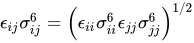
The Waldman–Hagler rules represent a set of modified combining rules for the Lennard-Jones potential, designed to improve the estimation of cross-interaction parameters between dissimilar atoms by introducing a size-dependent weighting in the well depth calculation. These rules were introduced in 1993 by Marvin Waldman and Arnold T. Hagler in response to discrepancies between standard combining rules and experimental data for rare gas interactions, with motivation drawn from quantum chemistry calculations aimed at developing accurate force fields for organic molecules.[11] The rules define the interaction distance parameter at the potential minimum, , using a sixth-power mean: The well depth, , is then computed as a weighted geometric mean that incorporates the size parameters: This formulation effectively averages the contributions related to the attractive dispersion term (proportional to ) while adjusting the well depth to account for differences in atomic sizes. Compared to the Lorentz–Berthelot rules, which use a simple geometric mean for , the Waldman–Hagler approach reduces overestimation of the well depth for pairs with significant size disparities, yielding more realistic interaction strengths in heterogeneous systems. Validation through comparisons with ab initio calculations has demonstrated improved agreement for interaction energies in dissimilar pairs.[12]Fender–Halsey Rules
The Fender–Halsey combining rules represent an empirical approach to determining the unlike-pair parameters for the Lennard-Jones (12-6) potential in mixtures of rare gases, emphasizing a harmonic averaging for the energy depth to better capture low-temperature interactions. Proposed by B. E. F. Fender and G. D. Halsey in 1962, these rules were developed through analysis of experimental data on noble gas systems, particularly to address discrepancies observed in mixture properties under standard geometric-mean approximations. The core formula for the unlike energy parameter employs the harmonic mean: This yields smaller values compared to the geometric mean, which aligns more closely with observed behaviors in dissimilar interactions. For the size parameter, follows the arithmetic mean convention: These expressions were fitted specifically to second virial coefficient measurements for pure argon (80–125 K), krypton (105–140 K), and argon-krypton mixtures (105–125 K), where experimental values exceeded prior predictions by 5–15%. In applications to argon-krypton mixtures, the rules demonstrate superior performance over the Lorentz–Berthelot geometric-mean approach by providing more accurate second virial coefficients at low temperatures, as the harmonic mean better reproduces the experimental mixed-gas data. This empirical adjustment also enhances predictions of vapor-liquid equilibria in noble gas systems, including liquid densities, where standard rules often overestimate interaction strengths. Overall, the Fender–Halsey method prioritizes fidelity to rare-gas experimental benchmarks, making it particularly suitable for thermodynamic modeling of simple mixtures.Kong Rules
The Kong rules were introduced by Chang Lyoul Kong in 1973 to improve the accuracy of intermolecular potential parameters for unlike pairs in the Lennard-Jones (12-6) potential, particularly in addressing discrepancies in critical constants for mixtures of simple molecules. These rules were developed based on an atomic distortion model that better correlates experimental data for noble gas interactions. By separating the treatment of the attractive and repulsive components, the approach accounts for their differing physical underpinnings, with the attractive term dominated by dispersion forces and the repulsive term by Pauli exclusion and overlap effects. The Lennard-Jones potential, which forms the foundation for these rules, models pairwise interactions as , where is the well depth and is the finite distance at which the potential is zero. For the attractive term, the combining rule employs a geometric mean: reflecting the additive nature of dispersion energies from fluctuating dipoles. For the repulsive term, a modified arithmetic mean is used to incorporate distortion effects: where the exponent 1/13 derives from the power-law form and ensures consistency with the potential's steep repulsive wall. Validation studies have demonstrated the superiority of Kong rules over traditional combining methods for predicting thermodynamic properties, such as vapor-liquid phase equilibria in alkane mixtures; for instance, simulations of n-alkane/CO₂ systems yield phase diagrams in excellent agreement with experimental data.Other Variants
The Böhm-Ahlrichs combining rules, proposed in 1982 by Hans-Joachim Böhm and Reinhart Ahlrichs, provide a method for estimating repulsive interactions in intermolecular potentials, derived from self-consistent field (SCF) calculations of overlap effects. These rules are particularly useful for short-range repulsions in systems where quantum overlap is significant, such as in heteronuclear pairs. They have been applied in studies of van der Waals complexes to improve modeling of repulsive walls. The Hudson-McCoubrey rules, introduced in 1960, derive ε_ij from ionization potentials I, providing a quantum-based alternative rooted in London dispersion theory for unlike molecules.[13] The key relation is with the right-hand side as the harmonic mean of the ionization potentials, which corrects the geometric mean for electronic structure differences and has been extended to Mie potentials for broader fluid mixture predictions. This approach improves accuracy in vapor-liquid equilibria for binary systems where quantum effects dominate, such as noble gas mixtures, though it requires experimental ionization data. These variants address limitations in empirical rules by integrating quantum properties, unlike the non-quantum Kong rules which separate repulsive and attractive exponents without such corrections.[14] Recent studies as of 2024 have evaluated these and similar rules using ab initio benchmarks, highlighting their performance in diverse systems.[1]| Variant | Key Feature | Pros vs. Lorentz–Berthelot | Cons vs. Lorentz–Berthelot | Typical Application |
|---|---|---|---|---|
| Böhm-Ahlrichs | Uses polarizability for repulsive parameters | Better for systems with significant quantum overlap (e.g., improved repulsive modeling in van der Waals complexes) | Requires SCF-derived data; more complex | Short-range repulsions in molecular complexes |
| Hudson-McCoubrey | Uses ionization potential harmonic mean for ε_ij | Enhanced quantum accuracy in dispersion-dominated mixtures (e.g., better agreement in rare gas VLE) | Needs ionization potentials; sensitive to sigma combining | Binary fluid phase equilibria with electronic effects |
Combining Rules for Other Potentials
Good–Hope Rule
The Good–Hope rule is a combining rule for estimating the intermolecular distance parameter between unlike atomic or molecular species in generalized potential functions, such as the Mie potential, which extends the Lennard-Jones form with arbitrary repulsive and attractive exponents and . It employs the geometric mean, given by where and are the self-interaction distance parameters for species and , respectively.[15] This approach contrasts with the Lorentz rule's arithmetic mean for , providing a more consistent scaling for repulsive interactions.[15] Proposed in 1970 by Robert J. Good and Christopher J. Hope, the rule was developed specifically to address limitations in prior distance-combining methods for intermolecular potential functions, including Mie–Lennard-Jones types.[15] It enhances accuracy in modeling pairwise interactions where the finite size of particles plays a dominant role, outperforming additive schemes like the Lorentz rule by better preserving the geometric nature of molecular overlaps. In particular, it improves consistency in the hard-sphere limit, where repulsive cores approximate impenetrable spheres, leading to more reliable predictions of packing and structural properties.[15] The Good–Hope rule finds application in simulations of soft-matter systems, such as colloidal suspensions and polymer melts, where Mie-like potentials capture the dominant repulsive contributions from particle cores or chain segments.[15] Its simplicity and effectiveness in these contexts have made it a preferred choice for parameterizing cross-interactions in models emphasizing steric effects over long-range attractions.[16]Hogervorst Rules
The Hogervorst combining rules provide a method for estimating the parameters of the Exp-6 intermolecular potential between unlike atoms based on the parameters of like-atom interactions, particularly suited for modeling noble gas mixtures. The Exp-6 potential, which features an exponential repulsive term and an inverse-sixth power attractive term, is expressed as where is the well depth, is the finite distance at which the potential is zero, and controls the steepness of the repulsion.[17] These rules were developed by W. Hogervorst in 1971 through a reanalysis of transport and equilibrium properties of simple gases, including viscosity and diffusion data for neon, argon, krypton, and xenon, to refine parameters for the Exp-6 model with a focus on exponential repulsion in noble gas interactions.[17] The key combining expressions are the harmonic mean for the well depth, and the arithmetic mean for the steepness parameter, This approach for bears similarity to the harmonic mean used in the Fender–Halsey rules.[17] The Hogervorst rules excel in applications involving high-density fluids, where the accurate representation of short-range exponential repulsion is crucial for predicting properties like densities and melting points in noble gas systems.[18]Kong–Chakrabarty Rules
The Kong–Chakrabarty rules were developed in 1973 by Chang Lyoul Kong and Manoj R. Chakrabarty to derive cross-interaction parameters for the exp-6 potential in molecular mixtures, extending the methodology from Kong's prior work on Lennard-Jones potentials to enhance predictions of mixture thermodynamics.[19] The exp-6 potential models interatomic interactions as where is the well depth, is the steepness parameter, and is the radial distance scale. Unlike simpler potentials with two parameters, the exp-6 form requires dedicated combining rules for all three unlike-pair parameters to account for the distinct repulsive (exponential) and attractive (dispersion) contributions. The Kong–Chakrabarty rules achieve this through coupled equations that assume an arithmetic mean for the repulsive component and a geometric mean for the attractive component, yielding more accurate cross-parameters than basic averaging methods. The key relations, often expressed in terms of the zero-potential distance (related to via ), are for the well depth and steepness, and for the length scale, with derived accordingly. These equations must typically be solved iteratively for , , and .[19] These rules improve upon earlier approaches by better capturing the parameter coupling in the exp-6 form, leading to superior agreement with experimental data for mixture properties such as second virial coefficients in rare gas and diatomic gas systems like oxygen-rare gas collisions.[19][20] They have been applied in force fields for hydrogen bonding models where exp-6 terms describe non-polar components, and they address shortcomings of geometric-mean rules by incorporating differential repulsion steepness, which indirectly accounts for quantum mechanical effects like electronic overlap absent in basic formulations.[21]Rules for the Buckingham Potential
The Buckingham potential models pairwise interactions as , where the exponential term captures short-range repulsion and the term accounts for long-range dispersion attraction. For interactions between unlike atom types and , standard combining rules apply the geometric mean to the pre-exponential factor and dispersion coefficient , while using the arithmetic mean for the decay length :These rules ensure physical consistency in multi-component systems by approximating the cross-term parameters from pure-component values, reducing the need for extensive empirical fitting. These combining rules trace their origins to variations developed in the 1960s, evolving from the Born-Mayer-Huggins potential form introduced in the 1930s and 1940s to describe exponential repulsion in ionic systems. Seminal parametrizations, such as those by Fumi and Tosi for alkali halide crystals, adopted the geometric mean for attractive and repulsive amplitudes alongside the arithmetic mean for to match experimental lattice properties like cohesive energies and elastic constants.[22] The rules are particularly valuable in simulations of ionic crystals, such as NaCl or KBr, and simple metals like alkali metals, where the exponential repulsion accurately represents overlap effects at short distances critical for structural stability and defect formation. This approach provides depth for solid-state applications, an area often underexplored in general molecular dynamics literature focused on van der Waals systems.
Applications
Equations of State
Combining rules play a crucial role in extending equations of state (EOS) developed for pure fluids to multicomponent mixtures by enabling the calculation of cross-interaction parameters. In cubic EOS such as the van der Waals equation, the pressure-volume-temperature relation for a mixture is given by where the mixture parameters and are derived from pure-component values , using mixing rules that incorporate combining rules for unlike pairs. Specifically, and , with often computed via the geometric mean (related to the energy parameter ) and via the arithmetic mean (related to the size parameter ). These rules ensure thermodynamic consistency and allow prediction of mixture properties like fugacity and phase behavior without additional adjustable parameters beyond pure-component data.[23] Historically, the geometric mean for the attraction parameter in van der Waals-type EOS originated from empirical fitting of mixture data by Marcellin Berthelot in the late 19th century, who proposed it to reconcile observed deviations in gas mixture compressibility from ideal behavior. This approach, later formalized as part of the Lorentz-Berthelot rules, was motivated by the need to match experimental pressure-volume relations for binary gas mixtures, providing a simple yet effective way to estimate cross-terms from pure-gas EOS parameters. In the context of corresponding-states theory, these rules facilitate scaling of mixture properties using reduced variables, particularly for noble gas mixtures where intermolecular forces are dominated by dispersion. For instance, applying Lorentz-Berthelot rules to helium-neon or argon-krypton mixtures yields compressibility factors that align closely with experimental values at moderate pressures, capturing the slight positive deviations due to unlike-pair attractions being weaker than like-pair averages.[24][25] A key analytical application lies in the virial expansion of the EOS, where the second virial coefficient governs low-density behavior: . For mixtures, , with derived from combining rules applied to the pair potential parameters. For a Lennard-Jones potential, , where and follow Lorentz-Berthelot, and is a temperature-dependent function from integration over the potential. This form highlights how combining rules influence mixture non-ideality, with the geometric mean for energy often underpredicting for polar or size-asymmetric systems, leading to adjusted compressibility in noble gas binaries like argon-oxygen. Experimental data for argon-oxygen mixtures at 100-300 K show that Lorentz-Berthelot-based virial coefficients reproduce compressibility factors in alignment with measurements, underscoring their utility for cryogenic air component modeling.[26][27] In modern thermodynamic modeling, combining rules are integral to advanced EOS like Statistical Associating Fluid Theory (SAFT), where they parameterize the dispersion and chain-formation contributions for mixtures. For non-associating mixtures, Lorentz-Berthelot rules compute cross-segment interactions in the perturbed-chain SAFT (PC-SAFT) variant, enabling predictions of phase envelopes and densities for complex fluids. Examples include hydrocarbon-noble gas systems, where these rules, combined with one-fluid mixing, accurately describe vapor-liquid equilibria. This integration bridges molecular-level parameters to macroscopic EOS, enhancing predictive power for industrial mixtures without relying on binary-specific fittings.[28]Molecular Dynamics Simulations
In molecular dynamics (MD) simulations, combining rules are essential for parameterizing non-bonded interactions in heterogeneous systems, such as those involving multiple atom types from different molecular species. Force fields like OPLS-AA employ geometric combining rules for both the Lennard-Jones well depth (ε_ij = √(ε_ii ε_jj)) and collision diameter (σ_ij = √(σ_ii σ_jj)), ensuring compatibility with organic molecules and biomolecules.[29] In contrast, the Lorentz–Berthelot rules, which use an arithmetic mean for σ_ij ((σ_ii + σ_jj)/2) and a geometric mean for ε_ij, serve as the default in many general-purpose simulations.[30] Popular MD software packages allow users to select these rules via input parameters; for instance, LAMMPS uses thepair_modify mix command to specify geometric, arithmetic, or other mixing options during pair style setup, while GROMACS defines combination rule types (e.g., type 2 for Lorentz–Berthelot, type 3 for OPLS geometric) in the topology file.[31][30]
During MD workflows, combining rules enable on-the-fly computation of interaction parameters for unlike atom pairs as neighbor lists are built, facilitating efficient handling of mixtures without pre-specifying all cross-terms. In LAMMPS, mixing coefficients are calculated at simulation initialization for each pair type I-J where explicit coefficients are absent, integrating seamlessly into the pair potential evaluation loop.[31] GROMACS constructs the Lennard-Jones parameter matrix using the selected rules prior to force computation, applying them in the Verlet cut-off scheme to update forces for all pairwise interactions within the cut-off distance.[30] This approach is particularly valuable in complex systems like solvated biomolecules, where diverse atom types (e.g., carbon, oxygen, nitrogen) interact dynamically.
The use of combining rules significantly enhances computational efficiency by reducing the number of required parameters from O(N^2) to O(N) for N atom types, avoiding the need to parameterize every possible unlike pair explicitly.[32] For example, in protein-ligand binding simulations, these rules allow modeling of interactions between protein residues and ligand atoms using OPLS-AA parameters, enabling trajectories that capture binding dynamics and solvation effects without excessive parameterization.[33] Validation often involves comparing simulated properties, such as diffusion coefficients in mixed solvents, to experimental data; discrepancies can arise from rule choice, highlighting the need for system-specific testing.[1]
In the 2020s, combining rules remain foundational even in advanced MD frameworks incorporating machine-learned interatomic potentials (MLIPs), where they are applied during data generation or to extend models to mixtures. For instance, Lorentz–Berthelot rules are used to generate consistent training data for MLIPs in zeolite-organic systems, bridging classical force fields with quantum-accurate predictions.[34] This integration supports scalable simulations of multicomponent materials while preserving the simplicity of classical parameter mixing.