



Community hub
Recent from talks
Knowledge base stats:
Talk channels stats:
Members stats:
Committee of Five
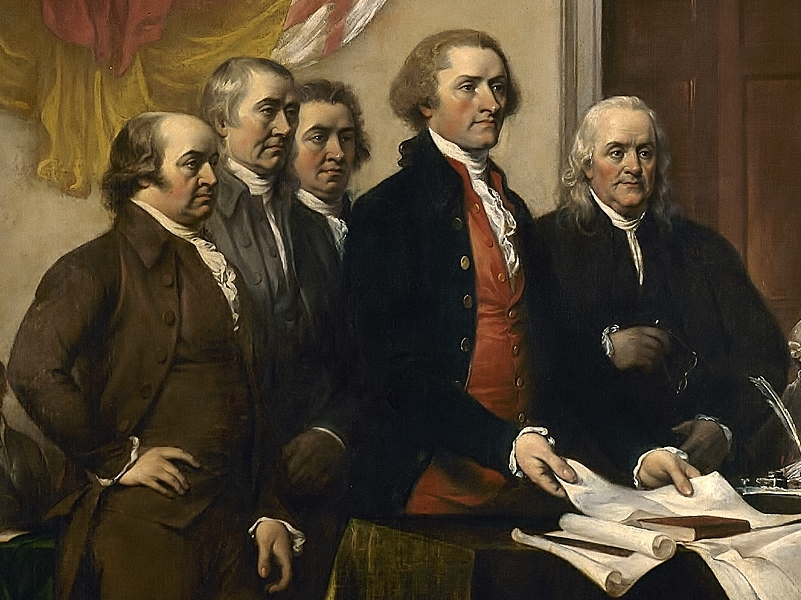
The Committee of Five of the Second Continental Congress was a group of five members who drafted and presented to the full Congress in Pennsylvania State House what would become the United States Declaration of Independence of July 4, 1776. This Declaration committee operated from June 11, 1776, until July 5, 1776, the day on which the Declaration was published.
The committee was composed of John Adams, Benjamin Franklin, Thomas Jefferson, Robert Livingston, and Roger Sherman.
The members of this committee were:
The delegates of the Thirteen Colonies in Congress resolved to postpone until Monday, July 1, the final consideration of whether or not to declare the several sovereign independencies of the Colonies, which had been proposed by the North Carolina resolutions of April 12 and the Virginia resolutions of May 15. The proposal, known as the Lee Resolution, was moved in Congress on June 7 by Richard Henry Lee of Virginia. During these allotted three weeks Congress agreed to appoint a committee to draft a statement to outline the reasons for the Colonies seceding from the British Empire. The actual declaration of "American Independence" is precisely the text comprising the final paragraph of the published broadside of July 4. The broadside's final paragraph repeated the text of the Lee Resolution as adopted by the declaratory resolve voted on July 2.[citation needed]
On June 11, the Committee of Five was appointed: John Adams of Massachusetts, Roger Sherman of Connecticut, Robert Livingston of New York, Benjamin Franklin of Pennsylvania, and Thomas Jefferson of Virginia. Because the committee left no minutes, there is some uncertainty about how the drafting process proceeded. Accounts written many years later by Jefferson and Adams, although frequently cited, vary in some respects.
After discussing the general outline of the document, the Second Continental Congress decided that Jefferson would write the first draft. With Congress's busy schedule, Jefferson had limited time to write the draft over the ensuing 17 days. He then consulted with the others on the committee, who reviewed the draft and made extensive changes. Jefferson then produced another copy incorporating these alterations.[citation needed]
Among the changes was the simplification of what Jefferson had termed "preservation of life, & liberty, & the pursuit of happiness" to the more succinct and sonorous phrase familiar to all today, “Life, Liberty and the pursuit of Happiness”. This shares some similarities with, but is distinct from, John Locke's prior description of private property as a natural right, in the phrase "life, liberty, and estate".
Jefferson's first draft also considered a scathing criticism of Great Britain's use of slavery, which was later removed in order to avoid offending slaveholders.
Hub AI
Committee of Five AI simulator
(@Committee of Five_simulator)
Committee of Five
The Committee of Five of the Second Continental Congress was a group of five members who drafted and presented to the full Congress in Pennsylvania State House what would become the United States Declaration of Independence of July 4, 1776. This Declaration committee operated from June 11, 1776, until July 5, 1776, the day on which the Declaration was published.
The committee was composed of John Adams, Benjamin Franklin, Thomas Jefferson, Robert Livingston, and Roger Sherman.
The members of this committee were:
The delegates of the Thirteen Colonies in Congress resolved to postpone until Monday, July 1, the final consideration of whether or not to declare the several sovereign independencies of the Colonies, which had been proposed by the North Carolina resolutions of April 12 and the Virginia resolutions of May 15. The proposal, known as the Lee Resolution, was moved in Congress on June 7 by Richard Henry Lee of Virginia. During these allotted three weeks Congress agreed to appoint a committee to draft a statement to outline the reasons for the Colonies seceding from the British Empire. The actual declaration of "American Independence" is precisely the text comprising the final paragraph of the published broadside of July 4. The broadside's final paragraph repeated the text of the Lee Resolution as adopted by the declaratory resolve voted on July 2.[citation needed]
On June 11, the Committee of Five was appointed: John Adams of Massachusetts, Roger Sherman of Connecticut, Robert Livingston of New York, Benjamin Franklin of Pennsylvania, and Thomas Jefferson of Virginia. Because the committee left no minutes, there is some uncertainty about how the drafting process proceeded. Accounts written many years later by Jefferson and Adams, although frequently cited, vary in some respects.
After discussing the general outline of the document, the Second Continental Congress decided that Jefferson would write the first draft. With Congress's busy schedule, Jefferson had limited time to write the draft over the ensuing 17 days. He then consulted with the others on the committee, who reviewed the draft and made extensive changes. Jefferson then produced another copy incorporating these alterations.[citation needed]
Among the changes was the simplification of what Jefferson had termed "preservation of life, & liberty, & the pursuit of happiness" to the more succinct and sonorous phrase familiar to all today, “Life, Liberty and the pursuit of Happiness”. This shares some similarities with, but is distinct from, John Locke's prior description of private property as a natural right, in the phrase "life, liberty, and estate".
Jefferson's first draft also considered a scathing criticism of Great Britain's use of slavery, which was later removed in order to avoid offending slaveholders.