Hubbry Logo
Roger ShermanRoger ShermanMain
Open search
Roger Sherman
Community hub
Roger Sherman
logo
8 pages, 0 posts
0 subscribers
Be the first to start a discussion here.
Contribute something
Roger Sherman
Roger Sherman
from Wikipedia

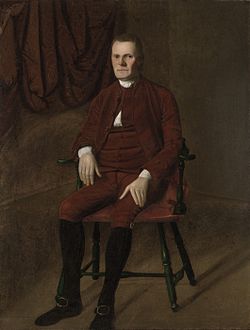
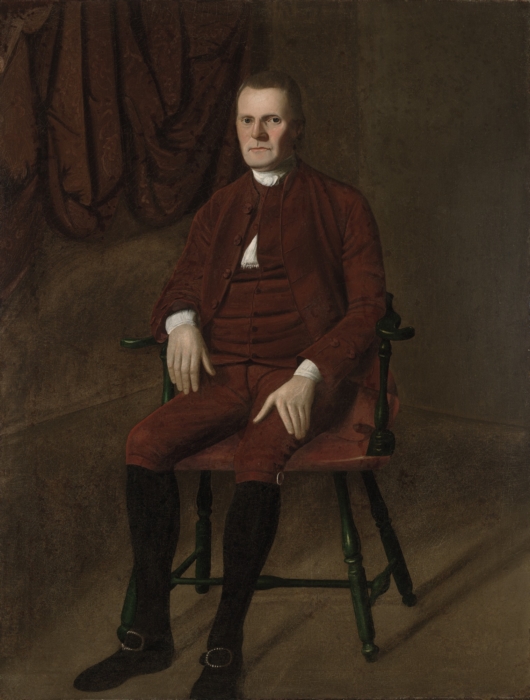
Roger Sherman (April 19, 1721 – July 23, 1793) was an early American politician, lawyer, and a Founding Father of the United States. Representing Connecticut, he is the only person to sign all four great state papers of the United States: the Continental Association, the Declaration of Independence, the Articles of Confederation, and the Constitution.[1][2] He also signed the 1774 Petition to the King.

Key Information

Born in Newton, Massachusetts, Sherman established a legal career in Litchfield County, Connecticut, despite a lack of formal education. After a period in the Connecticut House of Representatives, he served as a justice of the Superior Court of Connecticut from 1766 to 1789. Connecticut sent him to the Continental Congress, and he was a member of the Committee of Five that drafted the Declaration of Independence.

Sherman served as a delegate to the 1787 Philadelphia Convention, which produced the United States Constitution. After Benjamin Franklin, he was the second oldest delegate present at the convention. Sherman favored granting the federal government power to raise revenue and regulate commerce, but initially opposed efforts to supplant the Articles of Confederation with a new constitution.[3] After supporting the establishment of a new constitution, Sherman became a key delegate and main opponent of James Madison's Virginia Plan by introducing the Connecticut Compromise that won the approval of both the more and less populous states.[4][5][6]

After the ratification of the Constitution, Sherman represented Connecticut in the United States House of Representatives from 1789 to 1791. He served in the United States Senate from 1791 to his death in 1793.

Early life and family

[edit]

Sherman was born into a family of farmers in Newton, Massachusetts. His parents were William and Mehetabel Sherman. The Shermans left Newton and settled in what became the town of Stoughton, Massachusetts, 17 miles (27 km) southeast of his home in Newton, when Roger was two. Sherman's education did not extend beyond his father's library and grammar school, and his early career was spent as a shoemaker.[7] However, he had an aptitude for learning, access to a good library owned by his father, and a Harvard-educated parish minister, Rev. Samuel Dunbar, who took him under his wing.

In 1743, his father's death led to Sherman moving with his mother and siblings to New Milford, Connecticut. There, in partnership with his brother William, he opened the town's first store,[7] a cobbler shop. He earned a position as the county surveyor in 1745. The income from this office enabled him to buy land and to earn a favorable reputation throughout the county. Sherman published a series of almanacs between 1750 and 1761. He also studied law on his own, passing the bar in 1754.[8]

He very quickly introduced himself in civil and religious affairs, rapidly becoming one of the town's leading citizens and eventually town clerk of New Milford. He became county surveyor of New Haven County in 1745 and began providing astronomical calculations for almanacs in 1759.

Sherman was married two times and had a total of 14 children, with 12 reaching adulthood.

Sherman married, first, Elizabeth Hartwell (born August 31, 1726, in Stoughton, Massachusetts) on November 17, 1749, and had six children: John, William, Isaac, Chloe (1st), Chloe (2nd), Elizabeth.[9] Elizabeth died in New Milford, Connecticut, on October 19, 1760.[10]

Sherman married, secondly, Rebecca (also spelled Rebekah) Prescott (born on May 20, 1742, in Danvers, Massachusetts, second cousin of Samuel Prescott, who rode with Paul Revere) on May 12, 1763, and had nine children: Rebecca, Elizabeth, Roger, Mehetabel (1st), Mehetabel (2nd), Oliver, Abigail, Martha and Sarah. Rebecca died in New Haven, Connecticut on April 19, 1813.[11]

Sherman was a 5th cousin 3 times removed of Union general William Tecumseh Sherman.[12][13]

Political career

[edit]

Early political career

[edit]

Despite the fact that Sherman had no formal legal training, he was urged to read for the bar exam by a local lawyer and was admitted to the bar of Litchfield, Connecticut, in 1754, during which he wrote "A Caveat Against Injustice"[7][14] and was chosen to represent New Milford in the Connecticut House of Representatives from 1755 to 1758 and from 1760 to 1761. Sherman was appointed justice of the peace in 1762 and judge of the court of common pleas in 1765. During 1766, Sherman was first elected to the Governor's Council of the Connecticut General Assembly, where he served until 1785. From 1784 to 1785, he also served as a judge of the Connecticut Supreme Court of Errors.[15] Sherman served as Justice of the Superior Court of Connecticut from 1766 to 1789.

Sherman was also appointed treasurer of Yale College, and awarded an honorary Master of Arts degree. He was a professor of religion for many years, and engaged in lengthy correspondences with some of the theologians of the time. During February 1776, Sherman, George Wythe, and John Adams were members of a committee responsible for establishing guidelines for U.S. Embassy officials in Canada with the committee instructions that included, "You are to declare that we hold sacred the rights of conscience, and may promise to the whole people, solemnly in our name, the free and undisturbed exercise of their religion. And ... that all civil rights and the rights to hold office were to be extended to persons of any Christian denomination." In 1784, Sherman was elected mayor of New Haven, which office he held until his death.[7]

Continental and Confederation Congress

[edit]
The Declaration of Independence by John Trumbull (1819) depicts the Committee of Five presenting its work to Congress. Sherman is second from the left.

As a member of the First Continental Congress, Sherman signed the Continental Association to impose an economic boycott on all British trade. In the Second Continental Congress, Sherman was appointed to the Committee of Five that drafted the Declaration of Independence.[16] Sherman was also a member of the committee of 13 that was responsible for preparing a draft constitution for the new nation.[17] During debate, Sherman proposed a bicameral national legislature where states would be represented equally.[6] The committee of 13 rejected Sherman's proposal, adopting a unicameral legislature and what would become the Articles of Confederation.[18] As a member of the Confederation Congress, Sherman was a signatory of the Treaty of Paris which ended the Revolutionary War.

Constitutional Convention

[edit]

Sherman came into the Convention without the intention of creating a new constitution. He saw the convention as a means to modify the already existing government. Part of his stance was concerned with the public appeal. He defended amending the articles declaring that it was in the best interest of the people and the most probable way the people would accept changes to a constitution.[19] "The problem with the old government was not that it had acted foolishly or threatened anybody's liberties, but that it had simply been unable to enforce its decrees."[4] Sherman advanced the idea that the national government simply needed a way to raise revenue and regulate commerce.[4]

Sherman's views were heavily shaped by Connecticut's position as a particularly isolationist state. Connecticut operated almost without much need from other states, using its own ports[20][21][22][23] to trade with the West Indies[24][25] instead of utilizing ports in Boston,[19] and feared that "...the mass of people lacked sufficient wisdom to govern themselves and thus wished no branch of the federal government to be elected directly by the people".[26][27]

His views were also influenced by his personal beliefs and Puritan views.[7] Sherman opposed slavery and used the issue as a tool for negotiation and alliance.[7] He believed that slavery was already gradually being abolished and the trend was moving southward.[28] Sherman saw that the issue of slavery could be one that threatened the success of the Constitutional Convention. Therefore, Sherman helped shape compromises that benefited the slave states in order to obtain unlikely allies from the Carolinas due to the economies of their home states.[4][5]

Sherman is also known for his stance against paper money with his authoring of Article I, Section 10 of the United States Constitution and his later opposition to James Madison over the Bill of Rights.[6][29] He believed that these amendments would diminish the role and power of the states over the people.[30]

Mr. Wilson & Mr. Sherman moved to insert after the words "coin money" the words "nor emit bills of credit, nor make any thing but gold & silver coin a tender in payment of debts" making these prohibitions absolute, instead of making the measures allowable (as in the XIII art) with the consent of the Legislature of the U.S. ... Mr. Sherman thought this a favorable crisis for crushing paper money. If the consent of the Legislature could authorize emissions of it, the friends of paper money would make every exertion to get into the Legislature in order to license it."[31]

Sherman also had very little interest in creating an executive branch with much authority. He suggested that no constitutional provision needed be made for the executive because it was "nothing more than an institution for carrying the will of the Legislature into effect".[28]

Representation

[edit]
Foundation of the American Government. Roger Sherman is closest behind Morris, who is signing the Constitution. 1925 painting by John Henry Hintermeister.[32]

Two proposed options for the formation of the legislative branch emerged in the deliberations.[6] One was to form a bicameral legislature in which both chambers had representation proportional to the population of the states, which was supported by the Virginia Plan. The second was to modify the unicameral legislature that had equal representation from all of the states, which was supported by the New Jersey Plan introduced by William Paterson that Sherman helped author.[6] Sherman saw no reason for bicameralism. He defended the unicameral legislature of the Articles of Confederation by stating that the more populous states had not "suffered at the hands of less populous states on account of the rule of equal voting".[4] Sherman, Elbridge Gerry and others were of the shared opinion that the elected composition of the national government should be reserved for the vote of state officials and not for election by the will of the people. Sherman was wary of allowing ordinary citizen participation in national government and stated that the people "should have as little to do as may be about the Government. They want information and are constantly liable to be misled".[28]

While Sherman was a devout supporter of a unicameral legislature, he recognized that this goal was unattainable because it would not receive the support of the more populous states. With the aid of Oliver Ellsworth, Sherman repeatedly proposed a bicameral compromise where one house had representation proportional to the population, and the other had equal representation for the states.[6] Some scholars have identified Sherman as a pivotal delegate at the Convention because of his role in settling the debate over representation.[3][5][28] At important moments in the deliberations, Sherman consistently pushed the interests of the less populous states. When delegates were unable to reconcile the differences between his plan and Madison's Virginia Plan, Sherman helped to get the issue of representation in Congress delegated to a Grand Committee of which he was not only a member but whose membership was sympathetic to the views of the less populous states.[5]

The plan that emerged from the Grand Committee, originally introduced by Sherman, and which became known as the Connecticut Compromise, was designed to be acceptable to both the more and less populous states: the people would be represented proportionally in one branch of the legislature, called the House of Representatives (the lower legislative house).[6] The states would be represented in another house called the Senate (the upper house). In the lower house, each state had a representative for every one delegate. In the upper house, each state was guaranteed two senators, regardless of its size. In terms of modes of election, Sherman supported allowing each state legislature to elect its own senators.[28] In the House, Sherman originally proposed that the suffrage of the House should be figured according to the "numbers of free inhabitants" in each state.[4]

Later career

[edit]

Sherman was elected as a United States Representative in the First Congress, and then to the Senate in the Second and Third Congress until his death in 1793.[29] In 1790 both Sherman and Richard Law were appointed to revise the confused and archaic Connecticut statutes, which they accomplished. Throughout his life, Sherman was a major benefactor of Yale College, acting as the university's treasurer for many years and promoting construction of a college chapel.[7]

Sherman opposed appointment of fellow signer Gouverneur Morris as minister to France because he considered that high-living Patriot to be of an "irreligious nature".[33]

Death and burial site

[edit]

Sherman died in his sleep on July 23, 1793, after a two-month illness diagnosed as typhoid fever.[34] The Gazette of the United States (Philadelphia), August 17, 1793, p. 508, reported an alternate diagnosis, "He was taken ill about the middle of May last, and from that time declined till his death. His physician supposed his disorder to be seated in his liver." He was buried in New Haven Green. In 1821, when that cemetery was relocated, his remains were moved to the Grove Street Cemetery.[35]

Jonathan Edwards Jr. gave a funeral sermon at the ceremony for Sherman on July 25, 1793. He praised his contributions to his friends, family, town, and country, noting Sherman's piety and excellence in study.

Legacy

[edit]
The Committee of Five, including Sherman, is depicted on the pediment of the Jefferson Memorial in a sculpture by Adolph Alexander Weinman.

Sherman is especially notable in United States history for being the only person to sign all four great state papers of the United States: the Articles of Association, the United States Declaration of Independence, the Articles of Confederation, and the United States Constitution.[2] Robert Morris, who did not sign the Articles of Association, signed the other three. John Dickinson also signed three: the Continental Association, the Articles of Confederation, and the United States Constitution. He was involved with the Declaration of Independence but abstained, hoping for a reconciliation with Britain.

Sherman is one of the most influential members of the Constitutional Convention.[3][5][1] He is not well known for his actions at the Convention because he was a "terse, ineloquent speaker" who never kept a personal record of his experience, unlike other prominent figures. At 66 years of age, Sherman was the second eldest member at the convention following Benjamin Franklin (who was 81 years old at the time). Yet he was a critical opponent of James Madison and the more populous states.[5][6] Sherman was also one of the most active members of the convention, Sherman made motions or seconds 160 times (compared to Madison's 177 times).[3]

The town of Sherman, Connecticut, was named for Roger Sherman.[36] Sherman, as a member of the Committee of Five, is portrayed on the pediment of the Jefferson Memorial.

See also

[edit]

References

[edit]

Further reading

[edit]
[edit]
Revisions and contributorsEdit on WikipediaRead on Wikipedia
from Grokipedia
Roger Sherman (April 19, 1721 – July 23, 1793) was an American statesman, lawyer, , and Founding Father who contributed significantly to the era and the establishment of the federal government. Born in , to a farming family, Sherman relocated to in his late teens, where he self-educated in law, worked as a surveyor and , and built a successful career that included serving as New Haven's and Yale College's treasurer. As a delegate from to the First and Second Continental Congresses, he helped draft key early documents and was the only person to sign four foundational American papers: the (1774), of Independence (1776), the (1777), and the U.S. Constitution (1787). At the 1787 Constitutional Convention, Sherman co-authored the —also known as the Great Compromise—which proposed a bicameral featuring population-based representation in the and equal state representation in the , thereby averting a collapse of the proceedings and enabling the Constitution's ratification. Sherman's pragmatic , rooted in balancing state sovereignty with national unity, extended to his service as one of 's inaugural U.S. senators from 1791 until his death, marking him as a steadfast architect of early American governance.

Early Life and Education

Birth, Youth, and Relocation to Connecticut

Roger Sherman was born on April 19, 1721, in , into a farming family of modest means with deep Puritan heritage tracing back to early settlers. His parents, William Sherman, a farmer, and Mehetabel Sherman, raised him as the second of seven children in a household shaped by agrarian labor and communal religious observance typical of colonial Puritan society. When Sherman was two years old, in 1723, his family relocated from Newton to , approximately 17 miles southeast, where they continued farming on cleared land amid the challenges of early 18th-century rural life. This move exposed the young Sherman to the rigors of , fostering early habits of diligence and resourcefulness in a community still marked by frontier-like conditions despite proximity to . The death of his father, William Sherman, in March 1741, without a will, thrust the 19-year-old Roger into the role of family patriarch, as assigned him the bulk of the estate, including 109 acres of . Shortly thereafter, around 1742–1743, Sherman led his mother, siblings, and household to —a burgeoning western settlement on the frontier—where his older brother William had already established himself, seeking better economic prospects amid Connecticut's expanding colonial opportunities. This relocation immersed Sherman in a rawer environment of dense forests, rudimentary , and self-reliant pioneer existence, cultivating his innate practicality and as he managed family affairs without inherited wealth or formal support structures.

Self-Education, Surveying, and Initial Professions

Sherman lacked formal beyond basic instruction from his father, a and shoemaker, but demonstrated exceptional self-discipline in pursuing independently after the elder Sherman's death in 1741. He immersed himself in studies of , , , and related fields, often reading while engaged in manual labor such as cobbling. This autodidactic approach honed his analytical skills, particularly in , which he applied practically without institutional guidance. In 1743, Sherman relocated to , joining his brother William, and soon leveraged his mathematical proficiency to become a professional surveyor. Appointed surveyor for in 1745—a position he held until 1758—he conducted precise land measurements across the region, aiding in the subdivision of properties during Connecticut's territorial expansions and amid escalating boundary conflicts with over the Susquehanna claims. The work demanded accuracy in an era of imprecise colonial maps and rival colonial grants, yielding Sherman substantial income that funded land acquisitions and enhanced his local standing. Parallel to surveying, Sherman diversified into commerce by the late 1740s, establishing economic stability through mercantile ventures. In 1748, he partnered with his brother in a in New Milford's central village, stocking goods essential to frontier settlers and fostering trade networks. Concurrently, he began self-studying in spare time, culminating in admission to the bar in February 1754, after which he initiated legal practice alongside his other pursuits. These endeavors—surveying for precision mapping, storekeeping for commercial acumen, and nascent lawyering—solidified his pre-political foundation, reflecting versatility born of pragmatic necessity rather than elite privilege.

Family and Personal Beliefs

Marriages, Children, and Domestic Life

Roger Sherman married Elizabeth Hartwell on November 17, 1749, in . The couple had seven children: John (born 1750), William (1751), Isaac (1753), Chloe (1754, died young), Oliver (1756, died young), Susanna (1758), and Mehetabel (1760, died in infancy). Elizabeth Sherman died on October 19, 1760, at age 34, leaving Sherman to raise their surviving children amid his growing responsibilities. On May 12, 1763, Sherman married Rebecca Minot Prescott, a seamstress from , born in 1742. This union produced eight children: Rebecca (1764), Elizabeth (1765), Roger (1768), Mehitabel (1770), a second Mehitabel (1773), Oliver (1775), Martha (1778), and Sarah (1780). Of Sherman's fifteen children across both marriages, thirteen reached adulthood, contributing to a bustling household that exemplified familial resilience. Sherman's domestic life centered in New Haven after his relocation there around , where the family resided in a home adjoining his mercantile operations on Chapel Street, spanning over an acre opposite . This large, multigenerational setup fostered a structured environment of mutual support, with Sherman balancing paternal duties—such as overseeing and apprenticeships for his sons—against frequent absences for , yet maintaining a foundation of personal stability through close-knit relations. The emphasis on thrift, , and communal ties in the household reflected the era's colonial ethos of .

Calvinist Theology and Moral Principles

Roger Sherman embraced the rigorous Calvinist theology dominant in colonial New England Congregationalism, particularly the New Divinity variant developed by Jonathan Edwards' disciples, which stressed God's absolute sovereignty, human depravity, and divine moral governance over creation. This framework rejected Arminian notions of human free will in salvation, insisting instead on unconditional election and predestination, whereby God foreordained the elect for eternal life solely by grace, independent of foreseen merit. Sherman's adherence aligned him with theologians like Samuel Hopkins, with whom he corresponded on doctrinal matters, affirming that true faith manifests in moral transformation as evidence of regeneration rather than a means to earn salvation. Central to Sherman's convictions was the doctrine of , positing that unregenerate humanity, corrupted by , requires both for redemption and external restraints against sin's expression. underscored God's eternal decree, yet Calvinist ethics demanded moral reform among the elect, viewing virtuous living not as salvific but as obedience to scriptural imperatives and a to God's glory. Scriptural authority held supreme, with Sherman declaring in his 1788 Confession of Faith—written upon joining New Haven's First Congregational Church—that "the Scriptures of the Old and ... are a from God" containing "whatever is necessary for salvation" and serving as the infallible rule for and practice. This confession further affirmed core Reformed tenets, including the , Christ's vicarious , justification by alone, and the under divine preservation. Sherman expressed these principles in theological writings, such as his 1789 "A Short Sermon on the Duty of Self-Examination, Preparatory to Receiving the Lord's Supper," which exhorted believers to introspect for authentic signs of grace amid pervasive hypocrisy, echoing New Divinity calls for rigorous self-scrutiny and holy living. His moral framework, rooted in Calvinist realism about sin's power, rejected indulgences like gambling and theatrical entertainments as fomenters of idleness and dissipation, favoring instead disciplined pursuits aligned with biblical piety and communal virtue. Sherman advocated enforcing moral strictures to curb vice, viewing such measures as consonant with Scripture's mandate for righteousness, though always subordinate to divine initiative in human affairs.

Connecticut Political Ascendancy

Local Legislative and Judicial Positions

Sherman was first elected to the lower house of the Connecticut General Assembly in 1755, representing New Milford, and served intermittently thereafter, with documented terms from 1755 to 1756, 1758 to 1761, and resuming in 1764 to 1766. These early legislative roles involved oversight of colonial administration, where he applied his legal and mercantile experience to practical matters of local governance. In parallel, he held judicial positions, including justice of the peace for Litchfield County from 1755 to 1761 and justice of the quorum from 1759 to 1761, before transitioning to similar roles in New Haven County in 1765. In 1766, Sherman's stature led to his election to the , known as the Council of Assistants (later the state senate), where he served until 1785, and his appointment as an associate of the Connecticut Superior Court, a position he maintained through gaps in until 1788. As a superior court , he adjudicated civil and criminal cases across the , contributing to the efficient resolution of disputes in an era of expanding colonial litigation. His concurrent legislative and judicial duties exemplified pragmatic competence, particularly in addressing economic pressures like valuation—echoed in his contemporaneous almanacs and essays advocating stable monetary practices—and land conflicts, drawing on his prior expertise to support equitable property allocations. These local positions solidified his reputation for judicious and effective public service prior to broader revolutionary engagements.

State Treasurer and Wartime Administration

Sherman assumed the role of treasurer for in 1765, a position he held until , during which he managed the institution's limited resources amid growing colonial unrest and the onset of hostilities with Britain. Often dipping into personal funds to cover shortfalls, he exemplified frugality and ensured operational continuity without resorting to inflationary measures. As a prominent figure in Connecticut's governance, Sherman participated in the state's wartime administration through membership on the Council of Safety from 1777 to 1779, coordinating defensive preparations, munitions stockpiling at his New Haven store, and supply logistics for Continental forces. Connecticut's contributions—earning it the moniker "Provisions State"—included vast quantities of beef, grain, and arms, with Sherman helping organize procurements that sustained troops amid British blockades and domestic scarcities. Sherman's fiscal prudence shaped 's approach to financing, emphasizing taxation and asset-backed emissions over unchecked paper currency to avert the plaguing other colonies. His 1752 pamphlet A Caveat Against Injustice warned that bills of eroded , favored debtors at creditors' expense, and invited , principles he applied to advocate management via revenue generation rather than monetary expansion. This restraint enabled to extend loans and supplies to the Continental Congress—totaling millions in equivalent value—while maintaining currency stability grounded in land mortgages and specie reserves.

Revolutionary Era Service

Continental Congress Delegations and Declaration Signing

In 1774, Roger Sherman was selected as one of Connecticut's delegates to the , convened in from September 5 to October 26 to address colonial grievances against British policies. There, he endorsed and signed the , a compact adopted on October 20 that organized a non-importation, non-consumption, and eventual non-exportation boycott of British goods to protest the and assert colonial rights. Sherman continued his service in the Second , attending sessions from 1775 to 1779 and again from 1783 to 1784, during which the body functioned as the national government amid the Revolutionary War. He contributed to key committees on , addressing wartime funding and issues; commerce, regulating amid blockades; and Indian affairs, negotiating treaties with Native American tribes to secure frontiers. On June 11, 1776, Sherman joined the —alongside , , , and —tasked with drafting a , where he advocated for concise language and minimal revisions to Jefferson's initial draft while affirming the colonies' right to separate from Britain based on natural rights and repeated petitions for redress. The approved the on July 4, 1776, and Sherman affixed his signature as one of four delegates from (with Samuel Huntington, William Williams, and ), publicly committing the state to despite risks of charges.

Contributions to Articles of Association and Confederation

As a delegate to the from , Roger Sherman participated in the deliberations that produced the , adopted on October 20, 1774, which implemented a coordinated of British imports, exports, and certain domestic goods to protest parliamentary acts such as the Coercive Acts. This agreement, enforced through committees of inspection in each colony, marked an early step toward unified colonial resistance while preserving local enforcement mechanisms to uphold state-level autonomy. Sherman affixed his signature to the document alongside other Connecticut representatives, Huntington and Eliphalet Dyer, endorsing its framework as a non-violent assertion of colonial . In the Second Continental Congress, Sherman served on the Committee of Thirteen—comprising one delegate per state—appointed June 11, 1776, and tasked with drafting a plan of confederation to formalize interstate cooperation amid the Revolutionary War. The resulting Articles of Confederation, submitted in revised form and approved by Congress on November 15, 1777, established a "firm league of friendship" among sovereign states with a unicameral Congress holding limited powers over war, diplomacy, and coinage, deliberately excluding authority over internal taxation or commerce to safeguard against centralized tyranny. Sherman, representing Connecticut's interests as a smaller state, advocated during 1777 debates for provisions emphasizing state sovereignty, such as equal voting per state and retention of western land claims by individual states, which preserved the confederation's loose structure and prevented dominance by larger states. He signed the Articles that year as a Connecticut delegate, contributing to their initial endorsement before broader ratification. This approach aligned with his broader preference for decentralized authority, prioritizing prevention of overreach over expansive federal capabilities.

Constitutional Convention Role

Advocacy for Bicameral Compromise

On June 11, 1787, amid debates at the Constitutional Convention over legislative representation, Roger Sherman of moved to establish proportional suffrage in the first branch of based on the number of free inhabitants of each state, while granting equal —one vote per state—in the second branch. This proposal addressed the impasse between larger states favoring population-based representation in both houses under the and smaller states insisting on equal state votes to preserve their influence, as in the . Sherman argued that equal representation in the was essential for smaller states to safeguard their , warning that without it, "a few large States will rule the rest" and that "the smaller States would never agree to the plan on any other principle." He drew an to the British , which held equal voting power with the to defend aristocratic against popular majorities, underscoring the need for a balanced federal structure where states retained protective equality in one chamber. Supported by fellow delegate , Sherman's motion for Senate equality initially failed by a narrow margin of one vote, yet it laid critical groundwork for resolving the deadlock that threatened to dissolve the convention. By bridging the divide, Sherman's advocacy fostered an alliance among smaller and medium-sized states, preventing walkouts and enabling the eventual adoption of the bicameral compromise on July 16, 1787, via a Grand Committee report that secured equal representation alongside proportional apportionment. This structure preserved state equality as political entities in the upper house, reflecting Sherman's commitment to where individual state rights could counterbalance national popular pressures.

Interventions on Slavery, Taxation, and Executive Power

During the Constitutional Convention debates on , 1787, Sherman voiced moral disapproval of the international , describing it as contrary to principles of humanity, yet advocated retaining the existing clause permitting states to continue imports, arguing that prohibiting it outright would jeopardize by southern delegates and the formation of the union. He accepted the eventual compromise allowing to ban the trade after January 1, 1808—a 20-year delay—as a pragmatic concession to secure southern support, while expressing confidence that economic pressures and northern influence would lead to its voluntary cessation over time without federal coercion. Similarly, on the representation of enslaved persons, Sherman initially proposed on June 11, 1787, that apportionment in the be based solely on free inhabitants to avoid incentivizing , but endorsed the three-fifths clause as a necessary adjustment to balance sectional interests and prevent dissolution of the convention. Sherman consistently linked taxation to representation, insisting that direct taxes imposed by be apportioned among states in proportion to their populations as determined by the —including the three-fifths valuation of enslaved individuals—to ensure fairness and prevent disproportionate burdens on smaller or northern states. This stance reflected his broader commitment to aligning fiscal obligations with legislative influence, avoiding indirect taxes like duties that could favor commercial southern interests, and he opposed amendments that would decouple taxation from the representative ratio established in the bicameral compromise. Regarding executive authority, Sherman supported a unitary president over a to promote and decisiveness in administration, but emphasized congressional checks to avert monarchical tendencies, proposing on August 15, 1787, a qualified subject to override by two-thirds of both legislative houses rather than an absolute presidential negative or judicial involvement. He rejected stronger executive powers, viewing them as an undue concentration of authority that echoed British precedents unsuitable for a , and favored confirmation for key appointments and treaties to distribute rather than consolidate influence. These positions underscored his preference for legislative primacy in curbing potential executive overreach while enabling effective governance.

Later Federal Career

Congressional Service in House and Senate

Following ratification of the , Roger Sherman was elected as one of Connecticut's representatives to the First , serving in the from March 4, 1789, to March 3, 1791. As a Pro-Administration advocate aligned with principles, he supported measures to operationalize the new federal government, including revenue legislation such as the Tariff Act of 1789, which imposed import duties to fund national operations and retire Revolutionary War debts. Sherman also backed Alexander Hamilton's proposal for federal assumption of state debts, viewing it as essential for national credit stability despite regional tensions over costs borne by northern states. In the House, Sherman played a pivotal role in the debate over constitutional amendments proposed by James Madison to address Anti-Federalist concerns and facilitate broader acceptance of the Constitution. Initially skeptical of a bill of rights as unnecessary given state protections, he shifted to endorse appending specific amendments rather than revising the original text, authoring a key handwritten draft that organized Madison's proposals into a cohesive list of twelve amendments. This approach secured the two-thirds congressional majority needed under Article V, preserving the Constitution's structure while aiding ratification in holdout states like Connecticut and Virginia; ten of the proposed amendments were ratified by 1791. Sherman was subsequently appointed to the , serving from June 13, 1791, until his death on July 23, 1793. Continuing his Pro-Administration stance, he endorsed core elements of Hamilton's , including the Bank of the United States and funding mechanisms, to strengthen federal fiscal authority, though he critiqued potential executive overreach in implementation. His brief tenure focused on consolidating the young republic's institutions amid emerging partisan divides.

New Haven Mayoralty and Final Public Duties

Sherman was elected the first mayor of New Haven on February 16, 1784, shortly after the town's incorporation as a city, and he retained the position continuously until 1793. In this role, he directed municipal governance amid post-war recovery, focusing on administrative stability for a community that included , an institution he had supported as treasurer from 1765 to 1776 by advancing personal funds to cover its operational deficits during financial strains. As , Sherman contributed to local order by overseeing city incorporation processes and basic urban administration, though specific projects under his direct purview remain sparsely documented beyond general civic . Concurrently, he undertook state-level tasks, such as revising 's comprehensive legal in 1784 to streamline statutes for the developing republic. These efforts complemented his intermittent involvement in the Connecticut General Assembly's advisory structures, where earlier service had emphasized practical , though post-1785 records indicate a shift toward judicial and federal priorities. Sherman managed overlapping commitments by alternating residence between New Haven and national capitals, sustaining mayoral oversight— including Yale-related civic coordination—while fulfilling congressional terms from 1789 onward, a multitasking arrangement enabled by Connecticut's delegation practices and his established local influence. This blend of municipal leadership and residual state duties underscored his prioritization of grounded republican administration in his later career, prioritizing New Haven's stability amid emerging federal demands.

Political Philosophy

Federalism, States' Rights, and Limited Government

Sherman championed a constitutional framework that preserved strong confederal features to shield smaller states from the potential tyranny of a numerical majority dominated by larger states, most notably through his authorship of the adopted on July 16, 1787, which granted each state equal suffrage in the regardless of population size. This bicameral structure balanced in the with equal state representation in the upper chamber, ensuring that state sovereignty remained a cornerstone of the federal union and preventing the consolidation of power in a purely national legislature. During the Constitutional Convention, Sherman consistently emphasized the narrow scope of federal authority, asserting on June 6, 1787, that the Union's primary objects—defense against foreign threats, regulation of trade with foreign nations and among states, and treaties—did not necessitate direct popular election to the national government, as citizens' interests would be adequately represented via their state legislatures. He opposed proposals for the direct popular election of the president, arguing instead for selection through state intermediaries such as legislatures or electors nominated by states, to insulate the executive from transient popular passions and maintain checks rooted in state-level accountability. This preference aligned with his broader commitment to decentralized power, where federal institutions served as executors of limited, delegated functions rather than sovereign entities overriding state autonomy. Sherman underscored the principle of enumerated powers as a bulwark against federal overreach, defending the Constitution's explicit listing of congressional authorities in writings under the pseudonym "A Citizen of New Haven," where he clarified that unlisted powers remained reserved to the states, rendering a bill of rights superfluous and potentially dangerous by implying broader federal latitude. In convention debates and subsequent ratification efforts, he advocated retaining state mechanisms to constrain national expansion, including resistance to expansive federal vetoes over state laws, to preserve the equilibrium where the general government handled only those matters incapable of effective state-level resolution. This vision positioned the Constitution not as a shift to centralized absolutism but as a pragmatic federation confining national power to enumerated essentials while upholding states' rights as the default repository of governance.

Positions on Slavery and Moral Reforms

Roger Sherman regarded slavery as morally objectionable, rooted in his Calvinist convictions that it contravened Christian principles by depriving individuals of education and the capacity for moral agency essential to personal responsibility before God. In an August 25, 1787, speech at the Constitutional Convention, he expressed disapproval of the international slave trade while emphasizing that abolition was progressing through state-level actions in the North, predicting that "the good sense of the several States would probably by degrees complete it" without federal coercion, thereby prioritizing national union over immediate prohibition. This reflected his political realism: while supporting gradual manumission trends, such as Connecticut's 1784 law freeing children born to enslaved mothers after March 1 upon reaching age 25 (with males serving until 25 and females until 21), Sherman avoided measures that risked alienating Southern states, foreseeing slavery's eventual decline through economic disincentives like the superiority of free labor. As a revisor of Connecticut's legal code in 1783–1784 alongside Richard Law, Sherman incorporated provisions advancing gradual , aligning with Northern states' post-Revolutionary shifts toward abolition while respecting property rights and social stability. He anticipated Southern adoption of similar policies, arguing that slavery's inefficiencies would yield to market-driven moral progress, as evidenced by his convention observation that ongoing state emancipations signaled a broader trajectory toward eradication. On reforms, Sherman advocated state-enforced laws curbing vices like intemperance, , and , viewing them as threats to societal order and individual virtue under . His early almanacs promoted temperance, warning that excess in drink transformed men into "Beasts," underscoring personal and communal as bulwarks against decay. In Connecticut's 1784 code revisions, he endorsed prohibitions on and card-playing, and retained Puritan-era penalties such as branding adulterers with an "A" on the , rejecting federal intrusion into such matters in favor of localized authority suited to community enforcement. This approach embodied his belief that states, closer to the people and informed by religious , should regulate private vices to foster public virtue without overreaching into areas beyond constitutional bounds.

Integration of Religion in Governance

Sherman viewed the federal government as lacking authority to establish religion, rendering explicit prohibitions in amendments superfluous given the Constitution's structure and prevailing state practices. On August 15, 1788, he argued in the Connecticut ratifying convention that "Congress has no authority whatever delegated to them by the constitution, to make religious establishments," emphasizing that such powers resided with states, many of which maintained Protestant establishments into the early 19th century, including Connecticut until 1818. He opposed incorporating religious protections into the Constitution's core text, preferring them as separate recommendations to avoid diluting the document's original intent, while still contributing to the Bill of Rights' drafting. To safeguard in officials, Sherman supported the potential for religious tests, opposing their outright federal ban during the 1787 Constitutional Convention. When Charles Pinckney proposed prohibiting religious tests for office, Sherman objected, contending the measure was unnecessary as "the prevailing liberality" toward religious beliefs would naturally preclude oppressive applications, implying tests could ensure alignment with Protestant ethical standards essential for governance. This stance reflected his Calvinist conviction that public virtue, rooted in Christian , was indispensable for republican stability, prioritizing societal order over absolute barriers to faith-based qualifications. Sherman integrated Calvinist ethics into policy by advocating civil support for to foster without coercive uniformity. In Connecticut's 1783 legislative act, he helped enact provisions declaring that "the happiness of a People, and the good Order of , essentially depend upon , and ," obligating authorities to encourage such supports, including taxation for preferred churches. He promoted for religious dissenters, consistent with Connecticut's practices, but subordinated it to the broader imperative of Protestant-influenced for the republic's endurance, viewing unchecked as a to .

Death and Enduring Legacy

Final Illness and Burial

Sherman contracted in the spring of 1793, shortly after attending a session of the in , and suffered from the illness for approximately two months before dying in his sleep on July 23, 1793, at his home in , at the age of 72. He was initially interred in the burial ground at Center Church on the , a common site for prominent local figures at the time. In 1821, as part of the relocation of graves from the Green to the newly established New Haven City Burial Ground, his remains were transferred to , where they rest today under a marker noting his roles as a signer of foundational American documents. A funeral sermon delivered by clergyman Abiel Holmes emphasized Sherman's long devotion to public duties without seeking personal acclaim, portraying him as a modest figure whose unassuming character complemented his substantive contributions to . Family members and colleagues similarly recalled his plain demeanor and tireless commitment to civic responsibilities in contemporary accounts following his death.

Historical Assessments and Modern Relevance

Roger Sherman holds the distinction of being the only Founding-era figure to sign all four pivotal documents establishing American independence and governance: the Continental Association of 1774, the Declaration of Independence of 1776, the of 1778, and the Constitution of 1787. This singular achievement underscores his pragmatic role in bridging revolutionary fervor with institutional endurance, particularly through the , which reconciled in the with equal state in the , averting collapse of the Constitutional Convention on July 16, 1787. Historians credit this federalist balance with enabling the Constitution's and the Union's longevity, as it mitigated large-state dominance while curbing potential executive overreach via checks like senatorial . Sherman's conservatism drew criticism from centralizing Federalists, such as , who viewed his resistance to expansive national powers—like a strong executive veto or direct taxation—as overly deferential to state sovereignty, potentially weakening federal efficacy against internal threats. Abolitionists later faulted his accommodations on , including support for the three-fifths clause and a 20-year delay on banning the international slave trade until 1808, despite his explicit disapproval of the trade as impolitic and his preference for counting only free inhabitants for representation. These concessions, Sherman argued, preserved sectional unity essential for governance, reflecting a realist prioritization of institutional stability over immediate moral absolutism. Contemporary scholarship, including a 2022 Liberty University analysis, reevaluates Sherman as an overlooked architect whose Puritan-rooted covenantalism—emphasizing mutual obligations between rulers and ruled—shaped his advocacy for enumerated powers and moral restraints on authority. This framework resonates in modern debates over federal overreach, where Sherman's insistence on state-level experimentation and limited central mandates informs critiques of expansive interpretations of commerce or spending clauses, as seen in challenges to post-1937 jurisprudence. His integration of religious ethics into republicanism also offers a counterpoint to secular progressivism, highlighting tensions in balancing moral foundations with pluralistic governance amid cultural shifts.

References

Add your contribution
Related Hubs
Contribute something
User Avatar
No comments yet.