
Recent from talks
Common degu
Knowledge base stats:
Talk channels stats:
Members stats:
Common degu
The common degu (Octodon degus; /ˈdeɪɡuː/), or, historically, the degu, is a small hystricomorpha rodent endemic to the Chilean matorral ecoregion of central Chile. The name degu on its own indicates either the entire genus Octodon or, more commonly, just the common degu. Common degus belong to the parvorder Caviomorpha of the infraorder Hystricognathi, along with the chinchilla and guinea pig. The word degu comes from the Mapuche word dewü, meaning 'mouse' or 'rat'.
Although found in a relatively small natural habitat when compared to other species of rodents, degus are prolific and thus classified as a least-concern species by IUCN. The animal may be kept as a domestic pet, though there are prohibitions on their ownership in some territories. As a pet, the degu is larger than a golden hamster but smaller than a fancy rat.
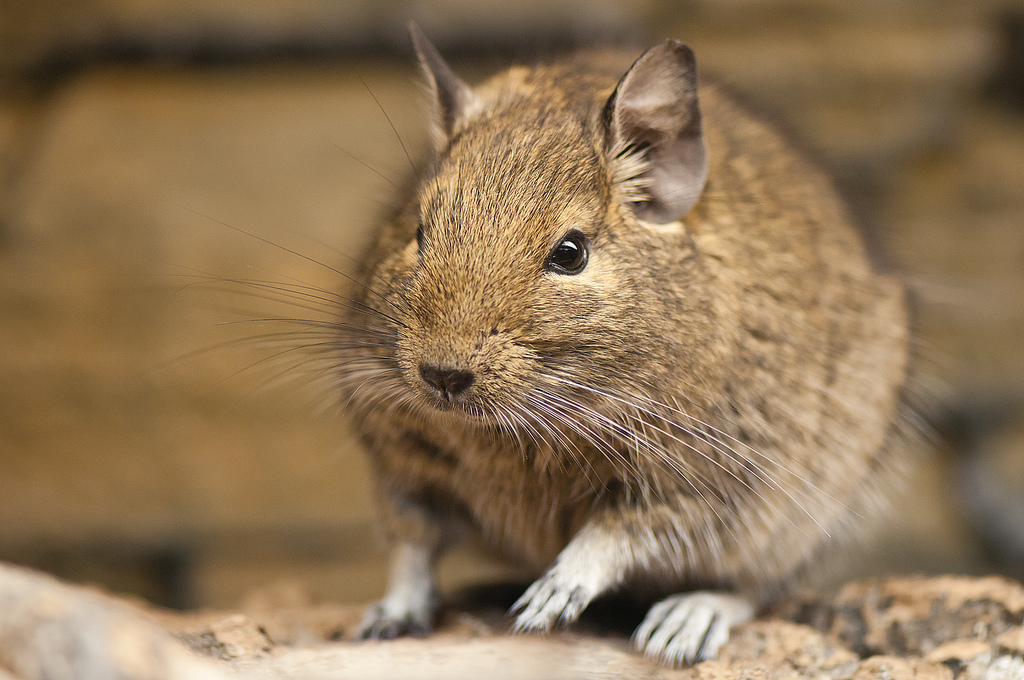
The common degu is a small animal with a body length of 25.0 to 31.0 cm (9.8–12.2 in) and a weight of 170 to 400 g (6.0 to 14.1 oz). It has yellow-brown fur above and creamy-yellow below, with yellow around the eyes and a paler band around the neck. It has a long, thin tail with a tufted, black tip, dark sparsely furred ears, and pale grey toes. Its fifth toe is small with a nail, rather than a claw, on the fore feet. Its hind feet are bristled. Its cheek teeth are shaped like figures-of-eight, hence the degu's genus name Octodon.
Common degus are highly social. They live in burrows, and, by digging communally, they are able to construct larger and more elaborate burrows than any one could dig on its own. Degus digging together coordinate their activities, forming digging chains. Females living in the same group have been shown to spontaneously nest communally; they nurse one another's young. They spend a large amount of time on the surface, where they forage for food. When foraging, their ability to detect predators is increased in larger groups, and each animal needs to spend less time being vigilant.
Common degus exhibit a wide array of communication techniques. They have an elaborate vocal repertoire comprising up to 15 different sounds, and the young need to be able to hear their mother's calls if the emotional systems in their brains are to develop properly. They use their urine to scent mark, and experiments have shown that they react to one another's marks, although in males the hormone testosterone may suppress their sense of smell somewhat.
Common degus are seasonal breeders. The breeding season for wild degus begins in the Chilean autumn when day and night are roughly equal, with pups born in early to mid-spring. Female degus are pregnant for approximately ninety days, which is a relatively long gestation period compared to other non-caviomorph rodents. Female pregnant weight varies over the course of gestation and according to litter size; litters contain an average of six pups, but size can range from one or two up to twelve young. Common degu pups are born relatively precocial, fully furred and with eyes open, and their hearing and sight are both functional at birth. Unlike most other rodents, male common degus also take part in protecting and raising their pups until they are old enough to leave the family.
Unlike some other octodontids, common degus are diurnal (active during the day), and they have good vision. Their retinas include rod cells and two types of cone cells, corresponding to peak sensitivity in the green and ultraviolet regions of the spectrum. Behavioral experiments have shown that degus are able to discriminate ultraviolet light (UV) from the wavelengths visible to humans. It is likely that this ultraviolet sensitivity has a social function, since both their ventral (stomach) fur and their urine are highly UV reflective.
Common degus are strictly herbivorous, in the wild feeding on grasses and browsing the leaves of shrubs, though they will also take seeds. Throughout much of the year forage is dried and so common degus are specially adapted to a very high fibre intake, and this varies between food types and environmental conditions. Like some other herbivores such as rabbits, they perform coprophagy (faecal reingestion) so as to extract more nutrition from their diet. This also serves to maintain healthy gut function during times when food is scarce. Although they are active by day, in high summer they do not leave their burrows in the middle of the day and instead emerge to forage in the mornings and evenings.
Hub AI
Common degu AI simulator
(@Common degu_simulator)
Common degu
The common degu (Octodon degus; /ˈdeɪɡuː/), or, historically, the degu, is a small hystricomorpha rodent endemic to the Chilean matorral ecoregion of central Chile. The name degu on its own indicates either the entire genus Octodon or, more commonly, just the common degu. Common degus belong to the parvorder Caviomorpha of the infraorder Hystricognathi, along with the chinchilla and guinea pig. The word degu comes from the Mapuche word dewü, meaning 'mouse' or 'rat'.
Although found in a relatively small natural habitat when compared to other species of rodents, degus are prolific and thus classified as a least-concern species by IUCN. The animal may be kept as a domestic pet, though there are prohibitions on their ownership in some territories. As a pet, the degu is larger than a golden hamster but smaller than a fancy rat.
The common degu is a small animal with a body length of 25.0 to 31.0 cm (9.8–12.2 in) and a weight of 170 to 400 g (6.0 to 14.1 oz). It has yellow-brown fur above and creamy-yellow below, with yellow around the eyes and a paler band around the neck. It has a long, thin tail with a tufted, black tip, dark sparsely furred ears, and pale grey toes. Its fifth toe is small with a nail, rather than a claw, on the fore feet. Its hind feet are bristled. Its cheek teeth are shaped like figures-of-eight, hence the degu's genus name Octodon.
Common degus are highly social. They live in burrows, and, by digging communally, they are able to construct larger and more elaborate burrows than any one could dig on its own. Degus digging together coordinate their activities, forming digging chains. Females living in the same group have been shown to spontaneously nest communally; they nurse one another's young. They spend a large amount of time on the surface, where they forage for food. When foraging, their ability to detect predators is increased in larger groups, and each animal needs to spend less time being vigilant.
Common degus exhibit a wide array of communication techniques. They have an elaborate vocal repertoire comprising up to 15 different sounds, and the young need to be able to hear their mother's calls if the emotional systems in their brains are to develop properly. They use their urine to scent mark, and experiments have shown that they react to one another's marks, although in males the hormone testosterone may suppress their sense of smell somewhat.
Common degus are seasonal breeders. The breeding season for wild degus begins in the Chilean autumn when day and night are roughly equal, with pups born in early to mid-spring. Female degus are pregnant for approximately ninety days, which is a relatively long gestation period compared to other non-caviomorph rodents. Female pregnant weight varies over the course of gestation and according to litter size; litters contain an average of six pups, but size can range from one or two up to twelve young. Common degu pups are born relatively precocial, fully furred and with eyes open, and their hearing and sight are both functional at birth. Unlike most other rodents, male common degus also take part in protecting and raising their pups until they are old enough to leave the family.
Unlike some other octodontids, common degus are diurnal (active during the day), and they have good vision. Their retinas include rod cells and two types of cone cells, corresponding to peak sensitivity in the green and ultraviolet regions of the spectrum. Behavioral experiments have shown that degus are able to discriminate ultraviolet light (UV) from the wavelengths visible to humans. It is likely that this ultraviolet sensitivity has a social function, since both their ventral (stomach) fur and their urine are highly UV reflective.
Common degus are strictly herbivorous, in the wild feeding on grasses and browsing the leaves of shrubs, though they will also take seeds. Throughout much of the year forage is dried and so common degus are specially adapted to a very high fibre intake, and this varies between food types and environmental conditions. Like some other herbivores such as rabbits, they perform coprophagy (faecal reingestion) so as to extract more nutrition from their diet. This also serves to maintain healthy gut function during times when food is scarce. Although they are active by day, in high summer they do not leave their burrows in the middle of the day and instead emerge to forage in the mornings and evenings.
Recent media