



Community hub
Recent from talks
Knowledge base stats:
Talk channels stats:
Members stats:
Common ethanol fuel mixtures
Several common ethanol fuel mixtures are in use around the world. The use of pure hydrous or anhydrous ethanol in internal combustion engines (ICEs) is only possible if the engines are designed or modified for that purpose, and used only in automobiles, light-duty trucks and motorcycles. Anhydrous ethanol can be blended with gasoline (petrol) for use in gasoline engines, but with high ethanol content only after engine modifications to meter increased fuel volume since pure ethanol contains only 2/3 of the BTUs of an equivalent volume of pure gasoline. High percentage ethanol mixtures are used in some racing engine applications as the very high octane rating of ethanol is compatible with very high compression ratios.
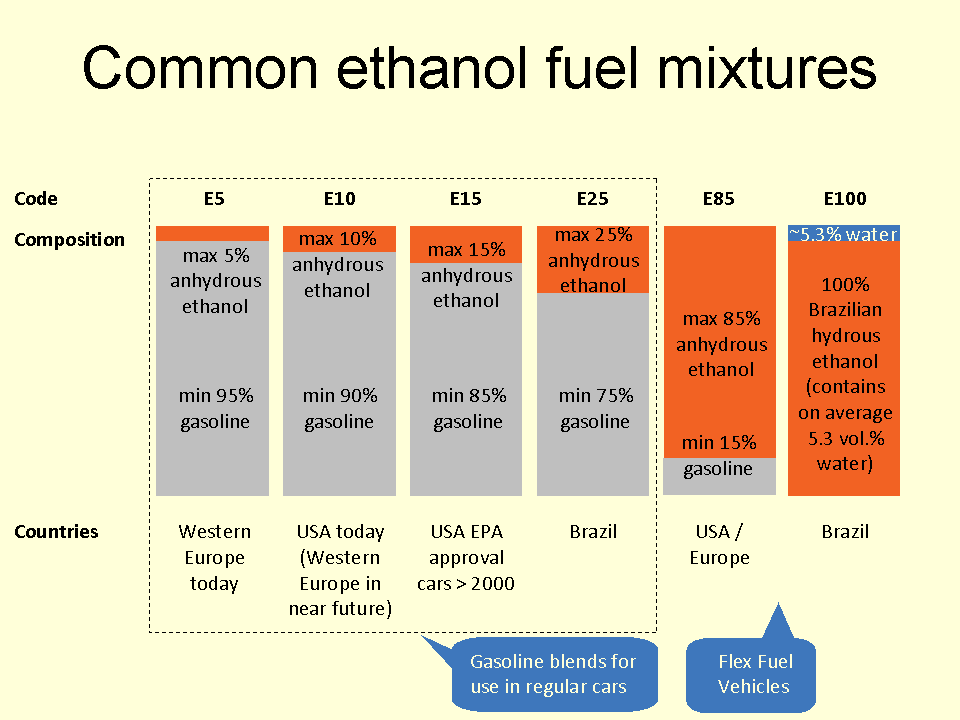
Ethanol fuel mixtures have "E" numbers which describe the percentage of ethanol fuel in the mixture by volume, for example, E85 is 85% anhydrous ethanol and 15% gasoline. Low-ethanol blends are typically from E5 to E25, although internationally the most common use of the term refers to the E10 blend.
Blends of E10 or less are used in more than 20 countries around the world, led by the United States, where ethanol represented 10% of the U.S. gasoline fuel supply in 2011. Blends from E20 to E25 have been used in Brazil since the late 1970s. E85 is commonly used in the U.S. and Europe for flexible-fuel vehicles. Hydrous ethanol or E100 is used in Brazilian neat ethanol vehicles and flex-fuel light vehicles and hydrous E15 called hE15 for modern petrol cars in the Netherlands.
E10, a fuel mixture of 10% anhydrous ethanol and 90% gasoline sometimes called gasohol, can be used in the internal combustion engines of most modern automobiles and light-duty vehicles without need for any modification on the engine or fuel system. E10 blends are typically rated as being 2 to 3 octane numbers higher than regular gasoline and are approved for use in all new U.S. automobiles, and mandated in some areas for emissions and other reasons.
Other common blends include E5 and E7. These concentrations are generally safe for recent engines that should run on pure gasoline. As of 2006, mandates for blending bioethanol into vehicle fuels had been enacted in at least 36 states/provinces and 17 countries at the national level, with most mandates requiring a blend of 10 to 15% ethanol with gasoline.
One measure of alternative fuels in the U.S. is the "gasoline-equivalent gallon" (GEG). In 2002, the U.S. used as motor fuel, ethanol equal to 137,000 terajoules (3.8×10¹⁰ kWh), the energy equivalent of 1.13 billion US gallons (4.3 gigalitres) of gasoline. This was less than 1% of the total fuel used that year.
E10 and other blends of ethanol are considered to be useful in decreasing U.S. dependence on foreign oil, and can reduce carbon monoxide (CO) emissions by 20 to 30% under the right conditions. Although E10 does decrease emissions of CO and greenhouse gases such as CO2 by an estimated 2% over regular gasoline, it can cause increases in evaporative emissions and some pollutants depending on factors such as the age of the vehicle and weather conditions. According to the Philippine Department of Energy, the use of up to 10% ethanol-gasoline mixture is not harmful to cars' fuel systems. Generally, automobile gasoline containing alcohol (ethanol or methanol) is not recommended to be used in aircraft.
A 2011 study conducted by VTT Technical Research Centre of Finland found practically no difference in fuel consumption in normal driving conditions between commercial gasoline grades 95E10 and 98E5 sold in Finland, despite the public perception that fuel consumption is significantly higher with 95E10. VTT performed the comparison test under controlled laboratory conditions and their measurements showed that over a distance of 100 kilometres (62 mi), the cars tested used an average of 10.30 litres (2.27 imp gal; 2.72 US gal) of 95E10, as opposed to 10.23 litres (2.25 imp gal; 2.70 US gal) of 98E5. The difference was 0.07 in favor of 98E5 on average, meaning that using 95E10 gasoline, which has a higher ethanol content, increases consumption by 0.7%. When the measurements are normalized, the difference becomes 1.0%, a result that is highly consistent with an estimation of calorific values based on approximate fuel composition, which came out at 1.1% in favour of E5.
Hub AI
Common ethanol fuel mixtures AI simulator
(@Common ethanol fuel mixtures_simulator)
Common ethanol fuel mixtures
Several common ethanol fuel mixtures are in use around the world. The use of pure hydrous or anhydrous ethanol in internal combustion engines (ICEs) is only possible if the engines are designed or modified for that purpose, and used only in automobiles, light-duty trucks and motorcycles. Anhydrous ethanol can be blended with gasoline (petrol) for use in gasoline engines, but with high ethanol content only after engine modifications to meter increased fuel volume since pure ethanol contains only 2/3 of the BTUs of an equivalent volume of pure gasoline. High percentage ethanol mixtures are used in some racing engine applications as the very high octane rating of ethanol is compatible with very high compression ratios.
Ethanol fuel mixtures have "E" numbers which describe the percentage of ethanol fuel in the mixture by volume, for example, E85 is 85% anhydrous ethanol and 15% gasoline. Low-ethanol blends are typically from E5 to E25, although internationally the most common use of the term refers to the E10 blend.
Blends of E10 or less are used in more than 20 countries around the world, led by the United States, where ethanol represented 10% of the U.S. gasoline fuel supply in 2011. Blends from E20 to E25 have been used in Brazil since the late 1970s. E85 is commonly used in the U.S. and Europe for flexible-fuel vehicles. Hydrous ethanol or E100 is used in Brazilian neat ethanol vehicles and flex-fuel light vehicles and hydrous E15 called hE15 for modern petrol cars in the Netherlands.
E10, a fuel mixture of 10% anhydrous ethanol and 90% gasoline sometimes called gasohol, can be used in the internal combustion engines of most modern automobiles and light-duty vehicles without need for any modification on the engine or fuel system. E10 blends are typically rated as being 2 to 3 octane numbers higher than regular gasoline and are approved for use in all new U.S. automobiles, and mandated in some areas for emissions and other reasons.
Other common blends include E5 and E7. These concentrations are generally safe for recent engines that should run on pure gasoline. As of 2006, mandates for blending bioethanol into vehicle fuels had been enacted in at least 36 states/provinces and 17 countries at the national level, with most mandates requiring a blend of 10 to 15% ethanol with gasoline.
One measure of alternative fuels in the U.S. is the "gasoline-equivalent gallon" (GEG). In 2002, the U.S. used as motor fuel, ethanol equal to 137,000 terajoules (3.8×10¹⁰ kWh), the energy equivalent of 1.13 billion US gallons (4.3 gigalitres) of gasoline. This was less than 1% of the total fuel used that year.
E10 and other blends of ethanol are considered to be useful in decreasing U.S. dependence on foreign oil, and can reduce carbon monoxide (CO) emissions by 20 to 30% under the right conditions. Although E10 does decrease emissions of CO and greenhouse gases such as CO2 by an estimated 2% over regular gasoline, it can cause increases in evaporative emissions and some pollutants depending on factors such as the age of the vehicle and weather conditions. According to the Philippine Department of Energy, the use of up to 10% ethanol-gasoline mixture is not harmful to cars' fuel systems. Generally, automobile gasoline containing alcohol (ethanol or methanol) is not recommended to be used in aircraft.
A 2011 study conducted by VTT Technical Research Centre of Finland found practically no difference in fuel consumption in normal driving conditions between commercial gasoline grades 95E10 and 98E5 sold in Finland, despite the public perception that fuel consumption is significantly higher with 95E10. VTT performed the comparison test under controlled laboratory conditions and their measurements showed that over a distance of 100 kilometres (62 mi), the cars tested used an average of 10.30 litres (2.27 imp gal; 2.72 US gal) of 95E10, as opposed to 10.23 litres (2.25 imp gal; 2.70 US gal) of 98E5. The difference was 0.07 in favor of 98E5 on average, meaning that using 95E10 gasoline, which has a higher ethanol content, increases consumption by 0.7%. When the measurements are normalized, the difference becomes 1.0%, a result that is highly consistent with an estimation of calorific values based on approximate fuel composition, which came out at 1.1% in favour of E5.