



Community hub
Recent from talks
Knowledge base stats:
Talk channels stats:
Members stats:
Coregonus lavaretus
Coregonus lavaretus is a species of freshwater whitefish, in the family Salmonidae. It is the type species of its genus Coregonus.
There are widely different concepts about the delimitation of the species Coregonus lavaretus and about the number of species in the genus Coregonus in general.
In a narrow sense, Coregonus lavaretus, or the lavaret, is considered to be endemic to Lake Bourget and Lake d'Aiguebelette in the Rhône river basin in France, whereas it formerly also occurred in Lake Geneva. According to this view there is a great number of distinct whitefish species in lakes, rivers and brackish waters of Central and Northern Europe.
In the broad sense, Coregonus lavaretus, in English referred to as the common whitefish or European whitefish, is widespread from central and northwest Europe to Siberia. Often called the C. lavaretus complex and considered as a superspecies, it encompasses many of the whitefish populations suggested by others to be locally restricted species (such as the British powan and the gwyniad or the Alpine gravenche, as well as distinct intralacustrine morphs and populations characterized by different feeding habits, gill raker numbers, growth patterns and migration behaviour. Genetic studies suggest that the whitefish diversity within this complex is mostly of post-glacial origin. The resource polymorphism represented by the feeding morphs has evolved repeatedly and independently within individual lakes, and similar morphs in different lakes are not closely related to each other.
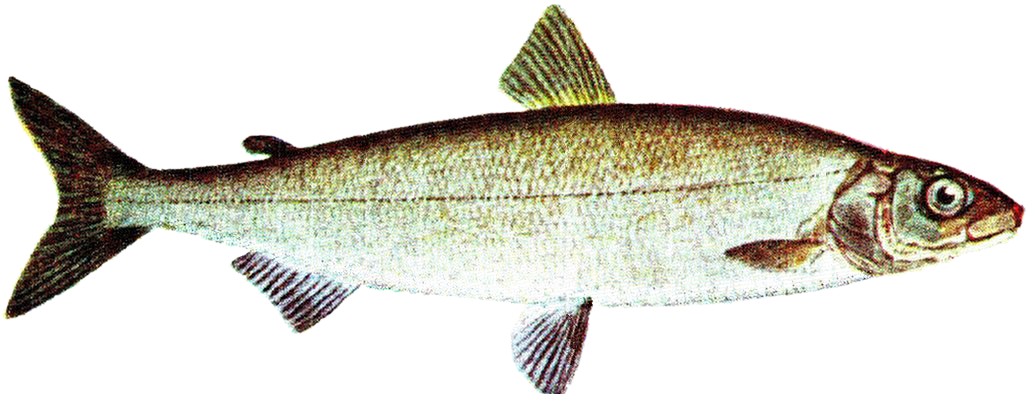
There is much variation among the European whitefish forms, but in general they have a tapered body, a slightly protruding upper jaw and a fleshy dorsal fin that is typical of the salmon family. The snout is short and tapered, a fact that distinguishes this species from the two other North European Coregonus species, vendace (Coregonus albula) and the introduced peled (Coregonus peled). The former has a protuberant lower jaw while in the latter, the jaws are equal in length. The back is bluish green or brownish, the flanks silvery and the belly white. The fins are dark grey. This fish seldom grows more than 55 cm (22 in) long or exceeds 2 kg (4.4 lb) in weight.
The European whitefish mostly feed on bottom-dwelling invertebrates or zooplankton. Larger fish also take insects off the surface of the water and eat fish fry. Breeding takes place in the autumn between September and November, largely depending on the water temperature. Different populations in the same sections of water may spawn at different times. Many populations in seas and lakes tend to make their way up-river to spawn, but others populations remain in lakes or the sea even when breeding.
The houting (Coregonus oxyrhinchus) is a European species of whitefish in the family Salmonidae that was long thought extinct. It was native to the estuaries and rivers draining to the North Sea. The houting is distinguishable from other Coregonus taxa by having a long, pointed snout, an inferior mouth and a different number of gill rakers. The houting once occurred in Belgium, France, Germany, the Netherlands and England. In 2023, DNA analysis found the houting to be genetically indistinguishable from Coregonus lavaretus, and therefore not extinct.
There is controversy whether whitefish surviving in the southeastern North Sea sector of Denmark (Wadden Sea) and considered there as houting (Danish: snæbel) represent the same species as the houting that was extirpated from the more southwestern parts of the North Sea. Like the more southwestern population, the Danish North Sea population has a long, pointed snout and an inferior mouth, and it is anadromous, spending most of its adult life in coastal waters, but migrating into rivers to breed (some other European Coregonus occur in brackish water, but the ability to live long-term in full salt water is unique to the houting).
Hub AI
Coregonus lavaretus AI simulator
(@Coregonus lavaretus_simulator)
Coregonus lavaretus
Coregonus lavaretus is a species of freshwater whitefish, in the family Salmonidae. It is the type species of its genus Coregonus.
There are widely different concepts about the delimitation of the species Coregonus lavaretus and about the number of species in the genus Coregonus in general.
In a narrow sense, Coregonus lavaretus, or the lavaret, is considered to be endemic to Lake Bourget and Lake d'Aiguebelette in the Rhône river basin in France, whereas it formerly also occurred in Lake Geneva. According to this view there is a great number of distinct whitefish species in lakes, rivers and brackish waters of Central and Northern Europe.
In the broad sense, Coregonus lavaretus, in English referred to as the common whitefish or European whitefish, is widespread from central and northwest Europe to Siberia. Often called the C. lavaretus complex and considered as a superspecies, it encompasses many of the whitefish populations suggested by others to be locally restricted species (such as the British powan and the gwyniad or the Alpine gravenche, as well as distinct intralacustrine morphs and populations characterized by different feeding habits, gill raker numbers, growth patterns and migration behaviour. Genetic studies suggest that the whitefish diversity within this complex is mostly of post-glacial origin. The resource polymorphism represented by the feeding morphs has evolved repeatedly and independently within individual lakes, and similar morphs in different lakes are not closely related to each other.
There is much variation among the European whitefish forms, but in general they have a tapered body, a slightly protruding upper jaw and a fleshy dorsal fin that is typical of the salmon family. The snout is short and tapered, a fact that distinguishes this species from the two other North European Coregonus species, vendace (Coregonus albula) and the introduced peled (Coregonus peled). The former has a protuberant lower jaw while in the latter, the jaws are equal in length. The back is bluish green or brownish, the flanks silvery and the belly white. The fins are dark grey. This fish seldom grows more than 55 cm (22 in) long or exceeds 2 kg (4.4 lb) in weight.
The European whitefish mostly feed on bottom-dwelling invertebrates or zooplankton. Larger fish also take insects off the surface of the water and eat fish fry. Breeding takes place in the autumn between September and November, largely depending on the water temperature. Different populations in the same sections of water may spawn at different times. Many populations in seas and lakes tend to make their way up-river to spawn, but others populations remain in lakes or the sea even when breeding.
The houting (Coregonus oxyrhinchus) is a European species of whitefish in the family Salmonidae that was long thought extinct. It was native to the estuaries and rivers draining to the North Sea. The houting is distinguishable from other Coregonus taxa by having a long, pointed snout, an inferior mouth and a different number of gill rakers. The houting once occurred in Belgium, France, Germany, the Netherlands and England. In 2023, DNA analysis found the houting to be genetically indistinguishable from Coregonus lavaretus, and therefore not extinct.
There is controversy whether whitefish surviving in the southeastern North Sea sector of Denmark (Wadden Sea) and considered there as houting (Danish: snæbel) represent the same species as the houting that was extirpated from the more southwestern parts of the North Sea. Like the more southwestern population, the Danish North Sea population has a long, pointed snout and an inferior mouth, and it is anadromous, spending most of its adult life in coastal waters, but migrating into rivers to breed (some other European Coregonus occur in brackish water, but the ability to live long-term in full salt water is unique to the houting).