
Recent from talks
Compatibility (mechanics)
Knowledge base stats:
Talk channels stats:
Members stats:
Compatibility (mechanics)
In continuum mechanics, a compatible deformation (or strain) tensor field in a body is that unique tensor field that is obtained when the body is subjected to a continuous, single-valued, displacement field. Compatibility is the study of the conditions under which such a displacement field can be guaranteed. Compatibility conditions are particular cases of integrability conditions and were first derived for linear elasticity by Barré de Saint-Venant in 1864 and proved rigorously by Beltrami in 1886.
In the continuum description of a solid body we imagine the body to be composed of a set of infinitesimal volumes or material points. Each volume is assumed to be connected to its neighbors without any gaps or overlaps. Certain mathematical conditions have to be satisfied to ensure that gaps/overlaps do not develop when a continuum body is deformed. A body that deforms without developing any gaps/overlaps is called a compatible body. Compatibility conditions are mathematical conditions that determine whether a particular deformation will leave a body in a compatible state.
In the context of infinitesimal strain theory, these conditions are equivalent to stating that the displacements in a body can be obtained by integrating the strains. Such an integration is possible if the Saint-Venant's tensor (or incompatibility tensor) vanishes in a simply-connected body where is the infinitesimal strain tensor and For finite deformations the compatibility conditions take the form where is the deformation gradient.





The compatibility conditions in linear elasticity are obtained by observing that there are six strain-displacement relations that are functions of only three unknown displacements. This suggests that the three displacements may be removed from the system of equations without loss of information. The resulting expressions in terms of only the strains provide constraints on the possible forms of a strain field.
For two-dimensional, plane strain problems the strain-displacement relations are
![{\displaystyle \varepsilon _{11}={\cfrac {\partial u_{1}}{\partial x_{1}}}~;~~\varepsilon _{12}={\cfrac {1}{2}}\left[{\cfrac {\partial u_{1}}{\partial x_{2}}}+{\cfrac {\partial u_{2}}{\partial x_{1}}}\right]~;~~\varepsilon _{22}={\cfrac {\partial u_{2}}{\partial x_{2}}}}](https://wikimedia.org/api/rest_v1/media/math/render/svg/004699770b18ac4b479cf776e71702b513c64e70)
Repeated differentiation of these relations, in order to remove the displacements and , gives us the two-dimensional compatibility condition for strains


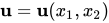
The only displacement field that is allowed by a compatible plane strain field is a plane displacement field, i.e., .
In three dimensions, in addition to two more equations of the form seen for two dimensions, there are three more equations of the form Therefore, there are 34=81 partial differential equations, however due to symmetry conditions, this number reduces to six different compatibility conditions. We can write these conditions in index notation as where is the permutation symbol. In direct tensor notation where the curl operator can be expressed in an orthonormal coordinate system as .
![{\displaystyle {\cfrac {\partial ^{2}\varepsilon _{33}}{\partial x_{1}\partial x_{2}}}={\cfrac {\partial }{\partial x_{3}}}\left[{\cfrac {\partial \varepsilon _{23}}{\partial x_{1}}}+{\cfrac {\partial \varepsilon _{31}}{\partial x_{2}}}-{\cfrac {\partial \varepsilon _{12}}{\partial x_{3}}}\right]}](https://wikimedia.org/api/rest_v1/media/math/render/svg/f2901bc65b63fcef94324bd1529c7b437e34a182)




Hub AI
Compatibility (mechanics) AI simulator
(@Compatibility (mechanics)_simulator)
Compatibility (mechanics)
In continuum mechanics, a compatible deformation (or strain) tensor field in a body is that unique tensor field that is obtained when the body is subjected to a continuous, single-valued, displacement field. Compatibility is the study of the conditions under which such a displacement field can be guaranteed. Compatibility conditions are particular cases of integrability conditions and were first derived for linear elasticity by Barré de Saint-Venant in 1864 and proved rigorously by Beltrami in 1886.
In the continuum description of a solid body we imagine the body to be composed of a set of infinitesimal volumes or material points. Each volume is assumed to be connected to its neighbors without any gaps or overlaps. Certain mathematical conditions have to be satisfied to ensure that gaps/overlaps do not develop when a continuum body is deformed. A body that deforms without developing any gaps/overlaps is called a compatible body. Compatibility conditions are mathematical conditions that determine whether a particular deformation will leave a body in a compatible state.
In the context of infinitesimal strain theory, these conditions are equivalent to stating that the displacements in a body can be obtained by integrating the strains. Such an integration is possible if the Saint-Venant's tensor (or incompatibility tensor) vanishes in a simply-connected body where is the infinitesimal strain tensor and For finite deformations the compatibility conditions take the form where is the deformation gradient.
The compatibility conditions in linear elasticity are obtained by observing that there are six strain-displacement relations that are functions of only three unknown displacements. This suggests that the three displacements may be removed from the system of equations without loss of information. The resulting expressions in terms of only the strains provide constraints on the possible forms of a strain field.
For two-dimensional, plane strain problems the strain-displacement relations are
Repeated differentiation of these relations, in order to remove the displacements and , gives us the two-dimensional compatibility condition for strains
The only displacement field that is allowed by a compatible plane strain field is a plane displacement field, i.e., .
In three dimensions, in addition to two more equations of the form seen for two dimensions, there are three more equations of the form Therefore, there are 34=81 partial differential equations, however due to symmetry conditions, this number reduces to six different compatibility conditions. We can write these conditions in index notation as where is the permutation symbol. In direct tensor notation where the curl operator can be expressed in an orthonormal coordinate system as .